Language Acquisition Exam 1
 Call Kai
 Learn
Learn Practice Test
 Spaced Repetition
 Match
Match Flashcards
 Knowt Play
1/172

There's no tags or description
Looks like no tags are added yet.
Name | Mastery | Learn | Test | Matching | Spaced | Call with Kai | Chat |
|---|
No analytics yet
Send a link to your students to track their progress
173 Terms
how many languages in the world
7100 langauges
language complexity
all human cultures have a grammatically complex language, regardless of the level of their technology, and almost all linguists see all human languages as about equally complex
language development
any normal child growing up in any language environment will master the local language
including children who are blind, deaf, or neurologically impaired
mastery of a first language is usually achieved early and without explicit instruction
normal adults have difficulty achieving competence, let alone fluency, in a second language, despite greater cognitive sophistication than children
language: 5 components
a system made up of different modules that interact with one another
phonology
morphology
syntax
semantics
pragmatics
phonology
study of phonemes and how they combine
phonemes- meaningless sounds
phonemic inventoryeach language has its own set of phonemes

morphology
study of morphemes and how they combine
morpheme- smallest meaningful units of language
most morphemes have an identifiable meaning
ex: bird-house
some do not: cran-berry
syntax
order and arrangement of words in phrases and sentences
combinations of subject, verb, object
semantics
study of meaning and sense
words, phrases, sentences
lexicon- mental dictionary
pragmatics
language use in context
ex- “its fine”
intentions
politeness rules are culturally dependent
communication
occurs when one organism (transmitter) encodes information into a signal which passes to another organism (receiver) which decodes the signal and is capable of responding appropriately
what distinguishes language and communication
arbitrariness
displacement
duality of patterning
creativity
grammaticality
arbitratiness
arbitrary nature of language symbols makes it possible to represent abstract concepts and imaginary ideas
nonarbitrary words- onomonotopias
grammaticality
ensures that communication of meaning is precies
displacement
language not limited to talking about the here and now
past and future
abstract concepts like feelings
creativity
language has openness, allowing users to create new words and new sentences
aka productivity
duality of patterning
small number of meaningless sounds that, when combined in various ways, yield unlimited number of meaningful words and sentences
human language has two levels of structure
meaningful elements (words and morphemes)
word-internal meaningless elements (phonemes)
how is communication through language similar to other forms of communication
both language and some nonverbal aspects of communication in humans are in part cultural transmitted; referential, intentional, purposeful
linguistic cues
paralinguistic cues- tone, pitch, volume, rate, intonation, pauses
nonlinguistic cues- face, body, space, appearance, posture, gaze
language is specific and uniform to humans
onset of speech is regular, not affected by culture or language being learned
speech is not suppressible
language cannot be taught to other species
languages have some universal features constrained by human cognition
biological bases of language
specific and uniform to humans
FOXP2- gene on chromosome 7
critical periods
social interaction is required and our brain is prepared for it
Broca’s area responsible for pronunciation and grammar
Wernicke’s area responsible for meaning and comprehension
Arcuate fasciculus connects these two
Modern imaging studies are able to show brain activity during language processing. Which of the following measures the changes in hemoglobin levels that accompany the increased blood flow to active areas?
NIRS, or Near-Infrared Spectroscopy
MEG, or magnetoencephalography
fMRI, or functional magnetic resonance imaging
ERPs, or event-related potentials
NIRS, or Near-Infrared Spectroscopy
A research study that follows the same children over a period of time to observe how their language develops is
a developmental study.
an incremental study.
a cross-sectional study.
a longitudinal study.
longitudinal study
The primary reason researchers decided to try to teach chimpanzees American Sign Language rather than a spoken language was that
chimpanzees do not have the articulatory and physiological ability that spoken languages require.
sign language is more flexible semantically than spoken languages.
chimpanzees have a natural tendency to imitate movement.
sign language is structurally less complex than spoken languages.
chimpanzees do not have the articulatory and physiological ability that spoken languages require.
Adam, Eve, and Sarah were
chimpanzees taught to use ASL in a Carnegie Mellon University study.
researchers on the neurology of speech in the 60s.
subjects in a famous language acquisition study at Harvard University.
nineteenth century “wild children” who never developed language.
subjects in a famous language acquisition study at Harvard University.
Researchers intensively tracked the early speech and language development of three toddlers given the pseudonyms
A person with brain damage whose speech is fluent but filled with nonsense words might have
Broca’s aphasia.
Developmental Language Disorder.
a defect in semanticity and displacement.
Wernicke’s aphasia.
Wernicke’s aphasia.
Normally developing children start to learn to talk at about the same time as they learn to walk.
True or False
True
Children whose native language contains difficult sounds and complex phonological rules, such as Chinese, learn to speak somewhat later than children whose native languages are relatively less complex.
True or False
False
Human language can be said to have a biological base because
humans have areas in the brain that are specialized for language.
very young children use vocalizations to make their wishes known
children’s first words are related to bodily functions.
children will learn language even if no one speaks to them.
humans have areas in the brain that are specialized for language.
Alex was a remarkable African grey parrot who was able to
ask for crackers and nuts in several unrelated languages.
sing Italian operatic arias in both perfect pitch and with a perfect accent.
recognize colors, shapes and numbers of objects and answer questions about them in English.
correctly name pictures of hundreds of other kinds of birds about 80% of the time.
recognize colors, shapes and numbers of objects and answer questions about them in English.
All true languages are said to be characterized by productivity,
semanticity and replacement.
specificity and generativity.
semanticity and displacement.
specificity and iconicity.
semanticity and displacement.
earliest language study
King Psamtik (664-610 BCE)
first ‘study’ of the roles of nature and nurture
if children are raised without language, then whatever they speak must be the language of the oldest group of humans
nativism theory- babies arrive in the world with a specific language already in their heads
method: take two children and raised not surrounded by langauge
result- first word was becos
conclusion- becos means bread in phrygian language, phrygians are the oldest race of humans
diary studies, baby biographies (1800s-1910)
descriptive, longitudinal parental observation of own children, not very theoretical
language studies in early 1900s
large sample studies- systematic, cross-sectional measurements of particular phenomena
outbreak of behaviorism- focus on simple learning principles (reinforcement, imitation)
view language as a skill not fundamentally different from any other behavior
language development involves linking stimuli in the environment to internal responses, and these responses to verbal behavior
conditioning and reinforcement
Chomsky- late 1900’s
Syntactic Structures- 1957
focus on syntax led developmental psycholinguists to concentrate on syntax, with other aspects of language explored only later
language research since the 1900s
new kinds of data- neuroimaging studies
use of computer models to try to understand language development
more emphasis on
individual differences
aspects of language outside of syntax
roles of the environment in language learning
longitudinal studies pros and cons
pro
control for individual and environmental differences
look for persistent traits
cons
takes a long time
doesn’t represent whole population
expensive
attrition
cross-sectional studies
pro
trend across time without having to wait
con
loss of control of individual and environmental differences
different methodological approaches in language studies
single-language vs. cross language (multiple language)
studies of individual children vs groups (interact with other kids)
typical vs atypical individuals
chronic ear infections- losing input, potentially effects language output
low birth weight or gaining weight
observational vs experimental approach
children vs adults
experimental design
hypotheses: what will happen
participants: experimental vs. control
randomization and standardization
independent variables: what is manipulated
exposure, training, itnervention
dependent variables: what is measured
some unit of language or behavior
since 2000: changes to how we conduct studies
preregistration of research studies- write and make hypothesis public
open materials
open data
changes in publication process- publishing null results
CHILDES & TalkBank
sharing of transcripts of speech samples, standardized format for transcripts corpora representing more than 20 different languages, bilingual and monolingual children, autistic and typical, …
before speech, infants develop prelinguistic abilties
perception- competence
production- performance
infant directed speech (child directed speech, motherese, parentese)
speech directed at infants differs from that usually directed at adults
prosodic features (sound quality)
elongated and hyperarticulated vowels and stress
wider range of pitches (intensity and volume)
slower tempo
other features
distinct label pronunciation *”this is a … ball..)
repetition
positive affect (happy talk)
some cultural and parental differences, but many similarities
infants prefer to listen to IDS
Fernald (1985)- IDS preference
4 month olds chose to listen more often to motherese when given the choice btw IDS and ADS
head-turn preference paradigm
ManyBabies (2020)- IDS
RQ: Are previous findings that infants prefer infant-directed speech over adult-directed speech replicable?
AND does a preference for infant-directed speech vary across age, native language background, and testing method?
Sixty-nine labs from 16 countries participated and collected data from 2,329 infants from 3 to 15 months old
results: head turning had the strongest effect sizes- requires more effort so captrues broader change
research methods for testing infants
central fixation: human controlled- starts and stops audio when baby looks/looks away
eyetracking
headturning
follow up to ManyBabies (2020)
studied babies’ preference for IDS across two sessions
Babies who show a larger preference for IDS in one session don’t
necessarily show a larger preference for IDS in another session
low test-retest reliability
what makes IDS attractive
infants prefer the prosody and pitch patterns
associated with positive interactions with caretakers
does this IDS benefit language aquisition
exaggerated stress patterns and shorter phrases may help infants isolate words and divide sentences into phrases
hyperarticulation may make vowels more distinguishable, easier to learns
alternatively, role of speech may be to direct infants’ attention or to rouse or calm them, and it may not benefit language acquisition
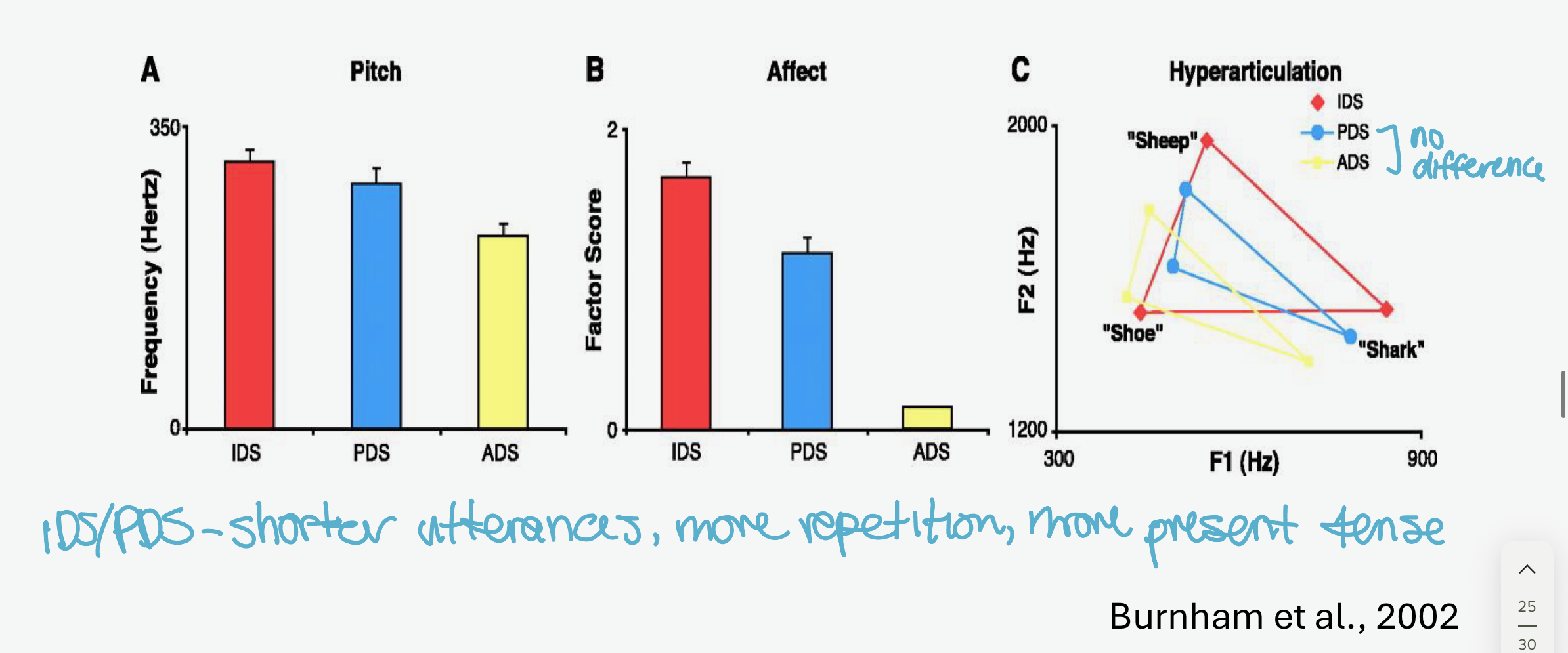
pitch, rated affect, and vowel hyperarticulation in infant, pet, and adult directed speech
IDS and PDS- shorter utterances, more repetition, more present tense
caregiver interactions characteristics (interaction style)
conversational; supports later linguistic competence
joint attention- directing attention at the same object at the same time
lead to contingent comments
interaction styles related to later language skills
sensitive/responsive (reacting to what baby is interested in) vs. intrusive (replace what baby is paying attention to)
structured (peek-a-boo, picture book reading) vs. unstructured
lexical differences compared with ADS
IDS words: shorter, higher frequency, lower phonotactic probability (easier to produce), higher neighborhood density (every word has neighbors that sound similar to it, high ex- cat)
emergent intentional communication
early crying, cooing, and babbling are not intentionally communicative
8-10 months
reach for objects
express frustration
6-10 months
direct attention with pointing or “showing”
9-12 months
understanding pointing
understand that others can have intent
research methods → real-world applications
low structured observation
structured observation
situation manipulation to increase likelihood of behavior of interest
Casby & Compata (1986)- communicative temptation task
developmental norms
aid in clinical evaluation
MacArthur-Bates Communicative Development Inventories (MCDI)- words child knows and can say
Language Development Survey (LDS)
Communication and Symbolic Behavior Scales (CSBS)
Which of the following best describes infants' learning of the sounds of their languages?
Infants come into the world being unable to perceive most speech sounds, and must gradually learn to hear the differences between sounds in their native language
Because infants can learn in utero, they come into the world being able to perceive only those speech sounds in their native language (and not perceiving nonnative contrasts)
Infants come into the world being able to perceive most possible speech sounds, and gradually lose the ability to distinguish sounds that do not occur in their native language
Infants, like adults, can naturally distinguish nearly all of the important speech sounds for the various languages of the world, and this ability does not change with age
Infants come into the world being able to perceive most possible speech sounds, and gradually lose the ability to distinguish sounds that do not occur in their native language
Adults probably use baby-talk characteristics to prelinguistic infants because
the infant pays more attention when they do
they are attempting to teach the baby how to talk
baby-talk is necessary for normal infant development
they are mimicking the baby's vocalizations
the infant pays more attention when they do
If an adult responds vocally to a 3-month-old's cooing, the infant will tend to?
begin to cry
make more speech-like sounds in return
try to repeat the sounds of the adult's voice
make more and louder sounds in return
make more speech-like sounds in return
When a mother points at a dog and says "Look! A doggie" to her seven-month-old, she is
establishing joint attention
familiarizing the child with his environment
explicitly teaching the child vocabulary words
probably not affecting the child's language development one way or another
establishing joint attention
A child exposed to a large quantity of adult-to-adult speech will learn language at about the same rate as a child who is exposed to a large quantity of direct adult-to-child speech.
True or False
False
By 12 months of age, infants who are later diagnosed with austism spectrum disorder will
respond when their name is called
respond to bids for joint attention
easily shift attention from one object to another
display differences in joint attention
display differences in joint attention
Pointing is considered
an early form of conversational turn-taking
a typical communicative gesture used by children in the first year of life
a more sophisticated action, that is generally not understood until the child is well into his second year
an inadequate substitute for true communicative behavior
a typical communicative gesture used by children in the first year of life
The type of study in which experimenters compare how long infants look at flashing lights on the side walls after turning their heads toward different types of sounds is called the
high amplitude sucking paradigm
headturn-preference procedure
preferential looking study
conditioned headturn study
headturn-preference procedure
Breaking up fluent speech into individual words is known as:
statistical learning
segmentation
habituation
joint attention
segmentation
During their first year of life, infants typically do all of the following EXCEPT:
begun to indentify statistical patterns in the language they hear around them
begun to communicate intentionally
begun to point to objects and become involved in joint attention
begun to produce multiword utterances
begun to produce multiword utterances
human can make ____ speech sounds
over 200 intelligibly different
english only uses 45
goal of phonetic alphabet
unambiguously convey the important aspects of the pronunciation of a given set of sounds using a written system of symbols
each symbol represents one sound only and there’s only one symbol per sound (think about the letter c in cat, cymbal, cynic)
if two sounds distinguish one word from another, they should be represented by different symbols
if two sounds are very similar, we should be able to represent the similarity
international phonetic alphabet (IPA) notation
/ /= individual sounds
[]= production, whole word
“ “ or italics for conventional spelling
english has opaque orthographic transparency of vowels
opaque- not 1 to 1
example of transparent- spanish
orthographic- how we represent language in writing
vowels- mechanics
vocal tract unobstructed
position of jaw- open vs close
position of tongue- front vs back
position of lips- round vs unrounded

consonants
place of articulation- where constriction is tightest
manner of articulation- how air is flowing
stop, fricatives, affricates, nasals, liquids/glides
voicing- whether vocal chords are vibrating
voiced vs. vocieless
allophones
different sounds but do not differentiate meaning
ex- pee vs put
phonemes and allophones
lack of invariance problem
speech signal is MESSY
phonemes vary in the acoustic signal based on:
coarticulation (the sounds surrounding it), speaker, accent, dialect, affect
children have to learn how to distinguish among sounds and learn which distinctions are important/signal meaning
categorical perception
perceiving values along a continuum as fixed points/categories
impose non-naturally occurring boundaries on perception
voice onset time
length of time between the release of a stop consonant (p, b, d, g, k, t, d) and the following sound
/b/ around 15 ms
/p/ around 100 ms
exists along a continuum
however we do not hear some sounds as being intermediate between /p/ and /b/
VOT less than 25ms categorized as /b/
VOT greater than 40ms categorized as /p/
adults succeed at differentiating 20ms across categorical boundary, but fail if it does not (40 vs 60)
do 4 mo show categorical perception- Eimas et al. (1971)
method: high amplitude sucking procedure, infants were habituated to a sound with one VOT
results
If the next sound had a different VOT that crossed the category boundary, the
infants dishabituated
if the next sound had an equally different VOT that did NOT cross the category boundary, they did not dishabituate

habituation
infants habituate to repeated stimuli
interest declines upon repeated presentation of stimuli
partly due to novelty-seeking
novelty decreases as familiarity increases
attention decreases as novelty decreases = habituation
if change in stimulus is detected and perceived as novel, then attention should increase
high amplitude sucking procedure
infant given pacifier with sensor to monitor sucking rate
each time the infant sucks the pacifier, a sound is played
when sucking rate declines by a prespecified amount (habituation criterion) computer switches the auditory stimulus
if sucking rate increases than we know the infant has detected change
dishabituation- renewed response
newborns as universal listeners Werker and Tees (1984)
newborns are sensitive to virtually every distinction between counts that has been tested
tested English-learning infants (and infants learning other languages) on non-native contrasts from Hindi and Salish
results- initially infants sensitive to all phonetic distinctions, experience with native language results in decline in ability to perceive unused contrasts
decline occurs before baby can produce any words in native language
language-specific sensitivity of infants in second half of first year extends to many other properties of language
native language vowels
stress patterns of words
phonotactics- rules and restrictions governing how speech sounds (phonemes) combine to form syllables and words

Strong similarities have been observed between the phonology of children's babbling consonants and the sounds of their earliest protowords and words. This is considered evidence of the
silent period
phonemic attraction hypothesis
child's use of vocal motor schemes
inevitability of phonological regression
child's use of vocal motor schemes (preferred sound sequences)
A child's speech is intelligible when
all her speech sounds are produced correctly
about half her speech sounds are produced correctly
an adult who doesn't know her could understand her without difficulty
her classmates can understand her without difficulty
an adult who doesn't know her could understand her without difficulty
The transition between babble and speech
is usually marked by a silent period
is a gradual progression: speech and babble often coexsist for several months
requires a phonetic inventory
does not predict the quality of phonetic development for children with hearing loss
is a gradual progression: speech and babble often coexsist for several months
The child's phonetic inventory at a particular time is
a list of speech sounds and word patterns that occur in her word productions
a list of all the speech sounds and word patterns that occur in the adult language she is aquiring
an alphabetical list of the child's words
a list of speech sounds and word patterns that occur in the adult form of the words she attempts to say
a list of speech sounds and word patterns that occur in her word productions
Which statement below is FALSE?
The several dialects of Spanish in the U.S. differ in how certain consonants are pronounced
Children develop sounds in different orders in the two languages
Bilingual children's errors in pronunciation are the same in their two languages
Bilingual children's pronunciation development is as fast or almost as fast as monolingual's pronunciation development
Bilingual children's errors in pronunciation are the same in their two languages
Vocalizations such as [baba] or [dada] normally first appear at about:
3-4 months
6-7 months
10-11 months
14-18 months
6-7 months
Consonant sounds are normally classified on the basis of
place and manner of articulation and voicing
voicing, alveolar interference, and articulatory difficulty
stops, glides, and contrasts
phonetic detail, specificity, and voicing
place and manner of articulation and voicing
The English consonants /t/, /n/, and /d/ are all:
voiced consonants
oral stop consonants
alveolar consonants
platal consonants
alveolar consonants
When we speak of a child having a rule of, for example, final stop deletion, this means that
she has deliberately decided not to say stop sounds at the end of words
she intends to say these sounds, but she can't manage to do so
she can't hear stop sounds at the ends of words
the stop sounds are missing at the ends of words that have them in the adult language, but no claim about the child's knowledge can be made
the stop sounds are missing at the ends of words that have them in the adult language, but no claim about the child's knowledge can be made
The sounds /b/ and /d/ are
voiced stops
unvoiced stops
open consonants
voiced affricates
voiced stops
speech segmentation (co-articulation)
speech sounds and words seem to adults like separable and sequential
in reality
usually no silent gaps between words
co-articulation: speech sounds overlap
spectrogram
a visual representation of a sound over time
x-axis is time and y-axis is frequency
specific frequency values are perceived as pitch
loudness (amplitude) is shown by intensity
used to see patterns in pitch and loudness over time and allow analysis of speech and music
how might infants identify possible words in the speech stream?
hypothesis- infants may note which syllables frequently occur together, store these phonological forms, and later link them to meanings
weakness- IDS lots of instances of isolation
but infants learn better when words are spoken in sentences

statistical learning as a segmentation cue
statistical cues are one of the first cues to detect word boundaries
segmented words can be mapped to words and related to later vocabulary
role of experience
in between nature and nurture- born with general ability, but need environmental input

transitional probabilities
the likelihood that one event predicts another
o-1
help infants discover word-like units in speech
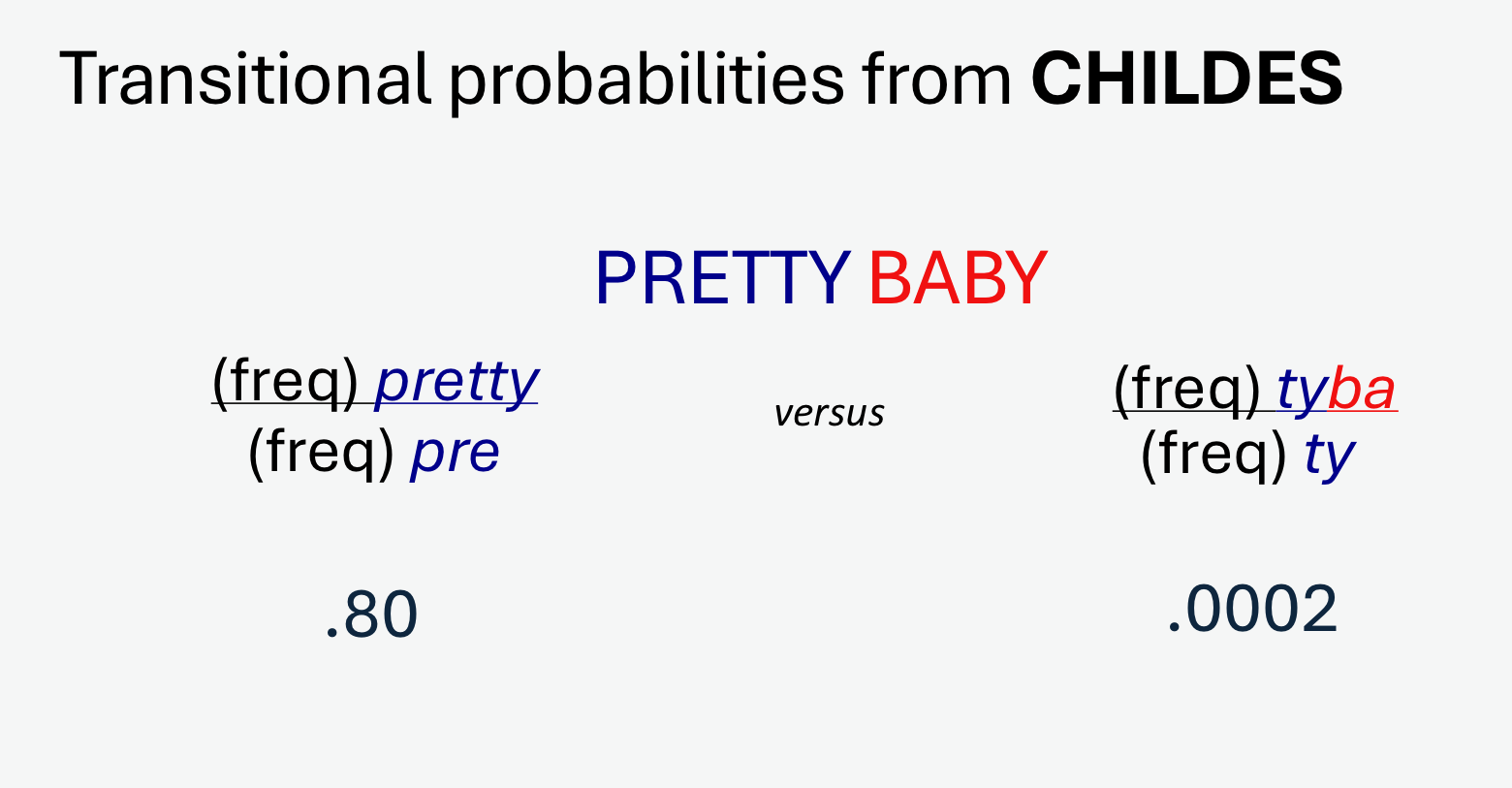
do infants use statistical cues to find word boundaries? saffran, aslin, and newport (1996)
8 month old infants
method
2-minute exposure to a nonsense language
tested with word and part-words (i.e. sequence spanning word boundaries)
hypothesis- infants show more interest in part words because more novel → infants learn and recognize the words
results- significantly more time spent looking during part-words
ecological validity- relevant to real world learning?
artificial stimuli
short exposure time
simplified task demands
lack of social context
provided proof of principle
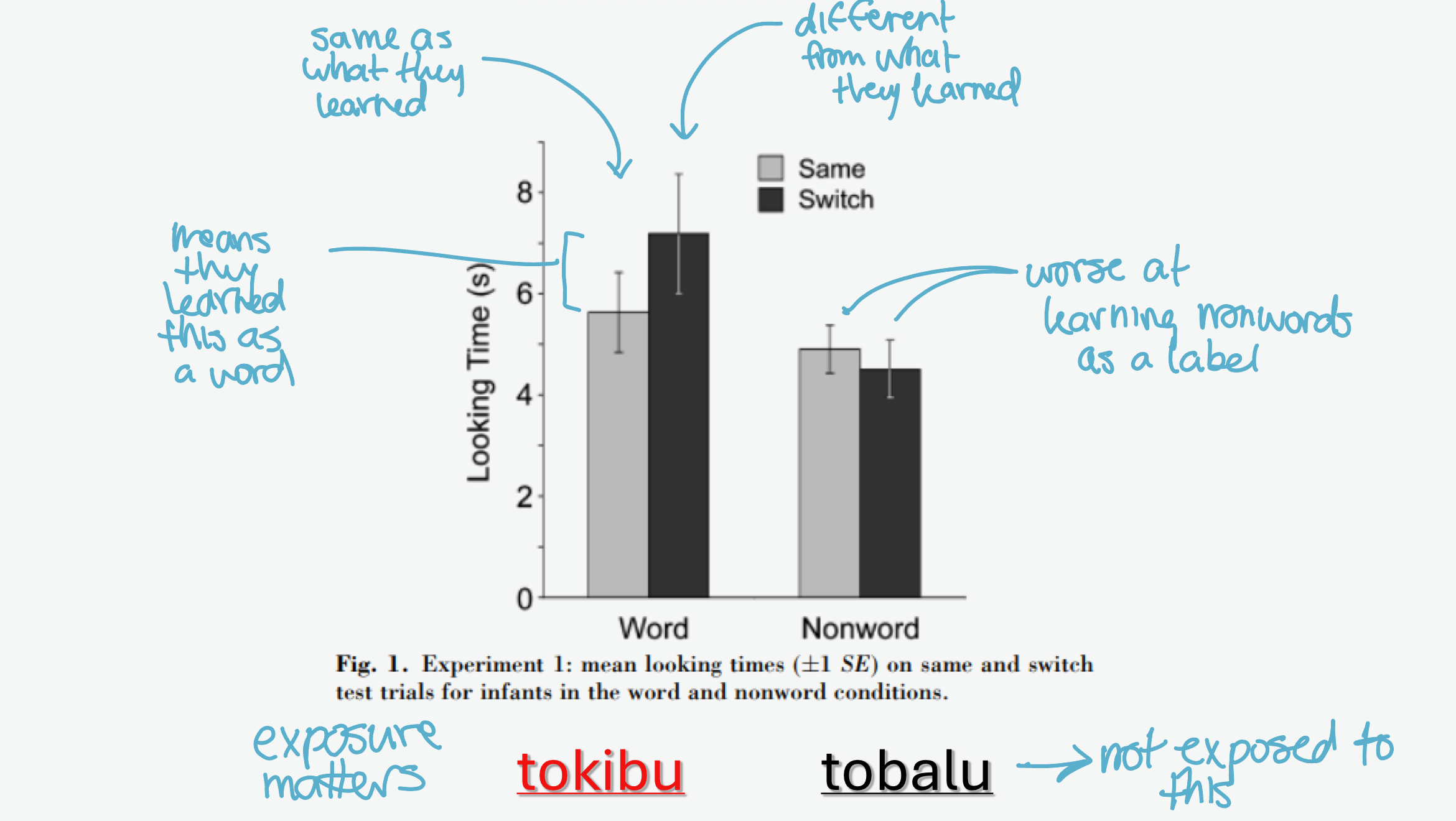
are representation of sequences with high transitional probability more available to be mapped onto words? Graf-Estes et al. (2007)
17 month olds in statistical word segmentation task + object-label-learning task (habituation)
labels were words, nonwords, or part-words from segmentation task
method- listen to string of made up words, then shown pictures of objects and labeled with either a word or nonwords, then tested with either the correct image or a different image
results-
more looking time at switched images for words
worse at learning non-words
no difference with part-words between correct and incorrect images
statistical learning is a domain-general mechanism
non-speech domains
tone sequences
visuospatial and visuomotor sequences
sequences of shapes
haptic events
non-baby evidence
even non-human primates can do some of these things
adults are similarly skiled as chidlren in these statistical learning tasks
stress patterns in the language- segmentation cue
around 80% of two syllable content words in English have stress on first syllable (trochaic pattern = STRONG-weak)
by 7.5 months infants use stress to detect word boundaries, expecting words to begin with stressed syllables
limitation- not always correct, but a good start
sometimes weak-STRONG
words in isolation- segmentation cue
high salience
unambiguous boundaries
often repeated = high frequency
can be used as “anchors” for other cues
account for substantial portion of earliest words
phonotactics- segmentation cues
language-specific rules about which phonemes may occur together
ex- consonant clusters- sequence of 2+ consonants either before or after the vowel in a single syllable
st-, sl-, gr-,
good night as goo + dnight or as good + night
infants are sensitive to phonotactics by 9 months and use the cue to infer word boundaries
infants prefer legal sequences over illegal sequences
traditional view of vocal development
experience independent
the same regardless of what language(s) the infant is exposed to
reflects constraints of anatomy and of motor control
PROVEN WRONG
stages of phonological development
prelinguistic (0-12 months)
prerepresentational (12-18 months)
representational (18-36 months)
phonetic inventory completion (3-7 years)
advanced phonology (7-12 years)
prelinguistic stage 1- reflexive vocalizations
brith-2 months
vegetative sounds
crying, burping, fussing