Chapter 23: Why do countries trade?
 Call Kai
 Learn
 Practice Test
 Spaced Repetition
 Match
 Flashcards
 Knowt Play
1/11

There's no tags or description
Looks like no tags are added yet.
12 Terms
What is international trade?
the exchange of goods and services between countries
What are the gains from international trade?
Lower prices - main gain is to buy goods and services cheaper than domestically
Greater choice - international trade gives countries more choice, don’t just have access to domestic material but now international
Differences in resources - diff countries possess diff resources, may be resources that a country needs but can't produce, eg oil and diamonds
Economies of scale - market increases and so does demand, so level of production and size of production increases
Increased competition - domestic firms compete with international ones, lead to greater efficiency and see consumers benefit from lower prices
More efficient allocation of resources - Free trade allows countries to specialise in producing goods and services they can make at the lowest cost, using their resources most efficiently and maximising global resource allocation.
What is absolute advantage?
When a country can produce a good or service using less resources than another country
What is comparative advantage?
A country is said to comparative advantage over another country if it can produce a good with a lower opportunity cost than another one
PPC to show comparative advantage?
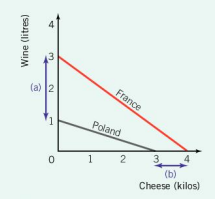
What is the law of comparative advantage?
there may be gains from trade arising when a country specialises in a certain good or service in which they have the comparative advantage in
How can we use a comparative advantage model to illustrate the “gains from specialisation and trade”?
see notes to fully explain
Does the theory of comparative advantage always work?
No if both countries have the same comparative advantage then there would be no point in trading
What gives a country comparative advantage?
Endowments - the quantity and quality of a countries factors of production
A country with large amounts of arable land will have a comparative advantage in agricultural goods. A country with cheap labour and a high population will have a comparative advantage in manufacturing. A country with highly educated workers will have a comparative advantage in financial services. A country with beaches and a hot climate will have a comparative advantage in tourism.
What are the limitations of the theory of comparative advantage?
it is assumed that the producers and consumers are perfectly informed and know exactly where to get the least expensive goods
assumed that there are no transport costs, as these may completely get rid of a countries comparative advantage, making trade useless
assumed that there are no economies of scale or diseconomies of scale, these would either increase or decrease a countries comparative advantage as costs fall or rise
assumed that there is free trade between countries, but there are likely to be some trade barriers imposed by govs
Potential sources of comparative advantage?
Comparative advantage occurs when a country can produce a good or service at a lower opportunity cost than another country.
Potential sources of comparative advantage
Differences in factor endowments: Countries have different amounts of land, labour and capital. For example, countries with abundant fertile land may specialise in agriculture.
Differences in climate and natural resources: Climate and resource availability affect production. For example, countries with oil reserves can specialise in oil production.
Differences in labour skills and productivity: Countries with highly skilled or productive workers may specialise in industries such as finance or technology.
Differences in technology: Countries with advanced technology can produce certain goods more efficiently, reducing their opportunity costs.
Economies of scale: Countries specialising in particular industries may benefit from lower average costs as output increases.
Historical specialisation: Countries may develop expertise and infrastructure in certain industries over time, giving them a comparative advantage.
Government policies: Investment in education, training and infrastructure can improve productivity and help develop a comparative advantage.
Key takeaway: Countries develop comparative advantages because of differences in resources, skills, technology and production costs, encouraging specialisation and international trade.

1)
Tea: 2, Coffee: ½
Tea: 1/2 , coffee: 2
2)
The law of comparative advantage: specialise in the good in which you have comparative advantage in. Amazonia has a comparative advantage in coffee because its opportunity cost is less than bretonia (1/2 to 2 units). Specialist in coffee, exchange ratio of 1:1 expands the PPC. Produces 500kg of coffee in which they consume 200 and export 300kg, importing 300kg of tea. At point x produce 100kg of coffee and 200 kg of tea, but at point y they produce 200kg of coffee and 300kg of tea, therefore showing the benefits of specialising and trade.
3)
The law of comparative advantage states you should specialise in production of goods that you have the comparative advantage in. Bretonia has the comparative advantage in the production of tea as its opportunity cost is lower. Specialising in tea with an exchange ratio of 1:1 will expand the PPC. Bretonia produces 1200kg of tea in which it exports 300kg and consumes 900kg, importing 300kg of coffee. At point x produce 800kg of tea and 200kg of coffee, but at point y they produce 900kg of tea and import 300kg of coffee, therefore showing benefits of specialisation and trade.
