Anatomy & Physiology I Final Exam - write out flashcards
 Call Kai
 Learn
 Practice Test
 Spaced Repetition
 Match
 Flashcards
 Knowt Play
1/39

There's no tags or description
Looks like no tags are added yet.
40 Terms
Nuclei
___________ are clusters of nerve cell bodies in the CNS
Ganglia
___________ are cluster of nerve cell bodies in the PNS
dendrites
__________ are the receptive regions of a nerve cell.
axon
The ______ is the impulse generating and conducting region of a nerve cell.
Sensory(afferent) and Motor (efferent)
The PNS is divided into what major divisions?
Somatic Nervous System (voluntary) and Autonomic Nervous System (involuntary)
The Motor (efferent) division of the PNS is divided into which major systems?
Sympathetic Division (fight or flight), Parasympathetic Division (rest and digest)
The ANS is divided into what two division?
smooth muscle, cardiac muscle, glands, support, body activities, blood, heart rate, subconscious
The ANS consist of motor neurons that innervate ______ ______, ______ _______, and ___________, that make adjustments to ensure optimal ________ for ______ ___________ (shunts _________ to areas that need it, adjusts _______ ______). The ANS operates via _____________ control.
skeletal muscle, cardiac muscle, smooth muscles, glands
The effectors of the somatic nervous systems innervate __________ _________. The effectors of the ANS innervate __________ __________, _________ ________, and ________
CNS, spinal, cranial nerves, skeletal muscle
In the SNS, the cell body is in the ______, and a single, thick, myelinated axons extends in _________ or _________ ________ directly to ____________ ________
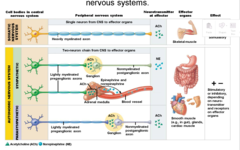
two-neuron chain
In the ANS, efferent pathways use a _______________ ________.
preganglionic neuron, preganglionic axon, postganglionic neuron, preganglionic, postganglionic
ANS two-neuron chain:
1) ________________ _______ - cell body in the CNS with a thin, lightly myelinated __________________ axon extending to the ganglion.
2) ________________ _________ - outside the CNS; cell body synapses with a ________________ axon in the autonomic ganglion with a nonmyelinated _________________ axon that extends to effector organs.
Preganglionic neuron, Postganglionic neuron
The efferent pathway is a 2-neuron chain:
1) _______________ _________ - first neuron
2) _____________ _________ - second neuron
acetylcholine (ACh), stimulatory, ACh, norepinephrine, ACh, stimulatory, inhibitory
Neurotrasmitter Effects:
1) In the somatic nervous system all somatic motor neurons release ________________, and the effect is always _______________.
2) In the ANS, the preganglionic fibers release __________________. The postganglionic fibers release ____________________ or _________________at effectors. The effect is either __________________ or ______________, depending on the type of receptors.
ok
Study this, then type ok.
visceral organs, opposite
All _________ ___________ are served by both the parasympathetic division and the sympathetic division of the ANS, but these divisions cause __________ effects.
sites or origins, length of fiber, location of ganglia.
The three main differences between the parasympathetic and the sympathetic divisions of the ANS are:
1) _________ __ _______
2) relative ________ __ _________
3) _________ ___ __________
craniosacral, brain, sacral, thoracolumbar, thoracic, lumbar
Parasympathetic fibers are ________________ - they originate in the _______ and ______ region of the spinal cord.
Sympathetic fibers are ____________________ - they originate in the _________ and ___________ regions of the spinal cord.
long, short, short, long
Parasympathetic NS has _____ preganglionic and _____ postganglionic fibers.
Sympathetic NS has _____ preganglionic and _____ postganglionic fibers
visceral effector organs, spinal cord
Parasympathetic ganglia are located in or near their ___________ _________ _______. Sympathetic ganglia lie close to the ________ _______.
oculomotor nerves (III), ciliary ganglia, facial nerves (VII), pterygopalatine ganglia, submandibular ganglia, glossopharyngeal nerves (IX), otic ganglia, vagus nerves (X)
In the cranial part of the parasympathetic division, preganglionic fibers run in:
1) ____________ _______ that control smooth muscle of the eye (pupils to constrict, lens to bulge for focusing). The postganglion cell bodies are located in _________ _______ within the eye orbitals.
2) __________ ________ that stimulate large glands in the head. Fibers that activate nasal and lacrimal glands have synapses in the ___________________ __________, while fibers that activate the submandibular and sublingual salivary glands synapse in ______________________ _________.
3) ________________ _________ that stimulate parotid salivary glands. These fibers synapse in _______ __________.
4) _________ ________ account for about 90% of all preganglionic parasympathetic fibers in the body. They serve all the thoracic and abdominal viscera.
thoracic, abdominal viscera, medulla, cardiac, pulmonary, esophageal, abdominal aorta
Vagus nerves (X) serve all _______ and __________ _________. Preganglionic fibers arise from the _______ and synapse in terminal ganglia in the walls of target organs. The fibers go to neck and nerve plexuses:
1) __________ plexuses: innervate the heart
2) __________ plexuses: innervate the lungs and bronchi
3) _____________ plexuses - innervate the esophagus.
4) ____________ _______ plexus - innervates many organs in the abdominal cavity
pelvic organs, distal, large intestine, ventral, pelvic splanchinic, pelvic floor (inferior hypogastric plexus), intramural ganglia
The sacral part of the parasympathetic nervous system originates from neurons in the S2, S3, and S4 vertebrae, and serves the _____ ______ and the _______ half of the __________ __________. Axons travel in the _________ root of spinal nerves, and branch off to form ________ ______________ nerves. They synapse with ganglia in the ______ ___________ and with __________ _________ in the walls of the distal half of the large intestine, the urinary bladder, ureters, and reproductive organs.
ventral root, rami communicantes, sympathetic trunk (chain ganglia), same, ascends, descends, passes through
In the sympathetic division of the ANS, preganglionic fibers exit spinal cord via the ______ _____, and pass through ______ ________________ into the ___________ _______ on either side of the vertebral column. There are 3 potential pathways from this point:
1) The axon synapses with postganglionic neuron in the ______ trunk ganglion
2) The axon _________ or __________ within the trunk and synapses with a postganglionic neuron in another trunk ganglion
3) The axon _________ ________ the trunk ganglion without synapsing with any postganglionic neuron there.
mechanoreceptors, thermoreceptors, photoreceptors, chemoreceptors, nocireceptors
Sensory receptors can be classified by stimulus type:
1) ________________ - mechanical force (touch, pressure, vibration, stretch)
2) _________________ - temperature changes
3) _________________ - light
4) __________________ - chemicals in solution (molecules that are tasted on tongue, smelled by nose, changes in blood chemistry, etc)
5) _____________ - damaging stimuli,would result in pain (extreme heat or cold, heavy pressure, damaging chemicals, would stimulate subtypes of thermo/chemo/mechano receptors).
exteroceptors, interoceptors (visceroceptors), proprioceptors
Sensory receptors can be classified by location:
1) ______________ - external stimuli
2) __________________ - internal stimuli
3) ________________ - changes in body position due to stretch
nonencapsulated (free) nerve endings, encapsulated nerve endings
Sensory receptors can be classified by receptor structure:
1) ___________________ _____ _______ - abundant in epithelial and connective tissue
2) ______________ ______ _________ - almost all are mechanoreceptors
free nerve endings, tactile (merkel) discs, hair follicle receptors
Nonencapsulated nerve endings:
1) _______ ____ _______ respond to temp, chemical change, pain, pressure
2) _________ _____ respond to light touch and are found in the depest layer of epidermis (stratum basale)
3) _____ ________ __________ - respond to light touch and wrap around hair follicles.
Tactile (Meissner's) corpuscles, Lamellar (pacinian) corpuscles, Bulbous corpuscles (Ruffini endings), Muscle spindles, Tendon organs, Joint kinesthetic receptors
Encapsulated nerve endings:
1) ___________ _________ - respond to light touch and is found in the papillary layer of dermis especially in hairless areas.
2) ____________ __________ - deep in dermis and in subcutaneous tissue. responds to deep pressure when first applied.
3) __________ ___________ - Respond to deep, continuous pressure, in dermis.
4) _________ ___________ - Respond to muscle stretch and length. Found in perimysium of skeletal muscle.
5) ________ _________ - Respond to tendon stretch. Found in tendons close to muscle insertion
6) ________ ________ _______ - respond to stretch of articular capsules. They sense joint movement/position.
12, 10, 2, 31
Peripheral Nerves -
A) Cranial Nerves (___ pairs)
- ___ pairs enter the brain stem
- ___ pairs enter the upper brain
B) Spinal Nerves (___ pairs)
afferent, brain, efferent, effectors
Sensory nerves are ___________ (impulses to _________). Motor nerves are ___________ (impulses to _________)
rootlets, dorsal root, ventral root, dorsal ramus, ventral ramus, meningeal branch, rami communicantes, nerve plexuses
Spinal Nerve Anatomy:
Within vertebral column:
1) ________ - attach along the length of the spinal cord segment
2) ________ _______ - sensory (afferent fibers)
3) ______ _______ - motor (efferent fibers)
Outside of vertebral collumn:
1) ________ _________ - dorsal branch
2) __________ _______ - ventral branch
3) _____________ _____ - branch that reenters spinal cord into meninges
4) _______ ______________ - autonomic nerve fibers that attach to ventral rami
5) ________ ___________ - interlacing nerve network formed from ventral rami
31, 8, 12, 5, 5, 1
Spinal nerves (___ total):
___ pairs of cervical spinal nerves
___ pairs of thoracic nerves
___ pairs of lumbar nerves
___ pairs of sacral nerves
___ pair of coccygeal nerves
C1, C4, Phrenic nerve
Cervical Plexus:
1) Formed by _____ through ____
2) The ________ _______ innervates the diaphragm (breathing)
T1, T12, intercostal nerves
Thoracic nerves go from ___ to ___. Include _____________ ______ which innervate intercostal muscles, skin, and muscles of the abdominal wall.
L1, L4, femoral nerve, obturator nerve
The lumbar plexus is formed by ___ through ___. Includes ________ _______ (thigh muscles, skin of legs) and the __________ ______ (enters the medial thigh via the obturator foramen, innervates the adductor muscles of inner thigh)
L4, S4, Sciatic nerve
The sacral plexus goes from ____ to ____ and innervates the buttocks, lower limbs, and pelvic structures. Includes the _________ _________ - largest branch of sacral plexus
vision, taste, smell, hearing, equilibrium
List the special senses:
taste buds
_______ _____ are the sensory organ for taste.
papillae
Most of the 10,000 taste buds are located on the tongue in ___________ - peg-like projections of tongue mucosa