IHUM Exam 1 (ben and ethan)
 Call Kai
 Learn
 Practice Test
 Spaced Repetition
 Match
 Flashcards
 Knowt Play
1/91

There's no tags or description
Looks like no tags are added yet.
92 Terms
And indeed I am at a loss to know how the weaver or the carpenter would be furthered in his art by a knowledge of this absolute good, or how a man would be rendered more able to heal the sick or to command an army by contemplation of the pure form or idea. For it seems to me that the physician does not even seek for health in this abstract way, but seeks for the health of man, or rather of some particular man, for it is individuals that he has to heal.
Aristotle - Nicomachean Ethics
Begin the morning by saying to thyself, I shall meet with the busybody, the ungrateful, arrogant, deceitful, envious, unsocial. All these things happen to them by reason of their ignorance of what is good and evil. But I who have seen the nature of the good that it is beautiful, and of the bad that it is ugly, and the nature of him who does wrong, that it is akin to me; not [only] of the same blood or seed, but that it participates in [the same] intelligence and [the same] portion of the divinity, I can neither be injured by any of them, for no one can fix on me what is ugly, nor can I be angry with my kinsman, nor hate him.
Marcus Aurelius - Meditations
But nevertheless happiness plainly requires external goods too, as we said; for it is impossible, or at least not easy, to act nobly without some furniture of fortune. There are many things that can only be done through instruments, so to speak, such as friends, and wealth and political influence: and there are some things whose absence takes the bloom off our happiness, as good birth, the blessing of children, personal beauty; for a man is not very likely to be happy if he is very ugly in person, or of low birth, or alone in the world, or childless, and perhaps still less if he has worthless children or friends, or has lost good ones that he had.
Aristotle - Nicomachean Ethics
For if we must speak as this very majesty of nature now known to us demands, he was a god, noble Memmius, a god he was, who first discovered that reasoned plan of life which is now called Wisdom, who by his skill brought life out of those tempestuous billows and that deep darkness, and settled it in such a calm and in light so clear.
Lucretius - On the Nature of Things
To conclude, always observe how ephemeral and worthless human things are, and what was yesterday a little mucus, tomorrow will be a mummy or ashes. Pass then through this little space of time conformably to nature, and end thy journey in content, as an olive falls off when it is ripe, blessing nature who produced it, and thanking the tree on which it grew.
Marcus Aurelius - Meditations
Happiness seems more than anything else to answer to this description: for we always choose it for itself, and never for the sake of something else; while honour and pleasure and reason, and all virtue or excellence, we choose partly indeed for themselves (for, apart from any result, we should choose each of them), but partly also for the sake of happiness, supposing that they will help to make us happy. But no one chooses happiness for the sake of these things, or as a means to anything else at all.
Aristotle - Nicomachean Ethics
Men of Athens, I honour and love you; but I shall obey God rather than you, and while I have life and strength I shall never cease from the practice and teaching of philosophy, exhorting any one whom I meet and saying to him after my manner: You, my friend,—a citizen of the great and mighty and wise city of Athens,—are you not ashamed of heaping up the greatest amount of money and honour and reputation, and caring so little about wisdom and truth and the greatest improvement of the soul, which you never regard or heed at all?
Plato - The apology of Socrates
For if I tell you that to do as you say would be a disobedience to the God, and therefore that I cannot hold my tongue, you will not believe that I am serious; and if I say again that daily to discourse about virtue, and of those other things about which you hear me examining myself and others, is the greatest good of man, and that the unexamined life is not worth living, you are still less likely to believe me. Yet I say what is true, although a thing of which it is hard for me to persuade you.
Plato - The apology of Socrates
Then they placed the chest in a hollow grave, and over the grave stacked great thick stones. Quickly they built up a barrow, and all around it they placed watchmen, in case the Achaeans with their fancy shinguards should set on them before the end of the truce. After they heaped up the barrow, they went back to the city. Gathered together, they dined on a splendid meal in the house of Zeus-nourished Priam, the king. In this way they held the funeral for Hector tamer of horses.
Homer - The Illiad
Philolaches: Take me, for example. I was always a steady, serious-minded chap, when I was in the builders’ hands. But left to my own devices … well, it didn't take me long to undo all their work and make the house a ruin. Rainy weather … that was idleness. Gales and hailstorms … carelessness and indifference. I did nothing to repair the damage. And then came love … pouring into my heart and soul. I was flooded out.
Plautus - The Haunted House
Be like the promontory against which the waves continually break, but it stands firm and tames the fury of the water around it. Unhappy am I because this has happened to me? Not so, but happy am I, though this has happened to me, because I continue free from pain, neither crushed by the present nor fearing the future.
Marcus Aurelius - Meditations
But unless the mind is purged, what battles and perils must then find their way into us against our will! How sharp then are the cares with which lust rends the troubled man, how great also the fears! Or and vices-- what of pride, of filthy lust, of petulance? How great the devastation they deal! What of luxury and sloth? He therefore who has vanquished all these and cast them forth from the mind by words, not by swords, will it not be proper that he be held worthy to be counted in the number of the gods?
Lucretius - On the Nature of Things
The difficulty, my friends, is not to avoid death, but to avoid unrighteousness; for that runs faster than death. I am old and move slowly, and the slower runner has overtaken me, and my accusers are keen and quick, and the faster runner, who is unrighteousness, has overtaken them. And now I depart hence condemned by you to suffer the penalty of death,—they too go their ways condemned by the truth to suffer the penalty of villainy and wrong; and I must abide by my award—let them abide by theirs.
Plato - The apology of Socrates
The rage sing, o goddess, of Achilles, the son of Peleus, the destructive anger that brought ten-thousand pains to the Achaeans and sent many brave souls of fighting men to the house of Hades and made their bodies a feast for dogs and all kinds of birds. For such was the will of Zeus.
Homer - The Illiad
Zeus, who assembles the clouds,
was deeply disturbed. He said: "This is bad
business. You will set me on to quarrel with Hera, who
will anger me with her words of reproach. Even as it is
she is always on my back among the deathless gods, saying
that in the battle I help the Trojans.
Homer - The Illiad
For so many first-beginnings of things in so many ways, smitten with blows and carried by their own weight from infinite time up to the present, have been accustomed to move and meet together in all manner of ways, and to try all combinations, whatsoever they could produce by coming together, that it is no wonder if they fell also into such arrangements, and came into such movements, as this sum of things now shows in its course of perpetual renovation.
Lucretius - On the Nature of Things
Accordingly I went to one who had the reputation of wisdom, and observed him—his name I need not mention; he was a politician whom I selected for examination—and the result was as follows: When I began to talk with him, I could not help thinking that he was not really wise, although he was thought wise by many, and still wiser by himself; and thereupon I tried to explain to him that he thought himself wise, but was not really wise; and the consequence was that he hated me, and his enmity was shared by several who were present and heard me. So I left him, saying to myself, as I went away: Well, although I do not suppose that either of us knows anything really beautiful and good, I am better off than he is,—for he knows nothing, and thinks that he knows; I neither know nor think that I know.
Plato - The apology of Socrates
Neptune with his trident
Helped them. He freed vast sandbanks, smoothed the surface,
His weightless chariot grazing the waves' peaks;
As often in a crowded gathering
Crude commoners in rage begin to riot,
Torches and stones fly, frenzy finds its weapons--
But if they see a stern and blameless statesman,
They all fall silent, keen for him to speak.
Then he will tame their hearts and guide their passions.
Vergil - The Aeneid
Callidamates: As for the money he owes, the money he spent on the girl … we're all going to club together and pay it back, at our expense, not yours.
Theopropides: I must say you plead for him very eloquently. Well, I won't be hard on him … I'm not angry any more. In fact, let him carry on … loving, drinking, whatever he wants … just like when I was away. Provided he's sorry … for having wasted all that money.
Plautus - The Haunted House
Tranio (sees audience and stops to explain to them): I expect you’re wondering why I’m in such a panic? Well, I’ll tell you. We’re doomed! It’s all over! There’s no hope for us! Why? I hear you ask. The master’s come home from his travels! I’m finished!
Plautus - The Haunted House
And so, Glaucon, I said, we have at last arrived at the hymn of dialectic. This is that strain which is of the intellect only, but which the faculty of sight will nevertheless be found to imitate; for sight, as you may remember, was imagined by us after a while to behold the real animals and stars, and last of all the sun himself. And so with dialectic; when a person starts on the discovery of the absolute by the light of reason only, and without any assistance of sense, and perseveres until by pure intelligence he arrives at the perception of the absolute good, he at last finds himself at the end of the intellectual world, as in the case of sight at the end of the visible.
Plato - The Allegory of the Cave
The prison-house is the world of sight, the light of the fire is the sun, and you will not misapprehend me if you interpret the journey upwards to be the ascent of the soul into the intellectual world …. But, whether true or false, my opinion is that in the world of knowledge the idea of good appears last of all, and is seen only with an effort; and, when seen, is also inferred to be the universal author of all things beautiful and right, parent of light and of the lord of light in this visible world, and the immediate source of reason and truth in the intellectual; and that this is the power upon which he who would act rationally either in public or private life must have his eye fixed.
Plato - The Allegory of the Cave
Arms and a man I sing, the first from Troy,
A fated exile to Lavinian shores
In Italy. On land and sea, divine will—
And Juno’s unforgetting rage—
Harassed him. War racked him too, until he set his city
And gods in Latium. There his Latin race rose,
With Alban patriarchs, and Rome’s high walls.
Vergil - The Aeneid
If this be so the result is that the good of man is exercise of his faculties in accordance with excellence or virtue, or, if there be more than one, in accordance with the best and most complete virtue.
Aristotle - Nicomachean Ethics
Chorus:
No longer will I go in reverence
to the sacred stone, earth's very centre,
or to the temple at Abae or Olympia,
if these prophecies fail to be fulfilled
and manifest themselves to mortal men.
But you, all-conquering, all-ruling Zeus,
if by right those names belong to you,
let this not evade you and your ageless might.
For ancient oracles which dealt with Laius
are withering--men now set them aside.
Nowhere is Apollo honoured publicly,
and our religious faith is dying away.
Sophocles - Oedipus the King

What is the name of this structure?
The Colosseum
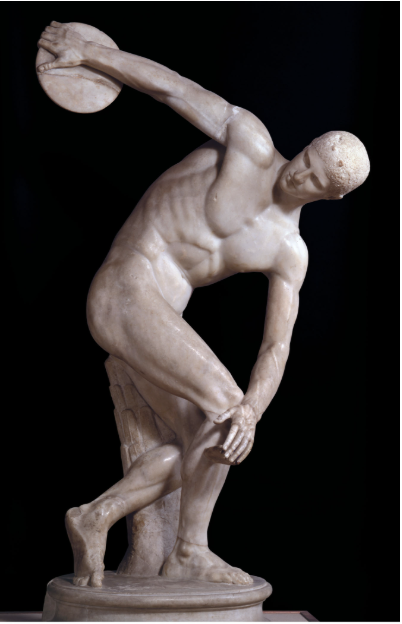
What style is this?
Classical

Who is the artist that created this?
Myron
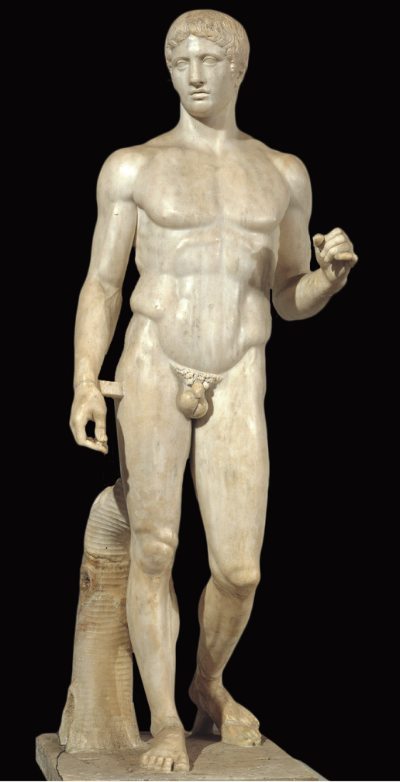
What style is this?
Classical

What is the name of this structure?
Arch of Titus

What style is this?
Hellenistic

What style is this?
Orientalizing

Who is the artist that created this?
Praxiteles

Who is the artist that created this?
Lysippus

What style is this?
Geometric

What is the name of this piece?
Nike

What is the name of this piece?
Peplos Kore

What is the name of this piece?
Aphrodite

What style is this?
Roman

What is the name of this piece?
Kritios Boy
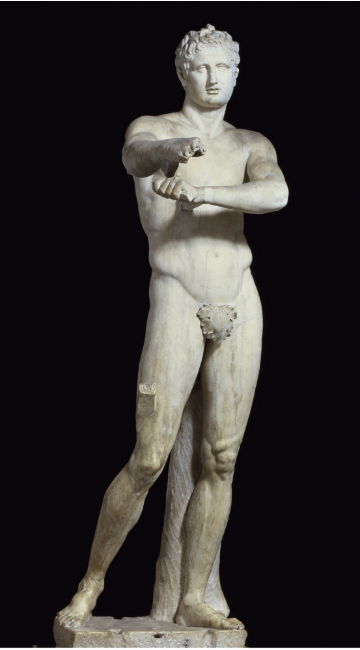
What is the name of this piece?
Apoxyomenos (Scraper)

What is the name of this piece?
Augustus of Prima Porta
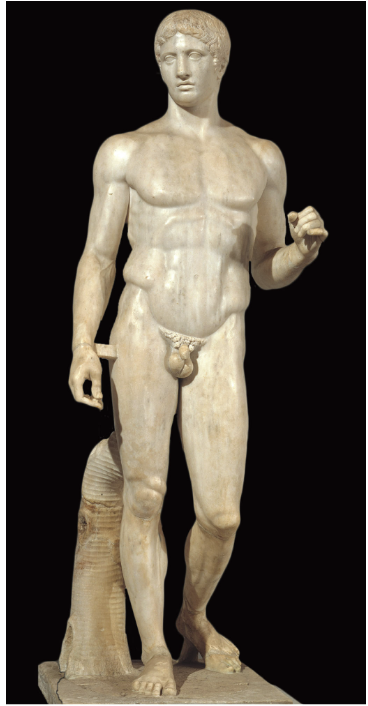
What is the name of this piece?
Doryphorus (Spear Bearer)

What is the name of this structure?
Ara Pacis
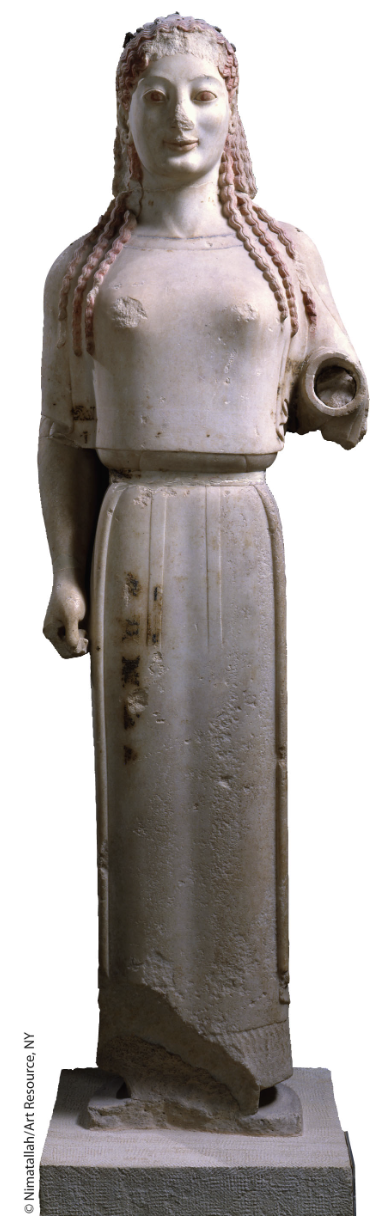
What style is this?
Archaic

What is the name of this structure?
The Parthenon

What is the name of this piece?
Hermes
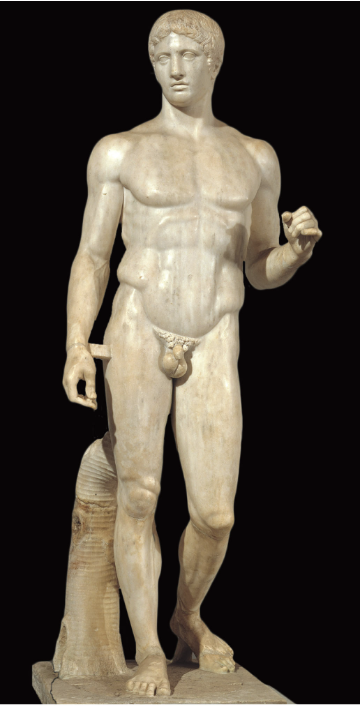
Who is the artist that created this?
Polyclitus

What is the name of this structure?
The Pantheon

What is the name of this piece?
Laocoon
Which of the following statements is true about early Greek art?
A. Red-figure vases were later supplanted by black-figure vases, which allowed for greater artistic expression.
B. The Orientalizing style in Greek vases is characterized by intricate repeated abstract decorative patterns and small abstract human figures.
C. As Greek sculpture moved into the Early Classical period, a characteristic smile appears on the statues.
D. The Orientalizing style emerged as the Greeks came into contact with other Mediterranean cultures.
E. None of the above
D
Which of the following is a characteristic of the Doric architectural order?
A. A base at the bottom of the column
B. Scroll-like capitals
C. Continuous frieze in the entablature
D. Triglyphs and metopes
E. A capital that looks like an acanthus plant
D
In ancient Greece, what was the polis?
A. The ruling class
B. The city-state
C. The city theater
D. Greek soldiers
E. An alliance of various Greek cities
B
According to the Epicureans, how was the earth created?
A. Random collisions of atoms without any intention or design
B. The gods put in motion natural forces that led to its creation.
C. The gods deliberately created it.
D. Some beings prior to the Roman gods created it.
E. It was not created; it simply has always existed.
A
Which of the following periods of Greek art placed the greatest emphasis on rationality, order, and control?
A. the Archaic
B. the Classical
C. the Late Classical
D. the Hellenistic
E. the Orientalizing
B
What name is given to the period of Greek history following the death of Alexander the Great?
A. The Doric Period
B. The Delian Period
C. The Peloponnesian Period
D. The Hellenistic Period
E. The Classical Period
D
The principal building material of the Pantheon is:
A. marble
B. granite
C. brick covered by stone
D. concrete
E. wood
D
In The Aeneid, who is the mother of Aeneas?
A. Venus
B. Dido
C. Minerva
D. Creusa
E. Juno
A
What are the two main periods of Roman history called?
A. The Caesarean and Augustan Periods
B. Republican and Imperial Rome
C. The Epicurean and Stoic Periods
D. Punic and Octavian Rome
E. The Etruscan and the Achaean
B
Plato’s most influential student was:
A. Aristotle
B. Socrates
C. Sophocles
D. Nichomachus
E. Epicurus
A
For the Epicureans, the state of a mind free of anxiety and fear is also known as:
A. ataraxia
B. pietas
C. areté
D. hubris
E. timé
A
The main hero of The Iliad is:
A. Odysseus
B. Hector
C. Achilles
D. Agamemnon
E. Priam
C
The move towards a more humanizing and natural style in the Late Classical period is most likely connected to:
A. the defeat of Athens in the Peloponnesian War.
B. the influence of philosophers like Socrates and Plato.
C. the conquest of Greece by the Romans.
D. the inspiring example of Alexander the Great.
E. the development of theater as an art form.
A
You and your team of archeologists have just unearthed a Greek vase. The vase is largely a terra cotta (red-orange) color, but it is extensively decorated with fanciful black representations of animals and mythological creatures that do not appear to tell any particular story. Your colleagues ask you what period the vase comes from. You answer:
A. Geometric
B. Red-figure
C. Orientalizing
D. Black-figure
E. None of the above
C
After his initial conversation with a politician, Socrates concludes:
A. that the politician is only wise about politics.
B. that politics trains people to be wise about other areas of their lives.
C. that the politician had a lot of knowledge.
D. that Socrates is wiser than the politician is, because he understands his own ignorance.
E. that the politicians are smarter than the poets.
D
According to Plato, dialectic:
A. Is the process by which the prisoner is freed intellectually.
B. Is the name given to the philosopher’s duty to return to the cave.
C. Refers to the moderate virtue in between the vices of excess (courage between cowardice and foolhardiness, for example).
D. Refers to the empty and meaningless debates that the prisoners hold regarding the shadows on the wall.
E. None of the above
A
What accounts for the powerful position of Athens during the first half of the Classical period?
A. Athenians' superior skill in craftsmanship
B. Athens's role in defeating the Persians and creating a league of Greek cities
C. Athens's highly developed system of trade routes
D. Athenians' rejection of religious worship in favor of more practical concerns
E. Athens’s powerful pottery industry
B
What typical characteristics of Roman comedy do we see in The Haunted House?
A. use of stock characters
B. lofty, poetic language
C. the triumph of the stern, moral characters
D. a setting in the mythical past
E. the satire of political figures
A
The Greek word that means “prowess” or “excellence” is:
A. areté
B. polis
C. timé
D. ethos
E. ataraxia
A
Oedipus is initially prompted to investigate the death of the previous king because of:
A. the pleas of the old shepherd.
B. the oracle of Apollo.
C. Jocasta, who would like information about how her previous husband died.
D. Creon, who wants to know the truth of his father’s death.
E. Tiresias, who tells him he must find the murderer.
B
Which of the following is true of the Ethics?
A. It states that children are not happy.
B. It claims that even the very poor have an equal chance for happiness.
C. It recommends a life of peaceful withdrawal from society.
D. Like Plato’s work, it tries to describe abstract universal good.
E. None of the above
A
In Oedipus the King, what is the name of the uncle of Oedipus, accused of plotting against the king?
A. Laius
B. Creon
C. Meletus
D. Tiresias
E. None of the above
B
In The Aeneid, why is Dido so hospitable to Aeneas and his men?
A. Venus makes Dido fall in love with Aeneas.
B. Aeneas and his men have brought many treasures from Troy with them.
C. Dido knows that the gods watch out for the rights of travelers.
D. She is originally from the same area that they are.
E. She thinks that they will be useful allies in fighting against the neighboring countries.
A
Which of the following is true of Greek theater?
A. Because of its worldly themes, religious officials abstained from attending.
B. Many performances were held during the festival celebrating the god Apollo.
C. It developed out of an earlier tradition of sung choral odes.
D. In order to keep the audience’s attention fixed, it eliminated distractions such as music or dance.
E. None of the above
C
During a visit to a famous art museum, your tour group stops in front of a statue by Lysippus. A member of the group asks in what period the sculpture was done. Your tour guide is stumped. You respond:
A. Hellenistic
B. Archaic
C. Early Classical or Severe
D. Late Classical
E. None of the above
D
It was Apollo, friends.
It was Apollo. He brought on these troubles—
the awful things I suffer. But the hand
which stabbed out my eyes was mine alone.
In my wretched life, why should I have eyes
when there was nothing sweet for me to see?
Oedipus the King - Sophocles
JOCASTA: O you unhappy man!
May you never find out who you really are!
Oedipus the King - Sophocles
Theopropides: Come on, don’t play the fool. You know my son made a deal with you while I was away.
Simo: What sort of deal? What was this for?
Theopropides: I understand that I owe you eight thousand.
Simo: You certainly don’t. But if you really want to give it to me, I won’t object.
Theopropides: Simo, please be serious. You admit that you’ve received four thousand drachmas already?
Simo: No. Why on earth would your son have given it to me?
The Haunted House - Plautus
Ah, my children, where are you? Come here,
come into my arms—you are my sisters now—
feel these hands which turned your father’s eyes,
once so bright, into what you see now,
these empty sockets. He was a man who,
seeing nothing, knowing nothing, fathered you
with the woman who had given birth to him.
I weep for you.
Sophocles - Oedipus the King
In the morning when thou risest unwillingly, let this thought be present,—I am rising to the work of a human being. Why then am I dissatisfied if I am going to do the things for which I exist and for which I was brought into the world? Or have I been made for this, to lie in the bed-clothes and keep myself warm?—But this is more pleasant.—Dost thou exist then to take thy pleasure, and not at all for action or exertion? Dost thou not see the little plants, the little birds, the ants, the spiders, the bees working together to put in order their several parts of the universe? And art thou unwilling to do the work of a human being, and dost thou not make haste to do that which, is according to thy nature?
Marcus Aurelius - Meditations
The ruler of the gods, whose strength bends heaven
And earth, has sent me down from bright Olympus,
Commanding that I fly here with this message:
“What will this loitering in Libya bring you?
If you’re unmoved by all the coming splendor
Which is a weight you do not wish to shoulder,
Think of your hopes as Iulus grows, your heir,
Owed an Italian realm and Roman soil.”
Vergil - Aeneid

What is the name of this piece?
Cicero

What style is this?
Roman
Portrait sculptures during the Roman Republic were:
A.
extremely realistic
B.
very idealized
C.
never made for living individuals
D.
only made for government officials
E.
almost non-existent
A
Which of the following is not an accusation brought against Socrates by the Athenians as either part of the official charges or, as Socrates claims, part of the older prejudices against him?
A.
Corrupting the youth
B.
Worshiping new gods
C.
Founding the Academy to spread his philosophy
D.
Teaching how to make weak arguments appear stronger
E.
All of the above are charges brought against Socrates
C
How is the Hebrew Bible divided?
A.
The Law, the Prophets, and the Writings
B.
The Psalms, the Tenets, and the Epistles
C.
The Gospel, The Babylonian Letters, and the Writings
D.
The Creation Story, The Pauline Letters, and the Book of Revelation
E.
The Mosaic Law, the Books of Wisdom, and the Apocrypha
A
The Apology of Socrates:
A.
Was in fact written by Aristotle.
B.
Ends with Socrates ordered into exile.
C.
Is one of several Greek philosophical works in which Socrates is featured.
D.
Shows that Socrates avoided mentioning the gods, privileging reason instead.
E.
None of the above
C
“Achilles was still in full pursuit of Hector, as a hound chasing a fawn which he has started from its covert on the mountains, and hunts through glade and thicket. The fawn may try to elude him by crouching under cover of a bush, but he will scent her out and follow her up until he gets her—even so there was no escape for Hector from the fleet son of Peleus.” The italicized selection is an example of which stylistic feature of Greek epic poetry?
A.
invocation of the muse
B.
epic simile
C.
In medias res
D.
ornamental epithet
E.
dialectic
B
According to the Ara Pacis, how did Augustus want to be remembered by future generations?
A.
As a war hero
B.
As a champion of the poor
C.
As a bringer of peace and stability
D.
As a great poet
E.
As a god
C
In Plato’s allegory of the cave, the shadows on the wall symbolize:
A.
That the philosopher’s role, like that of a prophet, is to predict correctly the sequence of future events.
B.
That the things we see in the real world are really only illusions or reflections.
C.
That only in pondering the dark and mysterious can the philosopher arrive at the truth.
D.
That the eternal Forms are copies of objects in the real world.
E.
None of the above
B
In The Aeneid, what is Aeneas’s response to Turnus’s plea for mercy?
A.
He grants him his life, but forces him into exile.
B.
He kills him.
C.
He spares him and forgives him.
D.
He chops off his arm so that he will live, but will never be able to fight again.
E.
He obligates Turnus to kill himself.
B
What architectural detail do we find on the Pantheon's roof?
A.
the oculus
B.
the archway
C.
the groin vault
D.
the barrel vault
E.
the frieze
A