PHRM 728 Exam 1
 Call Kai
 Learn
 Practice Test
 Spaced Repetition
 Match
 Flashcards
 Knowt Play
1/73

There's no tags or description
Looks like no tags are added yet.
74 Terms
In 1976, investigators wanted to examine the association btw hormonal abnormalities in
women with breast cancer. Based on laboratory results women were classified put in
groups: those with underlying abnormalities, including progesterone deficiency, and
those without such hormonal abnormalities. Both groups were followed for suspected
development of breast cancer. Information about the age menarche (first menses), history
of oral contraceptive use, history of benign breast disease, and age at first birth collection
(an adjusted for the analysis). The study found that the occurrence of premenopausal
breast cancer was 5.4 times greater in women with hormonal abnormalities then those
with normal hormone profile (P <0.05). Interpret further bolts of the study.
a. Case-control study
b. Case-series study
c. Clinical trial
d. Cohort study
e. Cross-sectional study
d. Cohort study
In 1976, investigators wanted to examine the association btw hormonal abnormalities in
women with breast cancer. Based on laboratory results women were classified put in
groups: those with underlying abnormalities, including progesterone deficiency, and
those without such hormonal abnormalities. Both groups were followed for suspected
development of breast cancer. Information about the age menarche (first menses),
history of oral contraceptive use, history of benign breast disease, and age at first birth
collection (an adjusted for the analysis). The study found that the occurrence of
premenopausal breast cancer was 5.4 times greater in women with hormonal
abnormalities then those with normal hormone profile (P <0.05). Interpret the results of
the study
a. Breast cancer is caused by hormone abnormalities
b. Hormonal abnormality is a protective factor for breast cancer
c. hormonal abnormality is a risk factor for breast cancer
d. no association between hormonal abnormalities and breast cancer was found
c. hormonal abnormality is a risk factor for breast cancer
In 1976, investigators wanted to examine the association btw hormonal abnormalities in
women with breast cancer. Based on laboratory results women were classified put in
groups: those with underlying abnormalities, including progesterone deficiency, and
those without such hormonal abnormalities. Both groups were followed for suspected
development of breast cancer. Information about the age menarche (first menses),
history of oral contraceptive use, history of benign breast disease, and age at first birth
collection (an adjusted for the analysis). The study found that the occurrence of
premenopausal breast cancer was 5.4 times greater in women with hormonal
abnormalities then those with normal hormone profile (P <0.05). The value 5.4 refers to
which of the following?
a. Incidence
b. number needed to treat
c. relative risk
d. statistical significance
c. relative risk
Why was the information on first menses history of oral contraceptive use history of
benign breast disease an age at birth controlled?
a. Information was collected to increase the statistical power of the study
b. information was collected to minimize selected bias
c. information was collected to minimize information bias
d. these factors were considered to be potential confounders for an association between hormonal deficiencies and breast cancer
d. these factors were considered to be potential confounders for an association between hormonal deficiencies and breast cancer
In a small pilot study, 12 women with endometrial cancer (cancer of the uterus) and 12
women with no apparent disease were contacted and asked whether they had ever
taken exogenous estrogen. Each woman with cancer was matched by age race weight
and parity (number of life born children) to women without disease. what was the study
design?
a. case control
b. clinical trial
c. cross sectional
d. perspective cohort
e. retrospective cohort
a. case control
In a small pilot study, 12 women with endometrial cancer (cancer of the uterus) and 12
women with no apparent disease were contacted and asked whether they had ever
taken exit genius estrogen. Each woman with cancer was matched by age race weight
and parity (number of live born children) to women without disease. What is the reason
for matching in this study?
a. to increase statistical power of the study
b. to minimize selection bias
c. to minimize information bias
d. to control for confounding
e. to have the same sample size in each study group
d. to control for confounding
A case-controlled study is characterized by all of the following except:
a. assessment of past exposure might be biased
b. case with disease are compared to controls without the disease
c. incidence rates and relative risk can be calculated
d. it is relatively inexpensive compared with other study designs
c. incidence rates and relative risk can be calculated
The controls in a case control study are:
a. Subjects free of the outcome under consideration
b. subjects free of the exposure of interest
c. subjects with an exposure of interest
d. subjects with an outcome of interest
a. Subjects free of the outcome under consideration
In studies of birth defects mothers with an impaired child might give a more valid and
complete report of their exposure to medications during pregnancy compared to a
mother with a non-impaired child. What type of problem does this represent?
a. Confounding by Co medications
b. detection bias
c. recall bias
d. referral bias
e. selection biased
c. recall bias
Which of the following observational studies is least prone to information bias?
a. Cross sectional
b. Case control
c. Prospective cohort
a. Cross sectional
Which of the following statements regarding descriptive studies is false?
a. A cohort study is an example of a descriptive study
b. the investigator usually allows nature to take its course in a descriptive study
c. they can be used to document unusual medical occurrences
d. they describe disease pattern occurrence in relation to person place and time
a. A cohort study is an example of a descriptive study
Bias and confounding are the major threats to:
a. External validity
b. internal validity
c. power of the study
d. statistical significance
e. sanity of investigators
b. internal validity
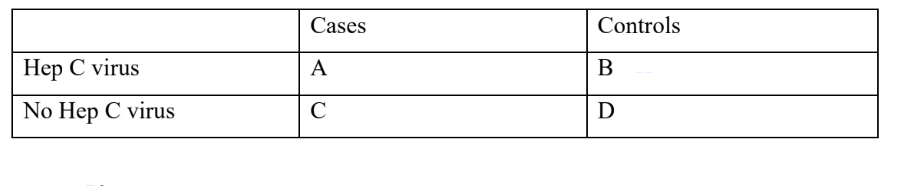
A case control study assesses the relationship of hepatitis C virus infection to be so non-
Hodgkin lymphoma. Cases (patients with B cell non-Hodgkin lymphoma n = 40)
identified and the hematology department wards of 10 hospitals, located in different
cities throughout Italy. The control group (n=396) consisted of patients admitted to
other wards of the same hospitals. Among cases 70 patients had documented histories
of hepatitis C virus infection. Among controls, 22 patients had documented histories of
each hepatitis C virus infection. enter the numerical value for cell A.
a. 70
b. 22
c. 330
d. 374
a. 70

What two features make the EBM question on Slide 4 stronger than a patient testimonial?
A. Animal data and expert opinion
B. A single detailed patient story and lab values
C. A large budget and a famous researcher
D. A random sample and a control group
D. A random sample and a control group
In Rosenberg's (1995) definition, EBM is a process of systematically doing which three things with research findings?
A. Publishing, citing, and reviewing
B. Asking, assessing, and approving
C. Designing, funding, and conducting
D. Finding, appraising, and using
D. Finding, appraising, and using
A pharmacist recommends a supplement because 'my last patient who took it felt much better.' What type of evidence is this, and what is its main weakness?
A. Case report; there is no comparison or control group
B. Systematic review; too many studies combined
C. Randomized trial; too expensive
D. Lab report; results came from animals
A. Case report; there is no comparison or control group
SELECT ALL THAT APPLY: Which of the following are components of EBM according to the Sackett definition? (Choose the option that lists ALL correct components.)
A. Patient testimonials, clinical expertise, and patient values
B. Best research evidence, animal studies, and patient values
C. Best research evidence, clinical expertise, and patient values
D. Best research evidence and clinical expertise only
C. Best research evidence, clinical expertise, and patient values
According to Sackett et al. (2000), evidence-based medicine is best defined as which of the following?
A. Following clinical practice guidelines exactly as written
B. Using the results of the largest randomized controlled trial available for every decision
C. Basing decisions on case reports from experienced clinicians
D. Integrating best research evidence with clinical expertise and patient values
D. Integrating best research evidence with clinical expertise and patient values

A case control study assesses the relationship of hepatitis C virus infection and non-Hodgkin lymphoma. Cases (patients with B cell non-Hodgkin lymphoma, n=40) identified in the hematology department wards of 10 hospitals, located in different cities throughout Italy. The control group (n=396) consisted of patients admitted to other wards of the same hospitals. Among cases, 70 patients had documented histories of hepatitis C virus infection. Among controls. 22 patients had documented histories of each hepatitis C virus infection. Enter the numerical value for cell B.
a. 70
b. 22
c. 330
d. 374
b. 22
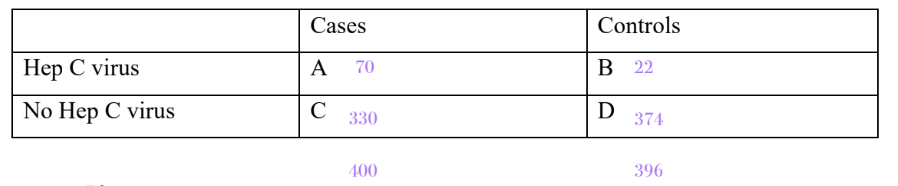

A case control study assesses the relationship of hepatitis C virus infection and non-Hodgkin lymphoma. Cases (patients with B cell non-Hodgkin lymphoma, n=40) identified in the hematology department wards of 10 hospitals, located in different cities throughout Italy. The control group (n=396) consisted of patients admitted to other wards of the same hospitals. Among cases, 70 patients had documented histories of hepatitis C virus infection. Among controls. 22 patients had documented histories of each hepatitis C virus infection.
a. Enter the numerical value for cell C.
330


A case control study assesses the relationship of hepatitis C virus infection and non-Hodgkin lymphoma. Cases (patients with B cell non-Hodgkin lymphoma, n=40) identified in the hematology department wards of 10 hospitals, located in different cities throughout Italy. The control group (n=396) consisted of patients admitted to other wards of the same hospitals. Among cases, 70 patients had documented histories of hepatitis C virus infection. Among controls. 22 patients had documented histories of each hepatitis C virus infection.
a. Enter the numerical value for cell D.
374
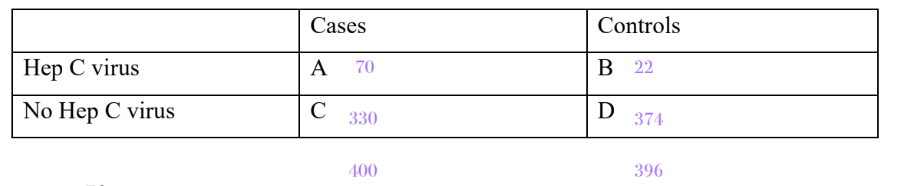
Identify the appropriate measure of association to estimate the relationship between HCV infection and B-cell non-Hodgkin lymphoma.
a. Incidence
b. Prevalence
c. Relative risk
d. Odds ratio
e. Number needed to treat
d. Odds ratio
What are the odds of exposure (HCV infection) among cases? (Odds = probability
of an event/probability of non-event)
a. 17.5%
b. 21.2%
c. 5.6%
d. 76%
e. 88%
b. 21.2%
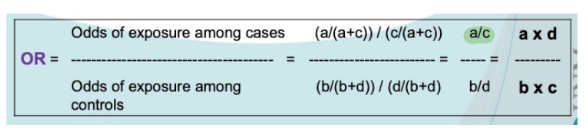
What is the magnitude of association between HCV infection and B-cell non-
Hodgkin lymphoma? (You are expected to choose and calculate the measure of
association that is appropriate for the study.)
a. 1.6
b. 3.6
c. 2.2
d. 0.45
e. 0.28
b. 3.6
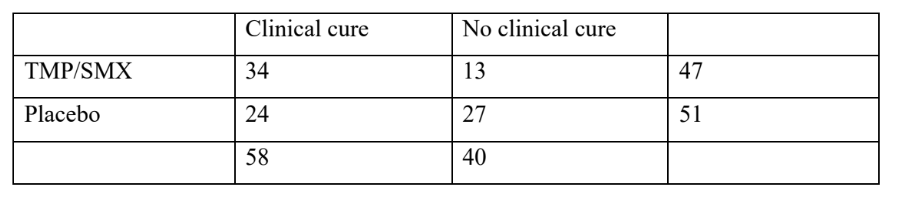
A study examined the effectiveness of trimethoprim-sulfamethoxazole (TMP/SMX) on chronic otitis media in children. After 6 weeks of therapy, the investigators reported the following results
The absolute risk reduction for clinical cure in this study is equal to:
a. 1.53
b. 0.25
c. 2.91
d. 0.50
e. 0.16
b. 0.25

A study examined the effectiveness of trimethoprim-sulfamethoxazole (TMP/SMX) on chronic otitis media in children. After 6 weeks of therapy, the investigators reported the following results
The NNT (number needed to treat) for TMP/SMX resulting from this study is
closest to:
a. 0
b. 2
c. 4
d. 6
e. 8
c. 4

A study examined the effectiveness of trimethoprim-sulfamethoxazole (TMP/SMX) on chronic otitis media in children. After 6 weeks of therapy, the investigators reported the following results
Assume the NNT for the above study was 50. Which of the following statements
below best reflects the interpretation of NNT?
a. 50 subjects need to be treated with TMP/SMX to cure every person of otitis media
b. 50 subjects are needed in each study group to reach statistical significance
c. If you treat 50 subjects with TMP/SMX instead of placebo, 1 more subject will show clinical cure when compared to placebo
d. All of the above
c. If you treat 50 subjects with TMP/SMX instead of placebo, 1 more subject will show clinical cure when compared to placebo
A clinical trial was conducted to determine whether a new blood pressure- lowering medication controlled hypertension better compared to a control group. NNT was estimated as 4.16. This means:
a. About one in every 4 patients will achieve positive blood pressure control by using the treatment instead of control
b. About one in every 4 patients must receive the treatment for one patient to experience and adverse event
c. The difference of the risk of uncontrolled hypertension between treatment and control groups is 4.16
d. The ratio between the risk of uncontrolled hypertension in the control group over the risk of uncontrolled hypertension in the treatment group is 4.16
a. About one in every 4 patients will achieve positive blood pressure control by using the treatment instead of control
Randomization refers to:
a. The process of assigning subjects to groups in cohort studies
b. The prospective allocation of patients to treatment groups in clinical trials
c. A double-blind study design
d. Selection of cases and controls from the study population
b. The prospective allocation of patients to treatment groups in clinical trials
A recent clinical trial was conducted to characterize the impact of bronchodilation on disease severity in patients with COPD. Patients were randomized into Group A (placebo) or Group B (bronchodilator – ipratropium bromide and albuterol combination). Spirometry and a walking test were conducted 60 minutes after nebulization (administration of treatment or placebo). The next visit, Group A patients received the bronchodilator treatment and Group B received the placebo. This is an example of:
a. Block allocation design
b. Crossover design
c. Factorial design
d. Phase 1 clinical trial
e. Triple blind clinical study
b. Crossover design
All of the following are important roles for case reports EXCEPT:
a. Investigation of mechanisms of action
b. Discovery of unexpected associations
c. Examination of variations in patient responses
d. Unexpected side effects of drugs
e. New indications for drugs
a. Investigation of mechanisms of action
The effect of alcohol intake on liver disease could potentially be underestimated if controls are selected from the trauma unit at the hospital (higher than average alcohol consumption resulting in admission for a variety of other conditions, including trauma). This represents the following methodological problem:
a. Recall bias
b. Lost to follow up bias
c. Selection bias
d. Confounding bias
c. Selection bias
Which of the following statements is FALSE when comparing a case series versus a cohort study? (SATA)
a. Case series has a higher level of evidence than a cohort study
b. Cohort study has a comparison group
c. Case series describes unusual symptoms/events in multiple patients
d. Case series are sometimes called cohort studies
a. Case series has a higher level of evidence than a cohort study
d. Case series are sometimes called cohort studies
A randomized clinical trial recruited 500 patients to compare the effect of an investigational drug to that of an established treatment. Data was collected at a clinic visit after 6 weeks of treatment, at which time only 200 study participants out of the 500 that started the treatment kept their clinical appointments. It was determined that the investigational treatment was superior to the standard of care. What type of bias is likely
to influence the results?
a. Recall bias
b. Participation bias
c. Publication bias
d. Detection bias
e. Lost to follow-up bias
e. Lost to follow-up bias
Several reports from New Zealand reported that an increase in mortality among asthma patients could be attributed to fenoterol (popular short-acting beta-agonist at that time). It took years to establish a definitive relationship because some of the studies had serious methodological limitations. What type of bias was likely to occur if patients receiving fenoterol were followed more closely (had more frequent EKG evaluations, lab work) than patients receiving other asthma drugs?
a. Recall bias
b. Participation bias
c. Publication bias
d. Detection bias
e. Lost to follow-up bias
d. Detection bias
Which of the following is NOT a strategy to reduce bias when designing a research study?
a. Choose study groups by similar mechanism or from similar sources
b. Standardize data collection
c. Post-hoc stratification
d. Maximize follow-up
e. Blind the data collectors
c. Post-hoc stratification
A study evaluated the effect of postmenopausal hormone therapy (HT) on depression in a study restricted to women. Prior research indicated that women who took HT often used complementary and alternative medicine (CAM) products, including St. John’s Wort, which could affect the results. Gender is a potential confounder in this study.
a. True
b. False
b. False
A study evaluated the effect of postmenopausal hormone therapy (HT) on depression in a study restricted to women. Prior research indicated that women who took HT often used complementary and alternative medicine (CAM) products, including St. John’s Wort, which could affect the results. Is the use of CAM products a potential confounder in this study?
a. Yes
b. No
a. Yes
There are many ways an investigator might minimize information bias. Which of the following is NOT a strategy to reduce information bias?
a. Use memory aids to help avoid recall bias
b. Blind the interviewers to avoid observer bias
c. Verify patients’ answers by accessing medical records
d. Use inclusion and exclusion criteria in selection of study patients.
d. Use inclusion and exclusion criteria in selection of study patients.
A 37-year-old woman with low back pain for the past 4 weeks wants to know if your medical team would recommend surgery. After a careful literature search, you find a study where investigators reviewed the medical records of 40 consecutive men with low back pain under care at their clinic. Out of these 40 men, 22 had been referred for surgery, and the remaining patients had remained under medical care without surgery. The study compared rates of disabling pain after 2 months. All of the surgically treated patients and 10 of the medical patients were being seen at the clinic throughout this time. Rates of pain relief were slightly higher in the surgically treated patients. The results of this study may not apply to your patient, a woman, because all the patients in the study were men. Indicate one response that best describes a potential problem this represents.
a. Selection bias
b. Measurement (information bias)
c. Confounding
d. Role of chance
e. External validity
e. External validity
Compared with patients who had medical care alone, patients who had surgery might have been less likely to accurately report their pain and physicians might have been less likely to report pain in the medical record. Indicate one response that best describes a potential problem this represents.
a. Selection bias
b. Measurement (information bias)
c. Confounding
d. Role of chance
e. External validity
b. Measurement (information bias)
A study examined the risk of gastrointestinal bleeding associated with the use of non-narcotic analgesics and NSAIDs. Patients with GI bleeding were identified in several hospitals. Patients in the same hospitals who did not have GI bleeding served as a control group. Medication use the week before the first symptoms was collected for each participant from their medical records. Results of the study demonstrated that aspirin, diclofenac, indomethacin, naproxen, and piroxicam, were associated with GI bleeding.
Please identify the study design.
a. Case report
b. Case series
c. Cross-sectional
d. Case-control study
e. Cohort study
d. Case-control study
A published study evaluated the association between restless leg syndrome (RLS) and nocturnal blood pressure (sleep-time HTN). The study included 230 patients treated for HTN who presented for initial evaluation of HTN. At the clinic visit, RLS was assessed using a self-administered questionnaire based on the International Restless Legs study group criteria and at the same point in time blood pressure was measured. Among 214 patients who completed the RLS questionnaire, 133 were diagnosed as hypertensive and 81 as normotensive. RLS was present in 61 patients (28.5%) in the total sample. Logistical regression analysis showed that the RLS was associated with HTN.
Please identify the study design.
a. Case report
b. Case series
c. Cross-sectional
d. Case-control study
e. Cohort study
f. Clinical trial
c. Cross-sectional
A study that is designed to detect a small effect size (i.e. small difference in the outcome between groups) will generally require _____ subjects.
a. More subjects
b. Fewer subjects
a. More subjects
Which statement is TRUE regarding the process of blinding in a clinical study?
a. Double blind study, the investigators keep both eyes shut
b. Blinding does nothing to minimize bias
c. An unblinded study is also known as open access
d. Blinding is crucial when dealing with outcomes that are subjective
e. Blinding can be sometimes used instead of randomization to minimize the effect of confounding
d. Blinding is crucial when dealing with outcomes that are subjective
Several studies have suggested an association between antidepressant use and an increased risk of infertility. However, depression itself is a known risk factor for infertility. There would appear to be an association between antidepressant use and infertility, while the association is largely driven by depression itself. Please identify a threat that this example demonstrates.
a. Insufficient statistical power
b. Confounding by co-medication
c. Selection bias
d. Information bias
e. Confounding by indication
f. Limited generalizability
e. Confounding by indication
Which of the following association(s) is/are considered statistically significant?
(SATA)
a. OR=1.6 (95% Cl: 1.1;3.2)
b. OR=2.0 (95% Cl: 0.8;4.1)
c. OR=4.5 (95% Cl: 0.9;8.1)
d. OR=0.7 (95% Cl: 0.6;0.95)
a. OR=1.6 (95% Cl: 1.1;3.2)
d. OR=0.7 (95% Cl: 0.6;0.95)
Often in RCTs, patients who drop out prematurely (non-compliant to the study treatment or even take the wrong study treatment) are included in the primary analysis within the respective treatment group they have been assigned to at randomization (“as randomized”). This principle refers to as:
a. Per protocol analysis
b. Intention-to-treat analysis
c. Stratified randomization
d. Allocation concealment
b. Intention-to-treat analysis
Warfarin has been the standard anticoagulant therapy for over 60 years but has some disadvantages, including the requirement for routine monitoring of the INR. Recently, several new drugs that are more convenient with regard to drug administration have been shown to demonstrate that they are not unacceptably worse than the control (warfarin). What type of RCT study design was chosen to draw such a conclusion?
a. Superiority trial
b. Equivalence trial
c. Non-inferiority trial
d. Double dummy trial
e. Double blinded trial
c. Non-inferiority trial
Meta-analyses of RCTs were conducted to estimate the effect of eicosatetraenoic and docosahexaenoic omega-3 fatty acids (EPA+DHA) found in fish oil on coronary heart disease (CHD). Results of the analyses are summarized in the forest plot in the attachment to the right. Each horizontal line in a forest plot represents an individual study with the measure of association plotted in as an oval and the ________ of the result displayed as the line (select one):
a. Effect size
b. 95% confidence interval
c. Sample size
d. Number of studies
b. 95% confidence interval
Meta-analyses of RCTs were conducted to estimate the effect of eicosatetraenoic and docosahexaenoic omega-3 fatty acids (EPA+DHA) found in fish oil on coronary heart disease (CHD). Results of the analyses are summarized in the forest plot in the attachment to the right. What is the overall conclusion of this meta-analyses, judged from this figure?
a. There was an overall protective effect of EPA+DHA on CHD outcomes
b. The use of EPA+DHA was associated with an increased risk of CHD outcomes
c. There was no overall effect, after taking all studies into consideration, between
EPA+DHA on CHD outcomes
d. None of the individual studies showed statistical significance
a. There was an overall protective effect of EPA+DHA on CHD outcomes
Meta-analyses of RCTs were conducted to estimate the effect of eicosatetraenoic and docosahexaenoic omega-3 fatty acids (EPA+DHA) found in fish oil on coronary heart disease (CHD). Results of the analyses are summarized in the forest plot in the attachment to the right. What is the most likely explanation that the horizontal line corresponding to the study by Albert et al, 1998 is wider than in other studies?
a. Suggests the study is old
b. Shows the overall effect of meta-analysis
c. Indicates a larger role this study had in deriving a pool estimate/overall effect
compared to other studies
d. Suggests a small sample size
d. Suggests a small sample size
As a pharmacist, you submitted a unique adverse drug reaction (ADR) observed in several of your patients to the FDA MedWatch program. This study design constitutes:
a. Case report/case series
b. Cross-sectional study
c. Crossover study
d. Retrospective cohort
e. A clinical trial
a. Case report/case series
The following descriptions apply to the case reports: (SATA)
a. They can identify rate or novel events
b. They can achieve high internal validity
c. Inclusion of a control group is a major strength
d. They do not include any statistical analyses
e. They have high potential for reporting false results
a. They can identify rate or novel events
d. They do not include any statistical analyses
e. They have high potential for reporting false results
Cross-sectional studies capture data on:
a. New (incident) cases
b. Existing (prevalence) cases
b. Existing (prevalence) cases
In a clinical trial of treatment for prostate cancer, remission rate at 1 year is 30% in patients given a new drug and 20% in those who received a standard of care treatment (p=0.04 for the difference in the remission rate between two treatment regimens). What is the best interpretation of this result?
Select one:
a.
The power of the study is 60%
b.
Neither treatment is effective
c.
Both treatments are equally effective
d.
The difference in remission rates between the new drug and the standard of care is statistically significant.
d. The difference in remission rates between the new drug and the standard of care is statistically significant.
In hypothesis testing, in order to determine if a result is statistically significant, researchers compare a p-value to an alpha level, which is often set to 0.05.
a.
True
b.
False
a.
True
A clinical trial found a statistical significance between treatment A and treatment B at p<0.0001. Identify an erroneous conclusion drawn from this observation:
a.
Results are not likely to be due to chance.
b.
Treatment A demonstrated a clinically significant improvement in symptoms over Treatment B.
c.
The study likely included a large sample size.
b.
Treatment A demonstrated a clinically significant improvement in symptoms over Treatment B.
Deciding on how many patients are enough in a study is usually done by:
a.
Calculating confidence intervals.
b.
Determining how many patients you can afford to enroll.
c.
Estimating p-values from statistical tests.
d.
Estimating sample size requirements (using power calculations).
d.
Estimating sample size requirements (using power calculations).
__________ consists of techniques that allow researchers to study samples and then make generalizations about the population from which these samples were selected.
a.
Descriptive statistics
b.
Post-marketing surveillance
c.
Inferential statistics
d.
Systematic error estimation
c.
Inferential statistics
Which of the following statements is framed like a null hypothesis?
Select one:
a.
There is a correlation between illegal drug use and viral infections
b.
The coin is not fair
c.
HbA1C levels in patients receiving metformin vs. a new drug A are not different (or are the same or similar).
d.
There is a small association between iron deficiency and anemia
c.
HbA1C levels in patients receiving metformin vs. a new drug A are not different (or are the same or similar).
What statement regarding the doctor's diagnosis and the patient's health is analogous to the concept of statistical power?
Select one:
a.
A doctor stating that a patient is healthy when she has had a stroke.
b.
A doctor diagnosing a patient with a stroke when she truly had a stroke.
c.
A doctor stating that a patient is healthy when it is unknown if the patient is sick.
d.
The doctor stating that a patient had a stroke, while it was just a migraine or a headache in reality.
b.
A doctor diagnosing a patient with a stroke when she truly had a stroke.
In a study of the effects of a new treatment for ovarian cancer on mortality, the α level is 5% and the β-level is 80%. What is the power of the study?
Select one:
a.
5%
b.
20%
c.
25%
d.
80%
e.
95%
b.
20% (100% - 80% = 20%)
Which of the following factors are known to affect the statistical power?
Select one:
a.
The magnitude of the difference between the experimental and control groups.
b.
Type I error
c.
Variability in the outcome among participating patients
d.
Type II error
e.
All of the above
All of the above
Specificity is:
a.
Probability that a person has the disease given that he/she is tested positive.
b.
Probability that a person is tested positive given that he/she has the disease.
c.
None of the answers are correct.
d.
Probability that a person is tested negative given that he/she does not have the disease.
d.
Probability that a person is tested negative given that he/she does not have the disease.
Which of the following is a reason an association found in a study may not imply causation:
(Select one)
a.
The statistical analysis of a study is irrelevant to establishing causation.
b.
Causation can only imply association.
c.
Expert opinion is needed to confirm an association exists.
d.
Population interval.
e.
Bias in selection of study methods.
e.
Bias in selection of study methods.
A test result is a ___________ when it incorrectly indicates that a particular condition or attribute is present.
a.
False negative
b.
True positive
c.
True negative
d.
False positive
d.
False positive
In a suspected myocardial infarction, which of the following can be considered a “Gold standard” test:
a.
Characteristic electrocardiogram and cardiac markers in serum
b.
Presence of risk factors, such as older age, smoking etc.
c.
Symptom of chest pain
d.
Auscultation
a.
Characteristic electrocardiogram and cardiac markers in serum
According to the Hill's Criteria for temporality, which of the following is true?
a.
The cause must occur in a biologically plausible way.
b.
The effect must be unique to the exposure.
c.
The effect must be analogous to the effects seen in other studies.
d.
There must always be a biologically plausible reason for the cause to occur after the effect.
e.
The effect has to occur after the cause.
e.
The effect has to occur after the cause.
A reference laboratory revised criteria for a cutoff concentration corresponding to an 'abnormal' test, which is now determined abnormal at a lower cutoff concentration of a metabolite measured. This will result in:
Select one:
a.
Higher sensitivity and specificity
b.
Higher specificity, lower sensitivity
c.
Lower sensitivity and specificity
d.
Higher sensitivity, lower specificity
d.
Higher sensitivity, lower specificity
The probability that a patient with a positive test truly has the disease is known as:
Select one:
a.
Sensitivity
b.
Negative predictive value
c.
Positive predictive value
d.
Specificity
c.
Positive predictive value
Researchers set α = 0.05 before starting a trial. What does this value represent?
A. The probability that the alternative hypothesis is true
B. The maximum probability of concluding an association exists when it actually does not
C. The probability of failing to detect a true effect
D. The p-value the study is expected to produce
B. The maximum probability of concluding an association exists when it actually does not