Pediatric Musculoskeletal, Neuromuscular, and Integumentary Disorders
 Call Kai
 Learn
Learn Practice Test
 Spaced Repetition
 Match
Match Flashcards
 Knowt Play
1/31

Earn XP
Description and Tags
Flashcards covering pediatric musculoskeletal defects, neuromuscular dysfunctions, and integumentary conditions from lecture notes.
Name | Mastery | Learn | Test | Matching | Spaced | Call with Kai | Chat |
|---|
No analytics yet
Send a link to your students to track their progress
32 Terms
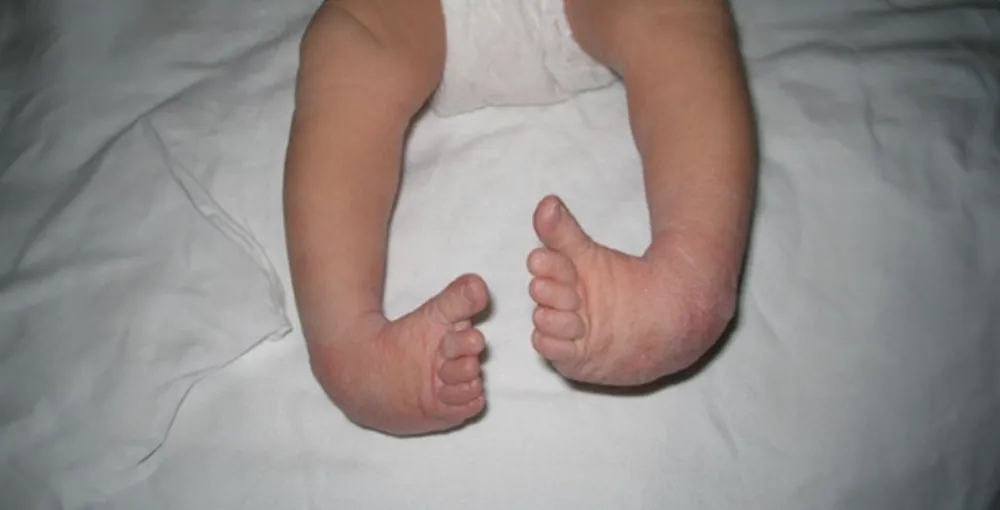
Clubfoot (Deformity Components, Risk Factors, Treatment, & Nursing Tips)
A congenital deformity where the front foot is turned inward due to shortened tendons.
Deformity Components: Midfoot plantarflexion (downward), hindfoot varus (inward), and forefoot adduction/cavus (inward and upward) with lower leg atrophy.
Risk Factors: Breech positioning and maternal smoking.
Treatment: Early serial casting within 1 to 2weeks of life (Ponseti method) for 2 to 3months, followed by bracing at naptime/bedtime for several years; surgery if casting fails.
Nursing Tips: Perform routine neurovascular checks (capillary refill, color, warmth).

Ponseti Method
A primary treatment protocol for clubfoot involving serial casting initiated within the first 1 to 2weeks of life, followed by splinting or bracing.
Developmental Dysplasia of the Hip (DDH) (Risk Factors, S/S, Diagnosis, & Treatment)
Abnormal development of the acetabulum socket.
Risk Factors: Breech positioning.
Signs & Symptoms: Limited hip abduction, asymmetrical gluteal/thigh folds, telescoping (shortened appearance) of the thigh, and a limp in older children.
Diagnosis: Barlow and Ortolani physical examination maneuvers.
Treatment: Age <6months: Pavlik harness or Bryant traction; Age >6months: Surgical reduction and spica cast; Age >18months: Surgery, casting, and bracing.
Barlow and Ortolani Tests (Procedure & Diagnostic Findings)
Diagnostic physical examination maneuvers for DDH performed supine with hips flexed.
Barlow: Posterior pressure is applied to assess if the femoral head dislocates from the acetabulum.
Ortolani: Abduction pressure relocates the hip back into place, producing an audible or palpable pop/click.

Pavlik Harness (Treatment & Nursing Tips)
An abduction orthotic device used to treat DDH in infants under 6months of age.
Treatment & Nursing Tips: Worn 23hours/day (with a 1hour break for skin care); keeps legs abducted; straps are adjusted ONLY by a physician; wear a soft undershirt under the harness at all times; gentle skin massage, sponge baths only (no lotions/powders), and regular neurovascular checks.

Bryant Traction (Indication & Nursing Tips)
Continuous skin traction used for infants under 6months with DDH to stretch soft tissues around the hip prior to surgery or casting.
Nursing Tips: Ropes must remain straight and weights hang freely; perform regular assessments for alignment, circulation, skin integrity, perfusion, infection, and pain; provide sponge baths while maintaining traction and avoiding soiling.

Spica Cast (Indication & Nursing Tips)
An immobilization cast used for DDH in children over 6months of age to hold the hip in alignment while it develops.
Nursing Tips: Double-diapering (one diaper inside cast edges, one outside), reposition child every 2hours, handle cast with palms of hands while wet, and monitor for compartment syndrome or signs of poor perfusion (e.g., cold/cyanotic toes).
Legg-Calvé-Perthes Disease (Stages, S/S, & Treatment)
Self-limited avascular necrosis of the femoral head caused by temporary blood supply interruption to the femoral epiphysis.
Stages: Ischemia -Bone death - Fragmentation - Healing/Remodeling.
Signs & Symptoms: Painless limp, hip pain or stiffness, and thigh muscle atrophy.
Treatment: Abduction casting/bracing, activity restriction, and limited weight-bearing (late diagnosis can lead to osteoarthritis).
Slipped Capital Femoral Epiphysis (SCFE) (S/S & Treatment)
A pediatric medical emergency where the femoral head slips off the femoral neck at the growth plate (epiphysis) during a growth spurt.
Signs & Symptoms: Limp, hip or knee pain, out-toeing gait, limited rotation, loss of hip motion, and severe inability to bear weight.
Treatment: Strict non-weight-bearing status to stabilize the femoral head, followed by urgent surgical fixation with pins or screws.
Scoliosis (S/S, Diagnosis, & Treatment)
An S- or C-shaped lateral curvature of the spine.
Signs & Symptoms: Spinal asymmetry, uneven shoulders/hips, prominent scapula, and a one-sided rib hump on forward bending.
Diagnosis: Radiographs evaluated via Cobb technique and Risser scale.
Treatment: Mild (10∙ to 20∙): Exercise and muscle toning; Moderate (20∙ to 40∙): Boston brace for 23hours/day; Severe (40∙ to 50∙): Surgical spinal fusion with rods, screws, hooks, and bone graft.

Boston Brace
An orthotic rigid brace worn 23hours/day for the management of moderate scoliosis with a spinal curvature between 20∙ and 40∙.
Kyphosis (Treatment & Nursing Tips)
An exaggerated posterior curvature of the spine ('hunchback').
- Treatment & Nursing Tips: Support, exercises, and brace wear.
Lordosis (Treatment & Nursing Tips)
An exaggerated inward curvature of the spine ('swayback').
- Treatment & Nursing Tips: Support and exercises; child usually outgrows it.

Torticollis (Treatment & Nursing Tips)
Tilting of the head caused by cervical spine rotation due to sternocleidomastoid muscle injury or neck abnormalities.
Treatment & Nursing Tips: Physical therapy (stretching neck rotation and lateral flexion multiple times daily) is primary; encourage repositioning (facing non-preferred side for feeding, play, sleep) and tummy time; helmet therapy for plagiocephaly; surgery if PT fails after 6 to 12months.
Osteogenesis Imperfecta (S/S, Treatment, & Nursing Tips)
A genetic disorder ('brittle bone disease') caused by defective collagen production resulting in fragile bones.
Signs & Symptoms: Frequent fractures, blue sclera, thin/soft skin, short stature, enlarged anterior fontanelle, weak muscles, and conductive hearing loss by adolescence.
Treatment & Nursing Tips: No cure; handle with care at all times; administer Pamidronate with calcium and Vitamin D; avoid alcohol; use braces/splints (child abuse may be initially suspected due to multiple fractures).
Pamidronate
A bisphosphonate medication administered in osteogenesis imperfecta to inhibit bone breakdown, strengthen fragile bones, and increase bone density.
Osteomyelitis (Risk Factors, S/S, Diagnosis, & Treatment)
Infection of long bones and surrounding soft tissue.
Risk Factors: Upper respiratory infection (URI), bone trauma, sickle cell disease, or compromised immune system.
Signs & Symptoms: Rapid onset of severe localized pain, swelling, erythema, fever, nausea, decreased mobility, and limping.
Diagnosis: Leukocytosis, elevated ESR and CRP, positive blood/wound cultures.
Treatment: High-dose IV broad-spectrum antibiotics (e.g., vancomycin, clindamycin) adjusted based on culture sensitivity; monitor inflammatory lab values.
Juvenile Idiopathic Arthritis (JIA) (Types/Features, S/S, Diagnosis, & Treatment)
A chronic autoimmune inflammatory disease attacking joint synovium.
Types/Features: Systemic (fever, rash, organ involvement), Psoriatic (nail changes), Uveitis (eye inflammation).
Signs & Symptoms: Joint swelling, pain, and morning/activity stiffness lasting at least 6weeks across 4+ joints.
Diagnosis: Anti-CCP, ESR, CBC, ANA, and radiographs.
Treatment & Nursing Tips: Exercise, splints, heat application; NO pillows under affected joints; NSAIDs, Corticosteroids (e.g., Prednisone for acute flare-ups — monitor blood glucose), and DMARDs (e.g., Methotrexate).
Methotrexate (Nursing Tips)
A disease-modifying antirheumatic drug (DMARD) used for long-term therapeutic control of juvenile idiopathic arthritis.
- Nursing Tips: Live vaccines are strictly contraindicated during therapy.
Compartment Syndrome (S/S, Treatment, & Nursing Tips)
A neurovascular emergency caused by increased tissue pressure within a muscle compartment.
Signs & Symptoms (6 Ps): Pain (out of proportion), Pressure (taut skin), Paresthesia, Pallor, Paralysis, and Pulselessness.
Treatment & Nursing Tips: Immediate emergency intervention; elevate the limb to heart level and apply cold compresses.
Cerebral Palsy (S/S, Treatment, & Nursing Tips)
A non-progressive motor dysfunction resulting from brain injury or hypoxic insult.
Signs & Symptoms: Hypertonia or hypotonia, poor coordination, delayed motor milestones, diplegia, hemiplegia, quadriplegia, and potential seizures.
Treatment & Nursing Tips: Modify home/school environment, use ankle-foot orthotics (AFOs) to prevent contractures, and maximize child independence.
Duchenne Muscular Dystrophy (S/S, Diagnosis, Treatment, & Prognosis)
The most common terminal genetic muscular dystrophy causing progressive muscle degeneration.
Signs & Symptoms: Generalized muscle weakness, Gower sign, lordosis, waddling gait, pseudohypertrophy (fat replacing muscle in lower limbs).
Diagnosis: Muscle biopsy and serum enzyme assays.
Treatment & Prognosis: Corticosteroids to preserve muscle function; loss of ambulation by age 12; death usually occurs in late adolescence due to respiratory or cardiac failure.

Gower Sign
A characteristic physical maneuver in muscular dystrophy where a child uses their hands to walk up their legs to rise to a standing position.
Spinal Muscular Atrophy (SMA) (S/S, Treatment, & Nursing Tips)
A genetic neuromuscular disease causing degeneration of motor neurons.
Signs & Symptoms: Severe hypotonia, poor suck/swallow (high aspiration/choking risk), frog-leg posture, absent deep tendon reflexes, bell-shaped chest, and progressive scoliosis/contractures.
Treatment & Nursing Tips: Respiratory support, nutritional management, and contracture prevention.
Osteosarcoma (Site & S/S)
A primary malignant bone tumor situated mainly in the metaphysis of long bones (especially lower extremities).
- Signs & Symptoms: Localized bone pain that worsens with physical activity, swelling, and a palpable lump over the tumor site.
Ewing Sarcoma (Origin & S/S)
A malignant bone tumor originating in the bone marrow of long and flat bones.
- Signs & Symptoms: Severe bone pain that increases at night, accompanied by systemic symptoms such as fever and headaches.
Rhabdomyosarcoma (S/S by Site)
A soft tissue malignancy predominantly occurring in the head/neck, genitourinary tract, or abdomen.
Signs & Symptoms: Painless tumor mass.
Head/Neck: Unilateral proptosis (bulging eye), facial swelling, ear pain.
GU Tract: Dysuria, hematuria, vaginal bleeding, bowel obstruction.
Abdomen: Abdominal mass and vomiting.
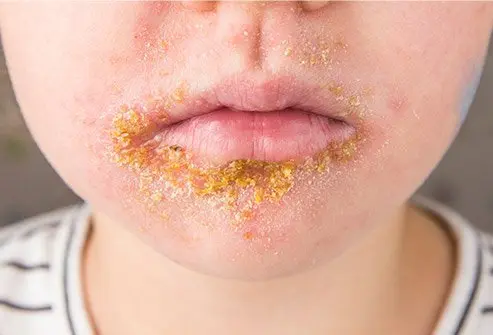
Impetigo (S/S & Treatment)
A highly contagious superficial bacterial skin infection secondary to minor trauma.
Signs & Symptoms: Erythematous macules evolving into characteristic honey-crusted lesions; child typically lacks systemic fever and appears well.
Treatment: Topical antibiotics.

Cellulitis (S/S & Nursing Tips)
A deep bacterial skin infection affecting facial tissues or extremities.
Signs & Symptoms: Rapidly spreading localized erythema with poorly defined borders, warmth, swelling, potential vesicles, and systemic illness/fever.
Nursing Tips: Mark and date the erythematous borders with a pen to monitor spreading.

Scabies (S/S, Treatment, & Nursing Tips)
A parasitic mite infestation where female mites burrow into skin over 45minutes.
Signs & Symptoms: Intensely pruritic linear burrow lesions.
Treatment & Nursing Tips: Take a warm bath prior to applying scabicide lotion, leave lotion on skin for 8 to 12hours, repeat treatment 1week later, and treat all household contacts simultaneously, even if not showing any s/s!

Lyme Disease (S/S & Treatment)
A tick-borne infection caused by Borrelia burgdorferi.
Signs & Symptoms: Characteristic expanding bullseye rash (erythema migrans) accompanied by flu-like symptoms.
Treatment: Oral Doxycycline.
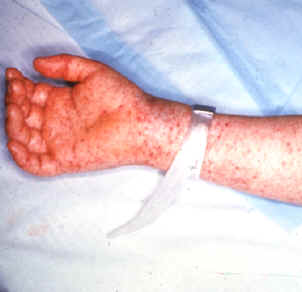
Rocky Mountain Spotted Fever (S/S & Treatment)
A severe, life-threatening tick-borne rickettsial infection.
Signs & Symptoms: High fever, severe headache, myalgia, nausea/vomiting, abdominal pain, and a maculopapular rash that starts on the palms and soles and becomes petechial, indicating vascular damage.
Treatment: Administer oral doxycycline immediately when clinically suspected.