Exam 2 Reactions
 Call Kai
 Learn
Learn Practice Test
 Spaced Repetition
 Match
Match Flashcards
 Knowt Play
1/21

There's no tags or description
Looks like no tags are added yet.
Name | Mastery | Learn | Test | Matching | Spaced | Call with Kai | Chat |
|---|
No analytics yet
Send a link to your students to track their progress
22 Terms
ketone/aldehyde + grignard/organLi reagents
(R-MgBr) (R-Li)
alcohol

aldehydes + KCN/H2O
cyanohydrins (alcohol and C-=-N groups)

wittig rxn: aldehyde/ketone + PPh3
generates alkenes (forms NEW C=C bonds)

alternate reaction to wittig reaction → horner wadsworth rxns: ketone/aldehyde + P(OMe)3
this is because the wittig reaction produces an annoying byproduct so to get around this we react with a different reaction instead

aldehyde/ketone + H2O
diol.
mechanism will vary based on acid/base catalyst
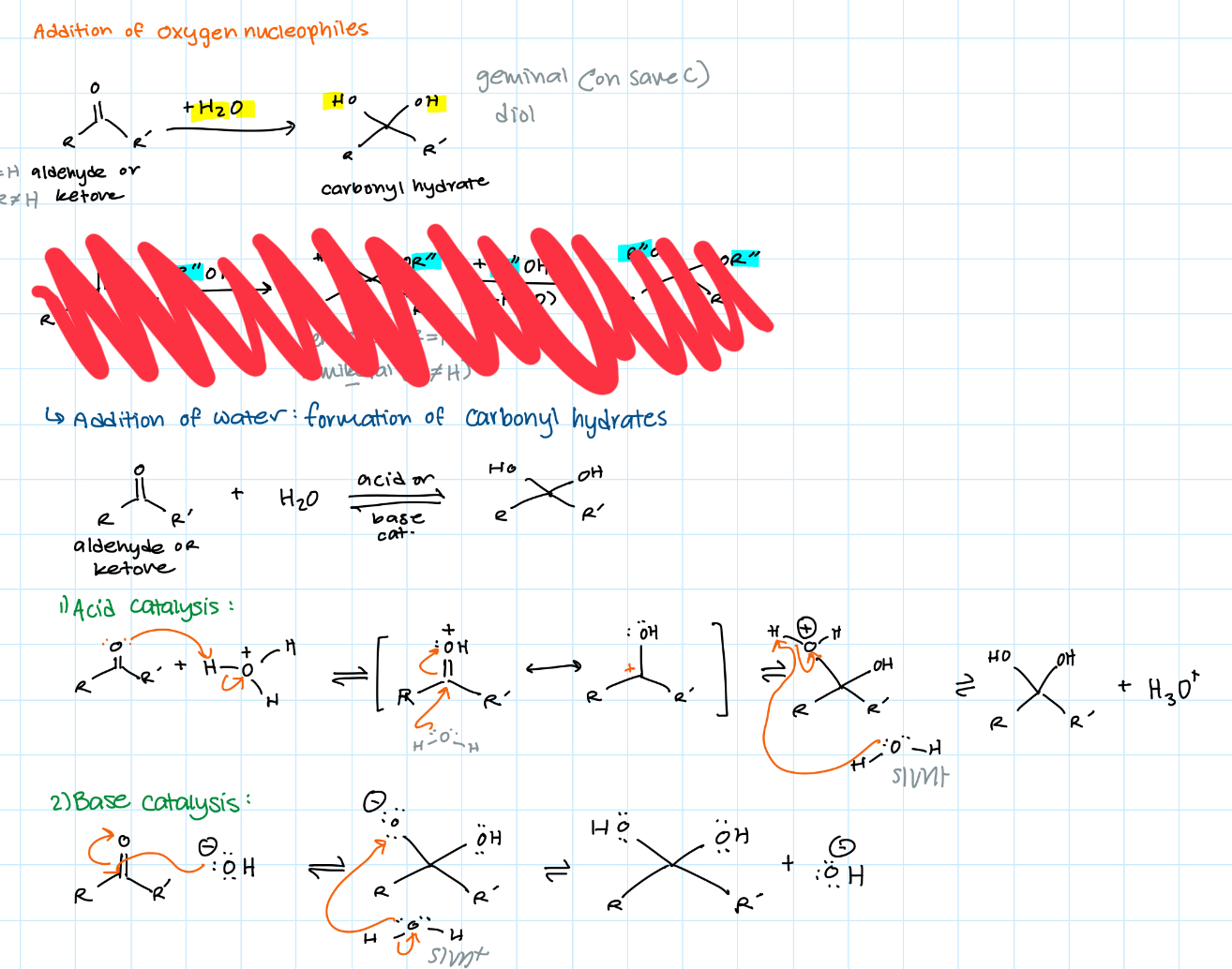
aldehyde/ketone + oxygen nucleophies (+R’’OH)
hemiacetals or acetals
PADPEAD

aldehyde/ketone + nitrogen nucleophiles (ammonia, 1 amines, 2 amines)
w/ ammonia or 1 amine → imine (R—C=N-R’)
2 amine → emine

aldehyde/ketone + NaBH4
reduction to alcohol

aldehyde/ketone + LiAlH4
reduction like NaBH4 but it is much more reactives.
can also reduce carboxylic acid and its derivatives*

aldehyde/ketone reductions + H2/cats
Rh
vs. Pt, Pd, Ni

COOH preparations with alcohols (3 ways)

COOH + LiAlH4
reduction to alcohol
so like just imagine it with a cooh
EXCEPT INSTEAD OF REPLACING THE C=O WITH C-OH LIKE IT DOES W KET/ALD IT GETS RID OF C=O ENTIRELY YKWIM

COOH + R-OH
esterification
PADPED mechanism

COOH + CH2N2
methyl esters
COOH to acid chlorides
SOCl2 (no pyridine)
Acid Chloride Substitutions

Decarboxylation (COOH)
minus CO2
high heat
vs warming

anhydrides + H2O
if using an acid catalyst: PADPED

acid catalyzing an ester + h2o
reverse fischer esterifications (PADPED)

ketal, acetal, hemiacteal, hemiketal
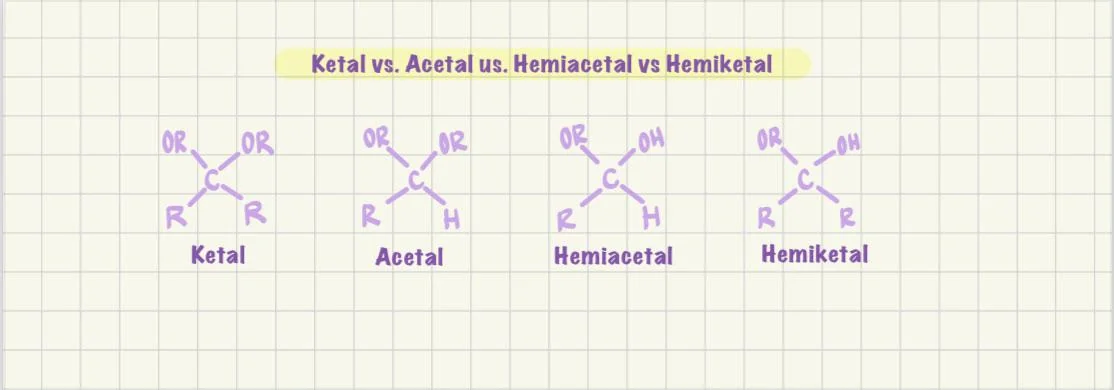
deoxygenation of ket/ald to…
clemmsons (acidic): Zn(Hg)/HCl
wolff kishner (basic): N2H4/ heat + KOH
ket/ald to alkanes

a-halogenation of alds/kets
X2/CH3CO2H → one X attached to alpha hydrogens
X2/ NaOH → multiple X attached to alpha hydrogens
