Clinical Orthopedics 222 Exam 3 Common conditions of the wrist and hand
 Call Kai
 Learn
 Practice Test
 Spaced Repetition
 Match
 Flashcards
 Knowt Play
1/130

There's no tags or description
Looks like no tags are added yet.
131 Terms
Nerve entrapment
Median nerve
-carpal tunnel syndrome
ulnar nerve
what does palsy mean
weakness
Nerve entrapment
-median and ulnar nerve are what
peripheral nerves and have no nerve roots
Nerve entrapment
-there is no what
radial nerve conditions because there is no tunnel so there is no place for the nerve to get trapped

Carpal Tunnel Syndrome
-what is it
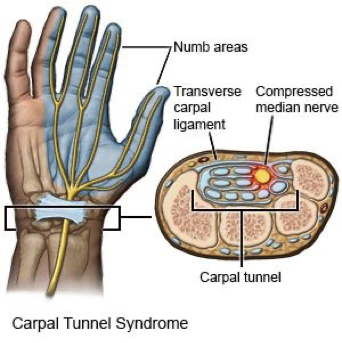
Entrapment compression neuropathy of the median nerve
-Increase in synovial fluid

Carpal Tunnel Syndrome
-most common what
Most common compression neuropathy of the wrist
Carpal Tunnel Syndrome
-caused how
by repetitive motion
(overuse of the flexors)

Carpal Tunnel Syndrome
-the carpal tunnel is formed by what
the transverse carpal ligament and the carpal bones

Carpal Tunnel Syndrome
-what is it (laymen’s terms)
swollen and irritated which entraps the median nerve.
Carpal Tunnel Syndrome
Symptoms
Pain
Numbness
parasthesia(tingling)
^-these 3 happen in the first 3 digits
weakness of grip and pinch
edema in the hand and forearm
atrophy of the thenar muscles
Symptoms are usually worse at night
Carpal Tunnel Syndrome
Factors
(all systemic)
Pregnancy
-fluid retention
Renal Dysfunction
Infection
Gout
Trauma
Collagen Disorder
Carpal Tunnel Syndrome
-what is the thenar
the palmar aspect of the base of the thumb
Carpal Tunnel Syndrome
-symptoms will follow what
Symptoms will follow the median nerve dermatome including the 1st three fingers and the medial aspect of the 4th digit
Conservative treatment
-how
modified activity
NSAIDS as per MD recommendation
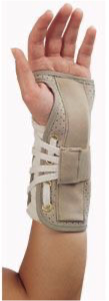
Splinting
Physical therapy
Conservative treatment
-modified activity
elimination of symptom producing movements
Conservative treatment
-splinting
“cock-up” splinting
-0-20 degrees of extension
Conservative treatment
-physical therapy
progressive ROM activities
joint mobilization
modalities as needed
Conservative treatment
-when are splints used
Cock up splints encouraged at night and PRN(as needed) throughout the day
Why do you think a splint in 20 degrees of extension will help carpal tunnel syndrome?
-puts the carpal tunnel in a position where its not stretched
-slight extension to keep the wrist functional
Conservative treatment
physical therapy
-when doing this for a person with carpal tunnel syndrome, what should you be asking
if they have any pain, numbness or tingling

what is this
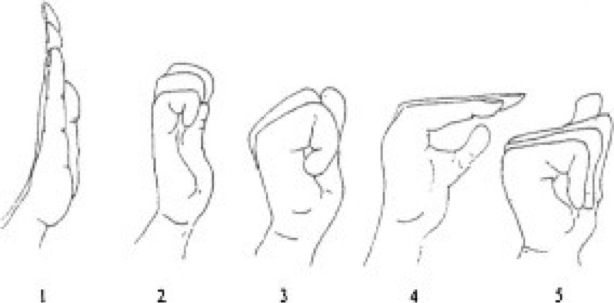
median nerve glide
what does a nerve glide do
moves the tendon (doesn’t stretch)

Surgical consideration
-if what doesn’t happen, then what is the next step
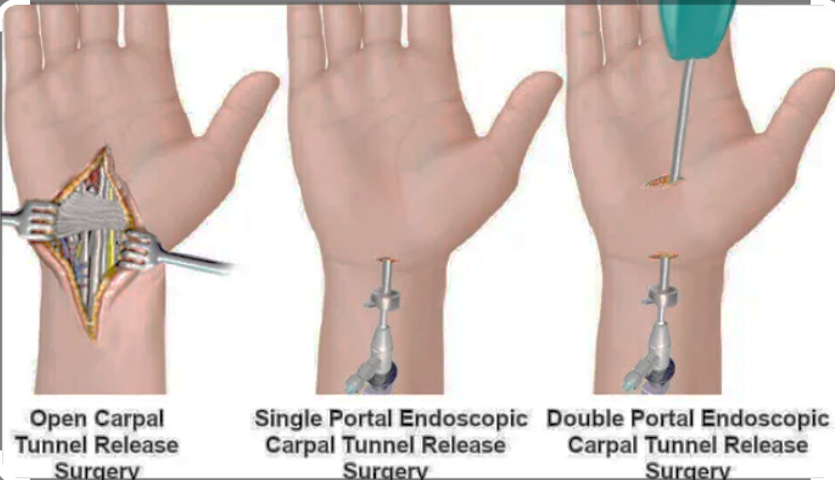
If symptoms do not respond to conservative treatment, surgical release is an option

Surgical consideration
-what symptoms do the patient present
Patient with constant sensory loss, pain, and atrophy
Surgical consideration
-what happens in surgery
cutting of the transverse carpal ligament
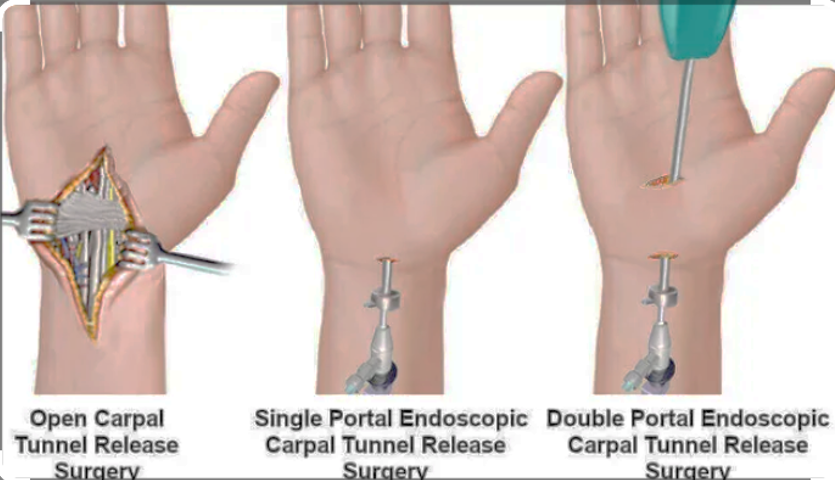
Surgical consideration
-surgical treatment?
Treatment is similar to conservative care, in addition to scar mobilization

ulnar nerve entrapment
-where does this happen
guyon’s canal

ulnar nerve entrapment
-what is this
Claw hand deformity
-extensor digitorum communis

ulnar nerve entrapment
-what does this affect
affects how you grab

ulnar nerve entrapment
-you are unable to do what
Inability to extend second and distal phalanges of any of the fingers
Inability to adduct or abduct fingers
-Including the thumb
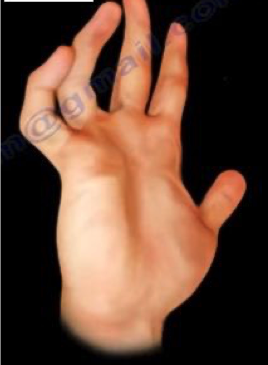
ulnar nerve entrapment
-patient loses wha t
Loss of sensation on ulnar side of hand
-ring finger, little finger

ulnar nerve entrapment
-treatment?
Same treatment as carpal tunnel syndrome (including splint)
except you are treating digits 4-5

Nerve entrapment deformities
Claw hand
hand of benediction
Wrist drop

Nerve entrapment deformities
wrist drop
-what does it affect
affects C1-C3 as well C4-C5
radial nerve (losing control of extensors )

Claw Hand
-what is it
Unopposed action of ED in the fourth & fifth digit

Claw Hand
-what causes this
due to ulnar nerve entrapment at the wrist

Claw Hand
-what do you lose
Inability to extend the second and distal phalanges of any digits
Inability to add/abduct the fingers or perform opposition
Loss of sensation on the ulnar side of the hand

hand of benediction
-what can’t you do
inability to make a fist fully

hand of benediction
-what can’t you do
Cannot flex the index and middle fingers at the MCP and IP
Loss of sensation of the median aspect of the hand
How can you differentiate between claw hand and hand of benediction
they look similar but what is impaired vs active is how you can tell the difference

Wrist drop
-what causes this
Entrapment via the radial head at the elbow
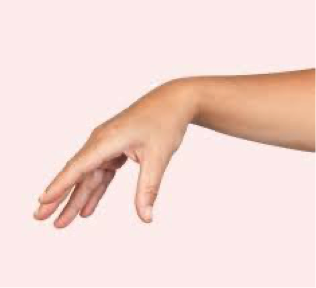
Wrist drop
-what can’t you do
Inability to extend the thumb, wrist and phalanges
-Possibly the elbow
Inability to pronate or adduct the thumb
this affects grip
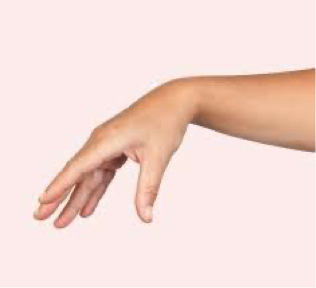
Wrist drop
-what type of involvement
Sensory involvement of the radial aspect of the hand
Where else can the radial nerve be entrapped
what would the effects be
Elbow / shoulder
Triceps muscle weakness, pronation weakness
Where else can the radial nerve be entrapped?
the elbow

TFCC sprain (triangular fibrocartilage complex)
-what does this refer to
referring to the disc inbetween ulna and metacarpal

TFCC sprain (triangular fibrocartilage complex)
-what does the TFCC do
functions to transmit the loads from the hand to the forearm

The distal radioulnar joint (DRUJ)
-what is it
is a double pivot joint that unites the distal radius and ulna and an articular disc

the triangular fibrocartilaginous complex (TFCC)
-what is it and what does it do
an articular disc
assists in binding the distal radius and is the main stabilizer of the distal radioulnar joint

the triangular fibrocartilaginous complex (TFCC)
-what does it enhance
It improves joint congruency and cushions against compressive forces

the triangular fibrocartilaginous complex sprain
-treatment
rest
gentle PROM
Modalities
PROM AAROM
AROM
Strength
Isometrics
Tendonitis and tenosynovitis are both what
tendinopathy
Tenosynovitis refers to what
sheath or fluid
Tenosynovitis
-what does this effect
Extensor Pollicis Longus
Extensor Indicis Proprius
Extensor Carpi Ulnaris
Flexor Carpi Ulnaris
Flexor Carpi Radialis
De Quervain’s Disease *

De Quervain’s tenosynovitis
-what is it
cumulative trauma disorder

De Quervain’s tenosynovitis
-what does it affect
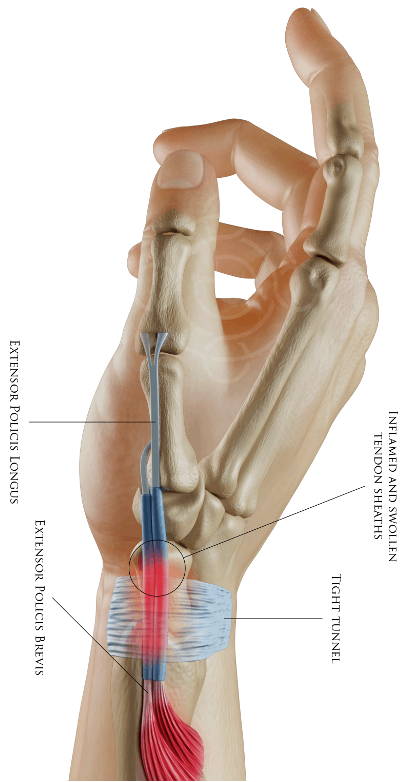
affects the tendon sheath of the abductor pollicis longus and extensor pollicis brevis

De Quervain’s tenosynovitis
-what kind of disorder
Disorder of the first dorsal compartment posteriorly

De Quervain’s tenosynovitis
-what is happening
Thickening of extensor retinaculum, narrowing of fibro-osseus canal
-Degneration

De Quervain’s tenosynovitis
-very common in who
Very common in new moms; lifting their babies with incorrect technique
Symptoms of De Quervain’s
which is
Pain at the radial styloid and decreased thumb ROM (snuff box)
Pain and weakness with radial deviation, thumb abduction and extension Possible inflammation
Difficulty gripping, grasping and lifting
Gradual onset
Symptoms of De Quervain’s
-what activites will be affected
Painting, hammering, golfing, fly fishing, typing, sewing, knitting, cutting, turning doorknobs
What is the difference between lateral epicondylitis and de quervain’s?
location, lateral epicondylitis is at the lateral epicondyle and de quervain’s is at the thumb

Treatment options for de quervain’s
Wrist/thumb immobilization x 2-4 weeks
Modification of activities
NSAIDS
Ice Iontophoresis/phonophoresis
Gentle ROM
Cortico-steroid injections
Surgical decompression
Treatment options for de quervain’s
-what demographic of people need to know what
New moms need to focus on using larger muscles and keeping thumb static when lifting their children

Treatment options for de quervain’s
-what does the surgical decompression entail
consists of the release of the sheath, post-op care/treatment parallels that of carpal tunnel release

Trigger finger
-what is it
Painful snapping of the finger
-Disproportion between flexor tendon and tendon sheath

Trigger finger
-sensitivity where
Tenderness over base of finger MCP

Trigger finger
-where is this found more
more common in the thumb, ring finger, and middle finger

Trigger finger
-cause?
idiopathic onset
-no real cause

Trigger finger
-treatment
immobilization in extension, steroid injections or surgical release (cutting the tendon), maybe modalities, STM

Dupuytren’s disease
-what is it
Palmar Fasciitis
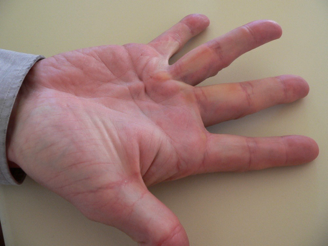
-Disease that affects the palmar fascia with fibrodysplastic development in the connective tissue

Dupuytren’s disease
-what can this produce
Develops nodules that progress into cord-like contractures
Dupuytren’s disease
-what demopgrahic does this affect
usually affects men over 40 years of age

Dupuytren’s disease
-what percent involves how many sides
45% of all cases are bilateral

Dupuytren’s disease
-what can cause this (risk factors)
overuse of alcohol, diabetes, seizures

Dupuytren’s disease
-first stage
formation of the nodule

Dupuytren’s disease
-second stage
alignment of myofibroblast along lines of tension

Dupuytren’s disease
-third stage
thick bands of collagen to form contracture

dupuytren’s disease and contracture are what
the same thing
Dupuytren’s Contracture
-Dupuytren’s disease leads to what
Eventually will cause contractures of the fingers
-Usually the ulnar aspect of the hand
-Most common is the fifth digit
Dupuytren’s Contracture
-when this is greater than what value lead to what
Contractures greater than 20 degrees usually indicate surgical release
Dupuytren’s Contracture
-surgery where
Fasciotomy(cutting of the fascia to relieve pressure) or excision(cutting of the tissue to remove it) of the palmar fascia
Dupuytren’s Contracture
-what happens after surgery
Surgical incision is usually left open to prevent the development of scar tissue
Dupuytren’s Contracture
-what happens when incisions are closed
History shows that incisions that are closed developed scar tissue, tendon adhesions, tissue necrosis and infection
Dupuytren’s Contracture
-conservative treatment?
-what about after>
Conservative treatment hasn’t been shown to help prior to surgery Stretching, PROM and scar massage have been shown to be helpful after surgery
Tendon ruptures
Mallet finger
boutonnniere
deformity
swan neck
deformity

Mallet finger deform
-what is it
Traumatic disruption of terminal tendon of extension hood
(trauma- DIP flexion )

Mallet finger deform
-treatment?
6 weeks immobilization then AROM and PROM progressing flexion in 5-10 degree increments

Boutonniere deformity
-what is it
Disruption of the central extensor tendon at the PIP

Boutonniere deformity
-what is this grouped with and where
Typically associated with RA
In thumb = zigzag deformity

Swan Neck Deformity
-what is it
DIP joint is hyperflexed
PIP joint is hyperextended

Swan Neck Deformity
-what is this group with, what also ahppens
Typically associated with RA
Disruption of the extensor tendon across the PIP joint
Ulnar drift (MP ulnar deviation)
-what is it
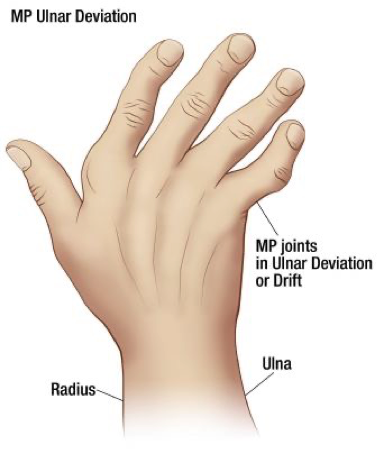
palmar subluxation of the carpals
damage to collateral ligaments and the extensor mechanism

Ulnar drift (MP ulnar deviation)
-imbalance the is the result of wha t
imbalance that has the resultant effect of pulling the fingers into ulnar deviation, pronation, and palmar subluxation.
RA

Distal Radial Fractures
Colles’s fracture
A radial fracture within 2.5 cm of the wrist
Distal radius is displaced in a dorsal direction

Distal Radial Fractures
smith’s fracture
“Reverse Colles’ fracture”
Results from a fall on the dorsum aspect of the hand
Distal radius is displaced in a palmar direction

colles’s fraction results from what
a FOOSH injury