Understanding Spain: Artworks Midterm 1
 Call Kai
 Learn
 Practice Test
 Spaced Repetition
 Match
 Flashcards
 Knowt Play
1/45

Earn XP
Description and Tags
Artworks to study for Midterm 1 of Understanding Spain Through History & Art
46 Terms
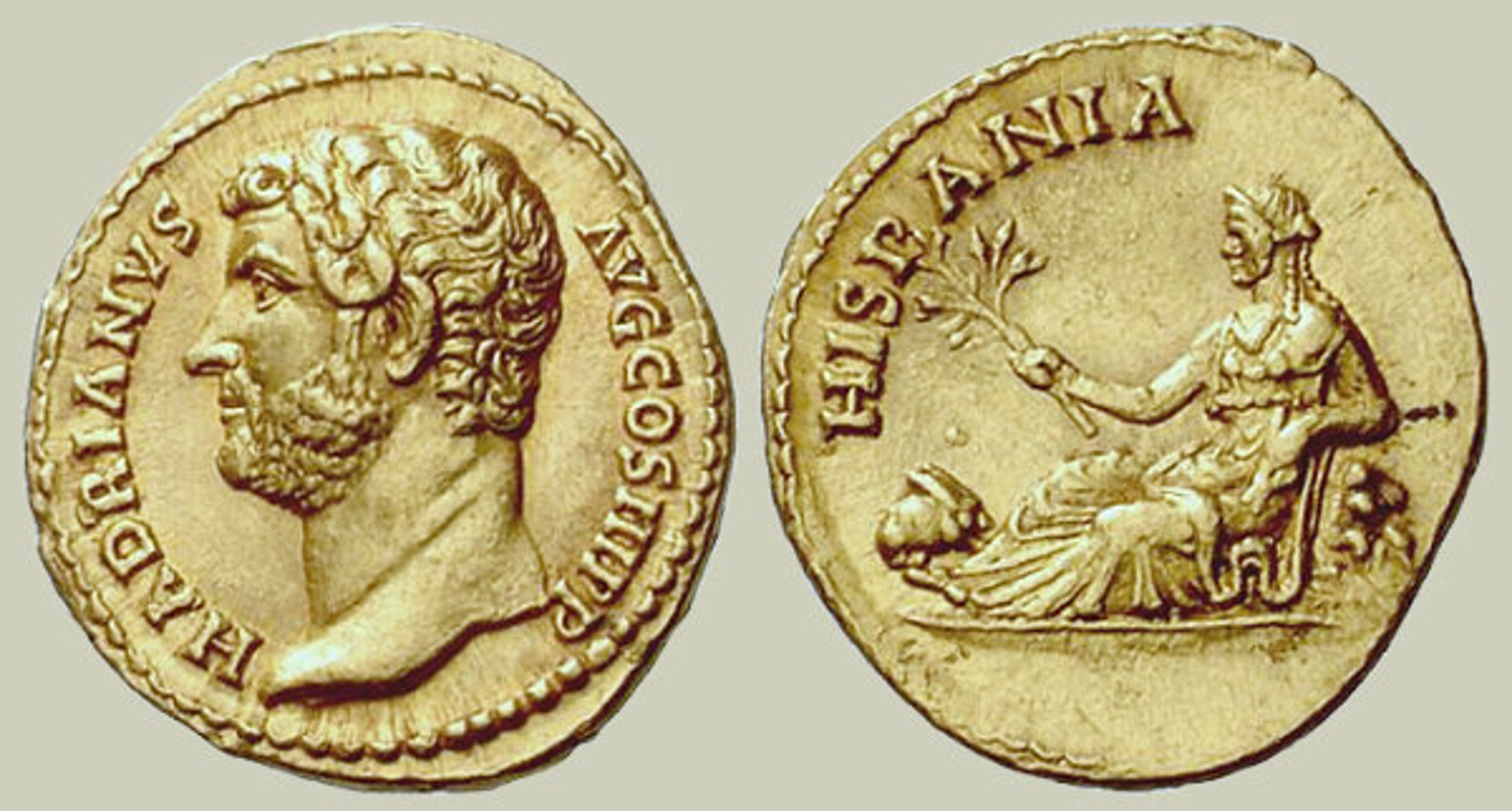
Hispania Gold Coin
Minted by Roman Emperor Hadrian (76-183), depicting Hispania as a seated woman flanked by rabbits

Divje Babe Flute
50,000 y/o musical instrument found in Slovenia, possibly associated with the Neanderthal —> traces to prehistoric humans

Decorated king scallop shell
Originating from Cueva Anton, Spain, this has traces of unnatural orange pigments —> theories of usage by prehistoric humans for cave art

Caves of Altamira
Cave paintings in Altamira (northern Spain) that depict animals such as bison & deer are some of the first examples of prehistoric art
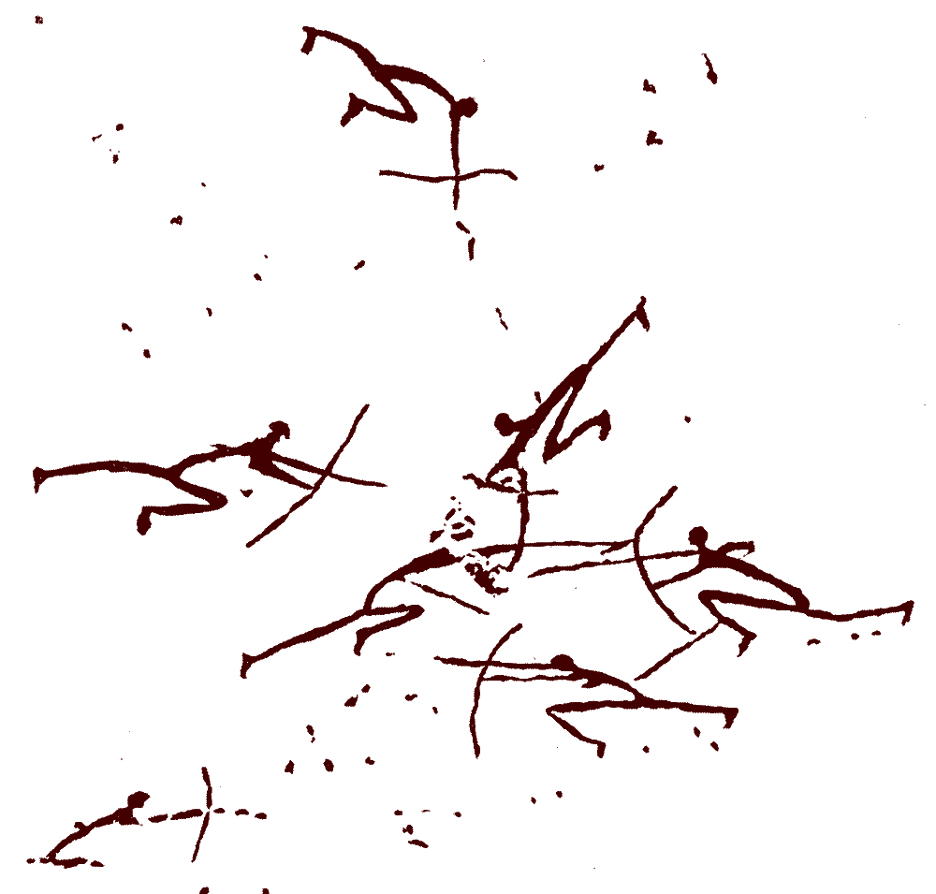
Battle between archers
Northern Valencia art piece, example of schematic art

Praying man
Southern Valencia art piece, example of macroschematic art

Dancers of Coqul
Catalonian cave painting that depicts common activities (hunting, dancing) with no hierarchical composition through schematic art
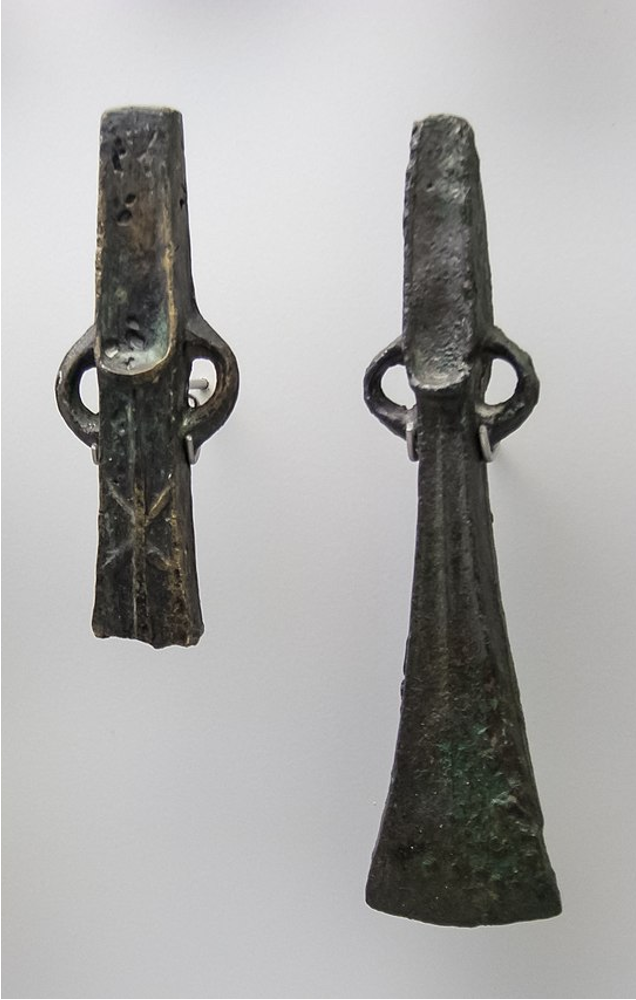
Bronze axe heads
Found in Asturias, Northern Spain: represent the beginning of the age of metal and introduction of metalwork artpieces

Los Millares
Copper Age (3200–2200 BC): Fortified settlement in Almería, Spain with tiered architecture, monumental walls, eye-decorated pottery (cerámica oculada)

El Argar burial practices
Burial sites indicated clear evidence of social inequality→ Leading men were buried with jewelry, swords, and gold whilst lower classes buried with less or no offerings


Lady of Elche
Iberian statues (500 B.C.) were influenced heavily by Greek and oriental styles, with specific emphasis on their depictions of wealthy women
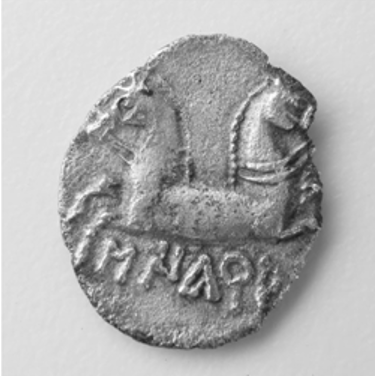
Iberian coin
Coins used their own writing language and copied Roman/Greek styles

Bicha of Balazote (6th century B.C.E.)
Iberian sculpture with Greek & Phoenician influences, representing the Greek river god Achelous → reinterpreted by Iberians as a protective entity

Iberian dracma coin (3rd century B.C.)
Iberian copy of 3rd century B.C. Greek coin from Emporion → new coin made in Barkeno (modern-day BCN)

The “first patriots” of “Ancient Spain” (Edelvives 1941)
Depicts Roman conquest of Iberian Peninsula as a “heroic resistance” by “indigenous Spaniards” to “foreign invaders”, while others believed the Romans to be a “unifying” and “civilizing” force

Santimamine cave (1918)
Excavated skulls and determined through measurements that Basques descended directly from Paleothic hunters of the region → arguing Basque peoples to the oldest people in Europe and contributing to the strong Basque nationalist identity

The Last Day of Numantia (1881)
Depicted as a tragedy by painter Cervantes → the day a Celtiberian town in 133 B.C. chose death over surrender to Rome (staged in besieged Madrid by the artist)

Sierra de Atapuerca (located in Burgos)
Site where new species named the homo antecessor was found in 1994. Became a UNSECO heritage site and is known as the home of the “first Europeans”

Hercules mosaic
Spanish mosaic of Hercules, found near Valencia, that encapsulates the lasting Romanisation of Spain (other examples: glassware, roman temples, amphitheathres, bridges, statues, coins)

Roman Bridge of Cordoba
Shows the lasting impact of the Romans on Spanish architecture -→ bridge is still operating 2000 yrs later

Augustus of Prima Porta (1st century AD)
Realistic depiction of one ruler → classical Greek depiction

Portrait of Four Tetrarchs (300 AD)
Schematic depiction of multiple rulers (the 4 co-emperors)→ Late empire style

Gold coin issued by Constantine (313)
Depicts the emperor and god Sol in his chariot (quadriga) on emperor’s shield

Battle of the Milvian Bridge (312 AD)
This image depicts Emperor Constantine riding into the Battle of the Milvian Bridge (312 AD) → pivotal event in Roman and Christian history, as illustrated in a 9th-century Byzantine Illuminated Manuscript
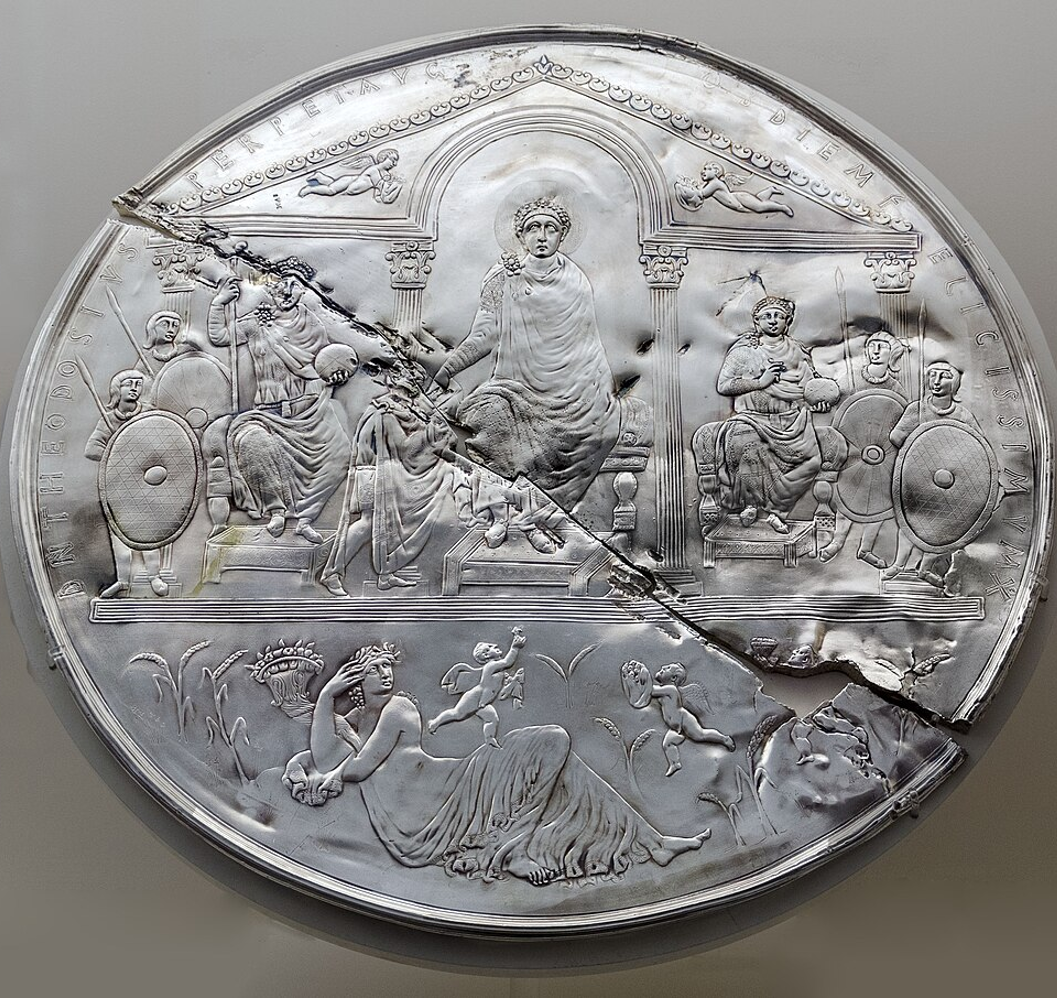
Missorium of Emperor Theodosius I (d. 395)
Found in Almendralejo, Spain: depicts Theodosius I’s divine right to political power, and he later declared Nicene Christianity to be the state religion of the Roman Empire and CONDEMNED Arianism

Reccared among the bishops in the Codex Vigilanus
Depicts ecclesiastical hierarchy & church governance → bishops at the top and lower ranking clergymen/priests at the bottom
depicts Reccared converting to Catholicism in the Third Council of Toledo
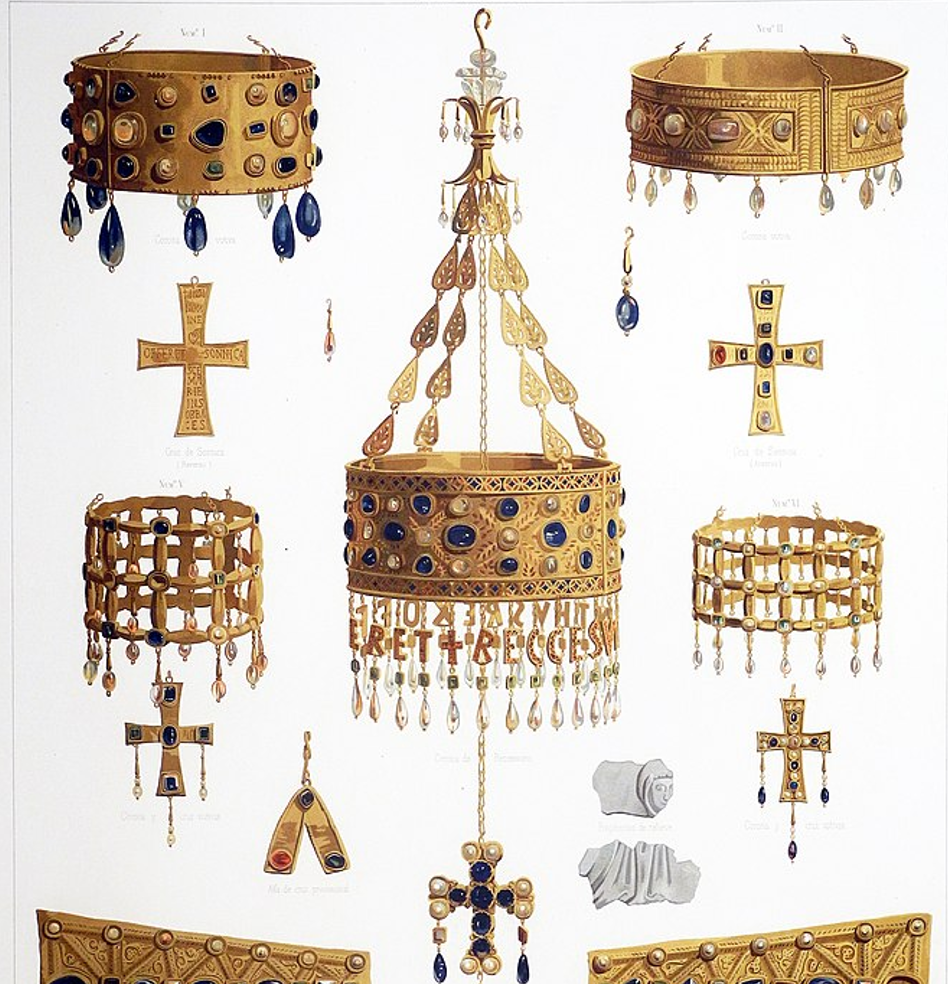
Visigoth crowns
Visigoths were well known by their fine, elaborate votive crowns, which they placed in churches
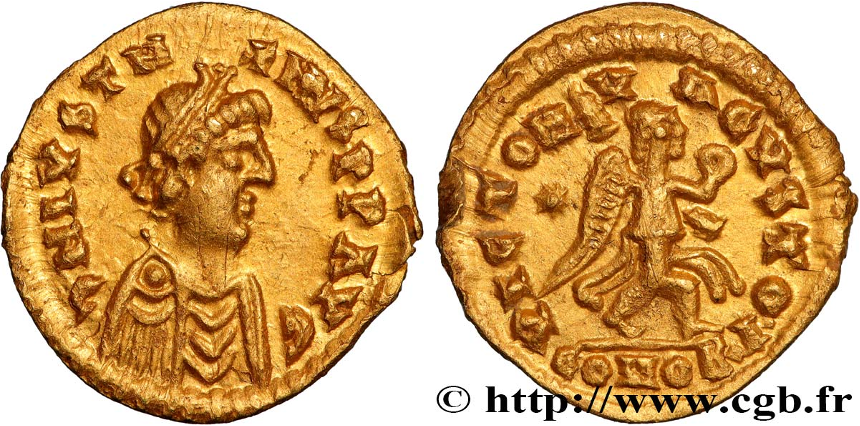
Gothic coins
Gothic pseudoimperial coinage bearing the ephigy of Roman emperor Justinian

Gold coin (586)
Depicts King Leovigild , the Visigothic king of Hispania and Septimania from 569 to 586

Portrait of King Reccared
19th-century work by Dióscoro Puebla: Shows turning point in Visigothic history wherein Reccared is known for renouncing Arianism, the branch of Christianity, followed by the Visigothic ruling class and converting to Nicene Christianity (Catholicism)

Rodrigo (d. 711) at the Battle of Guadalete
The last King of the Visigoths is depicted in a battle that would come to symbolize the end of a Christian, unified Spain, and King Rodrigo (Don Rodrigo) would become a tragic figure (according to Spanish nationalist propaganda)

Francisco Franco painting (1946)
Nationalist-Catholic propaganda following the Spanish Civil War that depicted Franco as a crusader → presented the Spanish Civil War not as a military coup or civil conflict, but as a holy "Crusade" to save Catholic Spain from communism, secularism, and "foreign" ideologies

World War II recruitment poster
Similar to framing Franco as continuing Spain’s Visigothic Catholic history, this poster places modern Waffen-SS soldier alongside a medieval Viking warrior to frame treasonous military collaboration as a continuation of Norway's heroic ancient past → appeals to shared "Nordic/Aryan" bloodlines → depictions of fighting a holy war

Miniature from Siyer-i Nebi (Life of the Prophet) 16th-century
Depicts Muhammad in front of the Kaaba

Muslim Umayyad coins (1)
Imitating Persian coins

Muslim Umayyad coins (2)
Imitating Byzantine coins
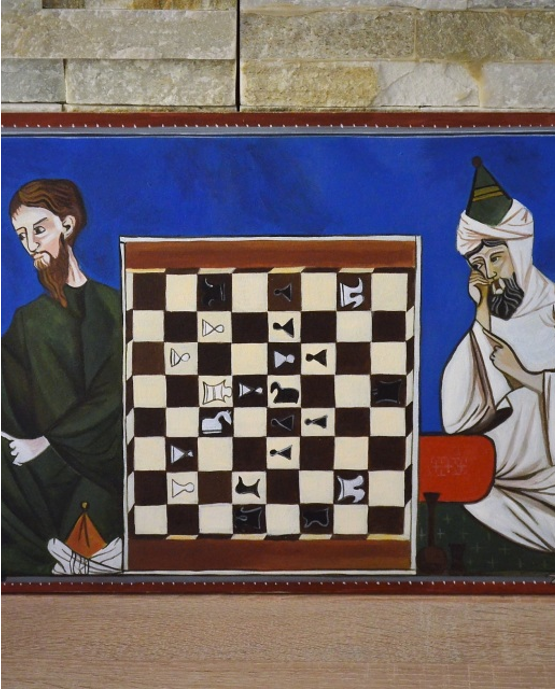
13th century painting
Depicts Muslim & Christian playing chess → demonstrates dhimmi under Muslim ruling, AKA tolerance for people of the book (Jews & Christians) by Muslims

14th-century Sephardic Jewish Haggadah illustration
Depicts visual evidence of medieval Iberian Jewish religious life, architecture, and liturgical customs before the expulsion of Jews from Spain in 1492
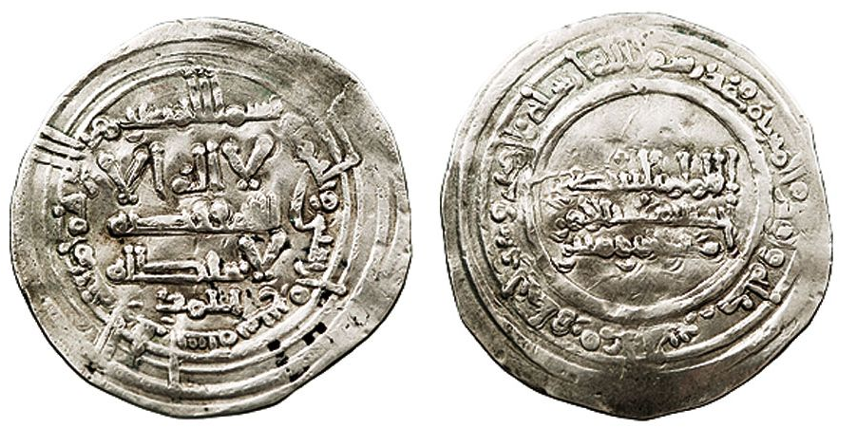
Silver dirham
Minted by Abd al-Rahman III (who established Caliphate of Cordoba), this coin established the Islamic norm of only using Arabic script as decoration, not human/animal images

Valcavado Beatus
Depicts the four Horsemen of the Apocalypse, an example of Mozarabic art made by Christians who lived in Muslim Spain

Church horseshoe arches
Horseshoe arches in the façade of the church of Santiago de Peñalba is an example of Mozarabic art, made by Christians who lived in Muslim Spain
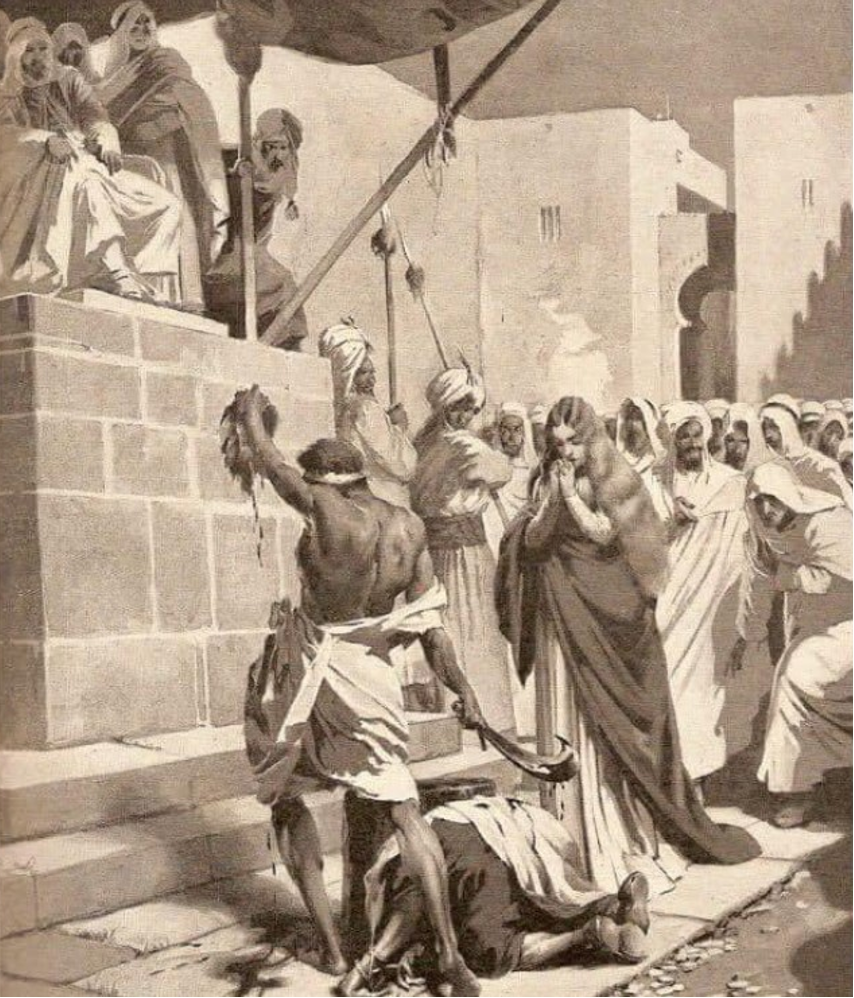
Martyrs of Cordoba (1910)
Depicts 859 A,D. beheading and martyrdom of Saint Eulogius and Saint Leocritia (Lucretia) of Córdoba, who were apart of the 50 Mozarabic men & women who publicly denounced Islam or converted from Islam to Christianity, which carried the death penalty under Islamic law

Cordoba irrigation water wheel
Muslim presence in Spain came with the introduction of highly developed techniques of irrigation and water engineering → led to an economic golden age

Map of al-Andalus
Urbanized society that lacked planned urbanism and had common spaces/institutions, diverse but separated areas, and centralized power

Great Mosque of Cordoba
Started by Abd al-Rahman I in 785 and expanded by its successors, later was partially converted to a Catholic church
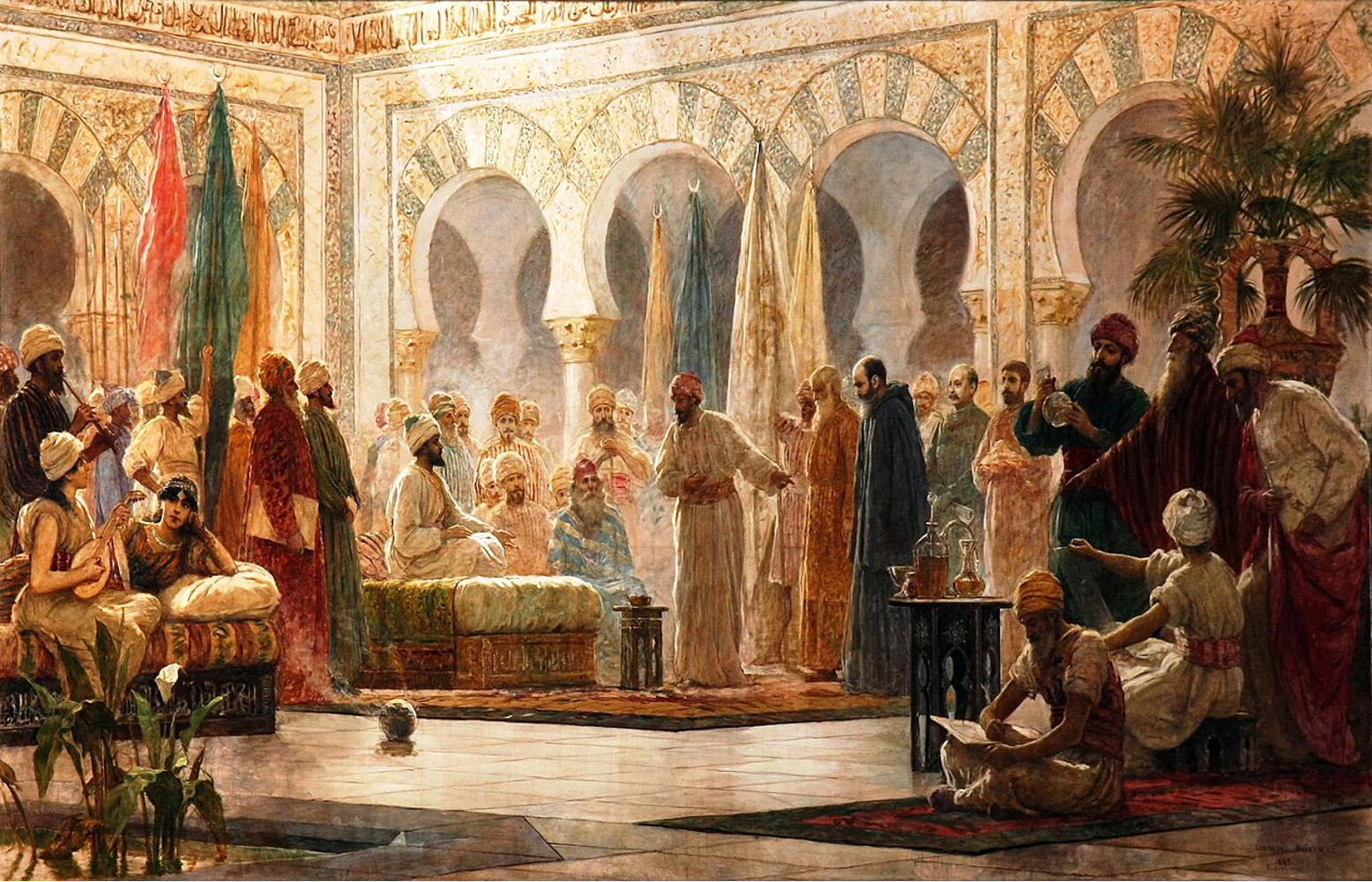
Abd al-Rahman III receiving ambassador John of Gorze (953 AD)
Orientalist painting by Catalan artist depicts:
Sophisticated diplomatic networks connecting Western Christian Europe with the Islamic Caliphate
How the royal palace complex of Madinat al-Zahra was the most prosperous, culturally advanced, and populous city in Western Europe. European chroniclers and ambassadors (such as John of Gorze himself) were famously awestruck by the court's opulence, vast libraries, and administrative grandeur