OCHEM Lab Practicum Prep
 Call Kai
 Learn
 Practice Test
 Spaced Repetition
 Match
 Flashcards
 Knowt Play
1/11

There's no tags or description
Looks like no tags are added yet.
12 Terms
TECH 700 - Safety in the Laboratory
know where the safety equipment is, + the safety datasheet —> how do I ID dangerous chemicals?
National label —> blue = health, red= fire, reactivity = yellow, specific hazards = white
TECH 702 - Using Microscale Techniques and Characterization of Unknown Liquid
understand how to weigh out samples. evaporate solvents,
boiling points —> somwhat inconsistent
refractive index—> very precise
Density —> absolutely useless
TECH 701- Measuring the Melting Points of Compounds and Mixtures
important that you understand the melting range vs. eutectic composition
The benzoic and mandelic acid melt at the same temp, but when mixed, they melt at a lower temperature and over a wider range.
The imperfect crystal lattice present in impure mixtures causes less energy to be required to break it down, so a lower and wider melting point is found.
The eutectic graph is the —> graph where the benzoic and mandelic go from 0-100% of the mixed solutions as the bend.
TECH 703- Purification of Acetanilide by Recrystallization
Recrystallizaiton solvent criterions —> good recrystalization solvents have a low solubility at a low temp (not insoluble), and a high solubility at a high temp (not total solubility tho)
also it is important that the bp of a recyrstalization solvent is lower than that of the mp of the purifying compound
SYNT 471 - Isolating Caffeine from Tea – Extraction Method
caffine is soluble in water, but when you mix the caffience with CL2CH2—> the caffine preferentially picks the Cl2Ch2 to dissolve in, which is how we can extract it form the tea. The sodium carbonate is added to bind the other impurities, making them insoluble in Cl2Ch2
TECH 722 - Isolating Clove Oil from Cloves Using Steam Distillation.
the theory of steam distillation is that oil is not soluble in water, but is in steam, so you can isolate the oil at a lower bp than that of the actual oil itself.
Bromine —> tests for eugenol (alkenes) —> loss of color = pos test
permangenate —>MnO4—> also tests for alkenes, and is very sensitive —> appearance of brown precpitate = Pos result
TLC —> Thin Layer Chromatography
plate covered in silica gel, and dots are placed ont he same line. Polar solvents stick to the plate and dont move much, while nonpolar solvents are transported up the plate.
divide the distance btween the line and the dot, and the total length to find each data peice.
in this lab, our product lined up perfectly wiht eugenol.
the 2nd peak is usually less polar → which is eugenol acetate
REAC 714 - Studying SN1 and SN2 Reactions
SN1 vs. SN2 rxnws. this si a comaprison of the time it takes for SN1 vs. SN2 reactions to occur.
first tests measure the leaving groups Br and Cl
2nd set of tests measure tertiary vs. Seconday Carbons,
3rd set of tests measures aprotic vs protic —> remember that water is the ultimate polar protic solvent (way better than ipr)
REAC 712 - Dehydrating Cyclohexanol
dehydrating cyclohexanol —> E1 rxn that takes out the oh group leaving a double bond.
a hickman still is needed to be used because the alkene turns into vapor, then condenses onto the cold tube of the hickman stilll (that has water running thorugh it), and then you use a pipette to get the cyclohexen out. not the cyclhexenhas a lower bp than cyclohexanol.
you can froce this rxn in the other direction with time, heat, and a lot of excess water.
the silver cerium nitrate test reacts wiht the alchohol for a red color, and we want a negative reult for our product (because it is cyclohexene)
SYNT 719 - Brominating Alkenes.
here the rxn creates an intermediate in the rxn shown below.
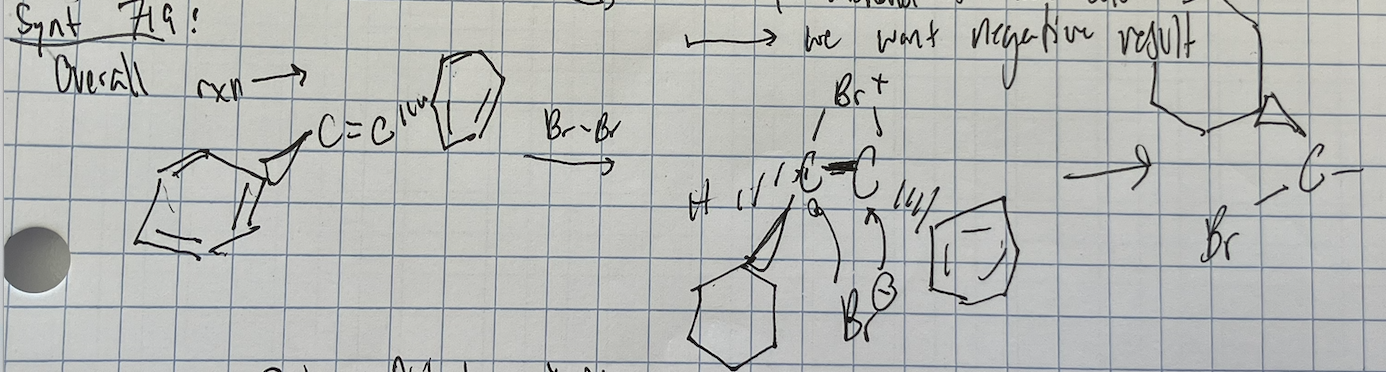
in the silver nitrate test, the AGBr comes out as a precipitate — > pos result
REAC 715 - Reducing Benzil Using Sodium Borohydride
i really need to go through thi overall rxn.
SN1 likes
Substrate: tertiary is best, then secondary. Allylic and benzylic substrates also work well because the carbocation is resonance-stabilized. Methyl and primary substrates basically don’t react by SN1.
Nucleophile: weak and neutral nucleophiles like H₂O, ROH, and RCOOH. Nucleophile strength doesn’t affect the rate, since it isn’t in the rate-determining step.
Solvent: polar protic solvents (water, alcohols, formic acid). They stabilize the carbocation and the leaving group through H-bonding. A high dielectric constant also helps.
Leaving group: a good leaving group, meaning a weak base. Approximate order: TsO⁻/OTf⁻ > I⁻ > Br⁻ > Cl⁻ ≫ F⁻.
Carbocation stability: anything that stabilizes the cation, such as hyperconjugation, resonance, or neighboring electron-donating groups.
Acid catalysis: this can turn a poor leaving group into a good one, for example protonating –OH to –OH₂⁺.
SN2 Likes
Substrate: methyl > primary > secondary. Less steric hindrance is better, and tertiary doesn’t react. Branching at the β-carbon (e.g., neopentyl) also slows it a lot.
Nucleophile: strong nucleophiles, usually anionic and often polarizable: I⁻, HS⁻/RS⁻, CN⁻, N₃⁻, RO⁻, OH⁻. A higher nucleophile concentration increases the rate, since rate = k[substrate][Nu].
Solvent: polar aprotic solvents (DMSO, DMF, acetone, acetonitrile). They don’t H-bond to the nucleophile, so it stays “naked” and reactive.
Leaving group: a good leaving group, same trend as SN1.
Geometry: the backside of the carbon must be open for attack, which is why bridgehead carbons don’t undergo SN2.