Gluconeogenesis
 Call Kai
 Learn
 Practice Test
 Spaced Repetition
 Match
 Flashcards
 Knowt Play
1/23

There's no tags or description
Looks like no tags are added yet.
24 Terms
gluconeogenesis
the synthesis of glucose from noncarbohydrate precursors
why is glucogenesis important?
b/c glucose is the primary energy source for the brain. erythrocytes do not have mitochondria and derive all of their energy by glycolysis converting glucose into two molecules of lactate
noncarbohydrate precursors
pyruvate, lactate, oxaloacetate, gluconeogenic amino acids and glycerol
enter the gluconeogenic pathway by pyruvate, oxaloacetate, and dihydroxyacetone phosphate
two major sites for gluconeogenesis
liver and kidneys
liver accounts for 90% and kidneys are other 10%
net reaction of glycolysis
Glucose + 2ADP + 2Pi + 2NAD+ → 2Pyruvate + 2ATP + 2NADH +2H2 O + 4H+ ∆G= -85 kJ/m
true or false. gluconeogenesis is simply the reversal of glycolysis
false. gluconeogenesis is not merely the reversal of glycolysis, as that would be highly endergonic
2Pyruvate + 2ATP + 2NADH +2H2 O + 4H + → Glucose + 2ADP + 2Pi + 2NAD+ ∆Go ’ = +85 kJ/mol
what are the three irreversible steps of glycolysis catalyzed by?
hexokinase, phosphofructokinase, and pyruvate kinase
how many NTPs are used to make gluconeogenesis exergonic?
six
gluconeogenesis equation
2Pyruvates + 4ATP + 2GTP + 2NADH + 4H2 O →Glucose + 4ADP + 2GDP + 6Pi + 2NAD+ + 2H+
∆Go ’ = −37 kJ/mol

two steps required to convert pyruvate back into PEP
the first step is the carboxylation of pyruvate to form oxaloacetate. this is catalyzed by pyruvate carboxylase and requires ATP
in the second step, oxaloacetate is decarboxylated and phosphorylated to produce phosphoenolpyruvate
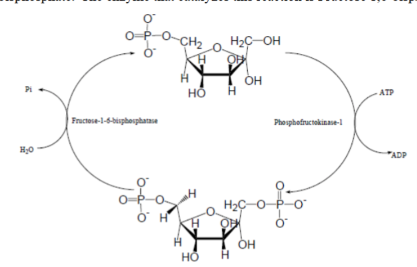
what enzyme catalyzes the irreversible step to convert fructose-1,6-biphosphate to fructose-6-phosphate
Fructose 1,6-bisphosphatase
what enzymes catalyzes the glucose-6-phosphate into glucose?
glucose-6-phosphate
pyruvate carboxylase
uses the energy of ATP to carboxylate pyruvate to form oxaloacetate
requires biotin, a cofactor that is covalently attached to a lysine residue
biotin serves as a carrier of activated carbon dioxide, just as acyl-CoA carries activated acyl groups
1st step of pyruvate carboxylase is to activate a molecule of bicarbonate for nucleophilic attack
bicarbonate is activated by phosphorylation with ATP to produce a high-energy carboxyphosphate intermediate
carboxyphosphate then undergoes nucleophilic attack by the N1 atom of biotic to form B-carboxybiotin
3rd step: remove a proton from the C3 of pyruvate to generate a resonance stabilized carbanion which is a good nucleophile, attacking the N-carboxybiotin to regenerate biotin and form oxaloacetate
regulation of pyruvate carboxylase
allosterically activated by acetyl-CoA
must be bound to an allosteric binding site of the enzyme
the nucleophilic attack of the pyruvate enolate on N-carboxybiotin, is not affected by this allosteric regulator
if the concentration of ATP is low and/or the concentration of acetyl-CoA is low → pyruvate directed into the CAC to promote synthesis of ATP
if ATP and acetyl-CoA are high, then pyruvate is converted into oxaloacetate and consumed in gluconeogenesis
high ATP and CoA means the cell energy levels are high
compartmentalization of pyruvate carboxylase and PEP carboxykinase
PC found only in the matrix of the mitochondria
PEPCK found in mitochondria or in cytosol
liver, in both
pyruvate is transported into the mitochondria where it is either converted into acetyl-CoA by pyruvate dehydrogenase and enters the CAC, or converts into oxaloacetate by pyruvate carboxylase and used for gluconeogenesis
in tissues where PEPCK is only in mitochondria, oxaloacetate is converted to PEP in the mitochondria, and then transported to cytosol
in tissues where PEPCK is found only in cytosol, oxaloacetate must be reduce to malate to be transported across mitochondrial membrane to the cytosol, where the malate is reoxidized into oxaloacetate and goes to gluconeogenesis
PEP carboxykinase
simultaneously decarboxylates and phosphorylates oxaloacetate
the CO2 added in the pyruvate carboxylase step comes off in the PEPCK step
the decarboxylation rxn is very exergonic and helps drive the endergonic rxn of PEP synthesis
what happens after PEP is formed by PEPCK?
PEP is hydrated by enolase to form 2-phosphoglycerate which in turn is isomerized into 3-phosphoglycerate by phosphoglycerate mutase, phosphoglycerokinase uses ATP to make 1,3-bisphosphoglycerate which is reduced by GADPH into glyceraldehyes-3-phosphate
what does triose phosphate isomerase produce?
dihydroxyacetone phosphate
aldolase catalyzes an ______ condensation of DHAP and glyceraldehyde-3P to form _______-1,6-bisphosphate
aldol, fructose
regulators of fructose-2,6-BP
Citrate↑
Fructose-2,6-bisphosphate↓
AMP↓
cori cycle
need to convert pyruvate into lactate to regenerate NAD+
lactate is released into the blood and then carried to liver, then reoxidized into pyruvate and then converted to glucose via gluconeogenesis
regulation of glycolysis: glucose-6-phosphate
gluconeogenesis replaces the irreversible steps of glycolysis (catalyzed by hexokinase, phosphofructokinase, and pyruvate kinase)
the enzymes that catalyze these reactions are glucose-6-phosphatase, fructose-1,6-bisphosphatase and the sequential reactions of pyruvate carboxylase and PEP carboxykinase
glucose-6-phosphate is not under allosteric control
Km of of glucose-6-phosphates for glucose-6-phosphate is considerably higher than the cellular concentation of glucose 6-phosphate
enzyme is said to be under substrate-level control
regulation of glycolysis: acetyl CoA
inhibits pyruvate kinase and reciprocally activates pyruvate carboxylase
inactivates pyruvate dehydrogenase
regulation of gluconeogenesis: fructose-1,6-bisphosphate
activated by high concentrations of citrate and inhibited by high concentrations of AMP
inactivated by fructose-2,6-bisphosphate
Citrate↑
Fructose-2,6-bisphosphate↓
AMP↓
AMP enchances the inhibition of Fructose-2,6-BP
all of these are effectors of phosphofructokinase as well