Topic 4: Patient Assessment
 Call Kai
 Learn
 Practice Test
 Spaced Repetition
 Match
 Flashcards
 Knowt Play
1/90

There's no tags or description
Looks like no tags are added yet.
91 Terms
A patient's health record belongs to?
The facility, not the patient
What are the steps taken if you break the PHIA agreement?
1. Warning
2. Probation
3. Reprimand
4. Termination
What do PHIA and FIPPA mean?
Personal health information act
Freedom of information and protection of privacy act
This act is directed at the public to whom accessing information from records held by public bodies such as government
_____ protects personal information by establishing rules for the collection of data and use of information by public bodies
It also gives a person access to their own information for the purposes of correction and for an independent review
FIPPA
Positives and negatives of disclosing issues regarding patient safety

Components of patient assessment
1. Clinical history
2. Baseline status
-no two patients are the same
3. Emotional/psychological status
4. Willingness/motivation
What is needed to diagnose a patient
1. History
2. Clinical/physical
Canadian cancer society causes of cancer
Aging
Smoking
Sun exposure
Obesity
Lack of physical activity
Contact with hazardous chemicals
Infections
Gene mutations
Diagnostic tests
Imaging
Laboratory tests
Invasive procedures
Biopsies
Incisional vs excisional vs needle aspiration
Using a scalpel, small area of tissue removes
Entire lump and surrounding tissue removed
Needle inserted and fluid or tissue removed
Why must a cancer patient go through the assessment process?
Correct diagnosis
Accurate stage/grade
Performance status
Goal of treatment
Pt desires and motivation
Barriers (underserved population)
Comorbidities
A CBC and urinalysis are two of the most common screening tools. How are these tests used to determine our current state of health.
CBC: analyzes the composition of blood and bone marrow to rule out blood disorders
Screens for infection, anemia, leukemia, neutropenia
Urinalysis: Analyzes the composition, concentration, volume, colour, odour, ph levels
Abnormal findings lead to further testing
Urinalysis
Why might this test be ordered
Normal value and appearance
Procedure
Related info
1. Screening
2. Urinary symptoms: burning, frequency, bleeding
3. Diagnosing
Clear, yellow
Negative for billirubin, glucose, ketones, protein, blood
ph: 4.3-8
15ml of urine
What are the two levels of cancer prevention?
Primary: changes a person can make to their lifestyle to prevent development of disease
Secondary: Screening for specific disease in specific populations or high-risk groups
-mammogram
-fit test
-colonoscopy
-pap smears
-psa test
_____ is a term that relates to the mass examination of a specific group in the population to detect disease prior to symptoms
Screening
Requirements for a good "testing tool"
1. Sensitive
2. Specific
3. Cost effective
4. Accurate
Screening programs exist because there is solid evidence that
-Fewer people will _____
-Early detection results in _____
-Fewer people are ______ in the first place
Die
Less treatment
Diagnosed with cancer
For mass screening to be worthwhile, the screening must be able to
1. Result in ______ survival of persons affected
2. Determine a _____ group
3. Develop an acceptable ______
4. Include a public _____ component
Improved
High-risk
Test tool
Education
What is the colorectal cancer screening program?
____% occur over the age of 50
often have no early warning signs
_____ of _____ can be cured if diagnosed in early stage
Sensitivity = %
Specificity = %
FIT test
Mailed to you at age 50
90%
9 of 10
78%
96%

Breast cancer screening
__ of ____ breast cancers occur in age 50 or older
only ____% of women diagnosed with breast cancer have a family history
Regular screening can find breast cancer early
Sensitivity, specificity
Approximately 2.6 million per year in Manitoba
Mammogram
8 of 10
10%
89%
95%
Cervical cancer screening
PAP test looks for _____ that can be removed so that cancer does not start
Regular PAP test with follow up can prevent up to ___% of cervical cancer
Sensitivity/specificity
hrHPV test sensitivity/specificity
PAP test
Abnormal cells caused by HPV
80%
73%
90%
95%
97%

What do you assess during a physical exam?
General appearance
Behaviour (coping mechanisms-smoking, alcohol, angry)
Four primary techniques used to perform physical examinations
1. Inspection
2. Palpation
3. Percussion
4. Ausculation
Physical exam positioning for head and neck, back, thorax, lung, breasts, axillae, heart, vital signs, upper exteremities
Sitting
Physical exam positioning for head and neck, thorax and lungs, breasts, axillae, heart, abdomen, extremities, pulses
Supine
Physical exam position for head and neck, thorax and lungs, breasts, axillae, heart, abdomen, vulva
Dorsal recumbent
Positioning for female genitalia and genital tract
Lithotomy
Positioning for rectum and vagina
Sims
Knee-chest
Positioning for musculoskeletal system
Prone
_____ is a structured, personalized document that outlines a patient's or care recipient's health conditions, specific care needs, goals, and the exact interventions required from healthcare providers and caregivers
Care plan
Subjective vs objective
Patient complaint
Can be measured by a health care worker
The assessment process (5 steps)
1. Information collection
2. Analyze the data
3. Identify current and potential problems
4. Implement care plan
5. Evaluate
____ measures a person's functional status
Performance status
What is holistic care?
Considering the whole person, mind, body, spirit
Be sensitive and inclusive
Be open to nontraditional medicine
Work with a team
Why do we have to know someone's pregnancy status?
Because radiation has negative outcomes on a fetus such as
Spontaneous abortion
Congenital defects
Increased risk of malignancies
Increased risk of genetic abnormalities
_____ are called erythrocytes, produced in bone marrow, 80-120 day life span, carry O2 and remove CO2
Red blood cells
erythrocytopenia
A reduction in red blood cells
_____ is the oxygen carrying component of the red blood cell
O2 is a radiosensitizer so if low it might alter the effectiveness of RT
Hemoglobin
_____ is the volume of RBC found in 100ml of blood
Hematocrit
______ relates to blood clotting
Low may lead to bruising, bleeding, petechia (small dot like hemorrhages)
eat protein rich food, avoid activties with potential injury, avoid aspirin
Platelets
____ are also called leukocytes, formed in bone marrow, 10-14 day life span
functions include phagocytosis and immunity
Avoid exposure to potential sources of infection
practice good handwashing
eat a well balanced diet
conserve energy
White blood cells
What are the granular leukocytes
Neutrophils
Eosinophils
Basophils
What are the agranular leukocytes?
Lymphocyes
Monocytes
Function of neutrophils
Phagocytosis
Febrile neutropenia
Fever of 38 degrees or higher for more than one hour with the neutrophil count below 0.5x10⁹ cells/L
Medical assessment is required within 15 minutes
Eosinophils function
Allergic reaction, destroys some parasites
Basophils function
Allergic reaction from inflammatory response
Lymphocytes function
Mediate immune system response (antibodies)
Bacterial/viral response
Monocytes function
Phagocytosis-convert to macrophages and help lymphocytes recognize antigens, stimulate T cells to produce fever
Facilitate healing
____ also called thrombocytes, formed in the bone marrow, life span 8-12 days, essential in hemostasis and blood clotting
Platelets
In oncology, the term nadir is used to represent the lowest level of a _____ while a patient is undergoing chemo
Lowest level of a blood cell count
What are the types of disabilities?
Mobility limitations
Chronic conditions
Sensory limitations
Psychiatric disorders
Other causes
What are the most limiting conditions (top 3)
Arthritis
heart disease
cancer
Ensure to use terminology that concentrates on their ______.
Abilities
Pulmonary edema
Fluid in interstitial spaces
Emphysema
Extension of interstitial spaces by air/gas
Form of COPD
Pneumonitis
Inflammation of the lungs
Pneumothorax
Air/gas in the pleural cavity
Cardiovasular system conditions that would affect oxygenation
Anemia
Vascular disease
Heart and muscle damage
Damage to electrical conducting system
Factors that affect oxygenation of the body
CNS disorders
environmental
lifestyle
narcotics
CVD, COPD
stress and anxiety
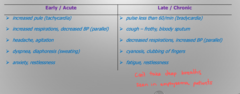
Hypoxia
what can we do for those with trouble breathing
maintain airway
improve positioning
provide oxygen therapy
oxygen saturation can be measured by a
measures the amount of oxygenated hemoglobin in arterial blood
normal is 96-100
less than ___ is life threatening
pulse oximeter
80%
Oxygen therapy can be portable via ___ or piped into _____
tanks
Wall unit
Adults 1-4 LPM, patients with normal breathing rates, turn on O2 before applying to patient because it can dry out the mucous membrane
Nasal prongs/cannula
5-8 LPM
Simple O2 mask (35-55% O2)
Partial (6-10 LPM (57-70% )2)
Nonbreathier (10-15 LPM) (70-100% O2)
Not comfortable for long periods
Risk of suffocation
May need humidifier for mositure
Face mask
Can you reuse the O2 tubing/cannula?
No! Source of infection
Patient with ____ rely on CO2 as a stimulus to breathe. If there is too much oxygen administered, the stimulus is gone
Can cause increased CO2 level, apnea, and respiratory failure
COPD (chronic obstructive pulmonary disease)
____ maintains upper air passages, are easy to insert, low risk of complications, stimulate the gag, short term use
Oropharyngeal
____ is most commonly used for patients under general anesthetic
Endotracheal tubes
______ is a surgical incision into the trachea just below the larynx (between 2nd and 3rd cartridge to avoid thyroid)
Tracheostomy
Why might a urinary catheter be inserted?
To keep the bladder empty
To irrigate the bladder
To deliver medication
The catheter tip is lubricated with _____ and inserted through the ______ into the bladder. The _____ rests in the junction of the bladder and the urethra.
KY jelly
Urinary meatus
Balloon
In radiation therapy, a patient may have a catheter inserted during the simulation process to accurately locate the bladder or prostate gland. What would you expect to assess while this patient is in the department?
Attachment to patient
Tubing
Drainage
Maintain gravity draining for urinary catheters by keeping the bag _____?
Below the patient's bladder at all times
The most common diversion is the ______. An ostomy, for the purpose of elimination of urine or feces, is a surgical opening on the abdominal wall
Ileal conduit
Why don't you want an ostomy in the treatment field?
Because it can cause severe reactions to the stoma and peristomal skin
What are the major vital signs?
Body temperature
Heart rate
Respiratory rate
Blood pressure
Normal range of respiration for infants and adults
Infants: 20-30/min
Adults: 10/12-20/min

How might a patients temperature be taken?

Taking a pulse gives you information about the ____ and ____ and _____, specifically the contraction of _______.
Rate, rhythm, volume
Contraction of the left ventricle
Normal pulse range of adults, children, infants
A: 60-100BPM
C: 70-120BPM
I: 100-160BPM
What will the pulse oximeter read?
Monitors O2 saturation in circulating blood
Normal value of pulse oximeter
95-97 to 100 is normal
Monitor if less than 95%
90% needs intervention
Less than 85%, tissues are not getting enough O2
Blood pressure measures the _____ in the _____ during ______ and _____ of the heart. The pulse pressure is the numerical difference.
Pressure
arteries
contraction (systolic)
relaxation (diastolic)
____ has a systolic reading from 120-139
Hypertension
_____ has a systolic reading consistently less than 90
Hypotension
Hemoglobin SI unit
g/L
Platelets SI unit
x10^9/L
Leukocytes (white blood cells) SI unit
Neutrophil
Eosinophils
Basophils
Lymphocytes
Monocytes
x10^9/L
Erythrocytes (red blood cells) SI units
x10^12/L