Intro to Ecology (BIO 262) Unit 1
 Call Kai
 Learn
Learn Practice Test
 Spaced Repetition
 Match
Match Flashcards
 Knowt Play
1/26

There's no tags or description
Looks like no tags are added yet.
Name | Mastery | Learn | Test | Matching | Spaced | Call with Kai | Chat |
|---|
No analytics yet
Send a link to your students to track their progress
27 Terms
Natural Selection
the differential survival and/or reproduction of organisms that vary in one or more characteristics.
Evolution
a change over time in the proportions of individual organisms differing genetically in one or more traits (= change in allele frequencies in a population over time)
Ecotypes
populations of a species adapted to specific environmental conditions, leading to distinct genetic traits.
Directional selection
natural selection that acts in favor of an extreme phenotype over other phenotypes in a population, pushing a population’s phenotype in one particular way. Ex: woolly mammoths: sabertooth tigers eat small ones, push population to be bigger.
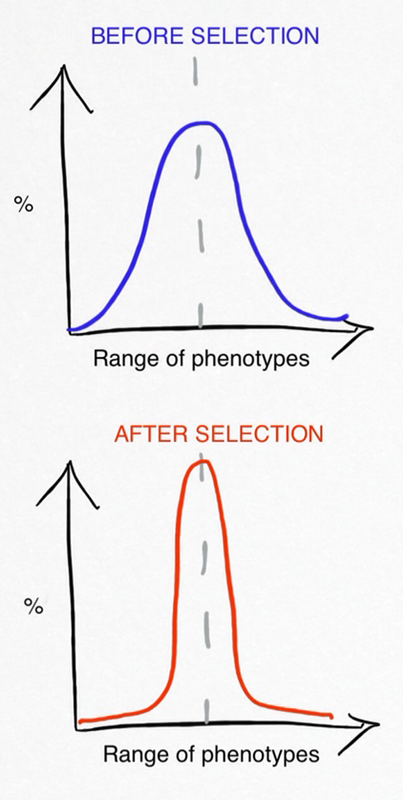
Stabilizing Selection
selection that acts against extremes; selection favoring phenotypes that are intermediate in some aspect. Ex: palm trees: small trees get eaten, large trees get knocked down by wind, so average trees do best
Disruptive selection
selection favors extreme phenotypes at the cost of intermediate phenotypes. Ex: fish: small fish hide or aren’t worth eating, large fish are too fast and hard to catch, medium fish are easy to catch and get eaten. Therefore, the small and large fish are selected for.
Heritability
(h2): proportion of total phenotypic variation in a trait that can be attributed to
genetic variance
Predation
eating animals
Herbivation
eating plants
Mimicry
prey looks like a harmful/dangerous organism
Batesian mimicry
harmless mimic looks like harmful model
Mullerian mimicry
harmful mimic that looks like a harmful model
Passive defense
do nothing, and hope that a predator doesn't notice you
Cooperative defense (active defense)
when seeing a predator, prey form large groups
Active escape
prey tries to flee the predator
Kin Selection
a type of natural selection where an organism acts to help its genetic relatives survive and reproduce, even if it hurts the helper's own chances of survival
Relatedness
the average proportion of alleles that two individuals share
Group Selection
Selection for traits that benefit individuals of a group that are not necessarily related to one another
metapopulations
a group of separate local groups of the same species that live in different areas and interact when individuals move between them
Acclimation
short-term physiological adjustments to the environment
Conformer
Adjust their body temp to that of the environment
Endotherm
an animal that generates its own body heat through internal metabolic processes rather than relying on the outside environment
Ectotherm
an animal that relies on external environmental sources of heat to regulate its body temperature
Behavioral Thermoregulation
a conscious, goal-directed action an organism takes to manage its body temperature and maintain thermal
Stabilizing Selection
Disruptive selection

Directional Selection
