Biomechanics muscle tickets
 Call Kai
 Learn
Learn Practice Test
 Spaced Repetition
 Match
Match Flashcards
 Knowt Play
1/126

There's no tags or description
Looks like no tags are added yet.
Name | Mastery | Learn | Test | Matching | Spaced | Call with Kai | Chat |
|---|
No analytics yet
Send a link to your students to track their progress
127 Terms

Gastrocnemius
Origin: posterior surfaces of the condyles of the femer. Insertion: Calcaneus via calcaneal tendon. Actions: 1. Flex the knee (tibiofemoral joint); 2. Plantar flex the ankle (talocrural joint). Innervation: Tibial S1, 2.

Soleus
Origin: Soleal line; proximal, posterior surface of tibia; and posterior aspect of the head of fibula. Insertion: Calcaneus via calcaneal tendon. Action: Plantar flex the ankle (talocrural joint). Innervation: Tibial L5, S1, 2.

Plantaris
Origin: Lateral supracondylar line of the femur. Insertion: Calcaneus via calcaneal tendon. Actions: 1. Weak plantar flexion of the ankle (talocrural joint); 2. Weak flexion of the knee (tibiofemoral joint). Innervation: Tibial L4, 5, S1 (2).
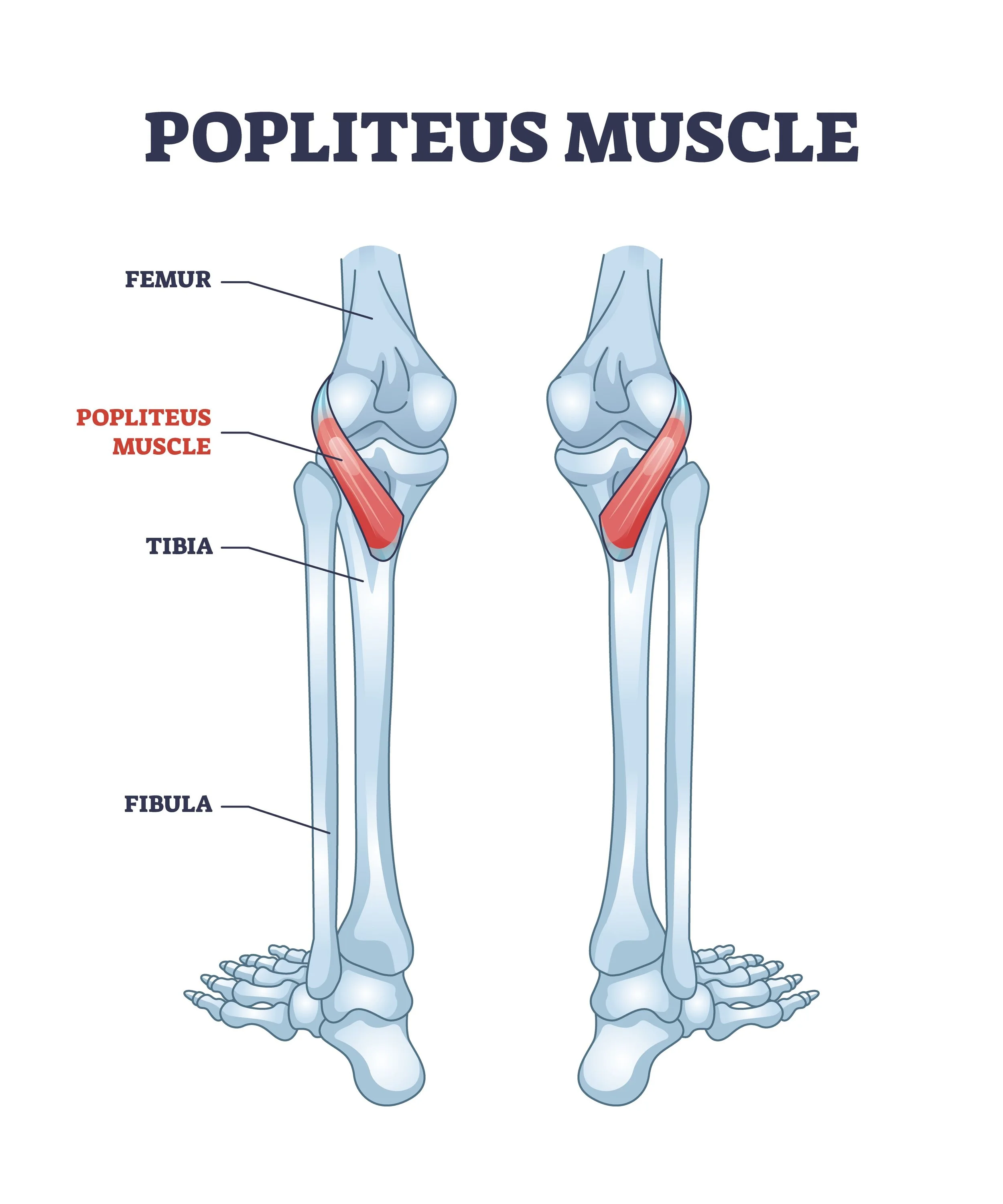
Popliteus
Origin: Lateral condyle of the femur. Insertion: Proximal, posterior aspect of tibia. Actions: 1. Medially rotate the flexed knee (tibiofemoral joint); 2. Flex the knee (tibiofemoral joint). Innervation: Tibial L4, 5, S1.

Fibularis Longus
Origin: Head of fibula and proximal two-thirds of lateral fibula. Insertion: Base of the first metatarsal and medial cuneiform. Actions: 1. Evert the foot; 2. Assist to plantar flex the ankle (talocrural joint). Innervation: Superficial fibular L4, 5, S1.
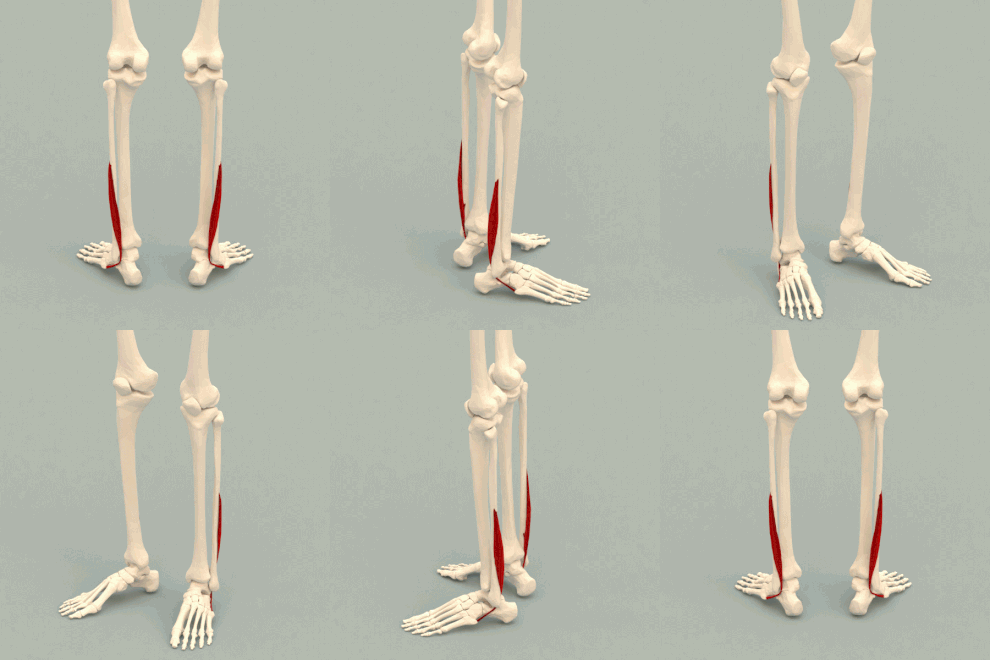
Fibularis Brevis
Origin: Distal two-thirds of lateral fibula. Insertion: Tuberosity of fifth metatarsal. Actions: 1. Evert the foot; 2. Assist to plantar flex the ankle (talocrural joint). Innervation: Superficial fibular L4, 5, S1.
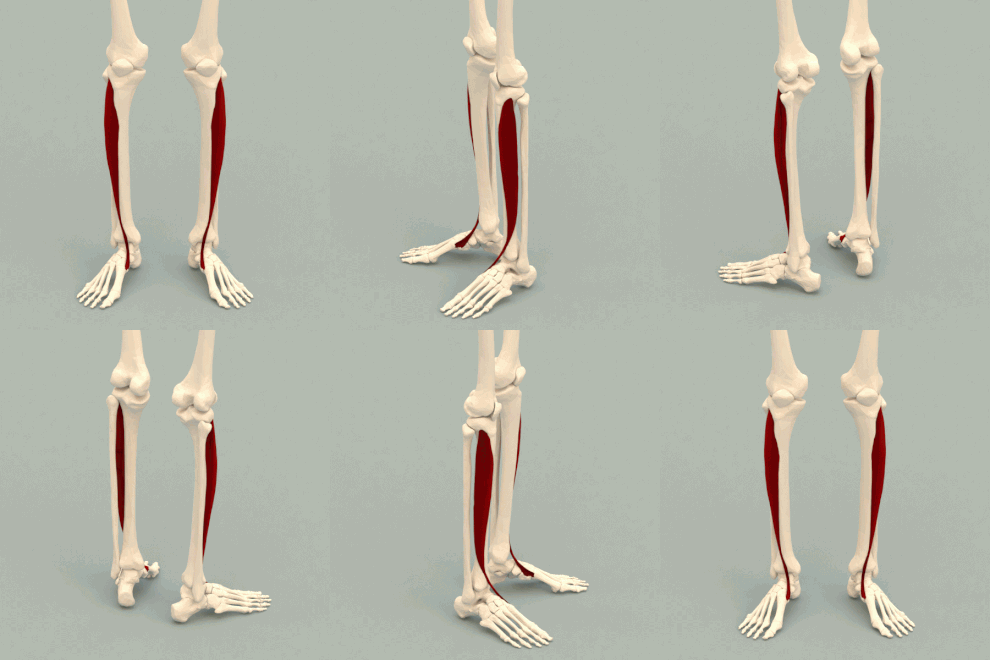
Tibialis Anterior
Origin: Lateral condyle of the tibia; proximal, lateral surface of tibia; and interosseous membrane. Insertion: Base of the first metatarsal and medial cuneiform. Actions: 1. Invert the foot; 2. Dorsiflex the ankle (talocrural joint). Innervation: Deep fibular L4, 5, S1.

Extensor Digitorum Longus
Origin: Lateral condyle of tibia; proximal anterior shaft of fibula; and interosseous membrane. Insertion: Middle and distal phalanges of second through fifth toes. Actions: 1. Extend the second through fifth toes (metatarsophalangeal and interphalangeal joints); 2. Dorsiflex the ankle (talocrural joint); 3. Evert the foot. Innervation: Deep fibular L4, 5, S1.
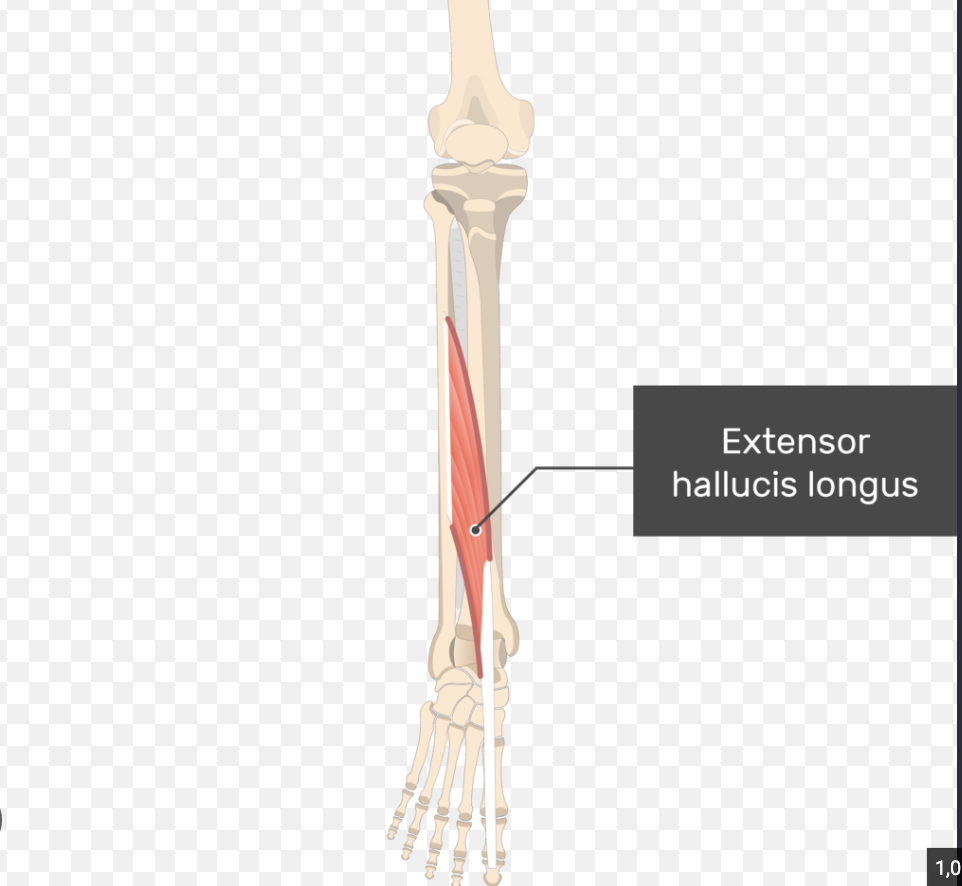
Extensor Hallucis Longus
Origin: Middle, anterior surface of fibula and interosseous membrane. Insertion: Distal phalanx of first toe. Actions: 1. Extend the first toe (metatarsophalangeal and interphalangeal joints); 2. Dorsiflex the ankle (talocrural joint); 3. Invert the foot. Innervation: Deep fibular L4, 5, S1.

Tibialis Posterior
Origin: Proximal, posterior shafts of tibia and fibula; and interosseous membrane. Insertion: All five tarsal bones and bases of second through fourth metatarsals. Actions: 1. Invert the foot; 2. Plantar flex the ankle (talocrural joint). Innervation: Tibial L(4), 4, S1.
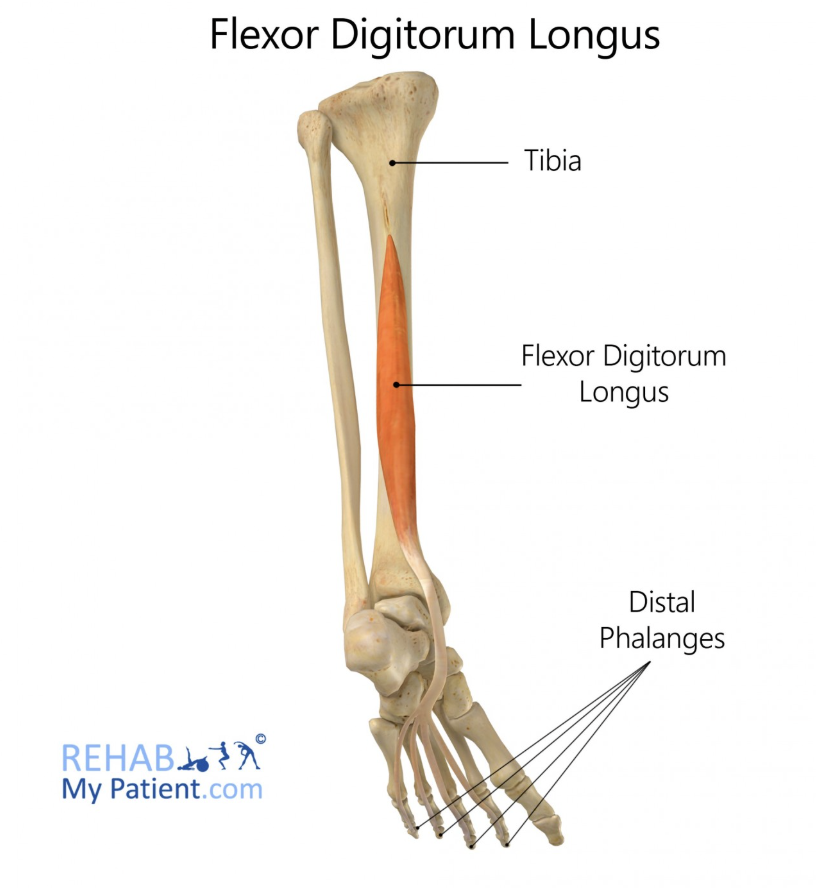
Flexor Digitorum Longus
Origin: Middle, posterior surface of tibia. Insertion: Distal phalanges of second through fifth toes. Actions: 1. Flex the second through fifth toes (metatarsophalangeal and interphalangeal joints); 2. Weak plantar flexion of ankle (talocrural joint); 3. Invert the foot. Innervation: Tibial L5, S1, (2).
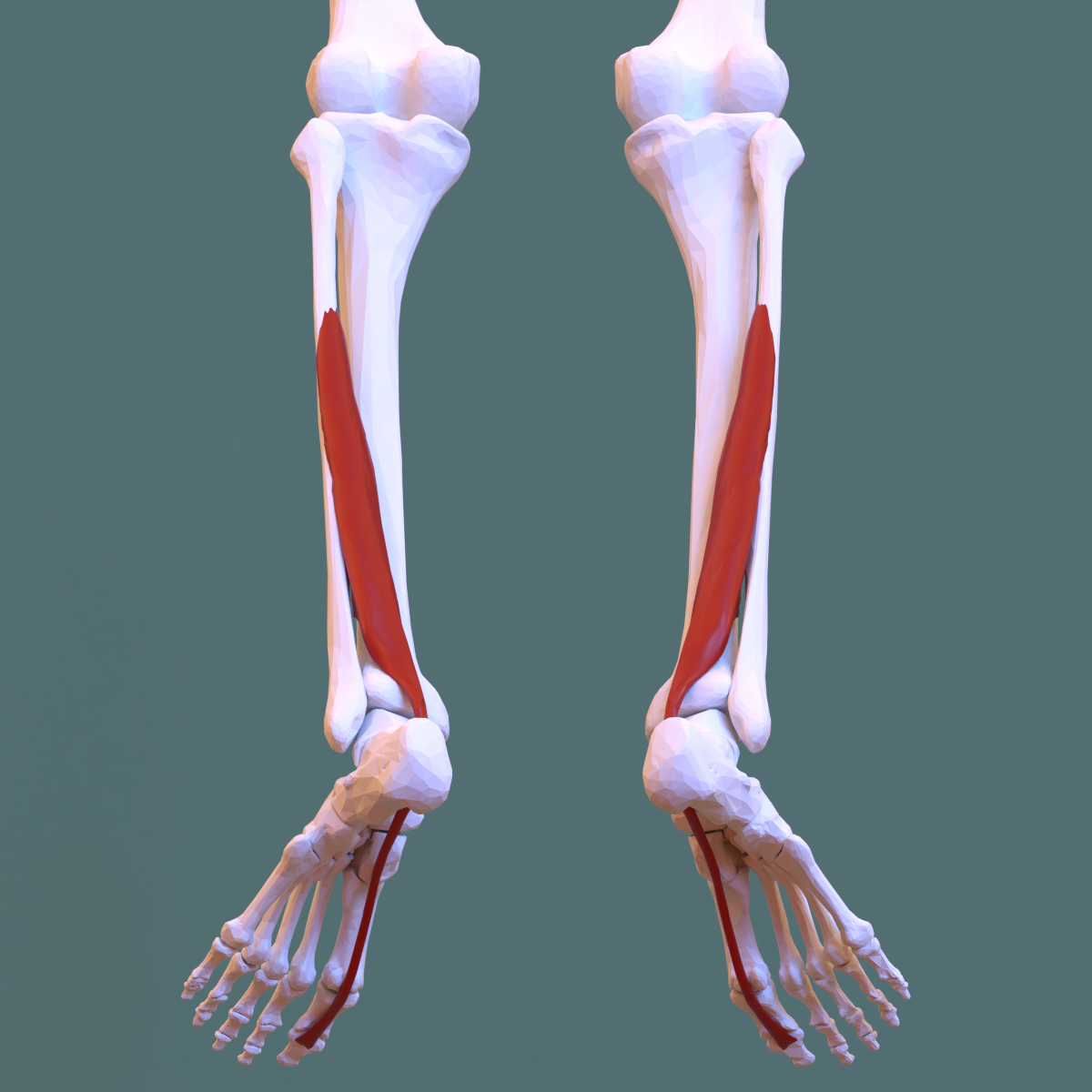
Flexor Hallucis Longus
Origin: Middle half of posterior fibula. Insertion: Distal phalanx of first toe. Actions: 1. Flex the first toe (metatarsophalangeal and interphalangeal joints); 2. Weak plantar flexion of ankle (talocrural joint); 3. Invert the foot. Innervation: Tibial L5, S1, 2.

Extensor Digitorum Brevis
Origin: Dorsal surface of calcaneus. Insertion: Second through fourth toes via the extensor digitorum longus tendons. Action: Extend the second through fourth toes (metatarsophalangeal and interphalangeal joints). Innervation: Deep fibular L4, 5, S1.

Flexor Digitorum Brevis
Origin: Medial process of calcaneus and plantar aponeurosis. Insertion: Middle phalanges of second through fifth toes. Action: Flex middle phalanges of the second through fifth toes (proximal interphalangeal joints). Innervation: Tibial L4, 5, S1.

Abductor Hallucis
Origin: Medial process of calcaneus and plantar aponeurosis. Insertion: Proximal phalanx of first toe (medial surface) and medial sesamoid bone. Actions: 1. Abduct the first toe (metatarsophalangeal joint); 2. Assist to flex the first toe (metatarsophalangeal joint). Innervation: Tibial L4, 5, S1.

Abductor Digiti Minimi
Origin: Lateral process of calcaneus and plantar aponeurosis. Insertion: Proximal phalanx of fifth toe (lateral surface). Actions: 1. Flex the fifth toe; 2. Assist to abduct the fifth toe (metatarsophalangeal joint). Innervation: Tibial S1, 2.

Extensor Hallucis Brevis
Origin: Dorsal surface of calcaneus. Insertion: Proximal phalanx of first toe. Action: Extend the first toe (metatarsophalangeal joint). Innervation: Deep fibular L4, 5, S1.

Flexor Hallucis Brevis
Origin: Plantar surfaces of cuboid and lateral cuneiform. Insertion: Medial and lateral surfaces of base of proximal phalanx of first toe. Action: Flex the first toe (metatarsophalangeal joint). Innervation: Tibial L4, 5, S1.

Adductor Hallucis
Origin: Oblique head: Bases of second through fourth metatarsals; Transverse head: Plantar ligament of third through fifth metatarsophalangeal joints. Insertion: Lateral surface of base of proximal phalanx of first toe. Actions: 1. Adduct the first toe; 2. Assist to maintain transverse arch of foot; 3. Assist to flex the first toe. Innervation: Tibial S1, 2.

Flexor Digiti Minimi Brevis (foot)
Origin: Base of the fifth metatarsal. Insertion: Base of proximal phalanx of fifth toe. Action: Flex the fifth toe (metatarsophalangeal joint). Innervation: Tibial S1, 2.
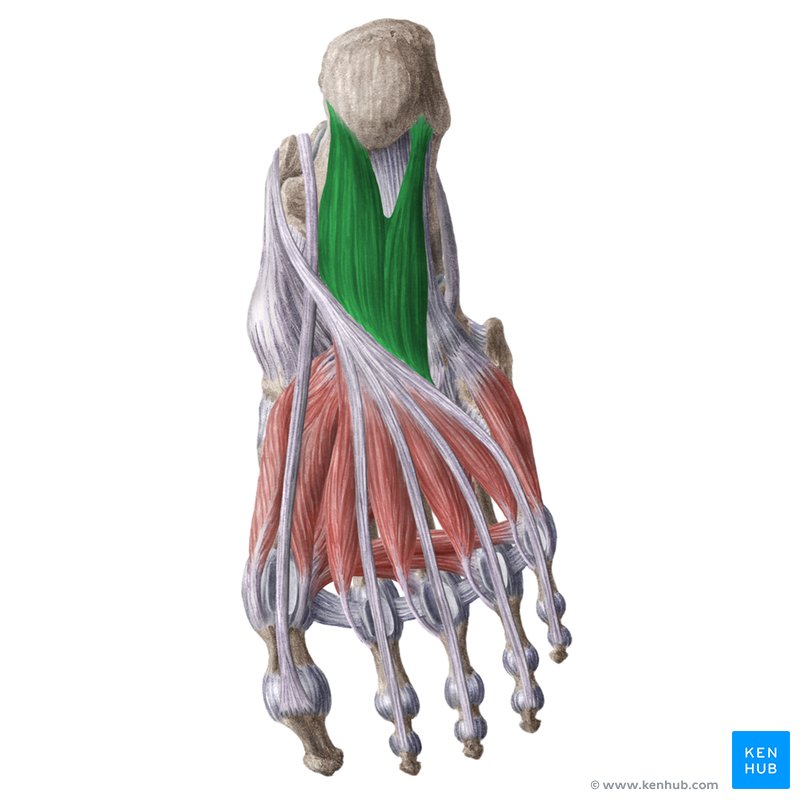
Quadratus Plantae
Origin: Medial and lateral sides of plantar surfaces of calcaneus. Insertion: Posterior, lateral aspect of flexor digitorum longus tendon. Action: Assist flexor digitorum longus to flex 2nd-5th toes. Innervation: Tibial S1, 2.

Plantar Interossei
Origin: Medial surfaces of 3rd-5th metatarsals. Insertion: Medial surfaces of proximal phalanges of 3rd-5th toes. Actions: 1. Adduct the 3rd-5th toes (metatarsophalangeal joints); 2. Flex the 3rd-5th toes (metatarsophalangeal joints). Innervation: Tibial S1, 2.

Dorsal Interossei
Origin: Adjacent surfaces of all metatarsals. Insertion: First: Medial surface of proximal phalanx of 2nd toe; Second through fourth: Lateral surfaces of proximal phalanges of 2nd-4th toes. Actions: 1. Abduct the 2nd-4th toes (metatarsophalangeal joints); 2. Flex the 2nd-4th toes (metatarsophalangeal joints). Innervation: Tibial S1, 2.

Lumbricals of the Foot
Origin: Tendons of flexor digitorum longus. Insertion: Bases of proximal phalanges of 2nd-5th toes and extensor digitorum longus tendons (on dorsal surface of the toes). Actions: 1. Flex the proximal phalanges of the 2nd-5th toes (metatarsophalangeal joints); 2. Extend the middle and distal phalanges of the 2nd-5th toes (interphalangeal joints). Innervation: First: Tibial L4, 5, S1; Second through fourth: Tibial L(4), (5), S1, 2.
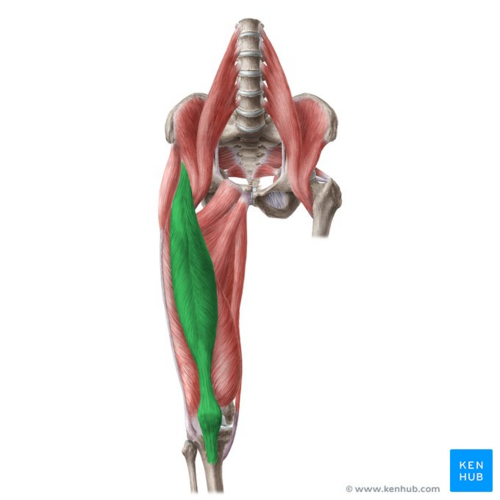
Rectus Femoris
Origin: Anterior inferior iliac spine. Insertion: Tibial tuberosity (via the patella and patellar ligament). Actions: 1. Extend the knee (tibiofemoral joint); 2. Flex the hip (coxal joint). Innervation: Femoral L2, 3, 4.

Vastus Medialis
Origin: Medial lip of linea aspera. Insertion: Tibial tuberosity (via the patella and patellar ligament). Action: Extend the knee (tibiofemoral joint). Innervation: Femoral L2, 3, 4.
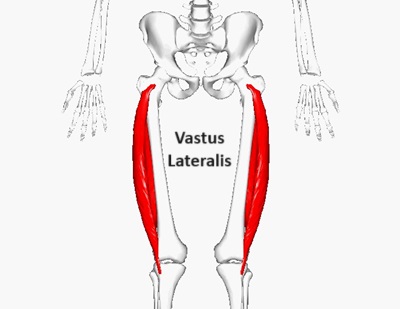
Vastus Lateralis
Origin: Lateral lip of linea aspera; gluteal tuberosity; and greater trochanter. Insertion: Tibial tuberosity (via the patella and patellar ligament). Action: Extend the knee (tibiofemoral joint). Innervation: Femoral L2, 3, 4.

Vastus Intermedius
Origin: Anterior and lateral shaft of the femur. Insertion: Tibial tuberosity (via the patella and patellar ligament). Action: Extend the knee (tibiofemoral joint). Innervation: Femoral L2, 3, 4.
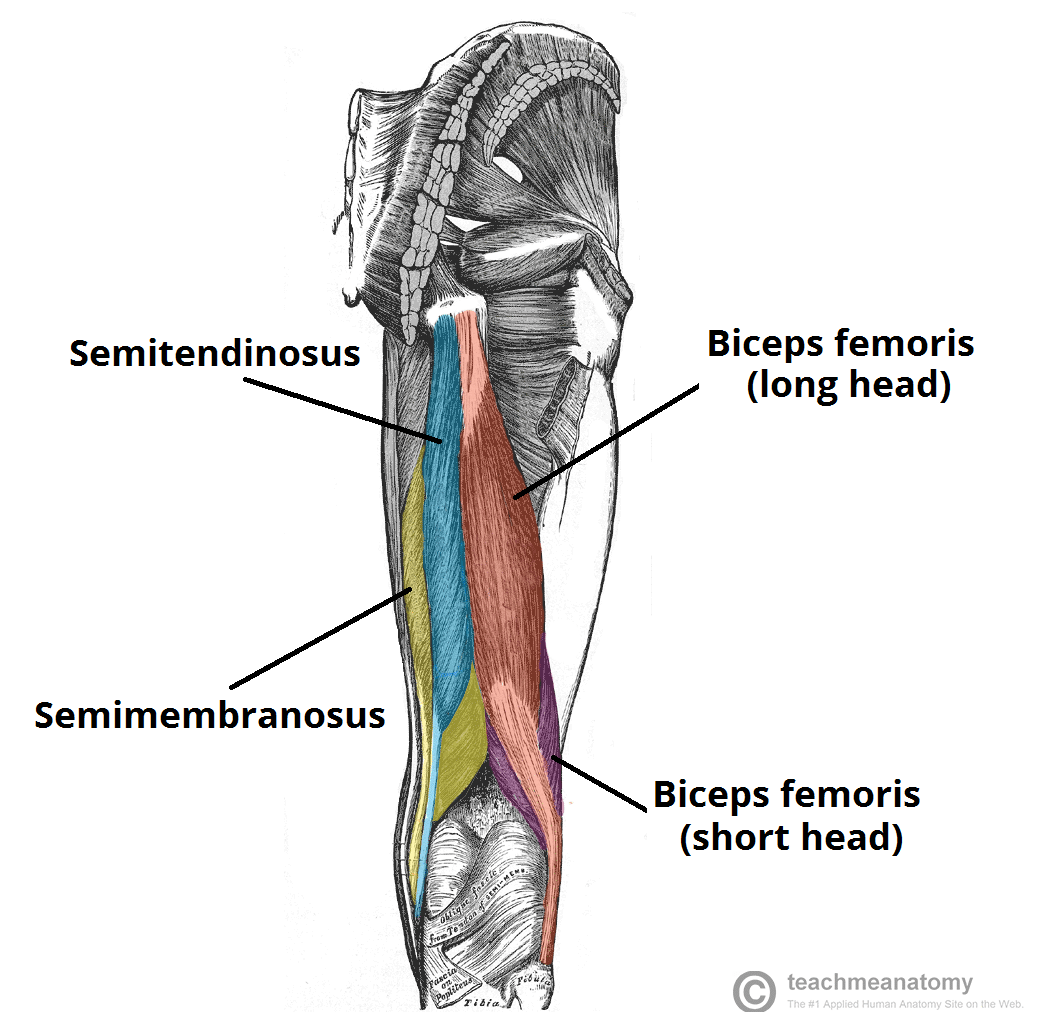
Biceps Femoris
Origin: Long head: Ischial tuberosity; Short head: lateral lip of linea aspera. Insertion: Head of the fibula. Actions: 1. Flex the knee (tibiofemoral joint); 2. Laterally rotate the flexed knee (tibiofemoral joint); 3. Long head: Extend the hip (coxal joint); 4. Long head: Assist to laterally rotate the hip (coxal joint); 5. Tilt the pelvis posteriorly. Innervation: Long head: Sciatic (tibial branch) L5, S1, 2, 3; Short head: Sciatic (fibular branch) L5, S1, 2.

Semitendinosus
Origin: Ischial tuberosity. Insertion: Proximal, medial shaft of the tibia at pes anserinus tendon. Actions: 1. Flex the knee (tibiofemoral joint); 2. Medially rotate the flexed knee (tibiofemoral joint); 3. Extend the hip (coxal joint); 4. Assist to medially rotate the hip (coxal joint); 5. Tilt the pelvis posteriorly. Innervation: Sciatic (tibial branch) L4, 5, S1, 2.

Semimembranosus
Origin: Ischial tuberosity. Insertion: Posterior aspect of medial condyle of tibia. Actions: 1. Flex the knee (tibiofemoral joint); 2. Medially rotate the flexed knee (tibiofemoral joint); 3. Extend the hip (coxal joint); 4. Assist to medially rotate the hip (coxal joint); 5. Tilt the pelvis posteriorly. Innervation: Sciatic (tibial branch) L4, 5, S1, 2.

Gluteus Maximus
Origin: Coccyx; edge of sacrum; posterior iliac crest; sacrotuberous and sacroiliac ligaments. Insertion: Iliotibial tract (upper fibers) and gluteal tuberosity (lower fibers). Actions: 1. Extend the hip (coxal joint); 2. Laterally rotate the hip (coxal joint); 3. Abduct the hip (coxal joint); 4. Lower fibers: Adduct the hip (coxal joint). Innervation: Inferior gluteal L5, S1, 2.

Gluteus Medius
Origin: Gluteal surface of the ilium between posterior and anterior gluteal lines, just below the iliac crest. Insertion: Lateral aspect of the greater trochanter. Actions: 1. All: Abduct the hip (coxal joint); 2. Anterior fibers: Flex the hip (coxal joint); 3. Anterior fibers: Medially rotate the hip (coxal joint); 4. Posterior fibers: Extend the hip; 5. Posterior fibers: Laterally rotate the hip (coxal joint). Innervation: Superior gluteal L4, 5, S1.

Gluteus Minimus
Origin: Gluteal surface of the ilium between the anterior and inferior gluteal lines. Insertion: Anterior aspect of greater trochanter. Actions: 1. Abduct the hip (coxal joint); 2. Medially rotate the hip (coxal joint); 3. Flex the hip (coxal joint). Innervation: Superior gluteal L4, 5, S1.

Adductor Magnus
Origin: Inferior ramus of the pubis; ramus of ischium; and ischial tuberosity. Insertion: Medial lip of linea aspera and adductor tubercle. Actions: 1. Adduct the hip (coxal joint); 2. Medially rotate the hip (coxal joint); 3. Assist to flex the hip (coxal joint); 4. Posterior fibers: Extend the hip (coxal joint). Innervation: Obturator L2, 3, 4, and Sciatic L4, 5, S1.
Adductor Longus
Origin: Pubic tubercle. Insertion: Medial lip of linea aspera. Actions: 1. Adduct the hip (coxal joint); 2. Medially rotate the hip (coxal joint); 3. Assist to flex the hip (coxal joint). Innervation: Obturator L2, 3, 4.
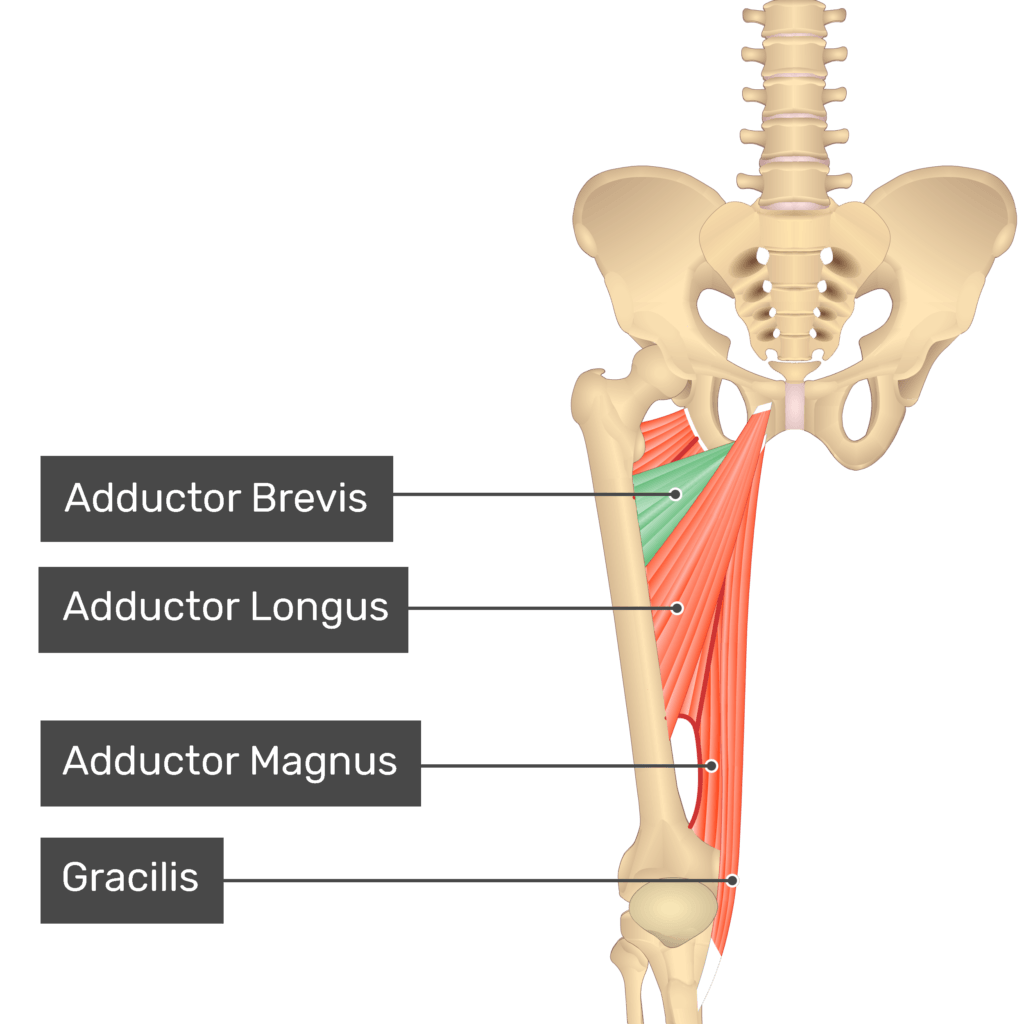
Adductor Brevis
Origin: Inferior ramus of pubis. Insertion: Pectineal line and medial lip of linea aspera. Actions: 1. Adduct the hip (coxal joint); 2. Medially rotate the hip (coxal joint); 3. Assist to flex the hip (coxal joint). Innervation: Obturator L2, 3, 4.

Pectineus
Origin: Superior ramus of pubis. Insertion: Pectineal line of femur. Actions: 1. Adduct the hip (coxal joint); 2. Medially rotate the hip (coxal joint); 3. Assist to flex the hip (coxal joint). Innervation: Femoral and Obturator L2, 3, 4.
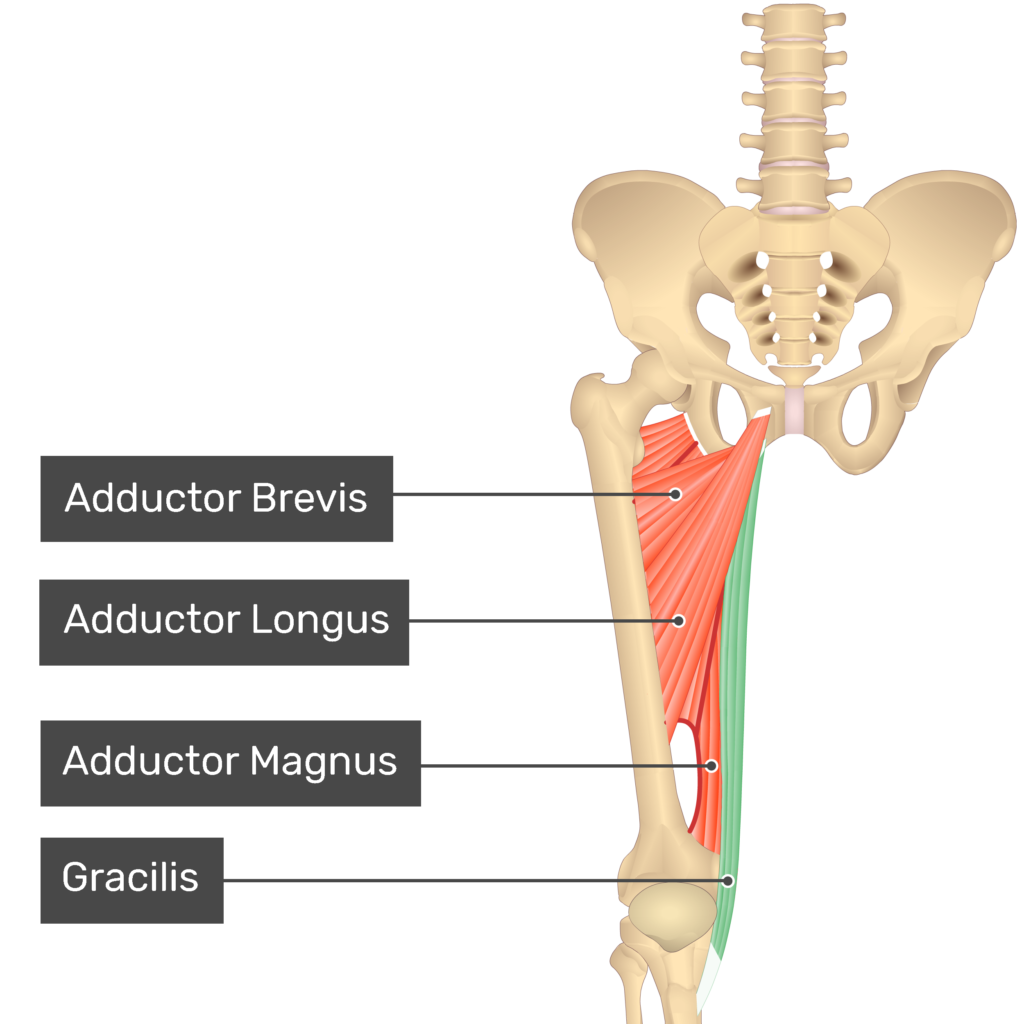
Gracilis
Origin: Inferior ramus of pubis. Insertion: Proximal, medial shaft of tibia at pes anserinus tendon. Actions: 1. Adduct the hip (coxal joint); 2. Medially rotate the hip (coxal joint); 3. Flex the knee (tibiofemoral joint); 4. Medially rotate the flexed knee (tibiofemoral joint). Innervation: Obturator L2, 3, 4.

Tensor Fasciae Latae
Origin: Iliac crest, posterior to the ASIS. Insertion: Iliotibial tract. Actions: 1. Flex the hip (coxal joint); 2. Medially rotate the hip (coxal joint); 3. Abduct the hip (coxal joint). Innervation: Superior gluteal L4, 5, S1.
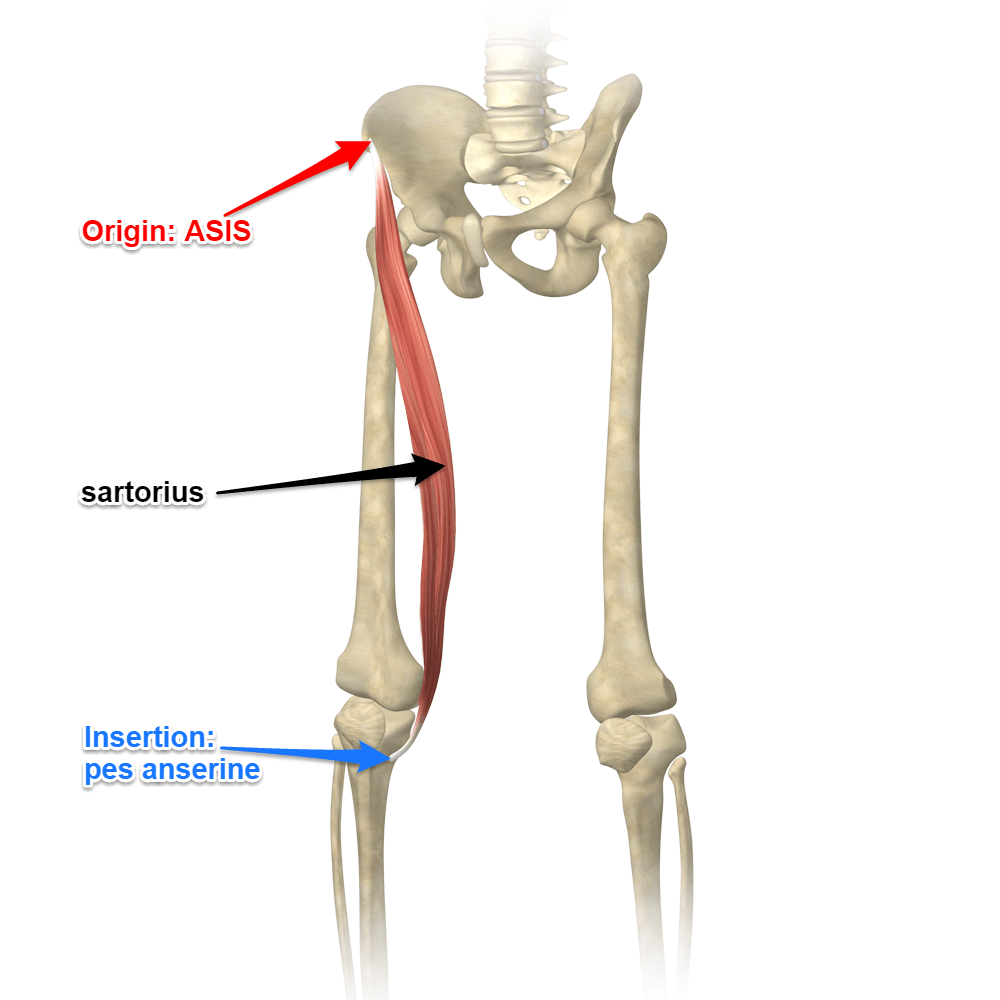
Sartorius
Origin: Anterior superior iliac spine. Insertion: Proximal, medial shaft of the tibia at pes anserinus tendon. Actions: 1. Flex the hip (coxal joint); 2. Laterally rotate the hip (coxal joint); 3. Abduct the hip (coxal joint); 4. Flex the knee (tibiofemoral joint); 5. Medially rotate the flexed knee (tibiofemoral joint). Innervation: Femoral L2, 3, (4).

Piriformis
Origin: Anterior surface of sacrum. Insertion: Superior aspect of greater trochanter. Actions: 1. Laterally rotate the hip (coxal joint); 2. Abduct the hip when the hip is flexed (fixed). Innervation: Sacral plexus L(5), S1, 2.

Quadratus Femoris
Origin: Lateral border of ischial tuberosity. Insertion: Intertrochanteric crest, between the greater and lesser trochanters. Action: Laterally rotate the hip (coxal joint). Innervation: Sacral plexus L4, 5, S1, (2).

Obturator Internus
Origin: Obturator membrane and inferior surface of obturator foramen. Insertion: Medial surface of greater trochanter. Action: Laterally rotate the hip (coxal joint). Innervation: Sacral plexus L5, S1, 2.
Obturator Externus
Origin: Rami of pubis and ischium; and obturator membrane. Insertion: Trochanteric fossa of femur. Action: Laterally rotate the hip (coxal joint). Innervation: Obturator L3, 4.
Gemellus Superior
Origin: Ischial spine. Insertion: Medial surface of greater trochanter. Action: Laterally rotate the hip (coxal joint). Innervation: Sacral plexus L5, S1, 2.
Gemellus Inferior
Origin: Ischial tuberosity. Insertion: Medial surface of greater trochanter. Action: Laterally rotate the hip (coxal joint). Innervation: Sacral plexus L4, 5, S1, (2).
Psoas Major
Origin: Bodies and transverse processes of lumbar vertebrae. Insertion: Lesser trochanter. Actions: 1. With the origin fixed: Flex the hip (coxal joint); 2. With the origin fixed: May laterally rotate the hip (coxal joint); 3. With the insertion fixed: Flex the trunk toward the thigh; 4. With the insertion fixed: Tilt pelvis anteriorly; 5. Unilaterally: Assist to laterally flex the lumbar spine. Innervation: Lumbar plexus L1, 2, 3, 4.
Iliacus
Origin: Iliac fossa. Insertion: Lesser trochanter. Actions: 1. With the origin fixed: Flex the hip (coxal joint); 2. With the origin fixed: May laterally rotate the hip (coxal joint); 3. With the insertion fixed: Flex the trunk toward the thigh; 4. With the insertion fixed: Tilt pelvis anteriorly. Innervation: Femoral L(1), 2, 3, 4.
Psoas Minor
Origin: Body and transverse process of the first lumbar vertebra. Insertion: Superior ramus of pubis. Actions: 1. Assist to create lordotic curvature in the lumbar spine; 2. Tilt pelvis posteriorly. Innervation: Lumbar plexus L1, 2.
Erector Spinae Group
Origin: Common tendon (thoracolumbar fascia) that attaches to the posterior surface of sacrum; iliac crest; spinous processes of the lumbar and last two thoracic vertebrae. Insertion: Various attachments at the posterior ribs, spinous and transverse processes of thoracic and cervical vertebrae, and mastoid process of temporal bone. Actions: 1. Unilaterally: Laterally flex vertebral column to the same side; 2. Bilaterally: Extend the vertebral column. Innervation: Spinal.
Spinalis
Origin: Spinous processes of the upper lumbar and lower thoracic vertebrae (thoracics); and ligamentum nuchae, spinous process of C7 (cervicis). Insertion: Spinous processes of upper thoracic (thoracis); and spinous processes of cervicals, except C1 (cervicis). Actions: 1. Unilaterally: Laterally flex vertebral column to the same side; 2. Bilaterally: Extend the vertebral column. Innervation: Spinal.
Longissimus
Origin: Common tendon (thoracics); and Transverse processes of upper five thoracic vertebrae (cervicis and capitis). Insertion: Lower nine ribs and transverse processes of thoracic vertebrae (thoracis); Transverse processes of cervical vertebrae (cervicis); and Mastoid process of temporal bone (capitis). Actions: 1. Unilaterally: Laterally flex vertebral column to the same side; 2. Bilaterally: Extend the vertebral column. Innervation: Spinal.
Iliocostalis
Origin: Common tendon (lumborum); and Posterior surface of ribs 1-12 (thoracis and cervicis). Insertion: Transverse processes of lumbar vertebrae 1-3 and posterior surface of the ribs 6-12 (lumborum); Posterior surface of ribs 1-6 (thoracis); and Transverse processes of lower cervicals (cervicis). Actions: 1. Unilaterally: Laterally flex vertebral column to the same side; 2. Bilaterally: Extend the vertebral column. Innervation: Spinal.
Multifidus
Origin: Sacrum and transverse processes of lumbar through cervical vertebrae. Insertion: Spinous processes of lumbar vertebrae through second cervical vertebra (spanning two to four vertebrae). Actions: 1. Unilaterally: Rotate the vertebral column to the opposite side; 2. Bilaterally: Extend the vertebral column. Innervation: Spinal.
Rotatores
Origin: Transverse processes of lumbar through cervical vertebrae. Insertion: Spinous processes of lumbar vertebrae through second cervical vertebra (spanning one to two vertebrae). Actions: 1. Unilaterally: Rotate the vertebral column to the opposite side; 2. Bilaterally: Extend the vertebral column. Innervation: Spinal.
Semispinalis Capitis
Origin: Transverse processes of C4-T5. Insertion: Between the superior and inferior nuchal lines of the occiput. Action: Extend the vertebral column and head. Innervation: Cervical.
Splenius Capitis
Origin: Inferior one-half of ligamentum nuchae and spinous processes of C7-T4. Insertion: Mastoid process and lateral portion of superior nuchal line. Actions: 1. Unilaterally: Rotate the head and neck to the same side; 2. Unilaterally: Laterally flex the head and neck to the same side; 3. Bilaterally: Extend the head and neck. Innervation: Cervical.
Splenius Cervicis
Origin: Spinous processes of T3-T6. Insertion: Transverse processes of C1-C3. Actions: 1. Unilaterally: Rotate the head and neck to the same side; 2. Unilaterally: Laterally flex the head and neck to the same side; 3. Bilaterally: Extend the head and neck. Innervation: Cervical.
Rectus Capitis Posterior Major
Origin: Spinous process of the axis (C2). Insertion: Inferior nuchal line of the occiput. Actions: 1. Rock and tilt the head back into extension; 2. Rotate the head to the same side. Innervation: Suboccipital.
Rectus Capitis Posterior Minor
Origin: Tubercle of the posterior arch of the atlas (C1). Insertion: Inferior nuchal line of the occiput. Action: Rock and tilt the head back into extension. Innervation: Suboccipital.
Oblique Capitis Superior
Origin: Transverse process of the atlas (C1). Insertion: Between the nuchal lines of the occiput. Actions: 1. Rock and tilt the head back into extension; 2. Laterally flex the head to the same side. Innervation: Suboccipital.
Oblique Capitis Inferior
Origin: Spinous process of the axis (C2). Insertion: Transverse process of the atlas (C1). Action: Rotate the head to the same side. Innervation: Suboccipital.
Quadratus Lumborum
Origin: Posterior iliac crest. Insertion: Last rib and transverse processes of L1-L4. Actions: 1. Unilaterally: Laterally tilt (elevate) the pelvis; 2. Unilaterally: Laterally flex the vertebral column to the same side; 3. Bilaterally: Fix the last rib during forced inhalation and exhalation; 4. Bilaterally: Assist to extend the vertebral column. Innervation: Lumbar plexus T12, L1, 2, 3.
Rectus Abdominis
Origin: Pubic crest and pubic symphysis. Insertion: Cartilage of fifth, sixth, and seventh ribs; and xiphoid process. Actions: 1. Flex the vertebral column; 2. Tilt pelvis posteriorly. Innervation: T5, 6, T7-11, T12, ventral rami.
External Oblique
Origin: External surfaces of fifth to twelfth ribs. Insertion: Anterior part of the Iliac crest; rectus sheath to linea alba. Actions: 1. Unilaterally: Laterally flex the vertebral column to the same side; 2. Unilaterally: Rotate the vertebral column to the opposite side; 3. Bilaterally: Flex the vertebral column; 4. Bilaterally: Compress abdominal contents. Innervation: T5, 6, T7-11, T12.
Internal Oblique
Origin: Lateral inguinal ligament; iliac crest; and thoracolumbar fascia. Insertion: Internal surface of lower three ribs; rectus sheath to linea alba. Actions: 1. Unilaterally: Laterally flex the vertebral column to the same side; 2. Unilaterally: Rotate the vertebral column to the same side; 3. Bilaterally: Flex the vertebral column; 4. Bilaterally: Compress abdominal contents. Innervation: T7, 8, T9-12, L1, iliohypogastric and ilioinguinal, ventral rami.
Transverse Abdominis
Origin: Lateral inguinal ligament; iliac crest; thoracolumbar fascia; and internal surface of lower six ribs. Insertion: Rectus sheath to linea alba. Action: Compress abdominal contents. Innervation: T7-12, L1, iliohypogastric and ilioinguinal, ventral divisions.
Diaphragm
Origin: Costal attachment: inner surface of lower six ribs; Lumbar attachment: upper two or three lumbar vertebrae; Sternal attachment: inner part of xiphoid process. Insertion: Central tendon. Actions: 1. Draw down the central tendon of the diaphragm; 2. Increase the volume of the thoracic cavity during inhalation. Innervation: Phrenic C3, 4, 5.
External Intercostals
Origin: Inferior border of the rib above. Insertion: Superior border of the rib below. Action: Draw the ribs superiorly (increasing the space of the thoracic cavity) to assist with inhalation. Innervation: Thoracic.
Internal Intercostals
Origin: Inferior border of the rib above. Insertion: Superior border of the rib below. Action: Draw the ribs inferiorly (decreasing the space of the thoracic cavity) to assist with exhalation. Innervation: Thoracic.
Serratus Posterior Superior
Origin: Spinous processes of C7-T3. Insertion: Posterior surface of second through fifth ribs. Action: Elevate the ribs during inhalation. Innervation: T1, 2, 3, 4.
Serratus Posterior Inferior
Origin: Spinous processes of T12-L3. Insertion: Posterior surface of ninth through twelfth ribs. Action: Depress the ribs during exhalation. Innervation: T9, 10, 11, (12).
Intertransversarii
Origin: Cervical: spanning the transverse processes of C2-C7; Lumbar: spanning the transverse processes of L1-L5. Actions: 1. Unilaterally: Laterally flex the vertebral column to the same side; 2. Bilaterally: Extend the vertebral column. Innervation: Spinal.
Interspinalis
Origin: Cervical: spanning the spinous processes of C2-T3; Lumbar: spanning the spinous processes of T12-L5. Action: Extend the vertebral column. Innervation: Spinal.
Sternocleidomastoid
Origin: Sternal head: top of manubrium; Clavicular head: medial one-third of the clavicle. Insertion: Mastoid process of the temporal bone and the lateral portion of the superior nuchal line of the occiput. Actions: 1. Unilaterally: Laterally flex the head and neck to the same side; 2. Unilaterally: Rotate the head and neck to the opposite side; 3. Bilaterally: Flex the neck; 4. Bilaterally: Assist to elevate the rib cage during inhalation. Innervation: Spinal accessory (XI), C2, 3.
Anterior Scalene
Origin: Transverse processes of C3-C6 (anterior tubercles). Insertion: First rib. Actions: 1. Unilaterally: Laterally flex the head and neck to the same side (w/ ribs fixed); 2. Unilaterally: Rotate the head and neck to the opposite side; 3. Bilaterally: Elevate the ribs during inhalation; 4. Bilaterally: Flex the head and neck. Innervation: C(3), 4-8.
Middle Scalene
Origin: Transverse processes of C2-C7 (posterior tubercles). Insertion: First rib. Actions: 1. Unilaterally: Laterally flex the head and neck to the same side (w/ ribs fixed); 2. Unilaterally: Rotate the head and neck to the opposite side; 3. Bilaterally: Elevate the ribs during inhalation. Innervation: C(3), 4-9.
Posterior Scalene
Origin: Transverse processes of C6-C7 (posterior tubercles). Insertion: Second rib. Actions: 1. Unilaterally: Laterally flex the head and neck to the same side (w/ ribs fixed); 2. Unilaterally: Rotate the head and neck to the opposite side; 3. Bilaterally: Elevate the ribs during inhalation. Innervation: C(3), 4-10.
Deltoid
Origin: Lateral one-third of clavicle; acromion; and spine of scapula. Insertion: Deltoid tuberosity. Actions: 1. All fibers: abduct the shoulder (glenohumeral joint); 2. Anterior fibers: Flex the shoulder (glenohumeral joint); 3. Anterior fibers: Medially rotate the shoulder (glenohumeral joint); 4. Anterior fibers: Horizontally adduct the shoulder (glenohumeral joint); 5. Posterior fibers: Extend the shoulder (glenohumeral joint); 6. Posterior fibers: Laterally rotate the shoulder (glenohumeral joint); 7. Posterior fibers: Horizontally abduct the shoulder (glenohumeral joint). Innervation: Axillary C5, 6.
Trapezius
Origin: External occipital protuberance; medial portion of superior nuchal line of the occiput; ligamentum nuchae; and spinous processes of C7-T12. Insertion: Lateral one-third of clavicle; acromion; and spine of the scapula. Actions: 1. Upper fibers, bilaterally: Extend the head and neck; 2. Upper fibers, unilaterally: Laterally flex the head and neck to the same side; 3. Upper fibers, unilaterally: Rotate the head and neck to the opposite side; 4. Upper fibers, unilaterally: Elevate the scapula (scapulothoracic joint); 5. Upper fibers, unilaterally: Upwardly rotate the scapula (scapulothoracic joint); 6. Middle fibers: Adduct the scapula (scapulothoracic joint); 7. Middle fibers: Stabilize the scapula; 8. Lower fibers: Depress the scapula (scapulothoracic joint); 9. Lower fibers: Upwardly rotate the scapula (scapulothoracic joint). Innervation: Spinal portion of accessory (XI) and ventral ramus C2, 3, 4.
Latissimus Dorsi
Origin: Inferior angle of scapula; spinous processes of last six thoracic vertebrae; last three or four ribs; thoracolumbar fascia; and posterior iliac crest. Insertion: Intertubercular groove of the humerus. Actions: 1. Extend the shoulder (glenohumeral joint); 2. Adduct the shoulder (glenohumeral joint); 3. Medially rotate the shoulder (glenohumeral joint). Innervation: Thoracodorsal C6, 7, 8.
Teres Major
Origin: Inferior angle and lower one-third of lateral border of the scapula. Insertion: Crest of the lesser tubercle of the humerus. Actions: 1. Extend the shoulder (glenohumeral joint); 2. Adduct the shoulder (glenohumeral joint); 3. Medially rotate the shoulder (glenohumeral joint). Innervation: Lower subscapular C5, 6, 7.
Supraspinatus
Origin: Supraspinous fossa of the scapula. Insertion: Greater tubercle of the humerus. Actions: 1. Abduct the shoulder (glenohumeral joint); 2. Stabilize the head of the humerus in the glenoid cavity. Innervation: Suprascapular C4, 5, 6.
Infraspinatus
Origin: Infraspinous fossa of the scapula. Insertion: Greater tubercle of the humerus. Actions: 1. Laterally rotate the shoulder (glenohumeral joint); 2. Adduct the shoulder (glenohumeral joint); 3. Stabilize the head of the humerus in the glenoid cavity. Innervation: Suprascapular C(4), 5, 6.
Teres Minor
Origin: Upper two-thirds of the lateral border of the scapula. Insertion: Greater tubercle of the humerus. Actions: 1. Laterally rotate the shoulder (glenohumeral joint); 2. Adduct the shoulder (glenohumeral joint); 3. Stabilize the head of the humerus in the glenoid cavity. Innervation: Axillary C5, 6.
Subscapularis
Origin: Subscapular fossa of the scapula. Insertion: Lesser tubercle of the humerus. Actions: 1. Medially rotate the shoulder (glenohumeral joint); 2. Stabilize the head of the humerus in the glenoid cavity. Innervation: Upper and lower subscapular C5, 6, 7.
Rhomboid Major
Origin: Spinous processes of T2-T5. Insertion: Medial border of the scapula between the spine of the scapula and inferior angle. Actions: 1. Adduct the scapula (scapulothoracic joint); 2. Elevate the scapula (scapulothoracic joint); 3. Downwardly rotate the scapula (scapulothoracic joint). Innervation: Dorsal scapular C4, 5.
Rhomboid Minor
Origin: Spinous processes of C7-T1. Insertion: Upper portion of the medial border of the scapula, across from the spine of the scapula. Actions: 1. Adduct the scapula (scapulothoracic joint); 2. Elevate the scapula (scapulothoracic joint); 3. Downwardly rotate the scapula (scapulothoracic joint). Innervation: Dorsal scapular C4, 6.
Levator Scapula
Origin: Transverse processes of C1-C4. Insertion: Medial border of the scapula between the superior angle and superior portion of the spine of the scapula. Actions: 1. Unilaterally: Elevate the scapula (scapulothoracic joint); 2. Unilaterally: Downwardly rotate the scapula (scapulothoracic joint); 3. Unilaterally: Laterally flex the head and neck; 4. Unilaterally: Rotate the head and neck to the same side; 5. Bilaterally: Extend the head and neck. Innervation: Cervical 3, 4 and dorsal scapular C4, 5.
Serratus Anterior
Origin: External surfaces of upper eight or nine ribs. Insertion: Anterior surface of the medial border of the scapula. Actions: 1. With the origin fixed: Abduct the scapula (scapulothoracic joint); 2. With the origin fixed: Upwardly rotate the scapula (scapulothoracic joint); 3. With the origin fixed: Depress the scapula (scapulothoracic joint); 4. With the origin fixed: Hold the medial border of the scapula against the rib cage; 5. With the scapula fixed: May act to elevate the thorax during forced inhalation. Innervation: Long thoracic C5, 6, 7, 8.
Pectoralis Major
Origin: Medial half of the clavicle; sternum; and cartilage of the first through sixth ribs. Insertion: Crest of the greater tubercle of the humerus. Actions: 1. Adduct the shoulder (glenohumeral joint); 2. Medially rotate the shoulder (glenohumeral joint); 3. With the arm fixed: Assist to elevate the thorax during forced inhalation; 4. Upper fibers: Flex the shoulder (glenohumeral joint); 5. Upper fibers: Horizontally adduct the shoulder (glenohumeral joint); 6. Lower fibers: Extend the shoulder (glenohumeral joint). Innervation: Upper fibers: Lateral pectoral C5, 6, 7; Lower fibers: Lateral and medial pectoral C6, 7, 8, T1.
Pectoralis Minor
Origin: Third, fourth, and fifth ribs. Insertion: Medial surface of the coracoid process of the scapula. Actions: 1. Depress the scapula (scapulothoracic joint); 2. Abduct the scapula (scapulothoracic joint); 3. Downwardly rotate the scapula (scapulothoracic joint); 4. With the scapula fixed: Assist to elevate the thorax during forced inhalation. Innervation: Medial pectoral, with fibers from a communicating branch of the lateral pectoral C(6), 7, 8, T1.
Subclavius
Origin: First rib and cartilage. Insertion: Inferior surface of the middle one-third of clavicle. Actions: 1. Depress the clavicle and draw it anteriorly; 2. Elevate the first rib (to assist during inhalation); 3. Stabilize the sternoclavicular joint. Innervation: Subclavian C5, 6.
Biceps Brachii
Origin: Short head: coracoid process of scapula; Long head: supraglenoid tubercle of scapula. Insertion: Tuberosity of the radius and aponeurosis of the biceps brachii. Actions: 1. Flex the elbow (humeroulnar joint); 2. Supinate the forearm (radioulnar joint); 3. Flex the shoulder (glenohumeral joint). Innervation: Musculocutaneous C5, 6.
Triceps Brachii
Origin: Long head: infraglenoid tubercle of the scapula; Lateral head: posterior surface of proximal half of the humerus; Medial head: posterior surface of distal half of the humerus. Insertion: Olecranon process of the ulna. Actions: 1. Extend the elbow (humeroulnar joint); 2. Long head: Extend the shoulder (glenohumeral joint); 3. Long head: Adduct the shoulder (glenohumeral joint). Innervation: Radial C6, 7, 8, T1.
Coracobrachialis
Origin: Coracoid process of the scapula. Insertion: Medial surface of the mid-humeral shaft. Actions: 1. Flex the shoulder (glenohumeral joint); 2. Adduct the shoulder (glenohumeral joint). Innervation: Musculocutaneous C6, 7.
Brachialis
Origin: Distal half of the anterior surface of the humerus. Insertion: Tuberosity and coronoid process of the ulna. Action: Flex the elbow (humeroulnar joint). Innervation: Musculocutaneous, small branch from radial C5, 6.
Brachioradialis
Origin: Proximal two-thirds of the lateral supracondylar ridge of the humerus. Insertion: Styloid process of the radius. Actions: 1. Flex the elbow (humeroulnar joint); 2. Assist to pronate and supinate the forearm when these movements are resisted (humeroradial joint). Innervation: Radial C5, 6.
Extensor Carpi Radialis Longus
Origin: Distal one-third of the lateral supracondylar ridge of the humerus. Insertion: Base of the second metacarpal. Actions: 1. Extend the wrist (radiocarpal joint); 2. Abduct the wrist (radiocarpal joint); 3. Assist to flex the elbow (humeroulnar joint). Innervation: Radial C5, 6, 7, 8.