203 – Organic chemistry
 Call Kai
 Learn
 Practice Test
 Spaced Repetition
 Match
 Flashcards
 Knowt Play
1/136

There's no tags or description
Looks like no tags are added yet.
137 Terms
Identifying the nucleophile
lone pair
negative charge
C=C double bond
σ Bond to an electropositive atom
curved arrows always from nucleophile to electrophile
configurational isomers
isomers in which bond rotation (only allowed on single bond) does not interconvert them.
two possibilities
Enantiomers: mirror image from each other, not superimposable (both configurations are changed)
Diastereomers: stereoisomers not related to each other through a mirror image (only one configuration is changed)
racemic mixture
a 50:50 mixture of two enantiomers
identifying a chiral molecule
carbon with four different substituents
no plane of symmetry
Assining priority
atoms with higher atomic numbers get higher priority
clockwise → R-compound
polarimetry
The observation of the rotation of plane-polarized light by an enantiomer. This is the only way of finding out if a sample is racemic or if it contains more of one enantiomer.
specific rotation α
The observed angle through which. the light is rotated given by α is obtained by dividing the path lenght (in dm) through the concentration. Typically measured at 20°C and 589nm. the one enantiomers which rotates the light to the right is given (+/D)
Number of stereoisomers
Usually, a structure with n stereo centers can exist as 2n stereoisomers. These stereoisomers consist of 2n−1 diasteroisomers, each of which has a pair of enantiomers.
Meso compound
a compound with a sterogenic center, but they are achiral as whole compound.
Separating enantiomers
This process is called resolution a can be don by reacting a racemic mixture with an enantiomerically pure compound. This reaction will lead to diastereoisomers, which can easily be separated. Another, but very expensive method is making a column chromatography with an enantiomerically pure stationary phase.
nucleophilic addition to the carbonyl group
Additions generally consist of 2 steps:
nucleophilic attack on the carbonyl group (a new C-C bond is formed, and the π electrones of the C=O bond are resonated on the Oxygen)
protonation of the alkoxide anion that results
orbitals explain the reactivity:
the π bond is skewed towards oxygen because of the higher electronegativity. Conversely, the unfilled π∗ antibonding has a larger coefficient at the carbon atom
During the reaction the electrones move from th HOMO of the nucleophile to the LUMO of the electrophile (in this case to the π∗)
orbital overlap is only efficient when the size and diffusity are similar.
Another factor regarding the reactivity are sterics:
aldehydes are less stericly hindred than Ketones therefore they react faster (Formaldehyde CH2O is an extremely reactive aldehyde)
electronic effects:
an electronegative atom bound to the carbon can also increase the reactivity, because they increase the polarization of the carbonyl group.
releasing strain:
especially on small rings addition to the C=O bond can release strain, therefore are compounds such as cyclopropanone and cyclobutanone very reactive electrophiles.
Typical Nucleophiles for the reaction with a carbonyl compund
BH4 (only reacts with aldehydes or ketones) resulting in a alcohol
H2O
Alcohols (which results in a hemiacetal (OH & OR bound to the same Carbon)) the reaction rate can be increased by adding an acid or base catalyst
→ a formation of an hemiacetal can also be intermolecularBisulfides such as NaHSO3 (the attack occurs from the lone pair of the sulfur to the carbonyl group) → this products are usefull for crystallization of liquid aldehydes and making aldehydes soluble in water
Hemiacteal formation
If you want to work out which is the original alcohol and which is the carbonyl compound in a hemiacetal, you simply need to identify which carbon atom has two bonds to the oxygen; this is the carbonyl compound.
Polarization of an carbon-metal bond
unlike the C=O bond an carbon-metal bond is polarized towards the carbon, making it a nucleophilic center. Metals such as LI,Mg,Na,Al have all a lower electronegativity than carbon.
Grignard reagents
Are very good reagent as they react with Methyl, primary, secondary and tertiary alkyl halides. But the reagent cannot contain a functional group which could react with the Grignard. (Grignard reagents are very strong bases)
Mechanism:
the reaction takes place on the surface of magnesium
it involves an insertion of magnesium into the carbon-halogen bond
magnesium is oxidized Mg(0) to Mg(II)
Organolithium reagents
The reagent cannot contain a functional group which could react with the Grignard. (organolithium reagents are very strong bases)
Mechanism:
because lithium can only donate one electron, two Li are needed to donate one electron to the halide and on to the carbon
it involves an insertion of lithium into the carbon-halogen bond
lithium is oxidized Li(0) to Li(I)
making organometallic by deprotonating alkynes
Alkynes are the most acidic of hydrocarbons, with pKas of about 25. They can be deprotonated by more basic organometallics such as butyllithium or ethylmagnesium bromide. Alkynes are sufficiently acidic to be deprotonated even by nitrogen bases. This results in am organometallic reagent.
making organometallic by halogen-metal exchange
organolithiums remove halogen atom from aryl or vinyl compound and the metal takes the place of the halogen.
making organometallic by transmetallation
Organolithiums can be converted to other types of organometallic reagents by transmetallation-simply treating with the salt of a less electropositive metal. The more electropositive Mg or Li goes into solution as an ionic salt, while the less electropositive metal such as Zn takes over the alkyl group. The high reactivity of Grignard reagents and organolithiums sometimes causes unwanted side reactions when they combine with very strong electrophiles (such as acid chlorides). The reaction is more under control when a much less reactive organozinc compound is used.
making carboxylic acids from organometallic and carbon dioxide
Carbon dioxide reacts with organolithiums and Grignard reagents to give carboxylate salts. Protonating the salt with acid gives a carboxylic acid with one more carbon atom than the starting organometallic.
Important details:
each step of the reaction is completed before the next is begun
there is no water present during the first two steps

making primary alcohols from organometallics and formaldehyde
Formaldehyde react with organolithiums or Grignard reagents to form primary alcohols. In order to get pure, dry formaldehyde it is necessary to heat ('crack') the polymer (CH,O)n to decompose it.

Making secondary and tertiary alcohols using organometallic reagents
Aldehydes: secondary
ketones: tertiary

making a secondary alcohol by reduction
one can reduce a ketone to obtain a secondary alcohol with for example NaBH4
Oxidation of alcohols
Cr(IV) (orange) compounds are good oxidizing agents: they remove hydrogen from organic compounds and are themselves reduced to Cr(III) (green). Some of the important reagents are related to the polymeric oxide (CrO3)Such as:
PDC
PCC
(Ca(OCl)2 is much stronger)
are preferred reagents especially as they are soluble in organic solvents
Mechanism:
one hydrogen is removed from the OH group
the second is removed from the carbon
stronger reagents may oxidize primary alcohols all the way to carboxylic acid, especially when water is involved.

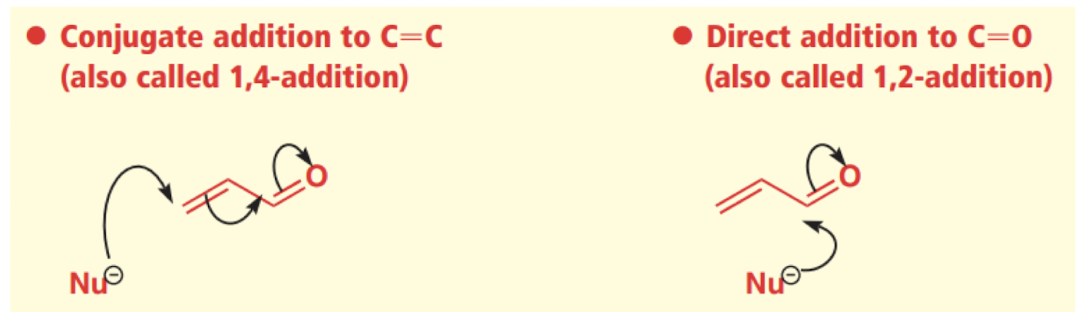
difference between conjugate addition and nucleophilic addition
Nucleophilic addition: nucleophile addition to C=O bond.
Conjugate addition: nucleophile addition to the C=C double bond of α,β unsaturated carbonyl compounds. (conjugated to =O bond)




when do nucleophiles do a conjugate addition an when directly to the carbonyl group
conditions of the reaction
→ 1,2 addition is faster (kinetic product) → lower temperatures shorter reaction time
→1,4 is more stable (thermodynamic product) → higher temperatures longer reaction timesthe nature of the α,β- unstaturated carbonyl compund
→ the more reactive the carbonyl group, the more addition (more reactive when O=C-Cl)type of the nucleophile
→ hard (rather 1,2 because they are dominated by charges and electrostatics) or soft (rather 1,4 because they are dominated by orbital effects)
Why is direct (1,2) addition faster
Although the carbon atom ß to the C=O group carries some positive charge, the carbon atom of the carbonyl group carries more, and so electrostatic attraction for the charged nucleophiles will encourage it to attack the carbonyl group directly rather than undergo conjugate addition.
Why is conjugate addition more stable
In the conjugate addition product, we gain a C-C σ bond, losing a C=C π bond, but keeping the C=0 π bond. With direct addition, we still gain a C-C bond, but we lose the C=O π bond and keep the C=C π bond. C=O π bonds are stronger than C=C π bonds, so the conjugate addition product is more stable.
Thiols as nucleophiles in conjugate addition
on of the best nucleophiles for 1,4 addition. Remarkably no acid/base catalyst is needed


Base deprotoniert den Alkohol zu einer kleinen Menge Alkoxid (da der pKa des Alkohols etwas höher ist als der von Wasser)
Sie sind weicher (soft) als Grignards und addieren an die weichere C=C-Doppelbindung
Cu ist diffus → guter Orbitalüberlapp und bessere Affinität zur β-Position




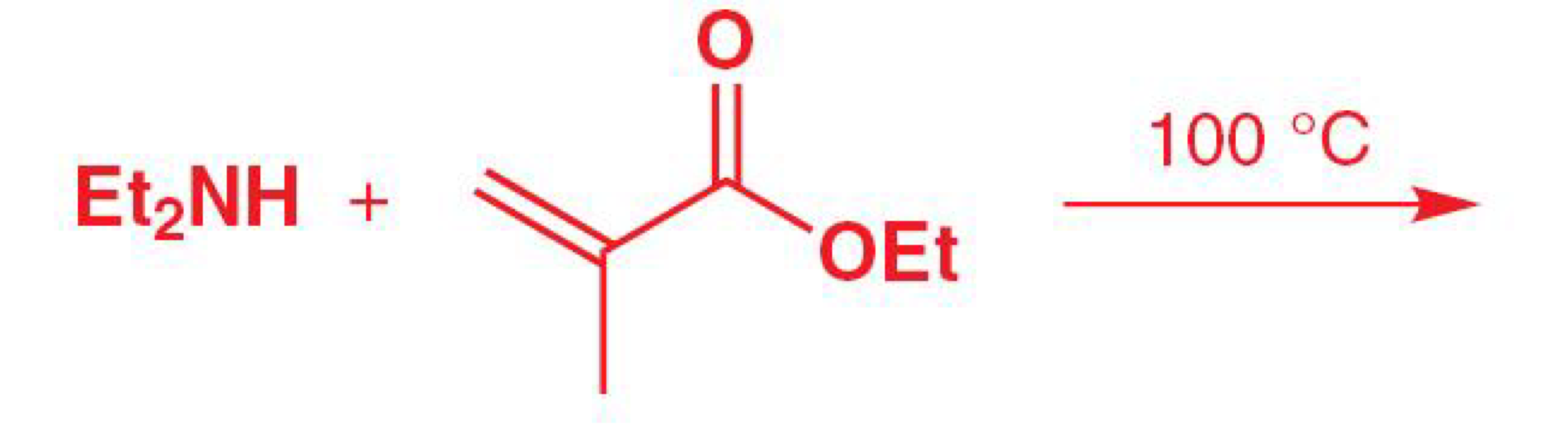
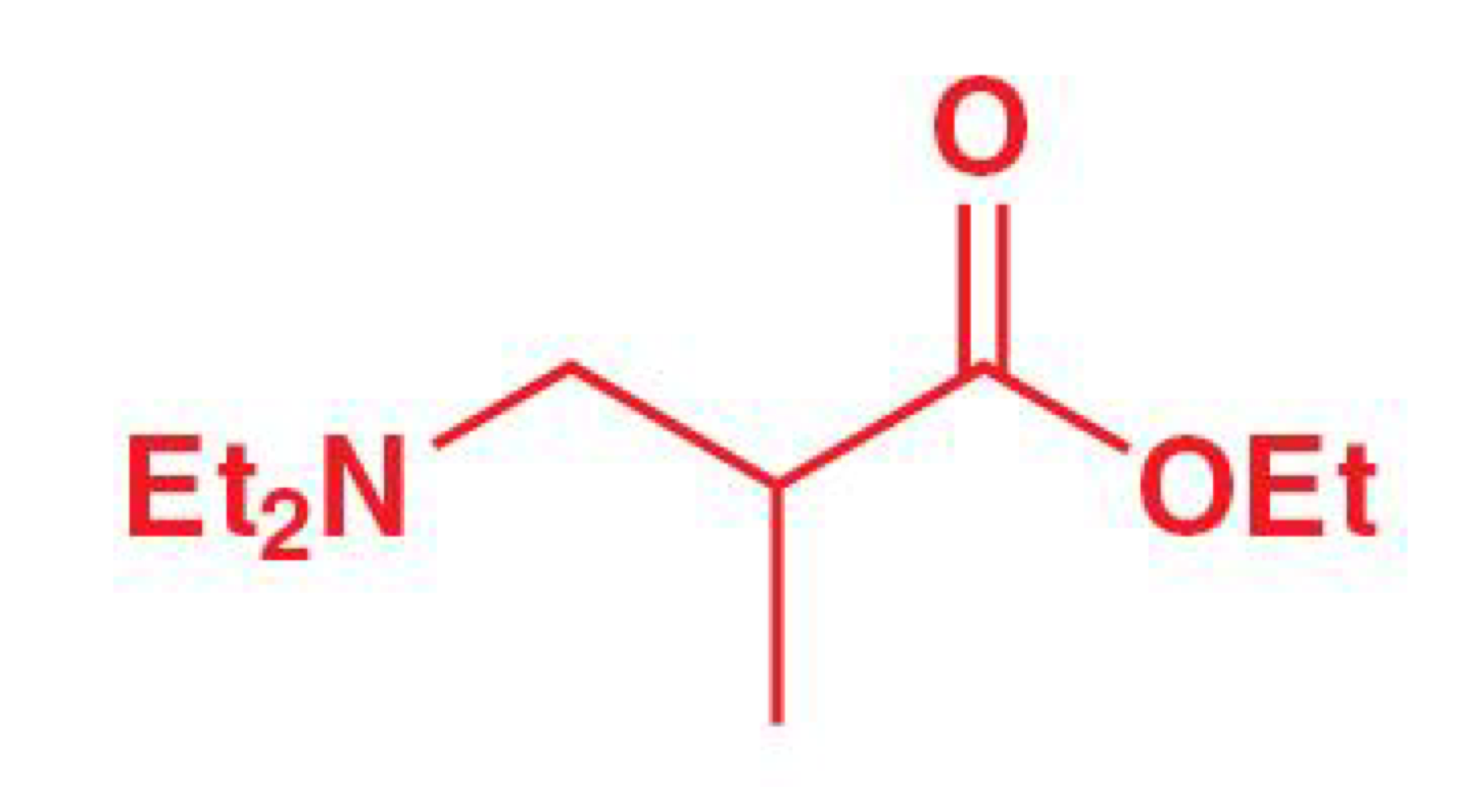
Was ist Cyanoethylierung?
Konjugierte Addition eines Nucleophils (z. B. Et₂NH) an Acrylnitril → Aminonitril (86 % Ausbeute)

Wie wird das Produkt der Cyanoethylierung gebildet?
Protonierung am Kohlenstoff stellt das Nitril wieder her → Aminonitril

Konkurrenz zwischen Element der 1. Reihe (N, O) und der 2. Reihe (S, P): Wer gewinnt?
Das Element der 2. Reihe (z. B. S): Thiol reagiert vor Alkohol (HOCH₂CH₂SH + Acrylnitril → S-Addukt)


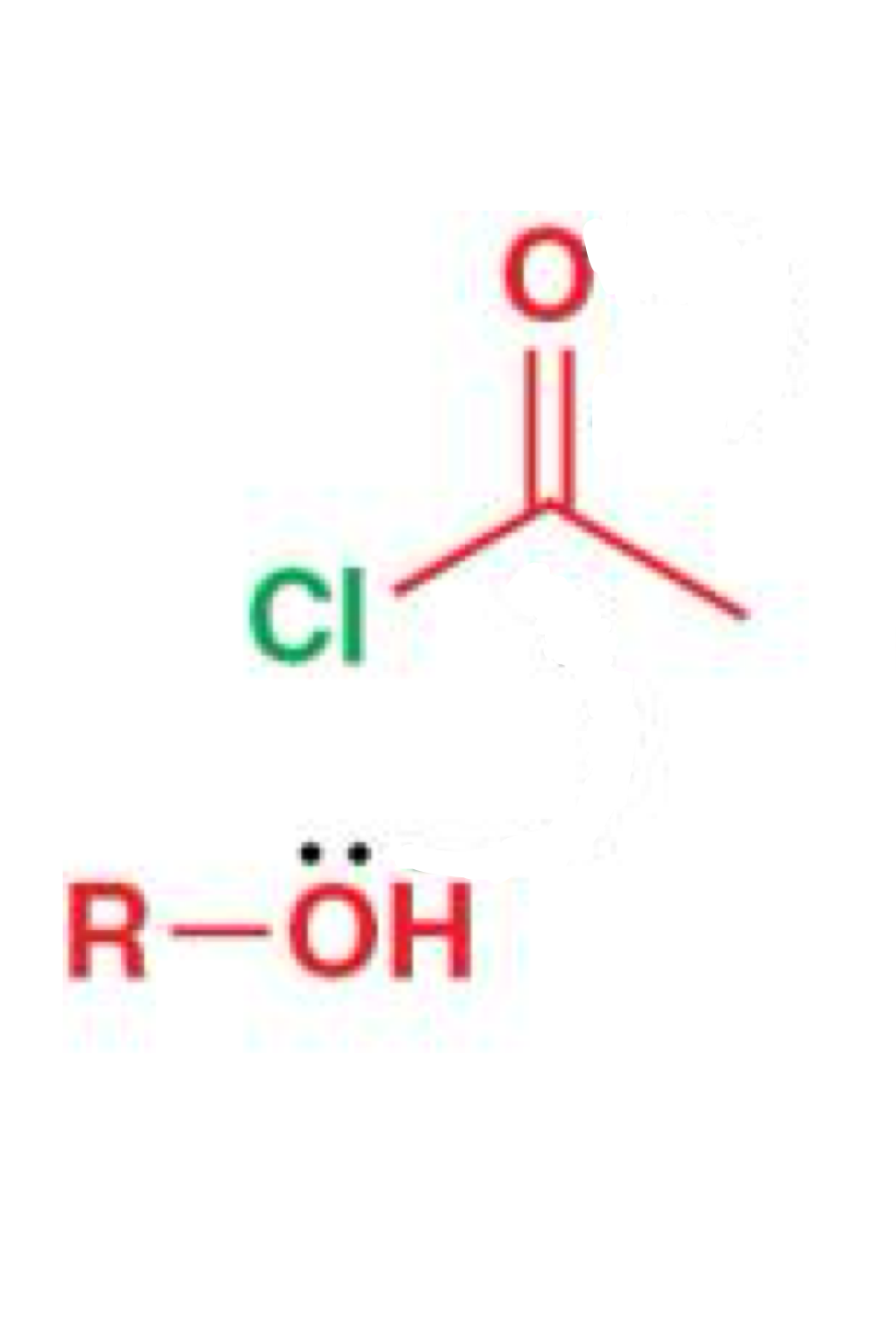
reaction of an acid chloride with an alcohol
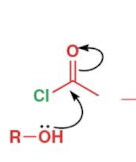

reaction of an acid chloride with an alcohol
Cl is the leaving group and the final product is an ester.

pKa as a guide to leaving group ability (carbonyl substitution reactions)
the lower the pKa of HX, the better the leaving group X− in carbonyl substitution reactions.
General scema for substitution reactions on a carbonyl group

Relationship between nucleophilicity and leaving group ability
a good nucleophile is a bad leaving group and vice versa

Sehr schwache Delokalisierung des Cl-Elektronenpaars in die C=O-Gruppe, daher stärker elektrophiler carbon der carbonyl Gruppe.