Age of Dinos exam 2
 Call Kai
 Learn
 Practice Test
 Spaced Repetition
 Match
 Flashcards
 Knowt Play
1/41

There's no tags or description
Looks like no tags are added yet.
42 Terms
Linnean Taxonomy
Genus (pl. genera)
Represents a “generic” category, including one or more species
One word name, Capitalized, italicized
Ex. Homo, Tyrannosaurus, Ginkgo
Species (pl. species)
Represents a more “specific” category
Two word names combining the genus name and a second, non-capitalized word
Ex. Homo sapiens, Tyrannosaurus rex, Ginkgo biloba
Note: In handwriting, can’t italicize. Underline instead!
Tyrannosaurus rex or T.rex
NOT: T-Rex, T-rex, t. rex, T Rex
Binomial Nomenclature
Rule used for naming the genus and species
Ex.
Homo sapien
Tyrannosaurus rex
Taxonomy and Systematics
Biological Nomenclature (Taxonomy)
Rules for names of groups of organisms
Taxon (plural = taxa)
A unit of biodiversity
Systematics
The study of biodiversity and its organization
How to write a species name
Homo sapiens — H. sapiens
Ginkgo biloba — G. biloba
Tyrannosaurus rex — T. rex
All species in the same genus have the same generic name
Homo erectus
Homo floresiensis
Homo neanderthalensis
Homo sapiens
Panthera tigris
Panthera leo
Panthera onca
Panthera pardus
How are names chosen, and are there rules to naming a specific species?
Names Can Be Chosen to…
Describe the species: Triceratops horridus, the “roughened three-horned-face”
Honor the geographical place or geological stratum in which it was discovered: Albertosaurus, after Alberta, Canada
Language: Seitaad, Navajo for “sand monster”
Honor a colleague, mentor, sponsor, discoverer, landowner, spouse, etc. Diplodocus carnegii, for Andrew Carnegie, who sponsored the expedition that discovered it
Rules: Principle of Priority
What is the Principle of Priority?
Oldest valid name is the one used
Examples:
Anatosaurus Lull & Wright 1942 vs. Edmontosaurus Lambe 1917
Brontosaurus excelsus 1879 vs. Apatosaurus excelsus 1877 (Lumping)
Tarbosaurus bataar Maleev 1955 vs. Tyrannosaurus rex Osborm 1905 (Splitting)
What are the Linnean ranks and the flaws that make us no longer use it today?
Linnean ranks: Domain, Kingdom, Phylum, Class, Order, Family, Genus, Species
Do they mean anything?
Number of Species?
Morphological Disparity?
Age of Origin?
???
Not really — Arbitrary, with no intrinsic meaning or equivalency across taxa
What is the species concept?
Traditionally based on shared common features of:
Appearance (morphology)
Behavior and Habits
Reproduction
Habitat
etc.
Charles Darwin:
“Species are only well-marked varieties”
“The only distinction between species and well-marked varieties is, that the latter are known, or believed, to be connected at the present day by intermediate gradations, whereas species were formerly thus connected.”
Ernst Mayr:
Modern Synthesis (early 20th Century)
Biological Species Concept
Naturally occurring populations that interbreed and produce viable fertile offspring and are reproductively isolated
Are there different types of species concepts?
~31 different definitions!
What are the flaws for each species concept?
Morphospecies: Different species can look similar, while individuals of the same species can look different because of age, sex, or variation
Biological species: It cannot be used easily for fossils or asexual organisms because we cannot determine whether they can successfully reproduce
Phylogenetic species: It can classify very closely related populations as separate species based on small evolutionary differences
Which species concept do paleontologists use?
Species are groups of morphologically distinct populations where:
Within group variation is of the degree displayed by populations of living species
Between group differences are the kind and degree expected to result from reproductive isolation
What did Carlos Linnaeus do?
The “Father of Systematics” (1707-1778)
Established a hierarchical system of organizing life
Established fixed ranks
Kingdom, Phylum, Class, Order, Family, Genus, Species
Principles for organizing taxa
In Linnaean Systematics, classification based on overall similarity
What is speciation?
Provides an explanation for the hierarchical arrangement of biodiversity
The basis of speciation is geographic variation within species
After 1859, living things were organized based on two criteria:
Phylogeny
Similarity
Problems!
Phylogeny (= evolutionary history) is objective
Similarity is not
Will Hennig (1913 - 1976)
German entomologist
Phylogenetic systematics = Cladistics
Developed in 1950s
Phylogeny should be the only organizing principle in systematics
Became prevailing view in 1970s
Currently best method for understanding shared evolutionary history
Cladistics: Reconstructing the Tree of Life
Presence of shared derived features (apomorphies)
Fossil record of intermediate forms (and entirely extinct branches of Tree of Life)
Pattern of shared DNA sequences
Apomorphy = a derived character
🌟Synapomorphy🌟 = a shared derived character
Autapomorphy = a unique derived character
Plesiomorphy = an ancestral character
Derived characters tell us about change over time (= evolution)
Character
A morphological feature of an animal
Derived Characters
traits that evolved more recently and are different from the ancestral form
Cladogram
stick-figure hypothesis of the pattern of shared common ancestry

Sister Taxa
Closest relatives on a cladogram
Closest relatives = taxa sharing a most recent common ancestor

Branch
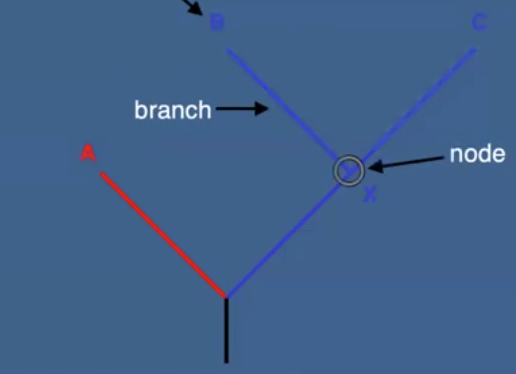
Node
represents the most recent common ancestor of the descendant branches

🌟Monophyletic Group🌟
an ancestor and all of its descendants
aka. “clade”

Paraphyletic Group
an ancestor and some (but not all) descendants

Polyphyletic Group
assemblage of similar but unrelated taxa

What are synapomorphies of Chordata?
What are synapomorphies of Gnathostomata?
Jaws
Some developed bony projections from their jaws — tooth plates
These fish are called Placoderms

Where do jaws come from?
The presence of jaws is a synapomorphy of the clade Gnathostomata
The vertebrate jaw was a major evolutionary innovation
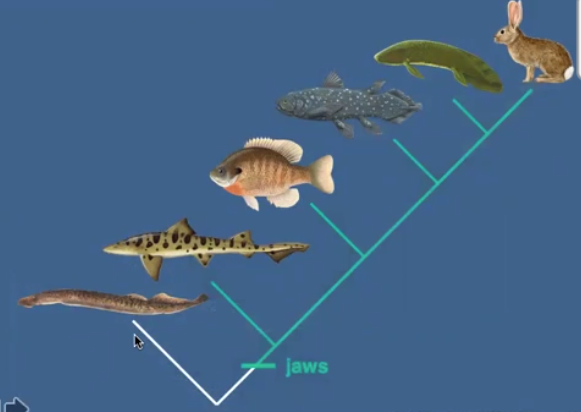
What are synapomorphies of Osteichthyes?
internal bony skeleton

What are synapomorphies of Sarcopterygii?
Humerus in forelimb
Femur in hindlimb

What adaptations are needed before moving onto land?
Scales and mucous
Prevented desiccation
Lungs
Able to breathe air
Bony skeleton
Could support weight out of water
Limbs with wrists/ankles and digits
Propulsion of body weight
How are swim bladders and lungs related?
Lungs
Why would fish need lungs?
Low oxygen aquatic environment, get extra oxygen from air
Environment dries out seasonally, burrowing and torpor during dry season
What group was able to move completely on land?
Tetrapods
When early tetrapods moved onto land, they had already inherited lungs and lots of other important features from their fully aquatic ancestors
Lungs were plesiomorphies
What is special about their eggs? What are their synapomorphies?
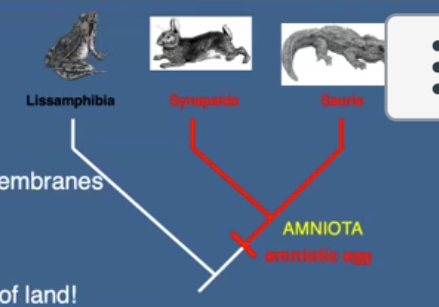
Amniota
1st appears in Carboniferous
Synapomorphy: amniotic egg
Shelled egg with specialized membranes
Laid on dry land
Allowed complete colonization of land!
What is a fenestra?
an opening or hole in an animal’s skull, often found in the temporal region behind the eye socket
What purpose does a fenestra serve?
makes the skull lighter and provides space for jaw muscles to attach and expand
What is the purpose of an infratemporal fenestra?
provides space for jaw muscles to attach and move, helping the animal bite and chew
Groups in Sauria
Testudines
Lepidosauria
Euryapsida
Archosauriformes
Sauria:
1st in Carboniferous
Synapomorphies
Post-temporal fenestra
Infratemporal fenestra
Supratemporal fenestra

Sauria is a polytomy
Polytomy = 3 or more branches emerging from one node
Usually indicated uncertainty

What are the synapomorphies of Lepidosauria?
Overlapping scales
Sphenodon (= tuatara; NOT a lizard!)
Squamata (lizards, snakes, amphisbaenians)
Have moveable joint between quadrate and rest of skull
Lower temporal bar is absent in most lepidosaurs
Squamata have moveable joints in their skulls. What is this called?
Cranial kinesis: ability to move one part of the skull relative to another