GENE 3200 Unit 4
 Call Kai
 Learn
 Practice Test
 Spaced Repetition
 Match
 Flashcards
 Knowt Play
1/72

There's no tags or description
Looks like no tags are added yet.
73 Terms
purine (2 rings)
adenine and guanine
pyrimidine (1 ring)
cytosine, thymine, uracil
#of H bonds between A-T
2
#of H bonds between G-C
3
theta replication
occurs in E coli and many other bacteria
single origin (Ori) of replication
single replication bubble and two replication forks
bidirectional replication from origin (whichever comes first)l
linear replication
occurs in eukaryotes
each chromosome has multiple origins
each replication bubble has two replication forks
bidirectional replication from each origin
stages of DNA replication in E. coli
initiation: Ori
unwinding: SSBs, helicase, gyrase
elongation: primase, RNA primer, DNA pol III, leading/ lagging strands, DNA pol I, ligase
termination: ligase
Initiation
single replication origin (oriC)
initiator protein binds to oriC and causes a short section of DNA to unwind
Unwinding
helicase binds to lagging strand, moves 5-3 and breaks H bonds
SSBs stabilize single-stranded regions
DNA gyrase/ topoisomerase relieves torsional strain in front of each fork
elongation
DNA synthesis is initated at RNA primers
synthesized by primase, a RNA polymerase
RNA primers are complementary and antiparallel to each template strand
primase
synthesizes RNA primers that are complementary to OriC sequences
DNA poly III
synthesizes DNA in 5’-3’ direction
DNA poly I
has a 5’-3’ exonuclease that removes primer; polymerase replaces DNA. requires free 3’-OH from previous Okazaki fragment to begin function
ligase
seals nicks in DNA strands
polymerase chain reaction (PCR)
generates billions of copies of one template DNA
takes only a few hours
oligonucleotides
short synthetic ss DNA that serve as primers for DNA synthesis in PCR.
right primer (reverse)
complementary to upper strand in PCR
left primer (forward)
complementary to lower strand in PCR
3 steps of PCR
denaturation
primer annealing
primer extension
Properties of DNA polymerases (Taq) for PCR
optimal temp of >70C
stable at high temps
highly processive 5’-3’ polymerase
taq polymerase lacks 3’-5’ exonuclease activity
denaturation
sample heated at 90-100C to denature target DNA into single strands
primer annealing
temp reduced to 30-60C to allow hybridization of primers to their complementary sequence
primer extension
temp inc to 72C to allow DNA synthesis; extension time based of size of template
dideoxy nucleotide (ddNTP)
reaction stops when ddNTP is randomly incorporated because ddNTP lacks -OH group
gel electrophoresis
DNA samples containing fragments of diff sizes are placed in wells
an electrical current is passed through the gel
DNA fragments move to the positive pole, smaller=faster, larger=slower
Short Tandem Repeats (STRs aka Microsatellites)
short repeated DNA sequences; produce diff sized fragments when copied by PCR
STR profiling experiment
PCR and gel electrophoresis of a specific genetic locus
base substitution mutation
change one base to another; sequence length stays the same
transition mutation
base sub from A-G OR C-T
transversion mutation
base sub from purine-pyrimidine
insertion (indel)
addition of 1 nucleotide
deletion (indel)
subtraction of 1 nucleotide
promotor
determines where transcription initiates but not part of the transcribed sequence; where RNA poly binds to and transcription initiates
consensus sequence
the most common base or amino acid sequence found at a specific location on the promotor; can be strong or weak meaning transcription rate is high or low
DNA binding proteins
can recognize specific sequences in DNA
sequence can be very small
bacterial RNA polymerase
core RNA polymerase can’t bind to the promoter or initiate RNA synthesis without a sigma factor; alternative sigma factors give the holoenzyme specificity for diff promoter consensus sequences
steps of bacterial transcription
initiation, elongation, termination
bacterial transcription: initiation
holoenzyme unwinds DNA
sigma factor and core polymerase form the holoenzyme and bind to the promoter
after initiation, sigma subunit disassociates from the core polymerase
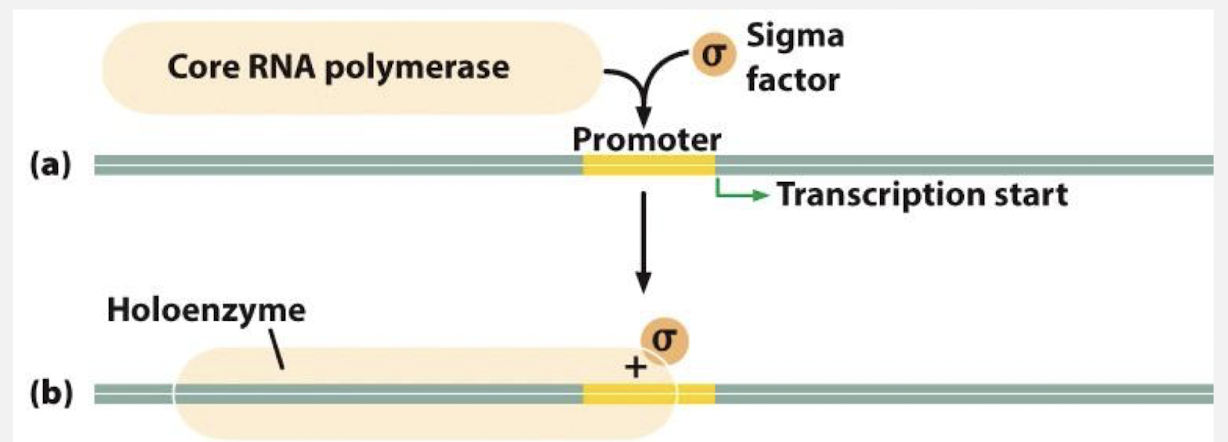
sigma factors
using different sigma factors allows coordinated expression of several genes
recognize the promoter
bacterial transcription: elongation
transcription bubble has 18 nt of unwound DNA
topoisomerases relieve torsional stress
bacterial transcription: termination
Rho dependent or Rho independent
Rho dependent termination
rho= ATP dependent helicase
Rho recognizes and binds to Rut site in RNA: a C-rich region that lacks secondary structure
Rho moves 5’-3’ along the RNA until in encounters RNA polymerase
helicase activity of Rho causes pairing between DNA and RNA to destabilize leading to the release of RNA
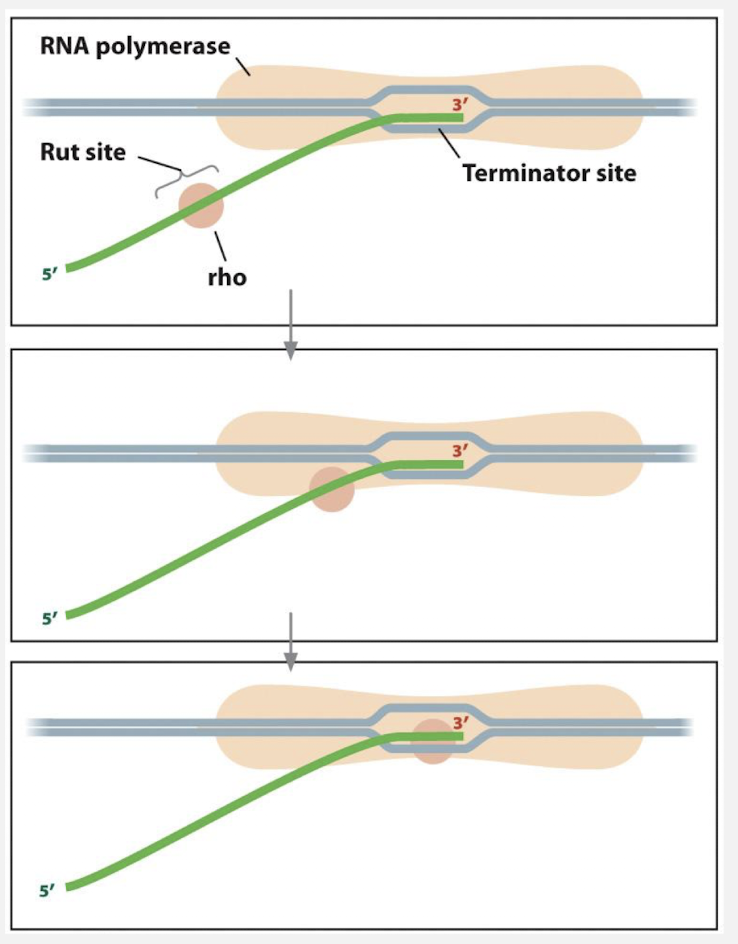
Rho-independent termination
consists of GC rich inverted repeats
RNA poly pauses at the string of U’s allowing hairpins to form at the inverted repeats
formation of the hairpin causes pairing between DNA and RNA to be destabilized leading to the release of RNA

genetic code qualities
unambiguous: each codon specifies only one amino acid
non-overlapping: the reading frame is set by the first codon used in translation
nearly universal: same code used in nearly all organisms
degenerate (redundant): most amino acids are encoded by more than one codon
tRNA
an adaptor for translation of mRNA
carries one specific amino acid
each has a specific anticodon that is complementary to the codon for a specific amino acid
tRNA and mRNA sequences are antiparallel
alignment of DNA, mRNA, and polypeptide
amino group is at the N-terminus
carboxyl group is at the C-terminus
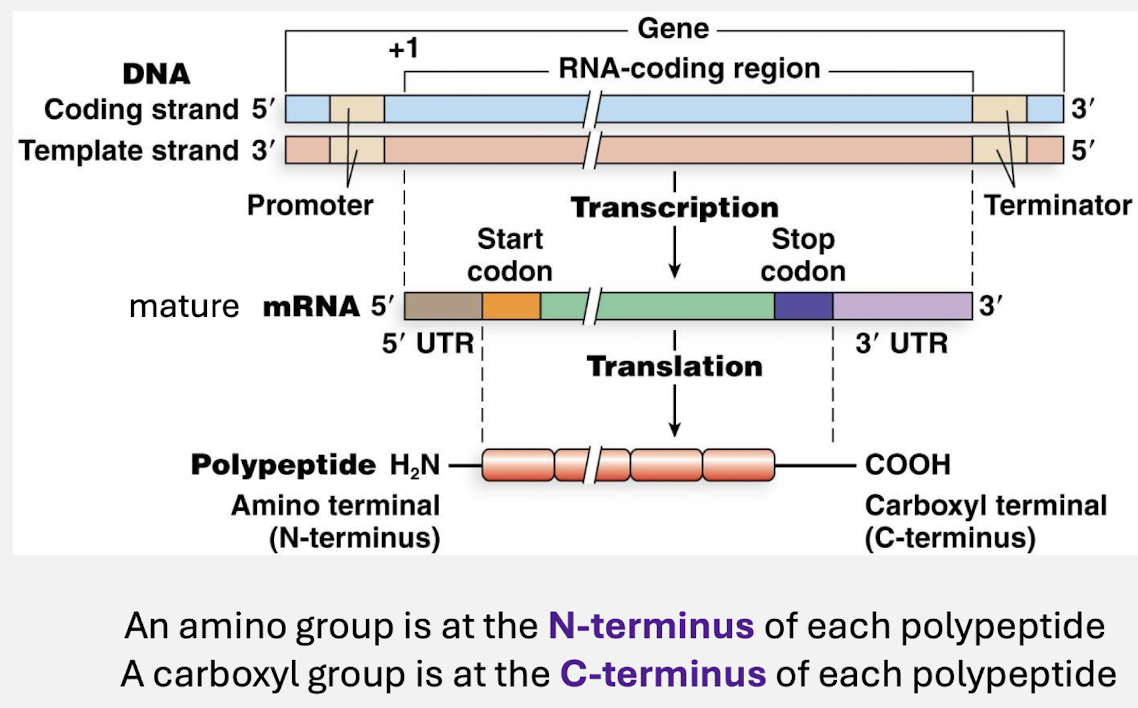
E site of ribosome
Exit site: 5’ side of the codon, exit of uncharged tRNA
peptidyl (P) site of ribosome
site where new peptide bonds are formed between the growing polypeptide and the amino acid in the A site
aminoacyl (A) site:
3’ site of the codon, accepts charged tRNA

polyribose
mRNA in the process of being translated by multiple ribosomes

amino acids
have amino group, carboxyl group, and radical (R) group
lac Y
imports lactose into the cell
lac Z
metabolizes the lactose into monosaccharides
monocistronic DNA
one gene from one promotor, terminator, transcription and mRNA
polycistronic DNA
many genes under one promoter; organisms can group more than one gene to be transcribed together
operon
a unit of DNA in which a group of genes is controlled by a DNA operator to which a repressor protein binds
adjacent to a group of genes and would control their activity
sensitive to a repressor produced by another gene; if present, the repressor inhibits transcription
set of functionally related structural genes transcribed from a single promoter

structural genes
encode proteins that function in metabolism, biosynthesis, or structural aspects of the cell
regulatory genes
encode regulatory RNAs or proteins that control expression of structural genes and/or their products
many transcriptional regulatory proteins have DNA-binding activity
usually have its own p and t meaning its transcribed independently
regulatory elements
DNA sequences that are not translated into proteins but play a role in regulating other genes
usually the binding site of regulatory proteins
operator
cis-acting regulatory sequence where trans-acting regulatory proteins bind and affect transcription
steps of lactose metabolism
permease actively transports lactose into the cell
where the enzyme B-galctosidase breaks into into galactose and glucose
B-galactosidase also converts lactose into the related compound allolactose
and coverts allolactose into galactose and glucose

lacI
binds to the operator and prevents transcription of the lac operon in the absence of lactose
lactose, when present, allosterically inhibits lacI binding to the operator, allowing transcription to occur
lac operon
coordinated control of lactose metabolism
lacI: repressor
lacP: promoter
lacO: operator
3 structural genes/proteins
lac Z= B-galactosidase
lacY= permease
lacA= transacetylase
no lactose, lacI binds to lacO, lacZ/Y/A not expressed
with lactose, lacI falls off lacO, lac Z/Y/A expressed
postitive regulation
proteins binding increases expression
negative regulation
protein binding decreases expression
repressible
signal present = decrease in expression
inducible
signal present = increase in expression
lacZ-
nonfunctional b-galactosidase
lacY-
nonfunctional permease
lacI-
defective repressor cannot bind to lacO
constitutive mutation
trans acting
lacIs
superrepressor, lacks allosteric site
non-inducible
trans acting
lacOc
fails to bind repressor protein
constitutive
cis acting
lacP-
defective promoter, no RNA polymerase
non-inducible ?
cis acting