MCB 2000 Chapter 15
 Call Kai
 Learn
 Practice Test
 Spaced Repetition
 Match
 Flashcards
 Knowt Play
1/41

There's no tags or description
Looks like no tags are added yet.
42 Terms
cells need energy for:
mechanical: cilia beating, flagella moving, organelles traveling around the cytoskeleton, chromosomes separating during mitosis
active transport: Na/K/ATPase
biosynthesis: proteins from amino acids, nucleic acids from nucleotides, lipids from smaller precursors, polysaccharides from sugars

metabolism is a network
pathways feed each other
almost nothing happens in isolation
central molecules like acetyl-CoA serves as metabolic crossroads
carbs, fats and proteins all enter as fuel— their carbon skeletons funnel towards central hubs (especially acetyl-CoA) and from there, carbon enters the TCA cycle and feed energy production through the electron transport chain
same intermediates can also be used to make new intermediates — TCA intermediates, pyruvates, and acetyl-CoA are not just fuel molecules, they’re crossroads
catabolic and anabolic pathways share intermediates and even enzymes and compartments

catabolism
breaking things down, releasing energy
ex. glucose → Co2 + H2O
one big ordered molecule (six carbons) becomes six tiny CO2 molecules and water
thermodynamically a slam dunk, ΔG is strongly negative
the cell captures some of the released energy by phosphorylating ADP to ATP and by reducing NAD+ to NADH.
catabolism is oxidative: carbons lose electrons as C-H bonds become C-O bonds
ATP made
anabolism
building things up, uses energy
ex. Amino acids → proteins
twenty different small molecules get joined into a long, specifically ordered chain with a defined 3D fold
thermodynamically uphill, ΔG is positive
the cell drives the reaction by spending ATP and GTP at each step
and reducing power (in the form of NADPH)
anabolism is reductive: carbons typically gain electrons during biosynthesis
ATP used
____ powers _____
catabolism powers anabolism
both run continuously
amphibolic
a pathway that serves as both catabolism and anabolism. It oxidizes substrate to release energy and supplies intermediates for biosynthesis
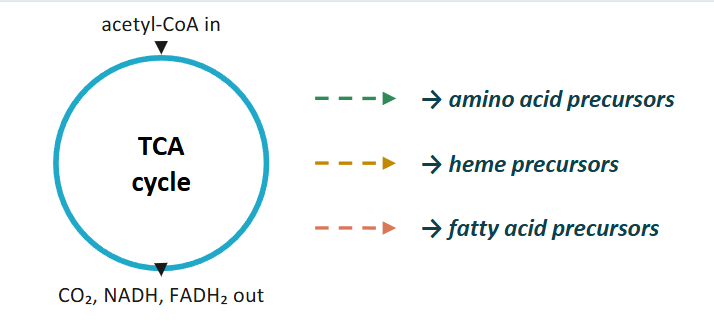
the TCA cycle is the canonical example
acetyl-CoA enters, carbon is oxidized to CO2 and cycle generates NADH and FADH2 that help make ATP
TCA intermediates also leave the cycle to build other molecules — make amino acids, heme (the iron-containing group in hemoglobin and cytochromes), citrate helps supply acetyl-CoA for fatty acid and cholesterol synthesis
the TCA cycle is not just a furnace, it is also a parts depot

three pathway topologies
linear
cyclic
branched
linear pathway
linear converts
input in, output out
once a molecule passes through, the pathway doesn’t see it again

cyclic pathway
cycles regenerate
one oxaloacetate processes thousands of acetyl-CoA, components are catalysts, not consumed
in the TCA cycle, oxaloacetate is regenerated each turn of the cycle, so a small pool of intermediates can process a steady stream of acetyl-CoA

branched pathway
branches allocate
one precursor fans out to multiple end products
branch points are decision points — cell can shift flow depending on what it needs

why so many small steps in glucose oxidation
capture energy in pieces, not all at one
combustion: all energy released as heat, none captured
biological oxidation: many capture points; only a few control points
same total ΔG. cells capture; fires dissipate
overall reaction releases a huge amount of energy (-2870 kJ/mol)
heat released is useful, but when released all at once like that, it can’t be used for as much, so smaller steps are used (glycolysis, pyruvate oxidation, TCA cycle and electron transport chain)
at key points, enzymes couple their smaller drops to ATP, NADH or FADH2 production

compartmentalization
opposing pathways, kept under separate control
why separate:
breakdown and synthesis are opposite jobs — burning fat versus building it
the cell runs them in different places, with different enzymes, and different cofactors
β- oxidation in the matrix uses NAD+ and FAD to harvest electrons.
synthesis in the cytosol uses NADPH to supply reducing power
so synthesis is not just β- oxidation in the reverse — the cell separates the spaces, enzymes and cofactors
separating opposing pathways keeps the cell from building and burning at one
location is part of regulation
opposite jobs, separate spaces, different cofactors — location is part of regulation

channeling: handing off intermediates
location control but on a smaller scale — instead of releasing an intermediate into a solution and waiting for it to find the next enzyme, an enzyme complex passes it directly from one active site to the next which improves efficiency, keeps concentrations high locally and protects unstable or reactive intermediates from side reactions
the pyruvate dehydrogenase complex as the classic example
why channel:
three active sites bolted into one complex: E2’s lipoyl arm , a long flexible cofactor, swings between them it picks up the acetyl group at E1, hands it to CoA at E2, then visits E3 to be reoxidized
E1, 2, 3 are physically assembled into one large complex
local substrate concentration stays high
side reactions can’t compete because the intermediate is never in bulk solvent
unstable intermediates are protected in transit
architecture as regulation, made literal

ATP
adenosine plus three phosphates in series
ATP strores and transfers energy
hydrolysis of the terminal gamma (γ) phosphate drives cellular work
phosphoanhydride bonds = the high energy bonds
when ATP is hydrolyzed, water attacks the gamma phosphate and the terminal phosphoanhydride bond breaks, releasing inorganic phosphate (Pi) and leaving ADP
the bond itself does not contain energy
hydrolysis is favorable because the products are more stable — less charge repulsion, more resonance stability

the goldilocks energy level
ATP sits in the middle of phosphate-transfer ladder
why the middle:
ATP accepts phosphate from compounds above it on the ladder
that’s how glycolysis charges ADP back to ATP, PEP and 1,3-BPG are uphill of ATP, so they donate
ATP donates phosphate to compounds below it
that’s how biosynthesis spends ATP, glucose-6-P is downhill of ATP, so ATP can phosphorylate glucose
if ATP was at the top, the cell could not easily regenerate it, but at the bottom would not be able to drive much chemistry
middle position = universal go-between
charged from above, spent below. ATP is the middle rung

kinetically stable, thermodynamically unstable
why ATP can sit in solution and still release energy on demand
ATP sits in your cells in water at about 5mM concentration, ATP hydrolysis is favorable — so why does it not hydrolyze on its own?
the 2 timescales:
kinetically stability: uncatalyzed hydrolysis of ATP in water is essentially zero. the activation barrier is too high to climb thermally. a solution of ATP sits for hours
thermodynamic instability: the product sits far below the reactants. when an enzyme provides a path over the barrier, that drop is released as usable energy
ATP holds its energy until an enzyme calls for it
an enzyme like hexokinase lowers the activation barrier and positions ATP for phosphoryl transfer so the favorable chemistry can have it on command
thermodynamics says where. kinetics says how fast

coupling: how ATP drives unfavorable reactions
Add the ΔG°' values. the combined reaction must be negative
add the standard free energies. if the sum is negative, the couples reactions run
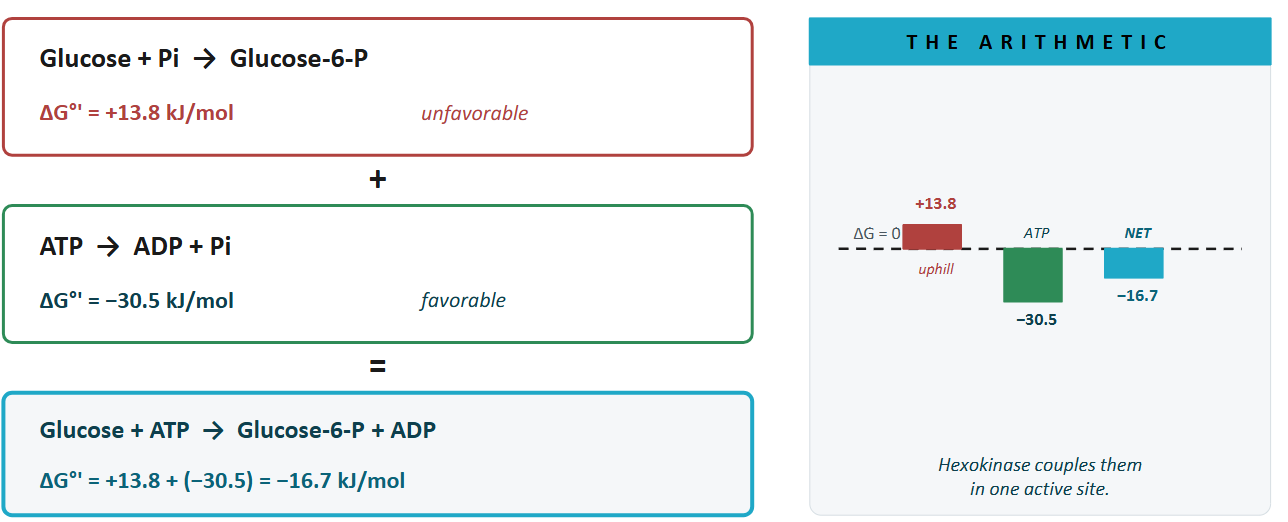
peptide bond formation
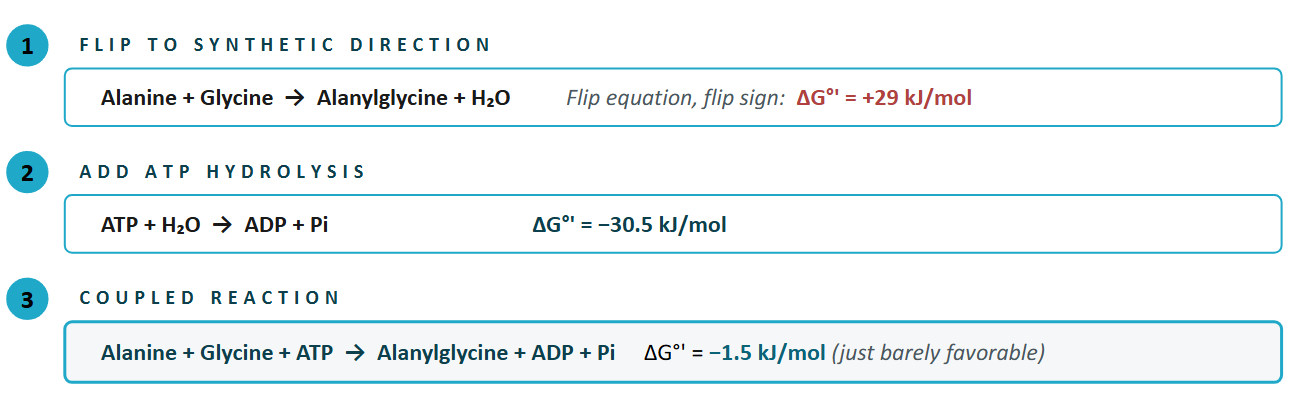
when you need to flip a half-reaction
as given in the text: alanylglycine + H2O → alanine + glycine; ΔG°' = -29 kJ/mol
real cells spend several high-energy bonds per peptide. just barely is not enough
ATP : universal and rapid
universal:
every domain of life uses ATP
bacteria, archaea, fungi, plants, animals, every cell on earth uses ATP as its primary energy currency
three and a half billion years of evolution and nothing has replaced it. the same molecule powers an E.coli dividing in a flask and a neuron firing in your visual cortex right now
currency, not capital:
spent and re-earned, second by second
cells don’t store ATP, they regenerate it constantly.. humans cycle roughly their own body weight in ATP every 24 hours
the standing pool of ATP would last only seconds under heavy demand. the cell holds its energy as flux, not as a stockpile
three and a half billion years and nothing has replaced ATP
fuel= reduced carbon
carbon with lots of C-H bonds has lots of electrons to give up
the principle:
fuels line near the bottom of the ladder. carbs sit in the middle. fatty acid tails sit at the very bottom, long hydrocarbon chains packed with C-H bonds (fatty acids — long chains of CH2 with very little oxygen)
reduced carbon is energy rich because it has electrons to give up
catabolism oxidizes that carbon towards CO2
oxidation releases energy: catabolism walks the carbon upward, transferring electrons to NAD+ or FAD at each step
more rungs to climb= more ATP per gram. that’s why fats yield more than carbs
reducing carbon has electrons to give. catabolism walks carbon up to CO2

three fuels, one engine
different inputs, common downstream pathways
three inputs, three preparations pathways, one common engine. Almost all of the ATP comes from the last two stages, not from the prep work
most roads lead to acetyl- CoA. all lead to the TCA cycle, then the ETC
carbs: some electrons captured as NADH
fats: some electrons captured as NADH and FADH2
shared engine is not just about carbon flow, but about electron flow
acetyl-CoA enters the TCA cycle and continues to oxidize carbon into CO2, and the released electrons are loaded onto NADH and FADH2
those carriers deliver the electrons to the ETC where oxygen is the final acceptor and ATP synthase captures the energy as ATP

three stages of catabolism
digestion/ hydrolysis
conversion to acetyl-CoA
TCA + ETC + ATP synthase
digestion/ hydrolysis
≈ 0 ATP
big polymers → monomers
starch → glucose
triglycerides → fatty acids+ glycerol
proteins → amino acids
happens in the gut, lysosomes, or extracellular space
conversion to acetyl- CoA
small ATP yield
glycolysis (glucose → pyruvate → acetyl-CoA )
β-oxidation (fatty acids → acetyl-CoA)
deamination (amino acids → various)
some ATP and NADH already generated here
TCA + ETC + ATP synthase
~90% of total ATP
acetyl- CoA enters the TCA cycle
NADH and FADH2 donate electrons to the ETC, which pumps protons and drives ATP synthase
this is where most of the ATP is made
most of the ATP comes from stage 3. the earlier stage mainly prepares the fuel
activated carriers do the work
ATP: phosphoryl groups — adenosine + 3 phosphates. donates phosphate to substrates, driving uphill reactions
NADH/ FADH2: electrons (high energy) — reduced cofactors. donate electrons to the ETC, which is where most ATP gets made
Acetyl- CoA: two carbon acyl units — carriers activated acetyl into the TCA cycle. the hub of carbon catabolism
other cofactors:
NADPH: biosynthetic electrons (anabolism)
CoA: acyl-group carrier (fatty acid metabolism)
TPP: decarboxylation
biotin: carboxyl-group carrier
same handful of carriers, every pathway. learn them once, recognize them everywhere
recurring reaction types
most of catabolism is four kinds of chemistry, repeated
phosphoryl transfer
oxidation-reduction
decarboxylation
group transfer / isomerization
recognize the chemistry, and every new pathway gets easier
phosphoryl transfer
ATP + glucose → ADP + glucose-6-P
ATP donates phosphate to a substrate (or vice versa)
oxidation-reduction
NAD⁺ + R-CH(OH)-R’ ⇌ NADH + H⁺ + R-CO-R’
electrons (often as hydrides: H⁻), move between substrate and NAD+/ FAD
decarboxylation
R-COO⁻ + H⁺ → R-H + CO2
a carbon leaves as CO2
common pyruvate, isocitrate, α-KG
key steps in the TCA cycle
group transfer/ isomerization
G6P ⇌ F6P or R–OH + R'–COOH → R'–CO–O–R + H₂O
rearranging a substrate or moving a group from one molecule to another
three mechanisms
allosteric (seconds)
covalent (minutes)
transcriptional (hours)
three timescales. the same enzyme is often regulated by all three at once
these layers stack
one enzyme can receive allosteric feedback, medium-term hormonal control and long term transcriptional adjustment all at once
allosteric
how: a small molecule effector binds away from the active site
ex. PFK-1: ATP inhibits it, AMP activates it; glycolysis tracks the cell’s ATP level
high ATP slows glycolysis while AMP activates it
second: fast, no covalent change
covalent
how: kinase adds a phosphate; a phosphatase removes it
that phosphate acts as a molecular switch
major way that hormones like insulin and glucagon coordinate metabolism across tissues
ex. glycogen synthase phosphorylated is inactive (fasting), dephosphorylated activated (fed)
minutes: hormone-responsive; requires kinase/ phosphatase
transcriptional
how: change how much enzyme exists: more mRNA, more protein
ex. insulin induces lipogenic enzymes when fed; glucagon induces gluconeogenic enzymes when fasting
where regulation happens: irreversible steps
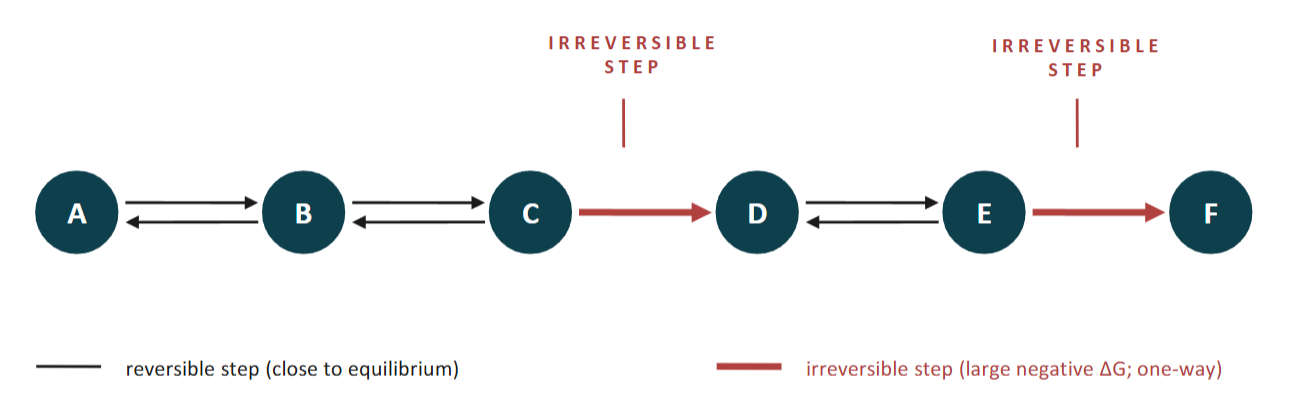
pathways are regulated at their irreversible steps
why here:
reversible steps run close to equilibrium, so slowing one does nothing
irreversible steps sit far from equilibrium (large negative ΔG), so changing their rate changes flux.
a pathway has several and each is a control point
glycolysis has three: hexokinase, PFK1, and pyruvate kinase
the committed step
one irreversible step is special: the first one unique to the pathway
what makes a step “committed”?
the first irreversible step unique to a pathway, the point of no return
test it: 1) is the step irreversible, and 2) once that step happens, does the molecule only have one fate afterward
many irreversible steps to regulate, but only one committed step per pathway (usually the most heavily regulated one)
ex. glycolysis: hexokinase is irreversible, but not the committed step because its product (glucose 6-phosphate) can still leave glycolysis (to make glycogen or into pentose phosphate pathway
PFK-1 is committed because once fructose 1,6-bisphosphate is made, the only road left is to finish glycolysis

three regulatory strategies
different sensors, all at acting one-way regulated steps
feedback inhibition
feed-forward activation
energy charge
three strategies. all act at one-way regulated steps. often layered across a pathway
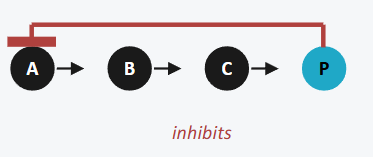
feedback inhibition
end product slows the pathway
logic: the end product inhibits the pathway’s committed step, so flux falls as product builds up
ex. CTP inhibits ATCase, the committed step of pyrimidine synthesis
cell stops making CTP when it already has enough
feed-forward activation
upstream surge primes the downstream
logic: an upstream metabolite switches on a downstream enzyme before its substrate arrives
ex. in glycolysis, F1,6BP activates pyruvate kinase downstream

energy charge
sense ATP/ ADP/ AMP ratios
logic: ATP inhibits and AMP activates catabolic enzymes, so energy state sets flux
ex. PFK-1: ATP inhibits, AMP activates

how the layers integrate
three layers of control converging on glycolytic flux
