biochemistry: exam

0.0(0)
Studied by 0 people
call kaiCall Kai
learnLearn
examPractice Test
spaced repetitionSpaced Repetition
heart puzzleMatch
flashcardsFlashcards
GameKnowt Play
Card Sorting

1/53

encourage image

There's no tags or description

Looks like no tags are added yet.

54 Terms

1
New cards

What can plant metabolism be divided into?

(primary)

  • rxns essential to plant survival. removing them, the plant will die

  • compounds directly involved in plant growth & development

  • eg sugars, lipids, DNA, RNA, proteins.

  • provides the energy for secondary metabolism. limitations to primary, affect everything else in the cell

  • all starts with CO2 feeding into photosynthesis, then through central metabolism, and into secondary metabolism

(secondary)

  • other metabolic pathways that use energy from primary metabolism. supplemental to core plant survival

  • everything else. removing these wont kill the plant (survival may be hindered).

  • important under certain conditions (stress, drought, etc), relating to environmental interactions

  • eg pheolics, terpenoids, alkaloids (eg smells produced when rubbing herbs, a stress response to damage)

  • THE EXCEPTION - phytohormones are essential to survival, despite coming off secondary metabolic pathways alongside non-essential compounds


<p>(primary)</p><ul><li><p>rxns essential to plant survival. removing them, the plant will die </p></li></ul><ul><li><p>compounds directly involved in plant growth &amp; development</p></li><li><p>eg sugars, lipids, DNA, RNA, proteins. </p></li><li><p>provides the energy for secondary metabolism. limitations to primary, affect everything else in the cell</p></li><li><p>all starts with CO2 feeding into photosynthesis, then through central metabolism, and into secondary metabolism</p></li></ul><p>(secondary)</p><ul><li><p>other metabolic pathways that use energy from primary metabolism. supplemental to core plant survival</p></li></ul><ul><li><p>everything else. removing these wont kill the plant (survival may be hindered). </p></li><li><p>important under certain conditions (stress, drought, etc), relating to environmental interactions</p></li><li><p>eg pheolics, terpenoids, alkaloids (eg smells produced when rubbing herbs, a stress response to damage)</p></li><li><p>THE EXCEPTION - phytohormones are essential to survival, despite coming off secondary metabolic pathways alongside non-essential compounds</p></li></ul><p></p>
2
New cards

how do primary and secondary metabolites differ

(primary)

  • eg carbs, essential AAs, lipids, nucleotides, antioxidants, organic acids, viatmins

  • rxns essential to plant survival. growth, development, reproduction.

  • small molecules that are made in giant quantities (eg glucose, fructose, starch - sugars), and can be increased or decreased depending on the conditions

  • are the same in all plants (eg ATP, glucose, DNA, RNA), and have basic structures that make up basic plant structure (eg starch)

  • formed during plant growth phase, rather than when actively existing but not dividing (a baseline)

(secondary)

  • eg pigments, alkaloids, drugs, essential oils, antibiotics

  • compounds and rxns not related to growth, development, reproduction. More importance for in environmental interaction

  • made in small quaintities, and complement basic plant structure (Eg crosslinked into a lipid protein in the plasma membrane) rather than making it up itself

  • typically are unique between plant species (eg herbs taste different, but all have glucose & DNA)

  • can lack them and be just fine until the specific stressor scenario occurs.

  • formed durng plant growth and stationary phases (still produced without growth)


3
New cards

Recap chloroplast structure

  • The powerhouse of photosynthesis, sugar production. Proteins essential for are embedded in the membranes, and light-absorbing photosynthetic pigments like chlorophyll are embedded within

  • within the leaves of plants. the more green, the more chlorophyll and chloroplasts

  • envelope (outer membrane) and inner envelope (inner membrane), intermembrane space between. being a hypothesised engulfed prokaryote, so is covered by the engulfee membrane also

  • in the middle (within the inner membrane) the stroma (solution, like cytoplasm) is what contains the thylakoids (stacked membrane-bound pockets) connected by stroma lamella (which contain PS1), and in total the stack is the grana lamella (contains PS2)

  • rxn is typically occurring between the thylakoid lumen, and stroma. inside and outside of the thylakoid membranes.

  • therefore the overall transport chain of photosynthesis, occurs within different compartments of the chloroplast.


<ul><li><p>The powerhouse of photosynthesis, sugar production. Proteins essential for are embedded in the membranes, and light-absorbing photosynthetic pigments like chlorophyll are embedded within</p></li><li><p>within the leaves of plants. the more green, the more chlorophyll and chloroplasts</p></li><li><p>envelope (outer membrane) and inner envelope (inner membrane), intermembrane space between. being a hypothesised engulfed prokaryote, so is covered by the engulfee membrane also</p></li><li><p>in the middle (within the inner membrane) the stroma (solution, like cytoplasm) is what contains the thylakoids (stacked membrane-bound pockets) connected by stroma lamella (which contain PS1), and in total the stack is the grana lamella (contains PS2)</p></li><li><p>rxn is typically occurring between the thylakoid lumen, and stroma. inside and outside of the thylakoid membranes.</p></li><li><p>therefore the overall transport chain of photosynthesis, occurs within different compartments of the chloroplast. </p></li></ul><p></p>
4
New cards

describe how light can be modelled as both a wave and a particle


(light as a wave)

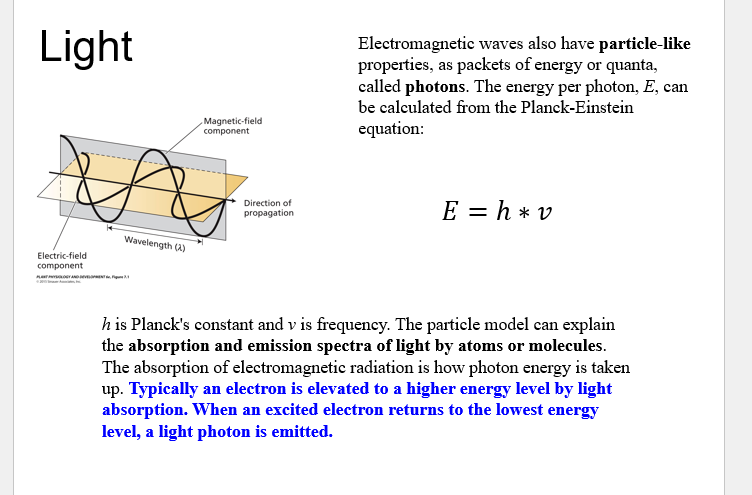
  • as a wave, it has two components. a magnetic field and electric field, sitting roughly 90 degrees from each other

  • => Light is a transverse electromagnetic wave. the oscilating electric and magnetic fields are perpendicular, and the light direction of origin sits in the middle of this perpendicularity.

  • wavelength is the distance between peaks of the waves. the period between waves. waves with more energy, have shorter wavelengths (eg are moving faster)

(light as a particle)

  • these waves also have particle-like properties, behaving as pockets of energy (photons!)

  • => This explains how atoms and molecules can absorb and emit light spectra.

  • typically, absorbing this pocket of light energy raises the nucleus / electron (/a propertiy of the atom) to a higher energy level. can be measured to measure absorbance, usually more absorbance means a higher energy photon absorbed for a higher energy jump

  • then as they return to the lower energy level, this photon is emitted back out.

<p>(light as a wave)</p><ul><li><p>as a wave, it has two components. a magnetic field and electric field, sitting roughly 90 degrees from each other</p></li><li><p>=&gt; Light is a transverse electromagnetic wave. the oscilating electric and magnetic fields are perpendicular, and the light direction of origin sits in the middle of this perpendicularity.</p></li><li><p>wavelength is the distance between peaks of the waves. the period between waves. waves with more energy, have shorter wavelengths (eg are moving faster)</p></li></ul><p>(light as a particle)</p><ul><li><p>these waves also have particle-like properties, behaving as pockets of energy (photons!)</p></li><li><p>=&gt; This explains how atoms and molecules can absorb and emit light spectra. </p></li><li><p>typically, absorbing this pocket of light energy raises the nucleus / electron (/a propertiy of the atom) to a higher energy level. can be measured to measure absorbance, usually more absorbance means a higher energy photon absorbed for a higher energy jump</p></li><li><p>then as they return to the lower energy level, this photon is emitted back out.</p></li></ul><p></p>
5
New cards

what type of light do plants absorb, and by what principle do they do this?

(light absorbed)

  • light in the visible spectrum is absorbed for photosynthesis. (400-700nm)

  • kind of a moderate enery wavelength. infrared light is less energy / longer wavelengths / lower frequency. ultraviolen light is higher enery / shorter wavelengths / higher frequency

(process)

  • they (whatever is absorbing, for this case electrons) start in the ground state (lowest energy, stable state), in the chlorophyll

  • they absorb visible light, at the wavelength / E / frequency, to match the E required to excite into the higher E state. (Blue light absorbed. Higher E)

  • heat loss can then occur, as the excitation E decreases, and it transitions into the LOWEST excited state. (Red light absorbed. Lower E)

  • then to return back to the ground state, the photon of light (now at lower E, longer wavelength as heat loss occurred) can be emitted via fluoresence.

  • other pigments may not go through as much excitation, and only be raised to the LOWEST E excited state

(specific absorbtion of light)

  • therefore, chlorophyll absorb visible light correlating to red and blue. Green is reflected, portraying them of this green colour.

  • this is why a diagram of plant light absorbance, there are peaks at both red and blue. these corrsepond to different excitation state possibilities upon absorbing a photon.


<p>(light absorbed)</p><ul><li><p>light in the visible spectrum is absorbed for photosynthesis. (400-700nm)</p></li><li><p>kind of a moderate enery wavelength.  infrared light is less energy / longer wavelengths / lower frequency. ultraviolen light is higher enery / shorter wavelengths / higher frequency</p></li></ul><p>(process)</p><ul><li><p>they (whatever is absorbing, for this case electrons) start in the ground state (lowest energy, stable state), in the chlorophyll </p></li><li><p>they absorb visible light, at the wavelength / E / frequency, to match the E required to excite into the higher E state. (Blue light absorbed. Higher E)</p></li><li><p>heat loss can then occur, as the excitation E decreases, and it transitions into the LOWEST excited state. (Red light absorbed. Lower E)</p></li><li><p>then to return back to the ground state, the photon of light (now at lower E, longer wavelength as heat loss occurred) can be emitted via fluoresence. </p></li><li><p>other pigments may not go through as much excitation, and only be raised to the LOWEST E excited state </p></li></ul><p>(specific absorbtion of light)</p><ul><li><p>therefore, chlorophyll absorb visible light correlating to red and blue. Green is reflected, portraying them of this green colour.</p></li><li><p>this is why a diagram of plant light absorbance, there are peaks at both red and blue. these corrsepond to different excitation state possibilities upon absorbing a photon.</p></li></ul><p></p>
6
New cards

what are the different types of chlorophyll, pigments

how and why do they differ?

(chlorophyll)

  • in higher plants - chlorophyll A & B (these differ in specific absorbtion spectrums. A with a higher peak at red. B blue peak is shifted towards green)

  • bacterial chlorophyll a, slightly different but comparable to plants.

(other pigments)

  • plants may have a variety.

  • carotenoids (reflect orange. long hydrophobic tails, typically only lipid soluble)

  • different absorbtion spectrums to chlorophyll

(why do they differ)

  • these are simply different adaptations to the photosynthetic niche, the ability to absorb light E and use this to make sugars

  • organisms close to light use chlorophyll A & B

  • organisms in dark or water require a wider portfolio of pigments, to exploit whatever light they can obtain


<p>(chlorophyll)</p><ul><li><p>in higher plants - chlorophyll A &amp; B (these differ in specific absorbtion spectrums. A with a higher peak at red. B blue peak is shifted towards green)</p></li></ul><ul><li><p>bacterial chlorophyll a, slightly different but comparable to plants. </p></li></ul><p>(other pigments)</p><ul><li><p>plants may have a variety.</p></li><li><p>carotenoids (reflect orange. long hydrophobic tails, typically only lipid soluble)</p></li><li><p>different absorbtion spectrums to chlorophyll</p></li></ul><p>(why do they differ)</p><ul><li><p>these are simply different adaptations to the photosynthetic niche, the ability to absorb light E and use this to make sugars</p></li><li><p>organisms close to light use chlorophyll A &amp; B</p></li><li><p>organisms in dark or water require a wider portfolio of pigments, to exploit whatever light they can obtain</p></li></ul><p></p>
7
New cards

how and why does O2 production vary across light wavelength like absorbance?

  • they follow a similar pattern due to the absorbance action of the pigment, being related to O2 production

  • this is the idea of photosynthesis, using light E absorbed by the pigment to create O2 ultimately

  • so as light wavelength varies, absorbance varies based on the E required to reach the excited state, so O2 production varies as more absorbance indicates more fulfillment of E required to do photosynthesis and produce O2

  • eg experimentally indicated in an interestiing way. chloroplasts in algae / water plants exposed to the range of visible light via a prism. bacteria growing nearby (indicated by absorbance) follows the chlorophyll absorbance spectrum corresponding to wavelength,based on where they grow, growing where sugars are available (where light is absorbed)


<ul><li><p>they follow a similar pattern due to the absorbance action of the pigment, being related to O2 production</p></li><li><p>this is the idea of photosynthesis, using light E absorbed by the pigment to create O2 ultimately</p></li><li><p>so as light wavelength varies, absorbance varies based on the E required to reach the excited state, so O2 production varies as more absorbance indicates more fulfillment of E required to do photosynthesis and produce O2</p></li><li><p>eg experimentally indicated in an interestiing way. chloroplasts in algae / water plants exposed to the range of visible light via a prism. bacteria growing nearby (indicated by absorbance) follows the chlorophyll absorbance spectrum corresponding to wavelength,based on where they grow, growing where sugars are available (where light is absorbed)</p></li></ul><p></p>
8
New cards

How does energy transfer work within the pigment molecules, to the rest of the PS system?

  • pigment molecules associate into Antenna Complexes, organised to harvest a wide variety of light wavelengths, to utilise light exposure better (& for changing environments & seasons). They function to harvest as much light as possible for E efficiency

  • they can transfer E between eachother, via the quick quantum transfer of photonic E (a passive energy gradient).

  • carotenoids absorb the highest E photons, and as E is lost as heat, this matches the E required to excite chlorophyll B, then A, electrons => Aka E is transferred down a gradient

  • after transfer to chlorophyll A, E is passed onto P680 rxn centre of PS2, also enabling it to excite (& photosynthesis can occur) - the lowest E point of the chain (heat E has been lost in each transfer)

  • with additional pigments, the gradient can span to higher E if absorbed, and more occurrences of transfer.


<ul><li><p>pigment molecules associate into Antenna Complexes, organised to harvest a wide variety of light wavelengths, to utilise light exposure better (&amp; for changing environments &amp; seasons). They function to harvest as much light as possible for E efficiency</p></li><li><p>they can transfer E between eachother, via the quick quantum transfer of photonic E (a passive energy gradient).</p></li><li><p>carotenoids absorb the highest E photons, and as E is lost as heat, this matches the E required to excite chlorophyll B, then A, electrons =&gt; Aka E is transferred down a gradient</p></li><li><p>after transfer to chlorophyll A, E is passed onto P680 rxn centre of PS2, also enabling it to excite (&amp; photosynthesis can occur) - the lowest E point of the chain (heat E has been lost in each transfer)</p></li><li><p>with additional pigments, the gradient can span to higher E if absorbed, and more occurrences of transfer.</p></li></ul><p></p>
9
New cards

how does electron excitation occur at the electron level?

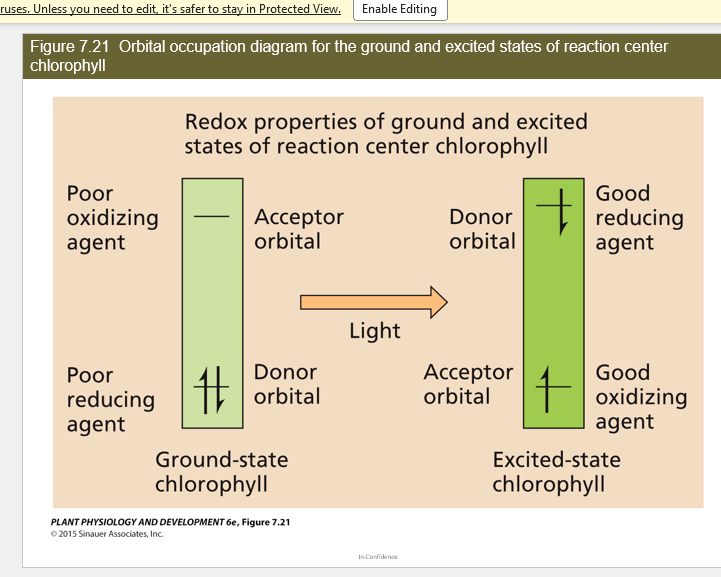
  • electron orbitals contain opposite e spins (+/-), to fit magnetically.

  • in the ground state, the pigment’s electrons in the orbital are poor reducing agent (doesnt want to lose e). it acts as the Donor orbital upon excitation, whose E raises it to the higher E orbital (Acceptor orbital)

  • now it becomes a good reducer, being higher E, less stable (wants to lose e), and this higher E level e becomes the Donor orbital, enabling return to ground state.

  • so energy can be used for redox purposes, via electrons acting in this way (reducing & oxidising)

  • this is how electron energy transfer along the gradient occurs. Energy coming and going, raising up e and them falling to pass E onto the next one, in a series of redox rxns (essentially passing the energy along)

  • its not the electrons themselves transported, its their energy in use of redox

  • ultimately eds up in P680 to excite it, which enables entry into PS

  • these energy levels are defined energy states. action in PS only occurs upon input of the exact excitation energy

<ul><li><p>electron orbitals contain opposite e spins (+/-), to fit magnetically.</p></li><li><p>in the ground state, the pigment’s electrons in the orbital are poor reducing agent (doesnt want to lose e). it acts as the Donor orbital upon excitation, whose E raises it to the higher E orbital (Acceptor orbital)</p></li><li><p>now it becomes a good reducer, being higher E, less stable (wants to lose e), and this higher E level e becomes the Donor orbital, enabling return to ground state. </p></li><li><p>so energy can be used for redox purposes, via electrons acting in this way (reducing &amp; oxidising) </p></li><li><p>this is how electron energy transfer along the gradient occurs. Energy coming and going, raising up e and them falling to pass E onto the next one, in a series of redox rxns (essentially passing the energy along)</p></li><li><p>its not the electrons themselves transported, its their energy in use of redox </p></li><li><p>ultimately eds up in P680 to excite it, which enables entry into PS </p></li><li><p>these energy levels are defined energy states. action in PS only occurs upon input of the exact excitation energy</p></li></ul><p></p>
10
New cards

photosythnesis overall

  • differentiate the two phases

  • inputs & outputs

  • in terms of redox


(phases)

  • light-driven and dark (carbon) rxns

  • light rxns use the input of light as E to generate cellular E (ATP) and reducing power (electrons carried, NADPH), to enable the dark rxn’s formation of Glucose from CO2 (E required to form C-C & C-H bonds)

  • therefore the dark rxns occur the light ones to happen first to power them, and the light rxns require light input to power them

  • light rxns occur in the thylakoid membranes (PS1&2 embedded within)

  • dark rxns occur in the stroma (surrounding fluid ‘cytoplasm’ of the chloroplast)

(inputs & outputs)

  • light> Light + H2O + ADP + Pi + NADP+ => NADPH + ATP + O2

  • dark> NADPH + ATP + CO2 + H2O => Glucose + ADP + NADP+

  • overall> CO2 + H2O => Glucose + O2

(redox)

  • chlorophyll electrons in ground state excite upon photon absorption (Light Energy), beginning the reduction chain theat ultimately enables formation of Glucose from CO2 & H2O, upon the additional input of ATP & NADPH created along the way


<p>(phases)</p><ul><li><p>light-driven and dark (carbon) rxns</p></li><li><p>light rxns use the input of light as E to generate cellular E (ATP) and reducing power (electrons carried, NADPH), to enable the dark rxn’s formation of Glucose from CO2 (E required to form C-C &amp; C-H bonds)  </p></li><li><p>therefore the dark rxns occur the light ones to happen first to power them, and the light rxns require light input to power them</p></li><li><p>light rxns occur in the thylakoid membranes (PS1&amp;2 embedded within)</p></li><li><p>dark rxns occur in the stroma (surrounding fluid ‘cytoplasm’ of the chloroplast)</p></li></ul><p>(inputs &amp; outputs)</p><ul><li><p>light&gt; Light + H2O + ADP + Pi + NADP+ =&gt; NADPH + ATP + O2</p></li><li><p>dark&gt; NADPH + ATP + CO2 + H2O =&gt; Glucose + ADP + NADP+</p></li><li><p>overall&gt; CO2 + H2O =&gt; Glucose + O2</p></li></ul><p>(redox)</p><ul><li><p>chlorophyll electrons in ground state excite upon photon absorption (Light Energy), beginning the reduction chain theat ultimately enables formation of Glucose from CO2 &amp; H2O, upon the additional input of ATP &amp; NADPH created along the way </p></li></ul><p></p>
11
New cards

How were the distinct light-requiring and dark (not light requiring but dependent on light rxns) rxns discovered?

  • Isotopic labelling of CO2 input, for plants in different conditions, and seeing where the C & O are incorporated & released

  • leaves were ground and centrifuged, to recover chloroplasts, and added to rxn tubes, along with H2O (a heavy version, H2O^18) and N2 (NO CO2)

  • adding light, O2 evolution occurred (using the H2O input as the O was ^18 labelled) but no sugars were produced

  • => Light energy is required for O2 production based on H2O input, but this rxn is seperate to the synthesis of Glucose based on CO2 input (lacking in this step)

  • removing light, and adding CO2 (14C labelled), 14C-labelled-Glucose was produced, but no O2. Glucose could be produced to a certain point, until E & e carriers (From light input in light rxns) ran out

  • => Light Energy is not directly required for Glucose synthesis from CO2 consumption, but it mustve happened before to provide the Energy input. The sugar synthesis step is seperate, and requires CO2 external input


<ul><li><p>Isotopic labelling of CO2 input, for plants in different conditions, and seeing where the C &amp; O are incorporated &amp; released</p></li><li><p>leaves were ground and centrifuged, to recover chloroplasts, and added to rxn tubes, along with H2O (a heavy version, H2O^18) and N2 (NO CO2)</p></li><li><p>adding light, O2 evolution occurred (using the H2O input as the O was ^18 labelled) but no sugars were produced</p></li><li><p>=&gt; Light energy is required for O2 production based on H2O input, but this rxn is seperate to the synthesis of Glucose based on CO2 input (lacking in this step)</p></li><li><p>removing light, and adding CO2 (14C labelled), 14C-labelled-Glucose was produced, but no O2. Glucose could be produced to a certain point, until E &amp; e carriers (From light input in light rxns) ran out</p></li><li><p>=&gt; Light Energy is not directly required for Glucose synthesis from CO2 consumption, but it mustve happened before to provide the Energy input. The sugar synthesis step is seperate, and requires CO2 external input </p></li></ul><p></p>
12
New cards

Describe the Z-Scheme of PS light rxns

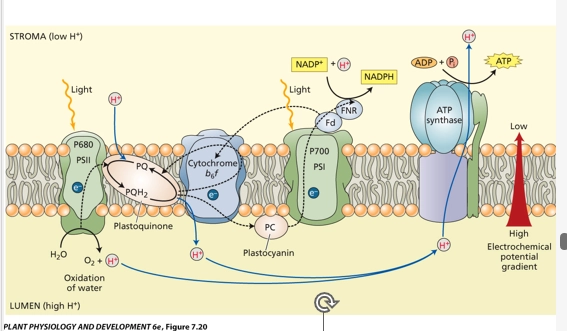
  • a gradient of redox rxns from light energy, to lower and lower redox potential beings, ultimately reducing NADP+, so this redox potential can be used to make Glucose (dark rxns)

  • (PS2) Light Photon > Antenna complex > P680 > electron transport chain (PS1. also fed into by Photons) P700 > NADP+

  • Light energy is transferred in such a way to form a good enough reductant, to reduce NADP+, so we can use this E.

  • To refresh the e lost to the transport chain carriers from PSII, H2O is split via the OEC right bellow P680, forming O2 to release

  • All the while, H+ are pumped across their gradient (INTO the lumen. via splitting H2O, e carrier reductions), to ultimately form a proton gradient to flow out of the lumen, into the stroma, via ATP synthase. This movement, is coupled with the hydrolysis of ATP.

  • ATP & NADPH generated, are essential for genereating Glucose in the dark rxns.


<ul><li><p>a gradient of redox rxns from light energy, to lower and lower redox potential beings, ultimately reducing NADP+, so this redox potential can be used to make Glucose (dark rxns)</p></li><li><p>(PS2) Light Photon &gt; Antenna complex &gt; P680 &gt; electron transport chain (PS1. also fed into by Photons) P700 &gt; NADP+</p></li><li><p>Light energy is transferred in such a way to form a good enough reductant, to reduce NADP+, so we can use this E.</p></li><li><p>To refresh the e lost to the transport chain carriers from PSII, H2O is split via the OEC right bellow P680, forming O2 to release</p></li><li><p>All the while, H+ are pumped across their gradient (INTO the lumen. via splitting H2O, e carrier reductions), to ultimately form a proton gradient to flow out of the lumen, into the stroma, via ATP synthase. This movement, is coupled with the hydrolysis of ATP.</p></li><li><p>ATP &amp; NADPH generated, are essential for genereating Glucose in the dark rxns.</p></li></ul><p></p>
13
New cards

how does the organisation of the chloroplast aid light-rxns

  • thylakoid stacks (grana) connected by stroma lamella, with the lumen inside. Many thylakoids to enable many rxns

  • Spatial arrangement of the complexes within these cellular structures, are purposeful for effieicient gradients

  • PS2 embedded in the infacing thylakoid membranes. flat structures that can fit right in

  • PS1 embedded in the stroma lamella. bulkier so need outfacing

  • ATP Synthase embedded on the outfacing areas of the lamella & thylakoids. THis increases their exposure to stroma, so that an effective H+ gradient can be generated to drive flow through into the stroma.

  • However, these complexes are dynamic, and arent rigidly confined to these areas. They move depending on need locally (eg light conditions)


<ul><li><p>thylakoid stacks (grana) connected by stroma lamella, with the lumen inside. Many thylakoids to enable many rxns</p></li><li><p>Spatial arrangement of the complexes within these cellular structures, are purposeful for effieicient gradients </p></li></ul><ul><li><p>PS2 embedded in the infacing thylakoid membranes. flat structures that can fit right in</p></li><li><p>PS1 embedded in the stroma lamella. bulkier so need outfacing</p></li><li><p>ATP Synthase embedded on the outfacing areas of the lamella &amp; thylakoids. THis increases their exposure to stroma, so that an effective H+ gradient can be generated to drive flow through into the stroma. </p></li><li><p>However, these complexes are dynamic, and arent rigidly confined to these areas. They move depending on need locally (eg light conditions)</p></li></ul><p></p>
14
New cards

How are PSII and PSI linked?

  • PSII > e carriers > PSI > ATP Synthase

  • the PS e transport chain has the same fundamental idea as the Mitochondria e transport chain. e are supplied to the system via H2O => O2 oxidation (P680 Reduction)

(To P680)

  • Light Energy via photons is harvested by exciting the chlorophyll electrons, which pass this onto P680 to excite its electron (Energy transferred, not physical electrons)

(Thru e transport chain)

  • This enables P680 to pass on electrons (Is oxidised) through the e transport chain, down redox potentials ultimaetely to ground state P700, to firstly not have a great big jump in energy, and secondly to couple this with pumping H+ for a gradient for later ATP formation.

  • So between excited P680 and ground-state P700, e carriers are the linkers of PSII and PSI.

(e carriers)

  • Plastoquionone (PQ), lipid soluble within the membrane, is initially reduced to form PQH2 (picking up H+ from the stroma). and upon oxidation, H+ are released to the lumen (= Generating the H+ gradient)

  • this cycles e to CytB6F complex (CytB6+ CytF), which are transfered down redox potential, thru a series of residues within the complex.

  • CytF subunit can then reduce PlastoCyanin (PC), a carrier on the membrane surface attached to a lipid - so it can float around in the lumen on a string (no H+ transport associated, being localised to this side.)

  • PC Then reducees P700, providing this refresh electron in ground state (because this electron ultimtaely is added to NADP+)

(P700)

  • Reduced by PC (From the e originally split from H2O, into P680, then transported thru the chain) to fill the electron’s ground state orbital

  • for excitation, the same Antenna principle must occur, the absorbption of photons to excite chlorophyll electrons, then this energy is passed through via resonance like a ripple.

  • Eventually P700 electron is excited, and finally it has enough energy to


<ul><li><p>PSII &gt; e carriers &gt; PSI &gt; ATP Synthase</p></li></ul><ul><li><p>the PS e transport chain has the same fundamental idea as the Mitochondria e transport chain. e are supplied to the system via H2O =&gt; O2 oxidation (P680 Reduction)</p></li></ul><p>(To P680)</p><ul><li><p>Light Energy via photons is harvested by exciting the chlorophyll electrons, which pass this onto P680 to excite its electron (Energy transferred, not physical electrons)</p></li></ul><p>(Thru e transport chain)</p><ul><li><p>This enables P680 to pass on electrons (Is oxidised) through the e transport chain, down redox potentials ultimaetely to ground state P700, to firstly not have a great big jump in energy, and secondly to couple this with pumping H+ for a gradient for later ATP formation.</p></li></ul><ul><li><p>So between excited P680 and ground-state P700, e carriers are the linkers of PSII and PSI.</p></li></ul><p>(e carriers)</p><ul><li><p>Plastoquionone (PQ), lipid soluble within the membrane, is initially reduced to form PQH2 (picking up H+ from the stroma). and upon oxidation, H+ are released to the lumen (= Generating the H+ gradient)</p></li><li><p>this cycles e to CytB6F complex (CytB6+ CytF), which are transfered down redox potential, thru a series of residues within the complex.</p></li><li><p>CytF subunit can then reduce PlastoCyanin (PC), a carrier on the membrane surface attached to a lipid - so it can float around in the lumen on a string (no H+ transport associated, being localised to this side.)</p></li><li><p>PC Then reducees P700, providing this refresh electron in ground state (because this electron ultimtaely is added to NADP+)</p></li></ul><p>(P700)</p><ul><li><p>Reduced by PC (From the e originally split from H2O, into P680, then transported thru the chain) to fill the electron’s ground state orbital</p></li><li><p>for excitation, the same Antenna principle must occur, the absorbption of photons to excite chlorophyll electrons, then this energy is passed through via resonance like a ripple. </p></li><li><p>Eventually P700 electron is excited, and finally it has enough energy to </p></li></ul><p></p>
15
New cards

What is the ultimate reason why 2 photosystems, and an electron chain with carriers, is required to reduce NADP+?

  • the electron split from water is very low energy compared to the energy required for an electron to add to NADP+ (much lower reducing potential).

  • furthermore, the process of splitting water is energy demanding itself, so a single photon of light doesnt have the energy to split water AND reduce NADP+. The wavelengths of visible light are not high enough Energy.

  • it requires the PSII > Boost by a photon > Split water > PSI > Boost by a photon > Reduce NADP+. it needs the initial boost, and then another one, to have enough reduction potential to reduce NADP+

  • additionally, having it in stages enables H+ to be pumped, to form the proton gradient to actually drive ATP production (efficiently form NADPH AND ATP)

  • this explains why the electron is made to decrease in energy through transfers, rather than being boosted then boosted again immediately, as the transfer of the electron enables the cell to do work with this energy to make ATP


<ul><li><p>the electron split from water is very low energy compared to the energy required for an electron to add to NADP+ (much lower reducing potential).</p></li><li><p>furthermore, the process of splitting water is energy demanding itself, so a single photon of light doesnt have the energy to split water AND reduce NADP+. The wavelengths of visible light are not high enough Energy. </p></li><li><p>it requires the PSII &gt; Boost by a photon &gt; Split water &gt; PSI &gt; Boost by a photon &gt; Reduce NADP+. it needs the initial boost, and then another one, to have enough reduction potential to reduce NADP+</p></li><li><p>additionally, having it in stages enables H+ to be pumped, to form the proton gradient to actually drive ATP production (efficiently form NADPH AND ATP)</p></li><li><p>this explains why the electron is made to decrease in energy through transfers, rather than being boosted then boosted again immediately, as the transfer of the electron enables the cell to do work with this energy to make ATP</p></li></ul><p></p>
16
New cards

What is the difference in energy transfer in the antenna complexes, versus the rest of the system (betwen the complexes)?

  • Antenna complex electrons are excited by a photon of light sending them to a excited energy level.

  • Through resonance energy transfer (quick. quantumn), energy is transferred to other pigments to excite their electrons, to ultimately excite the P680 electron to a higher E level

  • Then the Energy is harvested from P680 by oxidation. It acts to reduce PQ (the 1st e carrier) and physically the excited electron is transferred

  • versus the Antenna, where excited electrons are not physically transferred. It is simply the energy that passively passes through like a ripple, to ultimately excite P680.


17
New cards

What do PSII and PSI ultimately each create

  • PSII, H2O => O2 + H+ for the gradient, and the initial kick of energy to the electron for reducing NADP+

  • e transport chain, H+ pumped for the gradient

  • PSI, NADP+ => NADPH from PSII’s electron


<ul><li><p>PSII, H2O =&gt; O2 + H+ for the gradient, and the initial kick of energy to the electron for reducing NADP+</p></li><li><p>e transport chain, H+ pumped for the gradient </p></li><li><p>PSI, NADP+ =&gt; NADPH from PSII’s electron</p></li><li><p></p></li></ul><p></p>
18
New cards

how are PSII and PSI independent & dependent on one another?

  • they act independently, and can exist independently. seperating the system, just results in forming different products

  • they are both required together for photosynthesis to occur, but will function apart (just not doing photosynthesis)

  • PSI being second, is more reliant on PSII than PSII is on PSI because it requires e carriers to refresh the P700 e ultimately added to NADP+

  • however, these e carriers can come from anywhere, not just PSII. additionally, PSI can take in light enegry to excite the P700 and make glucose. it just may lose reduction potential as less energy is there to make NADPH AND likely less protons have been pumped to form ATP.


19
New cards

describe the 2 cyclic processes that occur during the e transport chain in PS light rxns

what is the overall reason why they are important to PS

(CytB6F)

  • can funnel e back to PQ pool to make PQH2, which is then added back to CytB6F and funnelled through e carrier residues

  • this becomes cyclic, a way of keeping electrons moving, but also for recycling to pump more H+ into the lumen for gradient formation (for ATP gen)

  • this is an important process when there is lots of electrons (Driven by lots of light exciting the pigments and causing water to be split to refresh P680), because uncontrolled extra electrons not being added to specific carriers, can create ROS

  • ROS cause cellular damage, so it is important that extra electrons are kept cycling.

  • HOWEVER - this can only be done with a large enough PQ pool, as to not saturate it as PQH2, where there will be no more available to be reduced, as they will be back to back cycling with CytB6F

  • therefore too much light, damage will occur, ROS will form, as there arent enough PQ to pick up electrons.

(Fd)

  • this is an electron carrier after PSI, that enables transport of the P700 excited electron, down its Energy gradient a little bit, before adding to FNR then to NADP+ as the final destination

  • Aside from reducing FNR, Fd can also reduce CytB6F, and cycle this electron back to the e transport chain before PSI, rather than for reducing NADP+

  • this has the purpose of enriching the reduced PQ and PC pools, so that more H+ can be pumped as PQH2 is oxidised, and then the subsequent events of the e transport chain happen

(importance)

  • a linear PSII > e transport chain > PSI would generate equal ratios of NADPH:ATP.

  • However the dark rxns (the rest of PS) require more ATP than NADPH, so a non linear energy and electron transfer process must occur, so we need these routes of backflow.

  • Also enables dynamisism, as in times of ATP need, backcycling can occur, and in times of NADPH need, linear flow can occur.

  • More backflow, more H+ pumped with the e before it is added to NADPH and that opportuinity to use the energy to do cell work has been lost


<p>(CytB6F)</p><ul><li><p>can funnel e back to PQ pool to make PQH2, which is then added back to CytB6F and funnelled through e carrier residues</p></li><li><p>this becomes cyclic, a way of keeping electrons moving, but also for recycling to pump more H+ into the lumen for gradient formation (for ATP gen)</p></li><li><p>this is an important process when there is lots of electrons (Driven by lots of light exciting the pigments and causing water to be split to refresh P680), because uncontrolled extra electrons not being added to specific carriers, can create ROS</p></li><li><p>ROS cause cellular damage, so it is important that extra electrons are kept cycling. </p></li><li><p>HOWEVER - this can only be done with a large enough PQ pool, as to not saturate it as PQH2, where there will be no more available to be reduced, as they will be back to back cycling with CytB6F</p></li><li><p>therefore too much light, damage will occur, ROS will form, as there arent enough PQ to pick up electrons. </p></li></ul><p>(Fd)</p><ul><li><p>this is an electron carrier after PSI, that enables transport of the P700 excited electron, down its Energy gradient a little bit, before adding to FNR then to NADP+ as the final destination</p></li><li><p>Aside from reducing FNR, Fd can also reduce CytB6F, and cycle this electron back to the e transport chain before PSI, rather than for reducing NADP+</p></li><li><p>this has the purpose of enriching the reduced PQ and PC pools, so that more H+ can be pumped as PQH2 is oxidised, and then the subsequent events of the e transport chain happen</p></li></ul><p>(importance)</p><ul><li><p>a linear PSII &gt; e transport chain &gt; PSI would generate equal ratios of NADPH:ATP. </p></li><li><p>However the dark rxns (the rest of PS) require more ATP than NADPH, so a non linear energy and electron transfer process must occur, so we need these routes of backflow. </p></li><li><p>Also enables dynamisism, as in times of ATP need, backcycling can occur, and in times of NADPH need, linear flow can occur. </p></li><li><p>More backflow, more H+ pumped with the e before it is added to NADPH and that opportuinity to use the energy to do cell work has been lost</p></li></ul><p></p>
20
New cards

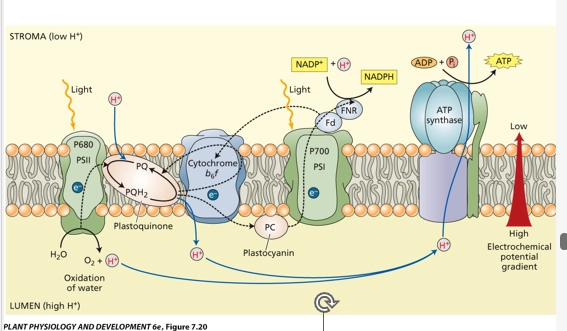
How is ATP actually formed in PS Light rxns?

What is the fate of this ATP Product

  • fuelled by the H+ gradient, generated along the PSII > e transport chain > PSI process (eg thru water splitting, PQH2 oxidation - a cycled process via Fd & CytB6F)

  • this acidifies the lumen. the lumen conc of H+ increases relative to the stroma outside of the thylakoids. A conc gtadient, and an electrochemical gradient.

  • Same principle as Mitochondrial ATP Synthase, chlorophyll ATP Synthase is closely related. diff structure slightly, but same mechanistic idea.

  • H+ from lumen taken up, head spins around, ADP phosphorylated to form ATP is able to be released from the AS upon energy input, ATP is released and H+ is released into the stroma, down its conc cradient

  • Coupling the passive & favorable movement of H+ down its conc gradient, to mechanically rotate the ATP synthase head, in order to release the phosphorylated ADP to make ATP.

(Fate of ATP)

  • can be used to drive dark PS rxns to actually make Glucose from CO2 (req to make C-C and C-H bonds)

  • May also be used elsewhere in the cell if needed / dark rxns had enough ATP. transported out.

<ul><li><p>fuelled by the H+ gradient, generated along the PSII &gt; e transport chain &gt; PSI process (eg thru water splitting, PQH2 oxidation - a cycled process via Fd &amp; CytB6F)</p></li><li><p>this acidifies the lumen. the lumen conc of H+ increases relative to the stroma outside of the thylakoids. A conc gtadient, and an electrochemical gradient.</p></li><li><p>Same principle as Mitochondrial ATP Synthase, chlorophyll ATP Synthase is closely related. diff structure slightly, but same mechanistic idea. </p></li><li><p>H+ from lumen taken up, head spins around, ADP phosphorylated to form ATP is able to be released from the AS upon energy input, ATP is released and H+ is released into the stroma, down its conc cradient</p></li><li><p>Coupling the passive &amp; favorable movement of H+ down its conc gradient, to mechanically rotate the ATP synthase head, in order to release the phosphorylated ADP to make ATP. </p></li></ul><p>(Fate of ATP)</p><ul><li><p>can be used to drive dark PS rxns to actually make Glucose from CO2 (req to make C-C and C-H bonds)</p></li><li><p>May also be used elsewhere in the cell if needed / dark rxns had enough ATP. transported out.</p></li></ul><p></p>
21
New cards

The OEC

  • where is it located

  • how does it work

  • how is this visualised experimentally


(where)

  • closeby to PSII’s P680, which couples these rxns locationally. H2O => O2 + H+, and P680 is reduced from the electron produced, refreshing the electron subsequently passed onto the e transport chain

  • PSI doesnt produce O2, so it doesnt have an OEC associated.

(Experimentally)

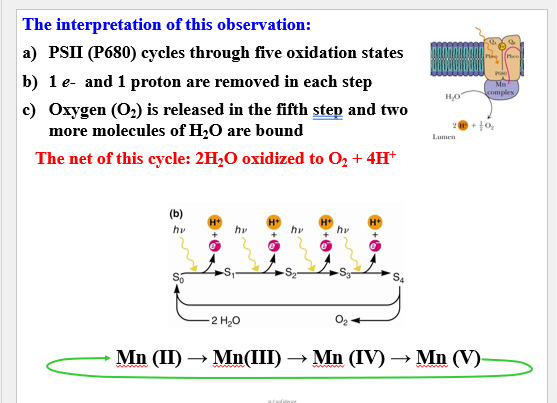
  • isolated chloroplasts in the dark. flashes of light (eg 1 photon), not every flash increased O2 yield, only every 3-4.

  • => Not every photon of light causes H2O to be split to refresh P680 electron. Some series of steps P680 must go thru before H2O can be split

(how does it work)

  • Specific AA residues in the structure, coordinate Mn ions (Mn II - V)

  • P680 must pass through 5 different oxidative stages in order to split water. S0-S4, related to Mn oxidation states (Mn II→ MnIII→ MnIV→ MnV→ MnII). and this is cylical

  • each change in redox state, electrons are taken up, stored, and released. each change in state, 1e is removed from 2H2O, since 1H2O => 1/2O2 + 2H+ + 2e

  • so the reason for the requirement of so many states, is because 1H2O cannot be split to form O2. O & O3 are super unstable (=ROS!), so this rxn has evolved to use 2H2O => O2. So these states must be passed thru, to fulfill this rxn.

  • Mn is coordinated, as it can exist in a range of oxidative states. It can have these 4 eletrons added to and be stable. Other metals are more reactive and likelier to make ROS if added this many electrons.

  • Additional metal clusters sttabilise the rxn (Ca, CuZn)

(Overall)

  • Mn coordinated so 4e can be addd to it from 2H2O, passing thru the redox states, which from each electrons can be removed and added to P680 to refresh it, and be passed thru the e transport chain

  • so 4 photons of light required to split water. excitation of each electron, and passed on, and required refreshing.

  • electrons and H+ used in PS, O2 as a waste.

<p>(where)</p><ul><li><p>closeby to PSII’s P680, which couples these rxns locationally. H2O =&gt; O2 + H+, and P680 is reduced from the electron produced, refreshing the electron subsequently passed onto the e transport chain </p></li><li><p>PSI doesnt produce O2, so it doesnt have an OEC associated. </p></li></ul><p>(Experimentally)</p><ul><li><p>isolated chloroplasts in the dark. flashes of light (eg 1 photon), not every flash increased O2 yield, only every 3-4. </p></li><li><p>=&gt; Not every photon of light causes H2O to be split to refresh P680 electron. Some series of steps P680 must go thru before H2O can be split </p></li></ul><p>(how does it work)</p><ul><li><p>Specific AA residues in the structure, coordinate Mn ions (Mn II - V)</p></li></ul><ul><li><p>P680 must pass through 5 different oxidative stages in order to split water. S0-S4, related to Mn oxidation states (Mn II→ MnIII→ MnIV→ MnV→ MnII). and this is cylical</p></li><li><p>each change in redox state, electrons are taken up, stored, and released. each change in state, 1e is removed from 2H2O, since 1H2O =&gt; 1/2O2 + 2H+ + 2e</p></li><li><p>so the reason for the requirement of so many states, is because 1H2O cannot be split to form O2. O &amp; O3 are super unstable (=ROS!), so this rxn has evolved to use 2H2O =&gt; O2. So these states must be passed thru, to fulfill this rxn. </p></li><li><p>Mn is coordinated, as it can exist in a range of oxidative states. It can have these 4 eletrons added to and be stable. Other metals are more reactive and likelier to make ROS if added this many electrons. </p></li><li><p>Additional metal clusters sttabilise the rxn (Ca, CuZn)</p></li></ul><p>(Overall)</p><ul><li><p>Mn coordinated so 4e can be addd to it from 2H2O, passing thru the redox states, which from each electrons can be removed and added to P680 to refresh it, and be passed thru the e transport chain</p></li><li><p>so 4 photons of light required to split water. excitation of each electron, and passed on, and required refreshing. </p></li><li><p>electrons and H+ used in PS, O2 as a waste. </p></li></ul><p></p>
22
New cards

How does chlorophyll photon absoption and P680 Redox work

  • Chlorophyll + Photon (Chl) => Chlorophyll Radical (Chl*) => Chlorophyll replenished & stabilised (Chl). a cyclic process where chlorophyll is reduced and oxidised. Energy is going downhill, but work is done with the passing of electrons

  • Do note, it isnt the chlorophyll reduced/oxidised. Its P680, which represents chlorophyll redox basically, as it is fed energy into for excitation, by chlorophyll resonance E transfer

  • Chl* reduces Pheophyin (Pheo) => Pheo- + Chl (back to normal)

  • Pheo- reduces PQ => PQH2 (PlastoQuionol) + Pheo (can recycle)

  • PQH2 reduces CytB6F => Reduced CytB6F + PQ (can recycle) + H+ (into lumen for gradient generation)

  • CytB6F reduces PC-Cu++ => PC-Cu+

  • the lost electron on reduced radical P680 is refreshed by H2O => O2 + H+ oxidation. The OEC closes the cycle and allows it to continue


<ul><li><p>Chlorophyll + Photon (Chl) =&gt; Chlorophyll Radical (Chl*) =&gt; Chlorophyll replenished &amp; stabilised (Chl). a cyclic process where chlorophyll is reduced and oxidised. Energy is going downhill, but work is done with the passing of electrons </p></li><li><p>Do note, it isnt the chlorophyll reduced/oxidised. Its P680, which represents chlorophyll redox basically, as it is fed energy into for excitation, by chlorophyll resonance E transfer </p></li><li><p>Chl* reduces Pheophyin (Pheo) =&gt; Pheo- + Chl (back to normal)</p></li><li><p>Pheo- reduces PQ =&gt; PQH2 (PlastoQuionol) + Pheo (can recycle)</p></li><li><p>PQH2 reduces CytB6F =&gt; Reduced CytB6F + PQ (can recycle) + H+ (into lumen for gradient generation)</p></li><li><p>CytB6F reduces PC-Cu++ =&gt; PC-Cu+</p></li><li><p>the lost electron on reduced radical P680 is refreshed by H2O =&gt; O2 + H+ oxidation. The OEC closes the cycle and allows it to continue</p></li></ul><p></p>
23
New cards

How does PQ actually take up electrons?

and how do they flow thru CytB6F?

  • Benzol ring as the centre, which narrates its reaction behaviour.

  • PQ + 1e => PQ* (shortlived, unstable) + 1e + 2H+ => PQH2 (C=O becomes C-OH)

  • plastoquione => Plastosemiquionone => plastohydroquione

  • each time PQH2 reduces, H+ are released into the lumen, from origin in the stroma (PQH2 being membrane solubled)

(make)

  • so reducers like CytB can make PQ* from reduction, and PQH2 from reduction and H+ input from the stroma (Enables gradient formation too.

  • electrons go into CytB6F via CytB => Fe-S cluster => CytF, then onto whoever.


<ul><li><p>Benzol ring as the centre, which narrates its reaction behaviour.</p></li><li><p>PQ + 1e =&gt; PQ* (shortlived, unstable) + 1e + 2H+ =&gt; PQH2 (C=O becomes C-OH)</p></li><li><p>plastoquione =&gt; Plastosemiquionone =&gt; plastohydroquione</p></li><li><p>each time PQH2 reduces, H+ are released into the lumen, from origin in the stroma (PQH2 being membrane solubled)</p></li></ul><p>(make)</p><ul><li><p>so reducers like CytB can make PQ* from reduction, and PQH2 from reduction and H+ input from the stroma (Enables gradient formation too. </p></li><li><p>electrons go into CytB6F via CytB =&gt; Fe-S cluster =&gt; CytF, then onto whoever. </p></li></ul><p></p>
24
New cards

how does the structure of PSI work?

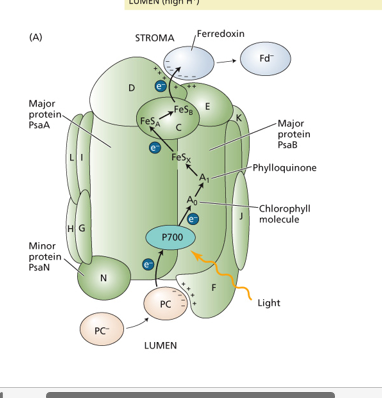
  • alot smaller than PSII, so less complex. but, lots of Fe-S clusters (vs PSII, more Chl molecules / pigments.)

(process)

  • CytB6F e + PC => PC-. charged but can go a distance, to PSI.

  • Docks to the PSI F unit => this positions reduction to occur on P700 => Positioning of Fe-S clusters result in their reduction => Fd ultimately reduced as the e carrier

  • Fd can then move away from PSI, and enable NADP+ reduction to form NADPH.

  • Fd works on charged based ionic interactions. the charge it gets upon reduction, enables movement away from PSI.

<ul><li><p>alot smaller than PSII, so less complex. but, lots of Fe-S clusters (vs PSII, more Chl molecules / pigments.)</p></li></ul><p>(process)</p><ul><li><p>CytB6F e + PC =&gt; PC-. charged but can go a distance, to PSI. </p></li><li><p>Docks to the PSI F unit =&gt; this positions reduction to occur on P700 =&gt; Positioning of Fe-S clusters result in their reduction =&gt; Fd ultimately reduced as the e carrier</p></li><li><p>Fd can then move away from PSI, and enable NADP+ reduction to form NADPH.</p></li><li><p>Fd works on charged based ionic interactions. the charge it gets upon reduction, enables movement away from PSI. </p></li></ul><p></p>
25
New cards

What are two PS inhibitors, and how do they work

  • both are herbicides. early herbicides worked by the means of inhibiting PS. This made them great for killing plants, but since all plants do PS - specificicity was a problem as weeds and crops alike were killed

(DCMU)

  • DiChlorophenyldiMethylUrea

  • this molecule takes up electrons meant to go into PQ pool (PQ => PQH2, between PSII & CytB6F), by being similar in structure to PQ

  • this depletes a key e carrier, right in the beginning of the cycle (also one that is fed into, so making these efforts futile) So energy from initial boost isnt obtained, so NADP+ reduction would be a struggle

  • But NADPH production can still occur via PSI. The problem is ATP production, which slows due to PQ’s key role in H+ gradient generation, through its reduction requiring the uptake of 2H+ from the stroma, that upon oxidation are released into the lumen.

  • NADPH production eventually runs out, as elecctrons arent being cycled back to join onto NADP+

  • However PS is still impacted by the direct depletion of ATP production. It becomes the limiting factor, so efficiency is limited

(Paraquat)

  • Methyl Viologen

  • this molecule’s mode of action is breaking up e transfer from P700 => Fd. Therefore NADPH production is directly affected, as the e meant to be put on Fd => NADP+, are taken up by Paraquat

  • ATP production can still occur though, as ATPase is functional AND the H+ gradient has been generated by previous e transfers (PSII…) upto this point

  • effiiency would still slow, NADPH is still req for dark rxns AND will become the limiting factor.


<ul><li><p>both are herbicides. early herbicides worked by the means of inhibiting PS. This made them great for killing plants, but since all plants do PS - specificicity was a problem as weeds and crops alike were killed</p></li></ul><p>(DCMU)</p><ul><li><p>DiChlorophenyldiMethylUrea</p></li><li><p>this molecule takes up electrons meant to go into PQ pool (PQ =&gt; PQH2, between PSII &amp; CytB6F), by being similar in structure to PQ</p></li><li><p>this depletes a key e carrier, right in the beginning of the cycle (also one that is fed into, so making these efforts futile) So energy from initial boost isnt obtained, so NADP+ reduction would be a struggle</p></li><li><p>But NADPH production can still occur via PSI. The problem is ATP production, which slows due to PQ’s key role in H+ gradient generation, through its reduction requiring the uptake of 2H+ from the stroma, that upon oxidation are released into the lumen. </p></li><li><p>NADPH production eventually runs out, as elecctrons arent being cycled back to join onto NADP+</p></li><li><p>However PS is still impacted by the direct depletion of ATP production. It becomes the limiting factor, so efficiency is limited</p></li></ul><p>(Paraquat)</p><ul><li><p>Methyl Viologen</p></li><li><p>this molecule’s mode of action is breaking up e transfer from P700 =&gt; Fd. Therefore NADPH production is directly affected, as the e meant to be put on Fd =&gt; NADP+,  are taken up by Paraquat</p></li><li><p>ATP production can still occur though, as ATPase is functional AND the H+ gradient has been generated by previous e transfers (PSII…) upto this point</p></li><li><p>effiiency would still slow, NADPH is still req for dark rxns AND will become the limiting factor. </p></li></ul><p></p>
26
New cards

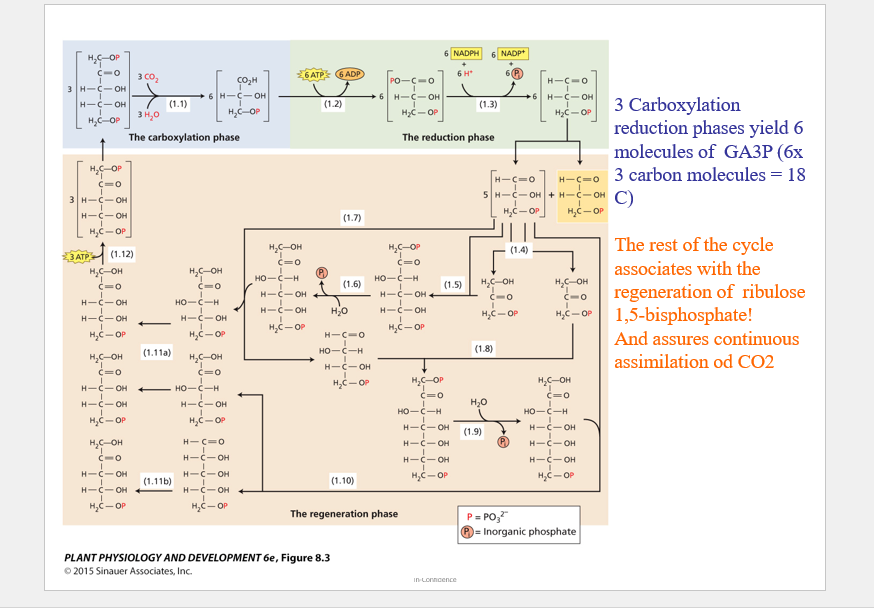
What is the purpose of the calvin-benson cycle

  • inputs & outputs

  • Name and differentiate the 3 phases


  • using the ADP & NADPH generated from the light rxns, to combine CO2 with other carbon compounds, to create G3P (which can then be turned into glucose, surcrose, and starch)

  • sugars can be used and broken down for respiration, used for growth and building parts of the plant, used for storage as starch. May be transferred to roots for storage

(phases)

  • Carboxylation (CO2 (&H2O) is added to R15BP, and split into 2× 3C molecules, 3-Phosphoglycerate)

  • Reduction (3-Phosphoglycerate is reduced using NADPH red potential, and phosphorylated with ATP) => Forming G3P (triose phosphates)

  • Regeneration (G3P are used with ATP to regenerate R15BP. rearrangements and combinations)


<ul><li><p>using the ADP &amp; NADPH generated from the light rxns, to combine CO2 with other carbon compounds, to create G3P (which can then be turned into glucose, surcrose, and starch)</p></li><li><p>sugars can be used and broken down for respiration, used for growth and building parts of the plant, used for storage as starch. May be transferred to roots for storage  </p></li></ul><p>(phases)</p><ul><li><p>Carboxylation (CO2 (&amp;H2O) is added to R15BP, and split into 2× 3C molecules, 3-Phosphoglycerate)</p></li><li><p>Reduction (3-Phosphoglycerate is reduced using NADPH red potential, and phosphorylated with ATP) =&gt; Forming G3P (triose phosphates)</p></li><li><p>Regeneration (G3P are used with ATP to regenerate R15BP. rearrangements and combinations)</p></li></ul><p></p>
27
New cards

Describe each phase of the calvin cycle

  • process

  • inputs

  • outputs


(Carboxylation)

  • Ribulose-1-5-bisphosphate is the starting material.

  • CO2 and H2O are added (Carboxylation) to R15BP, and split, => Forming 3-Phosphogylcerate x2

  • Carried out by Rubisco carboxylase activity.

  • In total: 3CO2 + 3H2O, onto 3×5C sugars => 6× 3C sugars (18C Conserved)

(Reduction)

  • 3-Phosphoglycerate as the starting material.

  • Phosphorylated via 1ATP => forming 1,3-Bisphosphoglycerate (via 3-Phosphoglycerate Kinase)

  • Reduced via 1NADPH + 1H+ => forming Glyceraldehyde-3-Phosphate (removing 1P, repositions it to 1C) (via NADP-G3P Dehydrogenase)

  • In total: 6× 3PG + 6ATP => 6G3P (1 used for glucose synthesis / starch / sucrose, 5 used for R15BP regneration)

(Regeneration)

  • G3P is the starting material. We need to regeneraete R15BP to enable cycling

  • A whole series of carbon combinations and rearrangements. ultimately using 3ATP per 5G3P => 1 R15BP

  • lots of side rxns coming off to make other sugars, AAs, nucleotides, etc.

  • also important for regenerating ADP for ATPsynthase to make more ATP (in light rxns) to drive the cycling

  • In total: 5x G3P + 3ATP => R15BP


<p>(Carboxylation)</p><ul><li><p>Ribulose-1-5-bisphosphate is the starting material.</p></li><li><p>CO2 and H2O are added (Carboxylation) to R15BP, and split, =&gt; Forming 3-Phosphogylcerate x2</p></li><li><p>Carried out by Rubisco carboxylase activity. </p></li><li><p>In total: 3CO2 + 3H2O, onto 3×5C sugars =&gt; 6× 3C sugars (18C Conserved)</p></li></ul><p>(Reduction)</p><ul><li><p>3-Phosphoglycerate as the starting material. </p></li><li><p>Phosphorylated via 1ATP =&gt; forming 1,3-Bisphosphoglycerate (via 3-Phosphoglycerate Kinase)</p></li><li><p>Reduced via 1NADPH + 1H+ =&gt; forming Glyceraldehyde-3-Phosphate (removing 1P, repositions it to 1C) (via NADP-G3P Dehydrogenase)</p></li><li><p>In total: 6× 3PG + 6ATP =&gt; 6G3P (1 used for glucose synthesis / starch / sucrose, 5 used for R15BP regneration)</p></li></ul><p>(Regeneration)</p><ul><li><p>G3P is the starting material. We need to regeneraete R15BP to enable cycling</p></li><li><p>A whole series of carbon combinations and rearrangements. ultimately using 3ATP per 5G3P =&gt; 1 R15BP</p></li><li><p>lots of side rxns coming off to make other sugars, AAs, nucleotides, etc. </p></li><li><p>also important for regenerating ADP for ATPsynthase to make more ATP (in light rxns) to drive the cycling </p></li><li><p>In total: 5x G3P + 3ATP =&gt; R15BP</p></li></ul><p></p>
28
New cards

What is Rubisco

  • where does it act

  • what are its two activities and how do these occur. what regulates which one is chosen?


  • R15BP Carboxylase Oxygenase

  • can either carboxylase, add CO2 to R15BP (CB cycle)

  • OR oxygenase, add O2 to R15BP (Photorespiration)

  • their intermediate is the same, removing H+ from R15BP to form Enediol which is unstable and quickly added either CO2 or O2 to. Then the next step both requires H2O addition, for hydrolysis to split R15BP

(Carboxylase)

  • Acts as part of the CB-cycle, in the carboxylation phase it carries out the fixation of CO2 onto R15BP => 2× 3-Phosphoglycerate

  • begins the CB cycle. More likely to occur with higher CO2 conc in cell / leaf

(Oxygenase)

  • Acts as part of photorespiration. Adds O2 to R15BP, forming 1×3-Phosphoglycerate, but also 1×3-Phosphoglycolate (2C body)

  • Because C is not added to begin with as O2 is added, 5C sugar => 3C sugar + 2C sugar

  • to recycle this 2C sugar back to R15BP to enable continuing cycling, Photorespiration pathway must be carried out.

  • This involves many organelles, and is energy costly, so often seen as inefficient activity. However, along the pathway important compounds are made via side rxns. So when the plant isnt in desperate need of sugars, photorespiration is useful for Secondary metabolism.


<ul><li><p>R15BP Carboxylase Oxygenase</p></li><li><p>can either carboxylase, add CO2 to R15BP (CB cycle)</p></li><li><p>OR oxygenase, add O2 to R15BP (Photorespiration)</p></li><li><p>their intermediate is the same, removing H+ from R15BP to form Enediol which is unstable and quickly added either CO2 or O2 to. Then the next step both requires H2O addition, for hydrolysis to split R15BP</p></li></ul><p>(Carboxylase)</p><ul><li><p>Acts as part of the CB-cycle, in the carboxylation phase it carries out the fixation of CO2 onto R15BP  =&gt; 2× 3-Phosphoglycerate</p></li><li><p>begins the CB cycle. More likely to occur with higher CO2 conc in cell / leaf</p></li></ul><p>(Oxygenase)</p><ul><li><p>Acts as part of photorespiration. Adds O2 to R15BP, forming 1×3-Phosphoglycerate, but also 1×3-Phosphoglycolate (2C body)</p></li><li><p>Because C is not added to begin with as O2 is added, 5C sugar =&gt; 3C sugar + 2C sugar</p></li><li><p>to recycle this 2C sugar back to R15BP to enable continuing cycling, Photorespiration pathway must be carried out.</p></li><li><p>This involves many organelles, and is energy costly, so often seen as inefficient activity. However, along the pathway important compounds are made via side rxns. So when the plant isnt in desperate need of sugars, photorespiration is useful for Secondary metabolism. </p></li></ul><p></p>
29
New cards

How can Rubisco Oxygenase activity be selected against?

  • What are the 3 methods of adaptation to efficient photosynthesis despite the seemingly inefficient Rubisco mechanism


  • Keeping a higher conc of CO2 in cells (and by proxy the space surrounding cells, within the leaf) relative to O2, favors Carbox activity for efficient photosynthesis.

  • Sometimes Ox activity is beneficial (Eg for side rxns when abundant sugarS). But sometimes plants live in conditions that make PS tougher, so cannot afford to lose out on potential Carbox activity.

  • Especially for water loss, where O2 accumulating from light rxns, must diffuse out stomata and CO2 in (to keep Carbox:Ox ratio high) BUT opening stomata incr water loss. So must evolve alternate strategies

(C3)

  • The typical PS model. domainant around the world (95%). Everything is happening in the same place (Light rxns, dark rxns, in chloroplast of the same cell)

  • Occurs in mesophyll cells, ground tissue of the leaf that contain chloroplasts.. CO2 diffuses into the leaf via stomata, so can be uptaken by mesophyll. Rubisco found in stroma, fixes CO2 using ATP & NADPH from light rxns. Stomata remain open for CO2 in, and O2 out from the light rxns.

(C4)

  • a strategy for hotter and drier environments than C3 is suitable for. Stomata cannot remain open for CO2 in and O2 out - as significant water loss would occur (water in thru guard cells, it opens, out thru pore as vapor)

  • light rxns are the same to generate ATP & NADPH. but before the CC, PEP Carboxylase enzyme in mesophyll cells, fixes CO2 onto PEP (a 3C sugar) => 4C sugar (C4! eg Malate)

  • C4 is then transported into specialised mesophyll cells (Bundle Sheath Cells), where Rubisco is localised to. C4 has CO2 removed (via Dehydrogenase eg Malate Dehydrogenase) => Rubisco Carboxylase activity is favored since CO2 conc is high, and light rxns to release O2 it isnt exposed to.

  • C4 plants need a lower CO2 conc, to assimilate the same amount as C3 (Carbox activity is favored, less Ox activity which would be favored in low CO2 in C3). But this plateaus earlier (Specialised area, can only do so much).

(CAM)

  • adated for super hot conditions, where nights are cold and humid (lots of H2O avaiable). To avoid water loss by day, stomata are instead opened at night

  • Opening stomata at night, CO2 comes in, O2 comes out, into the same organisation mesophyll as C3.

  • CO2 is fixed and stored (CO2 + PEP => C4 sugar like Malate, Malic acid), in the vacuole (as to not acidify the cell)

  • In the daytime, Light rxns begin, chloroplasts are activated, generating ATP & NADPH for CB cycle, but now we need CO2 (But stomata are closed!)

  • Malic acid is released into the cytosol, where it => Malate => CO2 (via Malate Dehydrogenase) => Rubisco performs Carbox activity and PS is effieicnt

  • Malate release makes Pyruvate, which can be phosphorylated to regen PEP

  • Based on circadian rhythm, stomata closes at day (signs of light) then as less light is recepted, they open


<ul><li><p>Keeping a higher conc of CO2 in cells (and by proxy the space surrounding cells, within the leaf) relative to O2, favors Carbox activity for efficient photosynthesis. </p></li><li><p>Sometimes Ox activity is beneficial (Eg for side rxns when abundant sugarS). But sometimes plants live in conditions that make PS tougher, so cannot afford to lose out on potential Carbox activity. </p></li><li><p>Especially for water loss, where O2 accumulating from light rxns, must diffuse out stomata and CO2 in (to keep Carbox:Ox ratio high) BUT opening stomata incr water loss. So must evolve alternate strategies</p></li></ul><p>(C3)</p><ul><li><p>The typical PS model. domainant around the world (95%). Everything is happening in the same place (Light rxns, dark rxns, in chloroplast of the same cell)</p></li><li><p>Occurs in mesophyll cells, ground tissue of the leaf that contain chloroplasts.. CO2 diffuses into the leaf via stomata, so can be uptaken by mesophyll. Rubisco found in stroma, fixes CO2 using ATP &amp; NADPH from light rxns. Stomata remain open for CO2 in, and O2 out from the light rxns.</p></li></ul><p>(C4)</p><ul><li><p>a strategy for hotter and drier environments than C3 is suitable for. Stomata cannot remain open for CO2 in and O2 out - as significant water loss would occur (water in thru guard cells, it opens, out thru pore as vapor)</p></li><li><p>light rxns are the same to generate ATP &amp; NADPH. but before the CC, PEP Carboxylase enzyme in mesophyll cells, fixes CO2 onto PEP (a 3C sugar) =&gt; 4C sugar (C4! eg Malate)</p></li><li><p>C4 is then transported into specialised mesophyll cells (Bundle Sheath Cells), where Rubisco is localised to. C4 has CO2 removed (via Dehydrogenase eg Malate Dehydrogenase) =&gt; Rubisco Carboxylase activity is favored since CO2 conc is high, and light rxns to release O2 it isnt exposed to. </p></li><li><p>C4 plants need a lower CO2 conc, to assimilate the same amount as C3 (Carbox activity is favored, less Ox activity which would be favored in low CO2 in C3). But this plateaus earlier (Specialised area, can only do so much).</p></li></ul><p>(CAM)</p><ul><li><p>adated for super hot conditions, where nights are cold and humid (lots of H2O avaiable). To avoid water loss by day, stomata are instead opened at night</p></li><li><p>Opening stomata at night, CO2 comes in, O2 comes out, into the same organisation mesophyll as C3. </p></li><li><p>CO2 is fixed and stored (CO2 + PEP =&gt; C4 sugar like Malate, Malic acid), in the vacuole (as to not acidify the cell)</p></li><li><p>In the daytime, Light rxns begin, chloroplasts are activated, generating ATP &amp; NADPH for CB cycle, but now we need CO2 (But stomata are closed!)</p></li><li><p>Malic acid is released into the cytosol, where it =&gt; Malate =&gt; CO2 (via Malate Dehydrogenase) =&gt; Rubisco performs Carbox activity and PS is effieicnt</p></li><li><p>Malate release makes Pyruvate, which can be phosphorylated to regen PEP</p></li><li><p>Based on circadian rhythm, stomata closes at day (signs of light) then as less light is recepted, they open </p></li></ul><p></p>
30
New cards

What species and environments…

  • Favor C3

  • Favor C4

  • Favor CAM

& Why not just do C4/CAM in a normal environment?

& What about hybrid systems?


  • Req extra structures and less overall PS efficiency if in normal conditions, so better just to do C3 if C4 CAM not required. better to do some Ox activity, if overall PS efficiency is fine

  • C3 ) 95% of plants. cool, moist, temperate (eg grasses like wheat, rice, barley, rye, oats, soybeans, potato)

  • C4 ) warm, humid (eg grasses like natives, sugarcane, maize)

  • CAM ) hot dry arid (deserts or beaches unique in NZ) (but cold at night with lots of humidity) (eg Cacti, big-leaved arid desert adaptees, orchids, pineapples)

  • Cam are pretty slow to grow, this strat isnt super efficieny AND they still have such a lack of H2O to grow. This just conserves the little they have.

(Hybrid)

  • Can exist. An interesting idea in Synth Bio

  • C3 + C4 would be quite complex (Or C3 => C4 conversion), as req a whole new specialised cell type (Bundle Sheath cells)

  • however, C3 + CAM would be optainable, since the machinery is all still the same as C4, just have this day and night open and close, and storage functioning.


31
New cards

How do stomata govern CO2 and O2 diffusion in and out of the leaf?

  • How does it vary with T


  • the epidermal cells of the leaf act as a boundary layer to gas diffusion, so stomata act as a point of resistance - this is where diffusion occurs. Incr resistance, Dcr gass exchange

  • Therefoer resistance decreases with leaf surface. Smaller leaves have lower reistance, and lose H2O and heat easier. May amplify with leaf hairs (Trichomes) vs smooths. (More hairs, more resistance, less GE)

  • eg Desert plants have smaller leaves for heat loss. Favors CAM strat as this even incr water loss) But will intake CO2 easier

(T)

  • Based on kinetic properties of gases, temperature plays into diffusion, but also for stomatal opening and closing

  • Higher T, more diffusion. (particles moving faster?)


<ul><li><p>the epidermal cells of the leaf act as a boundary layer to gas diffusion, so stomata act as a point of resistance - this is where diffusion occurs. Incr resistance, Dcr gass exchange</p></li><li><p>Therefoer resistance decreases with leaf surface. Smaller leaves have lower reistance, and lose H2O and heat easier. May amplify with leaf hairs (Trichomes) vs smooths. (More hairs, more resistance, less GE)</p></li><li><p>eg Desert plants have smaller leaves for heat loss. Favors CAM strat as this even incr water loss) But will intake CO2 easier</p></li></ul><p>(T)</p><ul><li><p>Based on kinetic properties of gases, temperature plays into diffusion, but also for stomatal opening and closing </p></li><li><p>Higher T, more diffusion. (particles moving faster?)</p></li></ul><p></p>
32
New cards

How do stomata open and close

  • What directly regulates this

  • What may signal this

  • How may stress alter


  • Guard cells turgid, stomata opens (more solutes)

  • Guard cells flaccid, stomata closes (less solutes)

(Directly)

  • Sucrose (a PS output made with Fruct onto Gluc) contributes to osmotic pressure for stomata opening and closing. (More sucrose, more solutes, open stomata. Sugars made, we need GE. But to an extent - lots of PS, weve done enough.)

  • Starch doesnt affect osmotic pressure, so can build glucose into this if not wanting an effect.

  • Ion potentials - K+, Cl-, Ca2+ action potentials. K/Cl stomatal closure.

(Signals)

  • Drought stress => Close stomata (conserve H2O. Turgidity lost by guard so will close auto, in a long term response. In a short term response, hormones may do an action potential to decrease turgidity)

  • Cold stress => Similar to drought, as H2O freezing renders it unavailable (Long term guard cells are flaccid, Short term hormones signal flaccidity)

  • eg ABA. Drought stress => ABA accumulates => Binds receptors => Signal drought stress => Stomata close

  • Pathogens => Signals from hormones immune response, close stomata

  • Ratio of light => darkness closes (PS ended) lightness opens (PS should begin). Indicated by the wavelengths.

  • CO2 presence => High conc open stomata

  • Energy requirements => Auxin signals growth, auxin accumulates we need PS, so stomata are signalled to open


<ul><li><p>Guard cells turgid, stomata opens (more solutes)</p></li><li><p>Guard cells flaccid, stomata closes (less solutes)</p></li></ul><p>(Directly)</p><ul><li><p>Sucrose (a PS output made with Fruct onto Gluc) contributes to osmotic pressure for stomata opening and closing. (More sucrose, more solutes, open stomata. Sugars made, we need GE. But to an extent - lots of PS, weve done enough.)</p></li><li><p>Starch doesnt affect osmotic pressure, so can build glucose into this if not wanting an effect. </p></li><li><p>Ion potentials - K+, Cl-, Ca2+ action potentials. K/Cl stomatal closure.</p></li></ul><p>(Signals)</p><ul><li><p>Drought stress =&gt; Close stomata (conserve H2O. Turgidity lost by guard so will close auto, in a long term response. In a short term response, hormones may do an action potential to decrease turgidity)</p></li><li><p>Cold stress =&gt; Similar to drought, as H2O freezing renders it unavailable (Long term guard cells are flaccid, Short term hormones signal flaccidity) </p></li><li><p>eg ABA. Drought stress =&gt; ABA accumulates =&gt; Binds receptors =&gt; Signal drought stress =&gt; Stomata close</p></li><li><p>Pathogens =&gt; Signals from hormones immune response, close stomata</p></li><li><p>Ratio of light =&gt; darkness closes (PS ended) lightness opens (PS should begin). Indicated by the wavelengths. </p></li><li><p>CO2 presence =&gt; High conc open stomata</p></li><li><p>Energy requirements =&gt; Auxin signals growth, auxin accumulates we need PS, so stomata are signalled to open </p></li></ul><p></p>
33
New cards

How exactly is photorespiration carried out?

  • When it happens to do oxygenase activity, to fix O2 onto R15BP instead of CO2. So in the CB cycle, 2× 3-Phosphoglycerate arent made. 1x Phosphoglycerate (3C sugar) + 1x Phosphoglycolate (2C sugar) as we arent adding the extra C

  • 3C sugar can continue onto CB cycle, to be used to make Glucose (sucrose, starch, lipids) or to regenerate R15BP (5x req => 3xR15BP, so cycling can continue)

  • The 2C sugar however, must go through a lengthy, various organelle, Energy expensive process, to regen R15BP.

  • But not an entire loss, the lengthy pathway makes for side rxns to generate AAs. We ultimately lose out on 1ATP & 1G3P to make an AA, so can be beneficial when sugar isnt under high demand

(the process)

  • Chloroplast ) 3-phosphoglycolate => glycolate => Transported into Peroxisome (closeby)

  • Here, various pathways and conversions occur.

  • => Glycine => Transported to Mitochon => Serine => Transported to Peroxisome.

  • Serine with various additions, and reduction with NADH => Glycerate => Transported to chloroplast

  • Glycerate phosphorylated with 1ATP (ATP gen from light rxns likely) => 3-Phosphoglycerate, and can continue on thru CB cycle => Make G3P => Make glucose / regen R15BP

(In summary)

  • Using various organelles, NADPH, and 1ATP in the final step, to use AA synthesis pathways, and convert 3-phosphoglycolate thru Glycine thru Serine ultimately to 3-phosphoglycerate to be fed into CB cycle again

  • Gen AAs along the way, so is useful as well. Arent just making waste productions.


34
New cards

How can Rubisco somewhat discriminate between CO2 & O2?

how does T play a role

How does respiration relate

  • selectivity factor. varies etween species (angiosperms more efficient)

  • 75% specificity for CO2

(O2)

  • Only when O2 at a higher ratio to CO2.

  • May occur when O2 prod in PS goes unused in respiration, and is not diffused.

  • CO2 and O2 balance however, directly impacted by H2O, due to stomal oprning and closure.

  • => Eg Arabdopsis mutatn, cannot reg stomal opening and closure, so plants only survive under high humidity and low T (Not inductive of stomatal closure. Abundant water, and not hot). In normal conditions, cannot close stomata, and water loss would occur and will die.

(T)

  • at higher T, ability to discrimnate decreases. Here the enedio interrmediate is less stable, and CO2 is less soluble so less enters the chloroplast relative to O2

(Respiration)

  • The opposite process - breaking down G6P to form CO2. However, cells need to do both. so plants maintain the balance of CO2 and O2, depending on whether they are favoring the use of O2 to make CO2, or the use of CO2 to make O2.

  • Opening the stomata or closing it, regulates what process occur therefore. Excess O2 generated in PS and not let out thru stomata => More respiration to generate ATP can occur.

  • TCA makes NADH, OxPhos makes ATP, so if these are needed more than sugars themseles, we can favor sugar breakdown.

  • DO NOTE - despite CO2 being a waste of respiration, mitochon can actually make use of it in high conc, to be used and recycled in TCA.


<ul><li><p>selectivity factor. varies etween species (angiosperms more efficient)</p></li><li><p>75% specificity for CO2</p></li></ul><p>(O2)</p><ul><li><p>Only when O2 at a higher ratio to CO2.</p></li><li><p>May occur when O2 prod in PS goes unused in respiration, and is not diffused.</p></li><li><p>CO2 and O2 balance however, directly impacted by H2O, due to stomal oprning and closure.</p></li><li><p>=&gt; Eg Arabdopsis mutatn, cannot reg stomal opening and closure, so plants only survive under high humidity and low T (Not inductive of stomatal closure. Abundant water, and not hot). In normal conditions, cannot close stomata, and water loss would occur and will die.</p></li></ul><p>(T)</p><ul><li><p>at higher T, ability to discrimnate decreases. Here the enedio interrmediate is less stable, and CO2 is less soluble so less enters the chloroplast relative to O2</p></li></ul><p>(Respiration)</p><ul><li><p>The opposite process - breaking down G6P to form CO2. However, cells need to do both. so plants maintain the balance of CO2 and O2, depending on whether they are favoring the use of O2 to make CO2, or the use of CO2 to make O2.</p></li><li><p>Opening the stomata or closing it, regulates what process occur therefore. Excess O2 generated in PS and not let out thru stomata =&gt; More respiration to generate ATP can occur.</p></li><li><p>TCA makes NADH, OxPhos makes ATP, so if these are needed more than sugars themseles, we can favor sugar breakdown.</p></li><li><p>DO NOTE - despite CO2 being a waste of respiration, mitochon can actually make use of it in high conc, to be used and recycled in TCA. </p></li></ul><p></p>
35
New cards

Describe the role of peroxisomes & mitochondria, in the context of PS

(peroxisomes)

  • powerhouse for redox rxns, protecting the rest of the cell from ROS generated.

  • Enables O2 cycling into the CB cycle (Photorespiration), and O2 cycling in general (Enables release of more or less as needed in the cell) - as they are bound into the peroxisomes.

(Mitochondria)

  • Same as the animal mitochondria

  • the only difference is that sugars made in chloroplasts, can then be broken down in the mitochondria. And O2 made in the chloroplasts, can be used as the terminal e acceptor in the mitochondria.

  • Additionally, they can release CO2 from the mitochondrial breakdown of glucose, and use this for PS

(overall)

  • more involvemenet and interaction of processes to fully sustain the plant, rather than requiring input like in animals.


36
New cards

how does Fd have an additional purpose?

  • Is an important regulator / activator of CB cycle enzymes, to activate the ahead process therefore.


37
New cards

What may plants do with sugars produced by PS? Where do they do this?

  • in the leaf chloroplasts, triose phosphate sugars are made (eg G3P) => Exported to the cytosol => Then these are converted to Hexose phosphates (Eg G6P)

  • they can be added with Fructose to make sucrose, which acts as the transport sugar and can flow thru the phloem to the roots (Driven by conc gradient.)

  • At the roots (most common site for this) Sucrose is broken back down into G6P => G3P => Transport to Amyloplast => Can synthesise starch for storage of sugars within Amyloplasts.

  • Starch is handy, as it can be stored for a long time, and has less impact on osmotic potential in the roots, as a large number of sugar solutes, are put into one polymer solute.

(Fed into metabolism)

  • Sugars can form other components that can do things like build organic acids to feed into the TCA cycle (=> Mitochondria), can make CO2 and NADPH (=> Pentose Phosphate Pathway in cytosol)

  • via entry points as glucose, fructose, G3P, etc.

  • Can also feed into Glycolysis, to be broken down in respiratioon to make ATP (They dont eat organic matter for food, they use these created sugars).

  • For plants living more than one season, they store sugars (Eg in root platids) for when PS is less efficient (eg in Witner when have no leaves, whe there is less light => But they still need energy)

  • So they can break down these stores and feed into glycolysis. Glycolysis can also ramp up in the spring to rapidly breakdown stored sugars, for biomass production (Growth associated with spring, requires energy)

  • Additionally, on the way to form pyruvate they form hexose & triose intermediates that can be fed into CC to make more sugars. All dependent on location, requiring transport from Glyc in the cytosol, into the plastid for use in CB cycle.

  • => Enables regulation spatially, to be able to use the same components but for different rxns (Opposite in this case).

  • Additionally, things like PEP are an intermediate in glycolysis, but also utilised for CAM & C4 strategies, so making use of the glycolysis substrates, for adaptive straegies.


<ul><li><p>in the leaf chloroplasts, triose phosphate sugars are made (eg G3P) =&gt; Exported to the cytosol =&gt; Then these are converted to Hexose phosphates (Eg G6P)</p></li><li><p>they can be added with Fructose to make sucrose, which acts as the transport sugar and can flow thru the phloem to the roots (Driven by conc gradient.)</p></li><li><p>At the roots (most common site for this) Sucrose is broken back down into G6P =&gt; G3P =&gt; Transport to Amyloplast =&gt; Can synthesise starch for storage of sugars within Amyloplasts.</p></li><li><p>Starch is handy, as it can be stored for a long time, and has less impact on osmotic potential in the roots, as a large number of sugar solutes, are put into one polymer solute.</p></li></ul><p>(Fed into metabolism)</p><ul><li><p>Sugars can form other components that can do things like build organic acids to feed into the TCA cycle (=&gt; Mitochondria), can make CO2 and NADPH (=&gt; Pentose Phosphate Pathway in cytosol)</p></li><li><p>via entry points as glucose, fructose, G3P, etc.</p></li><li><p>Can also feed into Glycolysis, to be broken down in respiratioon to make ATP (They dont eat organic matter for food, they use these created sugars). </p></li><li><p>For plants living more than one season, they store sugars (Eg in root platids) for when PS is less efficient (eg in Witner when have no leaves, whe there is less light =&gt; But they still need energy)</p></li><li><p>So they can break down these stores and feed into glycolysis. Glycolysis can also ramp up in the spring to rapidly breakdown stored sugars, for biomass production (Growth associated with spring, requires energy)</p></li><li><p>Additionally, on the way to form pyruvate they form hexose &amp; triose intermediates that can be fed into CC to make more sugars. All dependent on location, requiring transport from Glyc in the cytosol, into the plastid for use in CB cycle. </p></li><li><p>=&gt; Enables regulation spatially, to be able to use the same components but for different rxns (Opposite in this case). </p></li><li><p>Additionally, things like PEP are an intermediate in glycolysis, but also utilised for CAM &amp; C4 strategies, so making use of the glycolysis substrates, for adaptive straegies. </p></li></ul><p></p>
38
New cards

Respiration

  • What actually is it overall

  • Where is each process occurring

  • which products do each process form and when


  • the stepwise oxidation of Gluc => H2O + CO2.

  • controlled process to avoid explosion

(where)

  • Glycolysis - cytosol, make Pyruvate

  • Pyruvate Dehydrogenase - use Pyruvate, make Acetyl CoA

  • Krebs cycle - mitochondria, use Acetyl CoA, break it down completely into CO2

(what is being made)

  • Bascially turning the C from glucose into CO2, and harvesting the reducing power via NADH reduction for use in e transport chain to make ATP.

(Two phases of rxn)

  • C6H12O6 + O2 => 6CO2 + 6H2O

  • (GLYC & KREBS) removing C & H & e from glucose => CO2 + NADH

  • C6H12O4 + 6H2O => 6CO2 + 24H+ + 24e-

  • oxidising glucose with water and breaking down to CO2

  • (E TRANSPORT CHAIN) consuming O2 => H2O, as the ultimate product after using reducing potential to make ATP (NADH => NAD+)

  • 6O2 + 24H+ + 24e => 12H2O

  • reducing O2 to make water.


<ul><li><p>the stepwise oxidation of Gluc =&gt; H2O + CO2. </p></li><li><p>controlled process to avoid explosion</p></li></ul><p>(where)</p><ul><li><p>Glycolysis - cytosol, make Pyruvate</p></li><li><p>Pyruvate Dehydrogenase - use Pyruvate, make Acetyl CoA</p></li><li><p>Krebs cycle - mitochondria, use Acetyl CoA, break it down completely into CO2</p></li></ul><p>(what is being made)</p><ul><li><p>Bascially turning the C from glucose into CO2, and harvesting the reducing power via NADH reduction for use in e transport chain to make ATP. </p></li></ul><p>(Two phases of rxn)</p><ul><li><p>C6H12O6 + O2 =&gt; 6CO2 + 6H2O</p></li></ul><ul><li><p>(GLYC &amp; KREBS) removing C &amp; H &amp; e from glucose =&gt; CO2 + NADH</p></li><li><p>C6H12O4 + 6H2O =&gt; 6CO2 + 24H+ + 24e-</p></li><li><p>oxidising glucose with water and breaking down to CO2</p></li><li><p>(E TRANSPORT CHAIN) consuming O2 =&gt; H2O, as the ultimate product after using reducing potential to make ATP (NADH =&gt; NAD+)</p></li><li><p>6O2 + 24H+ + 24e =&gt; 12H2O</p></li><li><p>reducing O2 to make water.</p></li></ul><p></p>
39
New cards

How does oxidative phosphorylation differ from substrate level phoshphorylation

  • oxidative phosphorylation involves two seperate processes.

  • (Oxidation) O2 + NADH + H => H2O

  • => e transport chain

  • (Phosphorylation) ADP + Pi => ATP

  • => ATPsynthase

  • the oxidative phosphorylation is the coupling of these rxns. We require oxidation to form H2O, from the reducing potential of Glucose, to power themovement of H+ down the electrochemical gradient, providing the E to phosphoryalte ADP => ATP

  • => They arent directly linked. Occurring on two seperate complexes

(Substrate level phosphorylation)

  • the stages arent seperated. A substrate is phosphorylated with the phosphate from another phosphorylated substrate undergoing remobal.


<ul><li><p>oxidative phosphorylation involves two seperate processes. </p></li><li><p>(Oxidation) O2 + NADH + H =&gt; H2O</p></li><li><p>=&gt; e transport chain</p></li><li><p>(Phosphorylation) ADP + Pi =&gt; ATP</p></li><li><p>=&gt; ATPsynthase</p></li><li><p>the oxidative phosphorylation is the coupling of these rxns. We require oxidation to form H2O, from the reducing potential of Glucose, to power themovement of H+ down the electrochemical gradient, providing the E to phosphoryalte ADP =&gt; ATP</p></li><li><p>=&gt; They arent directly linked. Occurring on two seperate complexes</p></li></ul><p>(Substrate level phosphorylation)</p><ul><li><p>the stages arent seperated. A substrate is phosphorylated with the phosphate from another phosphorylated substrate undergoing remobal.</p></li><li><p></p></li></ul><p></p>
40
New cards

Describe beta oxidation’s place in metabolism

(&| Briefly, Urea Cycle)

  • Can feed into Krebs Cycle, via forming Acetyl CoA from fatty acids in adipose cells, that are oxidised in the mitochondria

  • => Can breakdown and form CO2, NADH, and H as before.

  • HOWEVER - cannot reverse Fatty Acid Acetyl CoA thru Gluconeogenesis in the brain to make glucose for energy. Req glucose or substitutes like ketone bodies.

(Urea cycle)

  • Breaking down proteins & AAs to generate C centers to oxidise in Krebs => Gen NADH & H as before for reedox potential.


<ul><li><p>Can feed into Krebs Cycle, via forming Acetyl CoA from fatty acids in adipose cells, that are oxidised in the mitochondria</p></li><li><p>=&gt; Can breakdown and form CO2, NADH, and H as before.</p></li><li><p>HOWEVER - cannot reverse Fatty Acid Acetyl CoA thru Gluconeogenesis in the brain to make glucose for energy. Req glucose or substitutes like ketone bodies.</p></li></ul><p>(Urea cycle)</p><ul><li><p>Breaking down proteins &amp; AAs to generate C centers to oxidise in Krebs =&gt; Gen NADH &amp; H as before for reedox potential.</p></li></ul><p></p>
41
New cards

Briefly describe mitochondrias….

  • Nature in the cell

  • Structure


(In the cell)

  • Same size as bacteria, cannot see naked eye, but yes with 1000x oil lens.

  • 800-2500 per cell, upper range in muscle cels (use lots of ATP) & kidney

  • dynamic, fuse and break apart, on the move. Not exist in a singular. more so as a population, exchanging contents, fusing, seperating.

  • Origin of prok enguf, explains genetics, structure, size. (1 - 0.5 bya)

(Structure)

  • two membranes (bacteriall + engulfee primitive euk, symbiotic infection), intermembrane space, matrix inner fluid.

  • inner membrane is rich in proteins, matrix soup is packed with proteins, infolds of the inner membrane are cristae - incr surface area for e transport chain rxns

  • even more infolds with incr activity.

  • PM are 50-70% proteins (prots > lipids) and the inner membrane is no different (densely packed)


<p>(In the cell)</p><ul><li><p>Same size as bacteria, cannot see naked eye, but yes with 1000x oil lens.  </p></li><li><p>800-2500 per cell, upper range in muscle cels (use lots of ATP) &amp; kidney</p></li><li><p>dynamic, fuse and break apart, on the move. Not exist in a singular. more so as a population, exchanging contents, fusing, seperating. </p></li><li><p>Origin of prok enguf, explains genetics, structure, size. (1 - 0.5 bya)</p></li></ul><p>(Structure)</p><ul><li><p>two membranes (bacteriall + engulfee primitive euk, symbiotic infection), intermembrane space, matrix inner fluid. </p></li><li><p>inner membrane is rich in proteins, matrix soup is packed with proteins, infolds of the inner membrane are cristae - incr surface area for e transport chain rxns</p></li><li><p>even more infolds with incr activity. </p></li><li><p>PM are 50-70% proteins (prots &gt; lipids) and the inner membrane is no different (densely packed)</p></li></ul><p></p>
42
New cards

Describe the mitochondrias…

  • Genes

  • Inheritance of these


(Genes)

  • an interesting genome, a leftover lump from engulfed prok, so is a circular plasmid, but some exhcange process over tme has put some mitochon DNA in the nuclear genome (shift of codons, settling them into euk DNA)

  • mitochondria codons are not entirely the same as AA genetic code in our DNA (more aligned with prim bacteria / more wobble garnered protection by the euk engulfee)

  • => But this means mitochon ribosomes must translate rather than cytosolic. 16s & 12s rRNA, made in the micothon DNA (this is what traps these genes in the mitochondrial genome, if are requird the specific mitochon machinery.)

  • all mtDNA genes code e transport chain proteins that form the complexes (EXCEPT complex 2 coded for in nucleus, then imported in & many ATP synthase prots)

  • mtDNA is as small as possible. genes seperated by tRNA encodes rather than introns to reduce size.

(Inheritance)

  • mtDNA stays with the egg, as the sperm just inserts DNA and mucks up mtDNA via oxidative stress => Inhertiance from mother only.

  • Enables tracking of mutations, for geneolgy thru the maternal line, much easier to track than male.

  • mutaitons in mtDNA, not too much of a problem due to mitochon abundance in the cell (one dud is amde up for by exchanging and combinations with others).

  • However can stack up over time, especially if repair methods get damaged, and mtDNA damage builds up, and can cause various diseases with issues in energy generation

  • eg neurodegenerative diseases => Damage of mtDNA until reaching a critical point with not enough mitochon activity then death. Earlier signs are less enery (eg for brain) => Neurodegeneration.


<p>(Genes)</p><ul><li><p>an interesting genome, a leftover lump from engulfed prok, so is a circular plasmid, but some exhcange process over tme has put some mitochon DNA in the nuclear genome (shift of codons, settling them into euk DNA)</p></li><li><p>mitochondria codons are not entirely the same as AA genetic code in our DNA (more aligned with prim bacteria / more wobble garnered protection by the euk engulfee) </p></li><li><p>=&gt; But this means mitochon ribosomes must translate rather than cytosolic. 16s &amp; 12s rRNA, made in the micothon DNA (this is what traps these genes in the mitochondrial genome, if are requird the specific mitochon machinery.)</p></li><li><p>all mtDNA genes code e transport chain proteins that form the complexes (EXCEPT complex 2 coded for in nucleus, then imported in &amp; many ATP synthase prots)</p></li><li><p>mtDNA is as small as possible. genes seperated by tRNA encodes rather than introns to reduce size. </p></li></ul><p>(Inheritance)</p><ul><li><p>mtDNA stays with the egg, as the sperm just inserts DNA and mucks up mtDNA via oxidative stress =&gt; Inhertiance from mother only.</p></li><li><p>Enables tracking of mutations, for geneolgy thru the maternal line, much easier to track than male. </p></li><li><p>mutaitons in mtDNA, not too much of a problem due to mitochon abundance in the cell (one dud is amde up for by exchanging and combinations with others). </p></li><li><p>However can stack up over time, especially if repair methods get damaged, and mtDNA damage builds up, and can cause various diseases with issues in energy generation</p></li><li><p>eg neurodegenerative diseases =&gt; Damage of mtDNA until reaching a critical point with not enough mitochon activity then death. Earlier signs are less enery (eg for brain) =&gt; Neurodegeneration.</p></li></ul><p></p>
43
New cards

What is the stage between Glycolysis & TCA cycle?

  • Complex responsible

  • Product produced

  • The rxn itself


(Complex)

  • Pyruvate Dehydrogenase (PDC), in the Mitochondrial Matrix (pyruvate must be transported here for conversion)

  • a multi-enzyme system (3 enzyme complex). req coenzymes (B1 vitamin, lipoate, FAD), essential to rxn, reagents in a way

(Rxn)

  • Decarboxylates (oxidises C=O then removes it as CO2) => 3C pyruvate => 2C, 1O

  • lipoate helps to add a Lysine to add an S to the carbonyl of Pyruvate 2C now (Thioester bond)

  • This thioster bond is broken and another is formed with CoA-SH => S-CoA is linked to 2C CH3C=O of pyruvate origin.

  • makes NADH for ATP gen later on, as FAD cofactor (removing e off lysine to get it back to normal) adds them to NAD+ for reest back to FAD for function (we form FADH2, bt this is located in the complex so the mobile conversion is NADH

  • (Overall) => Carboxylic group on pryvuate oxidised => disulfide bonds form on it => redox potential forms NADH

  • (Outputs) => NADH, CO2. Broken down glucose a bit more, into e and carbons.

(Product)

  • CoA, Coenzyme A, essentially a modified nucleotide (ATP)

  • the function of the CoA group is to carry the tiny Acetyl group (the leftovers of glucose we need to oxidise to make Energy) CH3C=O, leftover from pyruvate

  • the large handle, enables recognitin by enzymes (not just a tiny molecule).

  • Binding to it with a thioester bond has Energy tied up, so hydrolysis for letting go is favorable.


<p>(Complex)</p><ul><li><p>Pyruvate Dehydrogenase (PDC), in the Mitochondrial Matrix (pyruvate must be transported here for conversion) </p></li><li><p>a multi-enzyme system (3 enzyme complex). req coenzymes (B1 vitamin, lipoate, FAD), essential to rxn, reagents in a way</p></li></ul><p>(Rxn)</p><ul><li><p>Decarboxylates (oxidises C=O then removes it as CO2) =&gt; 3C pyruvate =&gt; 2C, 1O</p></li><li><p>lipoate helps to add a Lysine to add an S to the carbonyl of Pyruvate 2C now (Thioester bond)</p></li><li><p>This thioster bond is broken and another is formed with CoA-SH =&gt; S-CoA is linked to 2C CH3C=O of pyruvate origin. </p></li><li><p>makes NADH for ATP gen later on, as FAD cofactor (removing e off lysine to get it back to normal) adds them to NAD+ for reest back to FAD for function (we form FADH2, bt this is located in the complex so the mobile conversion is NADH</p></li><li><p>(Overall) =&gt; Carboxylic group on pryvuate oxidised =&gt; disulfide bonds form on it =&gt; redox potential forms NADH</p></li><li><p>(Outputs) =&gt; NADH, CO2. Broken down glucose a bit more, into e and carbons.</p></li></ul><p>(Product)</p><ul><li><p>CoA, Coenzyme A, essentially a modified nucleotide  (ATP) </p></li><li><p>the function of the CoA group is to carry the tiny Acetyl group (the leftovers of glucose we need to oxidise to make Energy) CH3C=O, leftover from pyruvate</p></li><li><p>the large handle, enables recognitin by enzymes (not just a tiny molecule).</p></li><li><p>Binding to it with a thioester bond has Energy tied up, so hydrolysis for letting go is favorable. </p></li></ul><p></p>
44
New cards

How is Pyruvate Dehydrogenase Complex controlled?

How is pyruvate transported to its fate in Acetyl CoA formation?

(Control)

  • Firstly, conc. of substrates and products. Lots of pyruvate => System activates. Lots of Acetyl CoA => System slows down (Allosteric)

  • Inactivated upon high cellular ATP, by PDK (PhosphoDehydrogenase Kinase) phosphorylation (WE dont need krebs if high ATP anyway)

  • Then Phosphatase removes P for reactivation

  • => Never OFF! just have fine tuning as cellular conc. and requirements change.

(Transport)

  • Pyruvate is produced thru Glycolysis in the cytosol, but then PDC exits in the Mitochondrial Matrix, so Pyruvate must transport here to form Acetyl CoA to continue respiration

  • First in thru outer membrane (More permeable) via VDAC

  • Then thru inner membrane (Less permeable, must hold back protons for e transport chain function) via Mitochondria Pyruvate Carrier (MPC).


<p>(Control)</p><ul><li><p>Firstly, conc. of substrates and products. Lots of pyruvate =&gt; System activates. Lots of Acetyl CoA =&gt; System slows down (Allosteric)</p></li><li><p>Inactivated upon high cellular ATP, by PDK (PhosphoDehydrogenase Kinase) phosphorylation (WE dont need krebs if high ATP anyway)</p></li><li><p>Then Phosphatase removes P for reactivation</p></li><li><p>=&gt; Never OFF! just have fine tuning as cellular conc. and requirements change.</p></li></ul><p>(Transport)</p><ul><li><p>Pyruvate is produced thru Glycolysis in the cytosol, but then PDC exits in the Mitochondrial Matrix, so Pyruvate must transport here to form Acetyl CoA to continue respiration</p></li><li><p>First in thru outer membrane (More permeable) via VDAC</p></li><li><p>Then thru inner membrane (Less permeable, must hold back protons for e transport chain function) via Mitochondria Pyruvate Carrier (MPC).</p></li></ul><p></p>
45
New cards

Overall, whats going on in the Krebs Cycle?

  • Redox redox redox.

  • CoA handle delivers the Acetyl to Citrate.

  • High energy C-H bonds have lots of reducing power (e to donate), so these in the Acetyl (CH3CHO) are transformed down the redox table

  • alkane => alcohol => aldehyde => carbox => ketone

  • each loss of e => loss of E => coupled to NADH reduction (to make ATP later)

  • ultimately, Acetyl is broken down into CO2

  • Oxaloacetate cycle-starting substrate is regenreated too.


<ul><li><p>Redox redox redox. </p></li><li><p>CoA handle delivers the Acetyl to Citrate. </p></li><li><p>High energy C-H bonds have lots of reducing power (e to donate), so these in the Acetyl (CH3CHO) are transformed down the redox table</p></li><li><p>alkane =&gt; alcohol =&gt; aldehyde =&gt; carbox =&gt; ketone</p></li><li><p>each loss of e =&gt; loss of E =&gt; coupled to NADH reduction (to make ATP later)</p></li><li><p>ultimately, Acetyl is broken down into CO2 </p></li><li><p>Oxaloacetate cycle-starting substrate is regenreated too.</p></li></ul><p></p>
46
New cards

Describe the first major stage of the TCA Cycle (Citrate Synthase)

  • Acetyl-CoA (2C) + Oxaloacetate (4C) => Citrate (6C)

  • CoA handle drops off Acetyl to bind to Oxaloactae (the starting, recycled, substrate of TCA cycle), first binding alltogether (citryl-CoA)

  • favorable rxn, driven by E from Thioester (Acetyl - CoA) bond hydrolysis

  • H2O added, as an H is added.

  • Still mostly C-C & C-H (Highly reduced) glucose bonds.

  • => Via Citrate Synthase.


<ul><li><p>Acetyl-CoA (2C) + Oxaloacetate (4C) =&gt; Citrate (6C)</p></li><li><p>CoA handle drops off Acetyl to bind to Oxaloactae (the starting, recycled, substrate of TCA cycle), first binding alltogether (citryl-CoA)</p></li><li><p>favorable rxn, driven by E from Thioester (Acetyl - CoA) bond hydrolysis</p></li><li><p>H2O added, as an H is added. </p></li><li><p>Still mostly C-C &amp; C-H (Highly reduced) glucose bonds.</p></li><li><p>=&gt; Via Citrate Synthase.</p></li></ul><p></p>
47
New cards

Describe the 2nd Step in the TCA cycle (Aconitase)

  • What is interesting about this enzyme


  • So thru an eq rxn, Citrate => cis-Aconitate => Isocitrate, removing and adding water, (dehydrationn & rehydraton), that makes Citrate more faborable as a substrate for subsequent enzymes.

  • Rearranges carbox groups also.

(interestingly)

  • Aconitase is an easily inhibitied enzyme, as in 1080 poison for Possum targetting.

  • 1080 is not toxic - is a Protoxin, that converts to a FLuorated Citric Acid, that binds aconitase and locks it up.

  • This F group (Fluoroacetate) is joined onto CoA as before, and reacts with Oxalocaeteate and enetrs the TCA cycle (Just reacognised as a normal Acetyl CoA)

  • Fluorine binds very strong to Aconitase, and prevents it from doing rearranging and continuing the cycle.

  • This bungs up subsequent TCA cycle & e transport chain therefore, shutting it down, => Is a lethal toxin to obligate aerobes (mammals, insects, humans) because only Glycolysis for energy gen is permitted.


<ul><li><p>So thru an eq rxn, Citrate =&gt; cis-Aconitate =&gt; Isocitrate, removing and adding water, (dehydrationn &amp; rehydraton), that makes Citrate more faborable as a substrate for subsequent enzymes.</p></li><li><p>Rearranges carbox groups also.</p></li></ul><p>(interestingly)</p><ul><li><p>Aconitase is an easily inhibitied enzyme, as in 1080 poison for Possum targetting.</p></li><li><p>1080 is not toxic - is a Protoxin, that converts to a FLuorated Citric Acid, that binds aconitase and locks it up.</p></li><li><p>This F group (Fluoroacetate) is joined onto CoA as before, and reacts with Oxalocaeteate and enetrs the TCA cycle (Just reacognised as a normal Acetyl CoA)</p></li><li><p>Fluorine binds very strong to Aconitase, and prevents it from doing rearranging and continuing the cycle. </p></li><li><p>This bungs up subsequent TCA cycle &amp; e transport chain therefore, shutting it down, =&gt; Is a lethal toxin to obligate aerobes (mammals, insects, humans) because only Glycolysis for energy gen is permitted. </p></li></ul><p></p>
48
New cards

Describe the 3rd step in TCA cycle (Isocitrate Dehydrogenase)

  • Now in a form that enzymes are happier to use, Citrate (Isocitrate, Oxaloacteate 4C + Acetyl-Coa Acetyl 2C) is the substrate

  • a simple redox. NADH is produced as oxidation occurs. CO2 is removed, and rearrangement forms Alpha-ketoglutarate

  • => A 5C compound.

  • Irreversible rxn. A two-step mechanism. (First = Oxidation via NAD+. Second = Removal of CO2, decarboxylation)


<ul><li><p>Now in a form that enzymes are happier to use, Citrate (Isocitrate, Oxaloacteate 4C + Acetyl-Coa Acetyl 2C) is the substrate</p></li><li><p>a simple redox. NADH is produced as oxidation occurs. CO2 is removed, and rearrangement forms Alpha-ketoglutarate</p></li><li><p>=&gt; A 5C compound. </p></li><li><p>Irreversible rxn. A two-step mechanism. (First = Oxidation via NAD+. Second = Removal of CO2, decarboxylation)</p></li></ul><p></p>
49
New cards

Describe Step 4 in TCA cycle (A-Ketoglutarate Dehydrogenase)

  • A-Ketoglutarate => Succinyl-CoA

  • A similar rxn to Pyruvate => Acetyl-CoA. B1 vitamin derivative involved (also lipoate, FAD, cofctors), with a 3-enzyme complex, doing similar rxns.

  • FADH2 tied up in complex 3, so NADH is generated

  • CO2 is generated, so C5 => C4, but with the added CoA handle again (a thioester bond with the C=O carbon and S)

  • => Gen NADH, lose CO2

  • To gen each CO2, O is added from 2H2O (vs O2 itself.)


<ul><li><p>A-Ketoglutarate =&gt; Succinyl-CoA</p></li><li><p>A similar rxn to Pyruvate =&gt; Acetyl-CoA. B1 vitamin derivative involved (also lipoate, FAD, cofctors), with a 3-enzyme complex, doing similar rxns. </p></li><li><p>FADH2 tied up in complex 3, so NADH is generated</p></li><li><p>CO2 is generated, so C5 =&gt; C4, but with the added CoA handle again (a thioester bond with the C=O carbon and S)</p></li><li><p>=&gt; Gen NADH, lose CO2</p></li><li><p>To gen each CO2, O is added from 2H2O (vs O2 itself.)</p></li></ul><p></p>
50
New cards

describe step 5 in the TCA cycle (Succinyl-CoA Synthetase), and what happens onwards

  • Succinyl-CoA synthetase, breaks the thiol ester bond sticking Succinyl (4C group) to CoA, and the E tied up in this bond is used to Substrate Level Phosphorylate.

  • GDP => GTP (then another enzyme, GTP => ATP, we just seperate tehse pools to drive rxn, thermodynamics).

  • => Symmetrical molecule, Succinate (4C)

  • At this point, we have essentially burnt off the Acetyl from Pyruvate, As 2CO2 (after the first CO2 taken off in PDC).

  • Now given the 4C body Succinate, it must be rearranged back to Oxaloacetate to continue cycling.

(From this point onwards)

  • FAD => FADH2, Succinate is oxidised to Fumarate (remove H2, remove e)

  • Add H2O, Fumarate => Malate,add an OH group (oxidised, add O)

  • NAD+ => NADH, Malate => Oxaloacetate (oxidise, remove e, form C=O again)

  • So essetually returning back the dual ended carboxylic acid (Succinate) with alkane in the middle, to get a ketone on one of these. Reduction cycle. Alkane => Alkene => Alcohol => Carbonyl.


<ul><li><p>Succinyl-CoA synthetase, breaks the thiol ester bond sticking Succinyl (4C group) to CoA, and the E tied up in this bond is used to Substrate Level Phosphorylate.</p></li><li><p>GDP =&gt; GTP (then another enzyme, GTP =&gt; ATP, we just seperate tehse pools to drive rxn, thermodynamics). </p></li><li><p>=&gt; Symmetrical molecule, Succinate (4C)</p></li><li><p>At this point, we have essentially burnt off the Acetyl from Pyruvate, As 2CO2 (after the first CO2 taken off in PDC). </p></li><li><p>Now given the 4C body Succinate, it must be rearranged back to Oxaloacetate to continue cycling. </p></li></ul><p>(From this point onwards)</p><ul><li><p>FAD =&gt; FADH2, Succinate is oxidised to Fumarate (remove H2, remove e)</p></li><li><p>Add H2O, Fumarate =&gt; Malate,add an OH group (oxidised, add O)</p></li><li><p>NAD+ =&gt; NADH, Malate =&gt; Oxaloacetate (oxidise, remove e, form C=O again)</p></li><li><p>So essetually returning back the dual ended carboxylic acid (Succinate) with alkane in the middle, to get a ketone on one of these. Reduction cycle. Alkane =&gt; Alkene =&gt; Alcohol =&gt; Carbonyl. </p></li></ul><p></p>
51
New cards

How is the krebs cycle controlled

How are C carriers topped up


(Succinyl CoA conc)

  • a key feedback point (When we have released Acetyl from Pyruvate as 2Co2, and are left with Succinyl-CoA, 4C from Oxalocatetate with CoA handle

  • enough SCoA, slows down cycle, from preventing Acetyl-CoA OXaloacetate rxn (First step)

  • Also slows down formation of Succinyl CoA from a-ketoglutarate

(Citrate conc)

  • Enough conc, slow down.

(Other)

  • Energy req. NAD+ Availability & NADH need.

(Topping up C carriers)

  • As the krebs cycle goes thru, we arent just using for respiration, carbon bodies formed may be siphoned of for biosynthesis, often acting as important precursrors

  • => Krebs cycle sits in the middle of metabolism.

  • Oxaloactate esepcially, as the starting and regen point. Can be remade by combining Pyruvate + Bicarbonate (HCO3) using biotin cofactor in pyruvate carboxylase.

  • Genreating more Oxalo can also speed up the cycle. espec important if components taken out for Biosynt.

(Use of intermediates elesewhere)

  • Not srraightforward use from Krebs, but use these molecules as origins.

  • eg FAs, heme, AAs, pyrimidines, purines, glucose.

  • Basically using these carbon skeletons, to make AAs. Can also go in reverse to make carbon skeletons form AAs (Entering AAs into Krebs, to get E from proteins.)

  • Removing the AA group, reforms the C skeleton, fo refeeding.

  • eg Oxalo => PEP => Glucose, Srine, Glyc, Trp, Cystine, Tyr.

  • eg Citrate => FAs, Sterols.


<p></p><p>(Succinyl CoA conc)</p><ul><li><p>a key feedback point (When we have released Acetyl from Pyruvate as 2Co2, and are left with Succinyl-CoA, 4C from Oxalocatetate with CoA handle</p></li><li><p>enough SCoA, slows down cycle, from preventing Acetyl-CoA OXaloacetate rxn (First step)</p></li><li><p>Also slows down formation of Succinyl CoA from a-ketoglutarate</p></li></ul><p>(Citrate conc)</p><ul><li><p>Enough conc, slow down. </p></li></ul><p>(Other)</p><ul><li><p>Energy req. NAD+ Availability &amp; NADH need.</p></li></ul><p>(Topping up C carriers)</p><ul><li><p>As the krebs cycle goes thru, we arent just using for respiration, carbon bodies formed may be siphoned of for biosynthesis, often acting as important precursrors </p></li><li><p>=&gt; Krebs cycle sits in the middle of metabolism.</p></li><li><p>Oxaloactate esepcially, as the starting and regen point. Can be remade by combining Pyruvate + Bicarbonate (HCO3) using biotin cofactor in pyruvate carboxylase.</p></li><li><p>Genreating more Oxalo can also speed up the cycle. espec important if components taken out for Biosynt.</p></li></ul><p>(Use of intermediates elesewhere)</p><ul><li><p>Not srraightforward use from Krebs, but use these molecules as origins. </p></li><li><p>eg FAs, heme, AAs, pyrimidines, purines, glucose. </p></li><li><p>Basically using these carbon skeletons, to make AAs. Can also go in reverse to make carbon skeletons form AAs (Entering AAs into Krebs, to get E from proteins.)</p></li><li><p>Removing the AA group, reforms the C skeleton, fo refeeding.</p></li><li><p>eg Oxalo =&gt; PEP =&gt; Glucose, Srine, Glyc, Trp, Cystine, Tyr.</p></li><li><p>eg Citrate =&gt; FAs, Sterols.</p></li></ul><p></p>
52
New cards
53
New cards
54
New cards