Introduction to the Built Environment: Project Delivery, Sustainability, and Technology
 Call Kai
 Learn
Learn Practice Test
 Spaced Repetition
 Match
Match Flashcards
 Knowt Play
1/35

Earn XP
Description and Tags
Vocabulary flashcards covering project delivery methods, construction contracts, sustainability and LEED rating fundamentals, Building Information Modeling (BIM), and construction reality capture technologies.
Name | Mastery | Learn | Test | Matching | Spaced | Call with Kai | Chat |
|---|
No analytics yet
Send a link to your students to track their progress
36 Terms
Project Delivery
A comprehensive process including planning, design, construction, and other services necessary for organizing, executing, and completing a building, facility, or infrastructure project.
Design-Bid-Build (DBB)
A traditional project delivery method where the owner contracts separately with the designer and the builder, requiring complete construction drawings before competitively bidding the project.

Construction Manager at Risk (CM-at-Risk / CMAR)
A project delivery method where the contractor is engaged early during the design phase to provide preconstruction estimates and constructability input before executing the build under a Guaranteed Maximum Price.

Design-Build (DB)
A project delivery method where the owner manages a single contract with one entity that covers both design and construction, offering the potential for faster delivery and minimal change orders.
Integrated Project Delivery (IPD)
A collaborative delivery approach that binds the owner, designer, and primary contractor under a multi-party agreement, integrating people, systems, and practices to optimize efficiency and shared risk/reward.
Big Room
A collaborative, co-located project workspace where the owner, designers, contractors, and specialty trades work together simultaneously to streamline communication and eliminate project silos.
Construction Project
A temporary endeavor defined by a specific goal, a distinct beginning and end, resource consumption (time, money, labor, materials, equipment), and the creation of a unique facility or structure.
Construction Project Management
The professional process of coordinating and controlling the work required to deliver a project across people, time, cost, resources, risk, safety, and quality.
Vertical Construction
The sector of the construction industry focused on buildings, typically categorized into residential, commercial, institutional, and industrial projects.
Horizontal / Heavy Construction
Infrastructure-focused construction encompassing public works such as highways, bridges, railroads, tunnels, dams, pipelines, utilities, and marine structures.
Lump Sum Contract
A fixed-price construction agreement where the contractor agrees to complete a defined scope of work for an agreed total sum, placing financial overrun risks primarily on the contractor.
Cost-Plus Contract
A contract where the owner reimburses the contractor for all allowable project costs plus an agreed contractor fee, offering scope flexibility while the owner absorbs the cost uncertainty.
Guaranteed Maximum Price (GMP)
A contract structure that reimburses the contractor for allowable costs plus a fee up to a specified cost ceiling, beyond which the contractor assumes liability for overruns.
Sustainability
Meeting today's needs without compromising future generations by balancing decisions across the environment, economy, and community.
Green Building
The practice of implementing sustainability in the built environment by considering energy, water, land, materials, waste, indoor air quality, and overall ecological impact.
Operational Carbon
Greenhouse gas emissions produced throughout the daily active use of a building, including heating, cooling, lighting, and electricity usage.
Embodied Carbon
Greenhouse gas emissions locked in prior to building occupancy, resulting from raw material extraction, manufacturing, transportation, and construction site operations.
U.S. Green Building Council (USGBC)
The nonprofit organization that develops the LEED green building rating system, administers professional credentials, and educates the industry on sustainable building.
LEED (Leadership in Energy and Environmental Design)
A standardized green building rating system published by the USGBC that provides a points-based framework for evaluating building performance and environmental sustainability.
LEED Prerequisite
A mandatory requirement within the LEED rating system that all projects must meet before being eligible for certification; it awards 0 points.
LEED Credit
An optional sustainability strategy within the LEED system that a project team can pursue to earn points toward higher tiers of certification.
LEED Certification Levels
The four rating thresholds awarded to a building based on verified points: Certified (40–49 points), Silver (50–59 points), Gold (60–79 points), and Platinum (80+ points).
LEED Green Associate
A foundational professional credential awarded to an individual verifying core knowledge of green design, construction, and LEED rating practices.
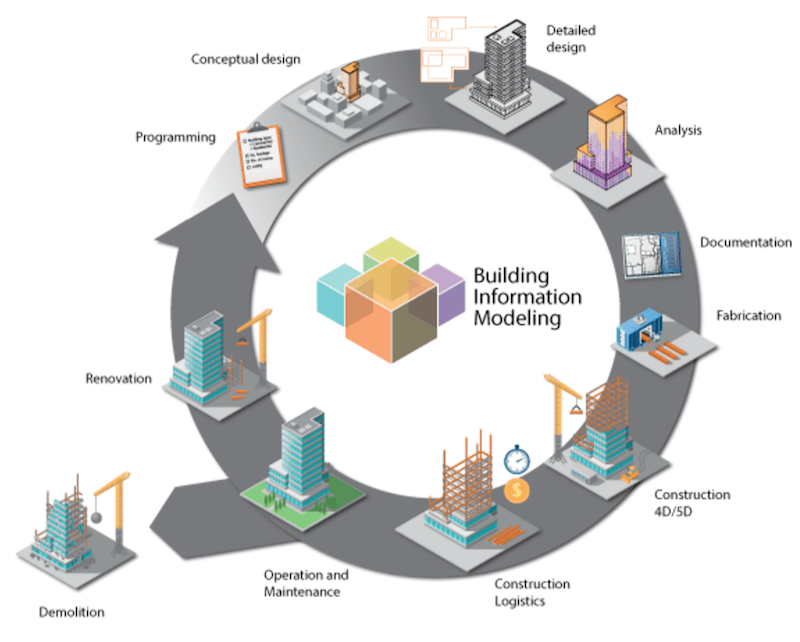
Building Information Modeling (BIM)
A digital representation of the physical and functional characteristics of a facility, serving as a shared knowledge resource and collaborative process throughout its entire life cycle.
4D BIM
The process of linking time and project scheduling data to a 3D digital building model to visualize, analyze, and communicate the construction sequence.
5D BIM
The integration of cost data, budget tracking, and material quantities into a digital building model for real-time model-based estimating.
Clash Detection
A digital coordination process that identifies physical spatial interferences between building systems (such as ductwork conflicting with structural beams) prior to fabrication and construction.
Unmanned Aerial System (UAS)
The FAA-preferred term for an integrated system consisting of an unmanned aerial vehicle (UAV), imaging payload, remote controller, and ground station support used for surveying and inspection.
Virtual Design and Construction (VDC)
The holistic management of integrated multi-disciplinary performance models of design-construction projects, including BIM, estimating, scheduling, and reality capture technologies.
Reality Capture
The technology and process of capturing real-world field conditions using 360-degree cameras, photogrammetry, or laser scanning to compare actual progress against design models.

OpenSpace
A reality capture software tool that stitches 360-degree video footage captured from hard-hat cameras to project floor plans and BIM models for virtual site inspections.
Procore
A cloud-based construction management and document control platform used for tracking daily logs, RFIs, submittals, safety tickets, and field issues.
Laser Scanning
A reality capture technology that emits laser light pulses to capture, measure, and map the precise three-dimensional geometry and as-built spatial conditions of a site.
Spatial Changes
Deviations between design models and as-built site conditions, including object dislocations, shape deformations, or unauthorized additions and removals.
Autodesk Navisworks
A project review software that aggregates 3D geometry and data from various disciplines into a single composite model for clash detection, construction simulation, and design reviews.
Construction 4.0
The digitalization and industrialization of the architecture, engineering, and construction industry through cyber-physical systems, robotics, IoT, AI, and advanced automation.