Physical Examination of MSK
 Call Kai
 Learn
 Practice Test
 Spaced Repetition
 Match
 Flashcards
 Knowt Play
1/38

Earn XP
Description and Tags
Mainly on identifying the special tests
39 Terms
What is grade 5 muscle strength
Normal → Full ROM against gravity and maximal resistance
What is grade 4 muscle strength
Good → Full ROM against gravity and moderate resistance
What is grade 3 muscle strength
Fair → Full ROM against gravity BUT no resistance
What is grade 2 muscle strength
Poor → Full ROM achieved only when gravity is ELIMINATED
What is grade 1 muscle strength
Trace → Visible/palpable contraction noted
What is grade 0 muscle strength
No contraction identified

This describes what
Apprehension test → arm in this position and force to posterior humeral head → Positive = pain/apprehension = shoulder problem
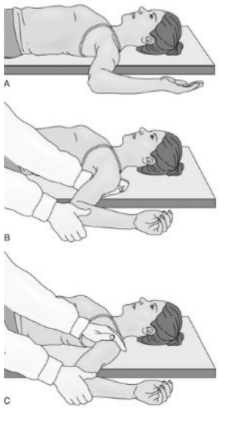
What test is this
Relocation/Fowler’s test → done after Apprehension test → if pain persist = shoulder impingement, full pain free = instability

What test is this
Sulcus sign → Downward traction on arm → If unstable see sulcus between acromion and humeral head
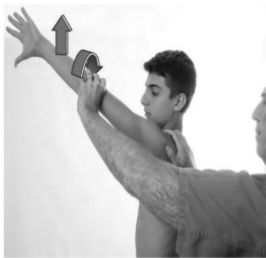
What is this
Neer’s sign test → pain on this action at 70-120 degrees = shoulder impingement
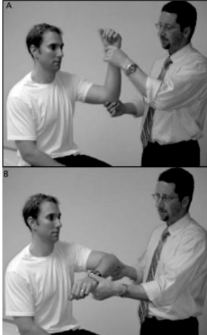
What test is this
Hawkin’s test → pain on IR indicates shoulder impingement

What test is this
Yocum → pain when raising elbow indicate shoulder impingement

What test is this
Painful arc → pain when abducting 60-120 degree indicate supraspinatus tendinitis

What is this
Drop arm test → drop arm after abduction → if completely drop at 60 degree = complete rupture of supraspinatus, if slow = inflammation/injury of supraspinatus
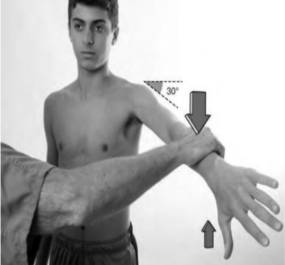
What is this
Jobe/Empty can test → Pain = supraspinatus tendinitis, weakness = supraspinatus tear
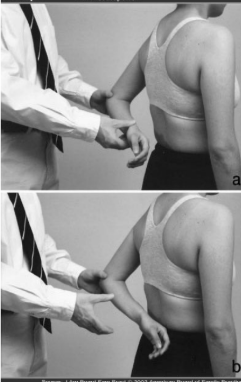
What is this
Lift off test → testing ability to internal rotate arm → pain on action = subscapularis disorder

What test is this
Patte test → forced internal rotation → Pain or inability to support arm/rotate laterally = teres minor and infraspinatus injury

What is this
Yergason’s test → supination against resistance (pronation) → pain in bicipital groove = pathology of long head bicep

What is this
Speed’s test → Pain on bicipital groove when resisting downward force → bicep tendon pathology

What is this
Cozen’s test → pain at lateral epicondyle = Tennis elbow

What is this
Mill’s test → pain on lateral epicondyle = tennis elbow

What is this
Pain on forced wrist extension at medial epicondyle = golfer elbow → involvement of FCR tendon

What is this
Valgus stress test of arm → test medial collateral ligament → positive if you feel gapping on medial elbow

What is this
Varus stress test of arm → test lateral collateral ligament → positive if you feel gapping on lateral elbow

What is this
Finkelstein → pain = De Quervain’s tenosynovitis = APL, EPB problem

What is this
Carpal compression test → within 15sec to 2 minutes positive if you feel numbness = carpal tunnel

What is this
Modified Phalen → numbness and paresthesia of 1-3rd and half of 4th finger in 1 min → carpal tunnel

What is this
Tinel sign → numbness of finger when pressing from nerve regeneration in Carpal tunnel

What is this
Froment → positive = adductor pollicis weakness from ulner nerve injury

what is this
Ok sign → lt = abnormal = weakness of FDP (2,3), FPL, PQ → anterior interosseous syndrome
Lower extremity inspection
Look for Pelvic tilt, lordosis, gluteal folds, gait abnormalities, varus/vulgus, joint swelling/edema/atrophy etc
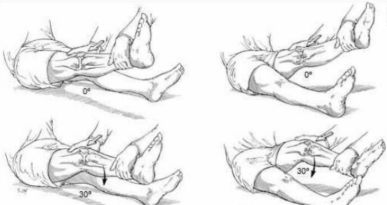
What tests are these
Valgus and varus stress test → test medial and lateral collateral ligament

What test is this
Anterior drawer → test for ACL tear

What is this
McMurray test → hold at ankle and flex knee → rotate → valgus → varus → Look for MCL/LCL injury

What is this
Apley/Grinding test → MCL/LCL injury

What test is this
Anterior drawer for the ATFL of foot

what is this
Spurling’s test → pressing on neck in this position causes radicular symptom → cranial nerve root compression

What is this
Hoffman’s test → positive if after flick of middle finger there will be flexion of other finger → UMN sign
What is straight leg raising test
Extend leg until there is pain → If pain is at posterior thigh below knee at 30-70 degree = sciatica/radiculopathy