I2 - DNA,RNA as drug targets,replication ,transcription and translation 1
 Call Kai
 Learn
 Practice Test
 Spaced Repetition
 Match
 Flashcards
 Knowt Play
1/18

There's no tags or description
Looks like no tags are added yet.
19 Terms
Why are DNA and RNA important drug targets?
Bacteria need DNA replication for cell division
Bacteria need dna for transcription to make mRNA for protein synthesis
DNA replication and transcription differ between bacterial and human cells, allowing selective drugs targeting of bacterial cells

What is the structure of DNA in bacteria?
most have a single, circular double-stranded chromosome
all DNA has 2 antiparallel strands , base pairing ( a,t and g,c) and each strand has a 5’ and 3’ end

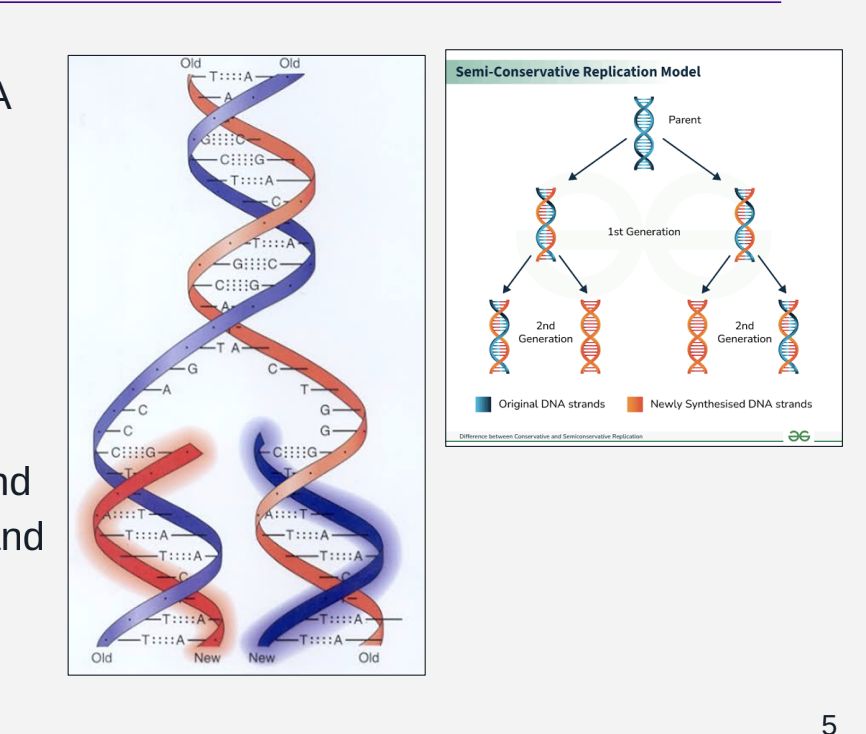
What is semi-conservative DNA replication?
Two strands of parental DNA are separated during replication
Each strand acts as a template for synthesis of a new complementary strand
Each daughter DNA molecule contains - one original strand and one new strand
What do antiparallel strands in dna mean?
● The two DNA template strands to be replicated are antiparallel
● They run in opposite directions
● A DNA strand can only be created in the 5 prime (5’) to 3 prime (3’) direction

Describe the synthesis of dna ?
● DNA polymerase can synthesise DNA only in the 5′→3′ direction
● Leading strand ( 3 to 5 ): synthesised continuously towards the replication fork
● Lagging strand ( 5 to 3 ): synthesised discontinuously away from the replication fork
● Short sections of lagging-strand DNA are called Okazaki fragments
● As well as DNA Polymerase, several other enzymes are needed
What are some characteristics of bacterial DNA replication?
E.coli has a single circular chromosome ( 4.6 million base pairs)
Replication is bidirectional
Rapid ( in 40 min , 1000 nucleotides per second )
highly accurate
How is bacterial DNA initiated?
Replication begins at a specific sequence of DNA sequence called the origin of replication ( oriC)
Two Y-shaped replication forks and move in opposite directions
Several enzymes and proteins are involved in the process

What happens at the replication fork in DNA replication?
● Helicase unwinds the DNA double helix at each replication fork, separating the parental strands
● Single-strand binding proteins (SSBs) stabilise the separated DNA strands
● DNA gyrase relieves torsional strain ahead of the replication forks
● The exposed DNA strands act as templates for new DNA synthesis

What happens at the leading strand in DNA synthesis?
DNA polymerase III adds nucleotides to the 3′-OH end of the growing DNA strand
Continuous synthesis
Complementary base pairing Helps to ensure accurate copying

What happens at the lagging strand in DNA synthesis?
DNA polymerase III synthesises DNA only in the 5′ to 3′ direction
The lagging strand is synthesised discontinuously, away from the replication fork
Short sections of newly synthesised DNA are called Okazaki fragments
Each Okazaki fragment requires an RNA primer, synthesised by primase
DNA ligase eventually joins the fragments to form a continuous DNA strand

How is DNA replication completed?
RNA primers are removed and replaced with DNA by DNA polymerase I.
DNA ligase seals the remaining gaps in the sugar-phosphate backbone
Replication continues until the two replication forks meet in the termination region
The two newly replicated circular chromosomes are separated by topoisomerase IV, allowing them to be distributed to daughter cells

Describe the stages of DNA replication in bacteria?
1. Initiation – Unwinding the DNA
Replication begins at a specific region of the circular bacterial chromosome called the origin of replication (oriC).
Two replication forks form and move in opposite directions (bidirectional replication).
DNA helicase unwinds the double helix, separating the two parental DNA strands.
Single-strand binding proteins (SSBs) stabilise the separated strands and prevent them from rejoining.
DNA gyrase relieves torsional strain (supercoiling) ahead of the replication forks.
Primase synthesises short RNA primers, providing a starting point for DNA synthesis.
2. Elongation – Synthesis of new DNA strands
DNA polymerase III adds complementary DNA nucleotides to the 3′-OH end of the growing strand.
DNA can only be synthesised in the 5′ → 3′ direction.
Because the two DNA strands are antiparallel, they are synthesised differently:
Leading strand: Synthesised continuously towards the replication fork.
Lagging strand: Synthesised discontinuously away from the replication fork, forming short sections called Okazaki fragments.
Each Okazaki fragment requires a new RNA primer produced by primase.
- Complementary base pairing (A–T and G–C) ensures accurate DNA copying.
3. Termination – Completing DNA replication
DNA polymerase I removes the RNA primers and replaces them with DNA nucleotides.
DNA ligase joins the Okazaki fragments by sealing breaks in the sugar-phosphate backbone.
Replication continues until the two replication forks meet at the termination region.
Topoisomerase IV separates the two interlinked circular chromosomes so they can be distributed into daughter cells.
Summary of enzymes involved in DNA replication?
Helicase: Unwinds the DNA double helix
DNA gyrase relieves torsional strain ahead of the replication fork
Primase: synthesises short RNA primers
DNA polymerase III Synthesises new DNA strands
DNA polymerase I removes RNA primers and replaces them with DNA
DNA ligase: seals breaks in the DNA backbone
Topoisomerase IV helps separate replicated bacterial chromosomes
What are the 2 main targets in DNA replication?
Fluoroquinolones (e.g. ciprofloxacin) target two bacterial enzymes:
1. DNA gyrase – relieves torsional strain during DNA replication
2. Topoisomerase IV –separates interlinked replicated chromosomes
Both enzymes normally cut and rejoin DNA
Fluoroquinolones prevent normal DNA rejoining, causing DNA damage and bacterial cell death

What is transcription - intro?
Transcription: DNA to RNA
Transcription is the process by which bacteria copy genetic information from DNA into messenger RNA (mRNA), which is then used for protein synthesis.
Transcription occurs in the cytoplasm and involves three main stages: initiation, elongation and termination.
Bacterial DNA is double-stranded, circular, and in the cytoplasm
● RNA polymerase binds to DNA and synthesises a complementary RNA strand
● RNA is synthesised in the 5′ to 3′ direction
● Messenger RNA (mRNA) carries genetic information for protein synthesis
How is bacterial transcription initiated?
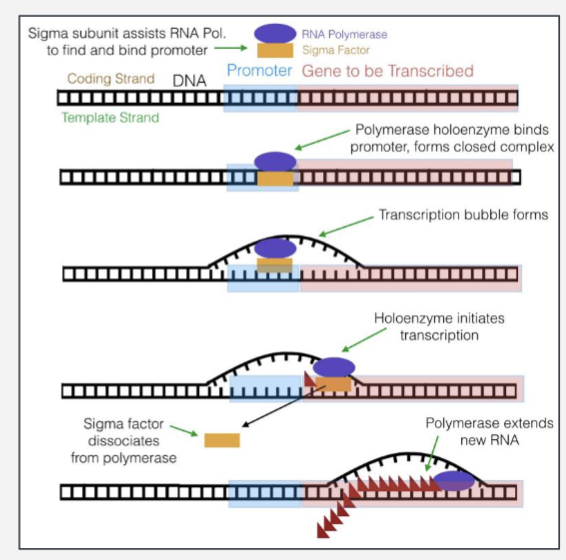
Begins at a specific DNA sequence ( promoter)
A sigma (σ) factor associated with RNA polymerase, helping it recognise the promoter
RNA polymerase binds to the promoter and locally unwinds the DNA
RNA synthesis begins at the transcription start site (TSS)
Describe the bacterial transcription: elongation, termination?
RNA polymerase moves along the DNA template strand in the 3′ to 5′ direction
Complementary RNA nucleotides are added, synthesising RNA in the 5′ to 3′ direction
As RNA polymerase moves forward, the DNA double helix reforms behind it
Transcription ends when RNA polymerase encounters a termination signal, releasing the newly synthesised RNA

What are the three stages of bacterial transcription?
● Initiation: RNA polymerase binds to the promoter with the help of a sigma factor and unwinds the DNA
● Elongation: RNA polymerase synthesises a complementary RNA strand in the 5′ to 3′ direction
● Termination: RNA synthesis stops and the newly synthesised RNA is released

Describe the process of transcription in bacteria.?
1. Initiation
Transcription begins at a specific DNA sequence called the promoter.
A sigma (σ) factor helps RNA polymerase recognise and bind to the promoter.
RNA polymerase locally unwinds the DNA double helix, exposing the template strand.
RNA synthesis begins at the transcription start site (TSS).
2. Elongation
RNA polymerase moves along the DNA template strand in the 3′ → 5′ direction.
It adds complementary RNA nucleotides to synthesise mRNA in the 5′ → 3′ direction.
RNA contains uracil (U) instead of thymine (T).
As RNA polymerase moves forward, the DNA double helix reforms behind it.
3. Termination
RNA polymerase reaches a termination signal on the DNA.
RNA synthesis stops, and the newly synthesised mRNA is released.
The mRNA carries genetic information that can be used by ribosomes for protein synthesis (translation).