Cranial Nerves and Special Senses
 Call Kai
 Learn
 Practice Test
 Spaced Repetition
 Match
 Flashcards
 Knowt Play
1/35

There's no tags or description
Looks like no tags are added yet.
36 Terms
Sensory Receptors
Respond to stimuli and initiate sensory input to the CNS by transduction.
Tonic Receptors
Adapt very slowly to continuous stimuli (e.g., proprioceptors, nociceptors).
Phasic Receptors
Adapt rapidly to continuous stimuli (e.g., mechanoreceptors, thermoreceptors).
General Sensory Receptors
Structurally simple receptors distributed throughout the body in skin and organs.
Special Sense Receptors
Structurally complex receptors located in specialized sense organs in the head.
Olfaction
Detection of volatile molecules dissolved in nasal cavity mucus by bipolar neurons.
Olfactory Pathway
Path where olfactory tracts project to the temporal lobe and hypothalamus, bypassing the thalamus.
Three Layers of the Eye Wall
Fibrous tunic, vascular tunic, and retina.

Cornea
Anterior, avascular, and transparent layer of the fibrous tunic that bends light.

Sclera
The white of the eye; dense irregular connective tissue providing shape and protection.

Ciliary Body
Vascular tunic structure that alters the shape of the lens.

Iris
Colored portion of the eye that controls pupil size and light entry using CN III.
Pigmented Layer of Retina
Absorbs extraneous light and provides Vitamin A to photoreceptors.
Inner Neural Layer of Retina
Contains rods for reduced light and cones for color vision.

Optic Disc
The blind spot of the eye lacking photoreceptors; axons converge here to form CN II.

Fovea Centralis
Region in the macula lutea with the highest proportion of cones and sharpest vision.
Visual Pathway
Optic nerve projects to optic chiasm, optic tracts, thalamus, and primary visual cortex.
Hearing Mechanism
Sound waves distort hair cells in the cochlea, initiating nerve impulses via CN VIII.
Equilibrium Mechanism
Hair cells in the vestibule detect head position, rotational movement, and tilt via CN VIII.
Four Types of Papillae
Filiform, fungiform, vallate, and foliate.
Vallate Papillae
Papillae that house the most taste buds on the tongue.

CN I (Olfactory)
Special sensory nerve responsible for smell.

CN II (Optic)
Special sensory nerve responsible for vision.

CN III (Oculomotor)
Controls most eye muscles and constricts pupils (parasympathetic).

CN IV (Trochlear)
Somatic motor nerve controlling the superior oblique eye muscle.

CN V (Trigeminal)
Provides head/face sensory innervation and controls muscles of mastication.

CN VI (Abducens)
Somatic motor nerve controlling the lateral rectus eye muscle.

CN VII (Facial)
Controls taste, facial expression, salivation, and tears.

CN VIII (Vestibulocochlear)
Special sensory nerve responsible for hearing and balance.

CN IX (Glossopharyngeal)
Controls taste and parasympathetic salivation.

CN X (Vagus)
Controls swallowing, talking, and autonomic/visceral functions of thoracic/abdominal organs.

CN XI (Accessory)
Somatic motor nerve controlling the trapezius and sternocleidomastoid muscles.

CN XII (Hypoglossal)
Somatic motor nerve controlling tongue muscles.
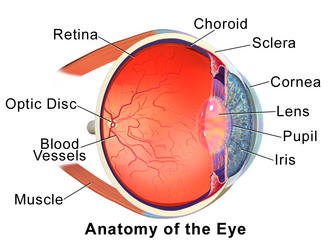
Choroid
Houses network of capillaries
Macula Lutea
Yellowish region, contains fovea centralis (highest portion of cones almost no rods, area of sharpest vision)
Lens
Focuses oncoming light into retina, shape determines degree of light refraction