PS365 -- Memory Systems
 Call Kai
 Learn
 Practice Test
 Spaced Repetition
 Match
 Flashcards
 Knowt Play
1/34

There's no tags or description
Looks like no tags are added yet.
35 Terms
What is Memory?
Process by which we store and retrieve information for later use as we interact with the every day world
Does not imply conscious awareness
Implicit Memory -- Without awareness
Explicit Memory -- With awareness
Location where information is kept -- Memory Store
Record that holds the contents of experience -- Memory Trace
Mental processes used to acquire, store, and retrieve previous experiences -- Memory Process
Repitition and Memory
Strength
Each presentation increments the strength of a single representation
Multiplexing
Each presentation establishes a new memory trace/representation
Classical Conditioning -- Ivan Pavlov
Learning by association
Neutral stimulus (bell) is repeatedly associated with an unconditioned stimulus (food) until it elicits the same response (salivation) without the US
Operant Conditioning -- B.F. Skinner
Specific consequences/rewards are associated with a voluntary behaviour
Rewarding stimulus reinforces behaviour -- Associated with a desire (food)
Consequence stimulus reinforces behaviour -- Associated with unpleasant outcome (shock)
Episodic Memory vs. Semantic Memory
Episodic more susceptible to forgetting
Episodic retrieval has time/place reference
Retrieval created an episodic memory
Autobiographical memories are typically dated episodic memories
Encoding Specificity Principle
The way in which information is encoded determines the optimal way to retrieve that information
Levels of Processing -- Depth
Shallow -- Acoustic
Deep -- Semantic
Methods in Memory Research
Behavioural studies of memory in the lab
Computer based
Paper and pencil tasks
Brain damaged patients
Amnesia illustrates sensitivity to changes in brain function
Animal Models
Lesions
Neuroimaging
fMRI, PET, ERP
Herman Ebbinghaus
Learn a serial list of nonsense syllables -- Record time or number of trials required to learn list in its entirety
Vary list length or retention interval
Relearn the list to the same criterion -- Record number of trials required
Difference is evidence of savings in memory
Free Recall
Write down (or say aloud) all of the words you can remember in any order
Nevertheless, Ss tend to have a retrieval plan
Reminiscence -- Remembering something once forgotten
Hypermnesia -- Improved memory over successive tests
Serial Position Curve
U-Shaped learning curve
Normally obtained while recalling a list of words due to the greater accuracy of recall of words from the beginning and end of the list then words from the middle of the list
Recognition
Have you seen this item before?
Which one of these have you seen before?
How certain are you that you have/have not seen this item before? -- Confidence rating
Animal Lesions
Karl Lashley trained cats and monkeys to perform complex tasks, then destroyed or removed specific parts of their brain
Attempt to erase or remove their memory for training
Results:
Only very large cortical lesions disrupted retention
Site of lesion had no consequence on memory
Concluded:
Memories are stored diffusely in the neo-cortex -- Principle of Mass Action
All parts of neo-cortex play an equal rill in storage -- Principle of Equipotentiality
Three Steps to Retention
Encoding -- Taking in information
Consolidation -- Process of transferring information from STM to LTM through rehearsal
Retrieval -- Recalling information
Atkinson and Shiffrin Model
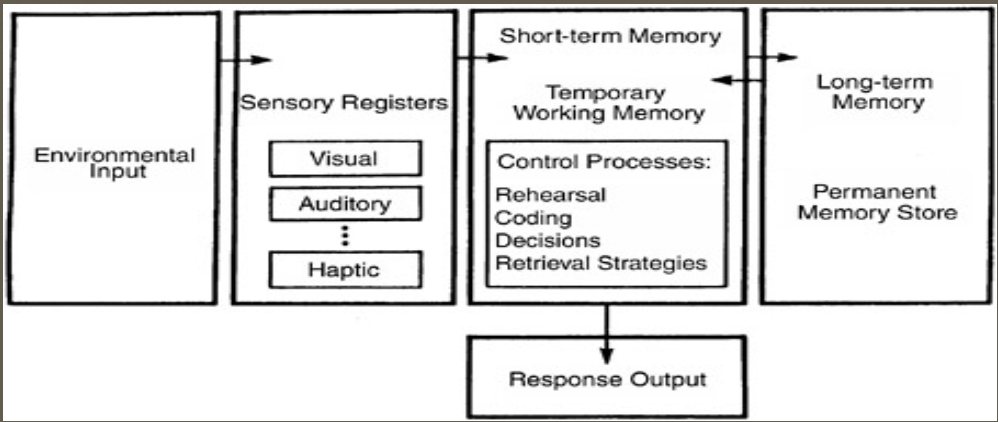
How Does Consolidation Occur?
Process by which memories become more resistant to loss by psychological interference, neurobiological intervention, or neurological insult
New information is assimilated or integrated with existing knowledge and memories
Synaptic Consolidation
Occurs within minutes to hours of learning and entails protein synthesis and consequent changes to the strength and stability of connections between neurons
System Consolidation
Reorganization of memory representations
Donald Hebb -- How Does Consolidation Occur?
An event is held in short-term “mode” by reverberating neural activity around a closed loop in the neural circuits made by the event
This activity produces a change in synapse structure, which facilitates this specific pattern of activity at a later time
Synaptic facilitation is the basis of long-term memory
Memory and Consolidation During Sleep
Improvement in memory retention when a person slept for a period of time relative to a person who was awake for the same period of time
Two Approaches:
1. Sleep simply protects person from engaging with other competing information -- Interference
2. Active learning occurs during sleep -- These processes improve the memory representation for that information
Assemblies
Memories assumed to be represented in the brain by sets of neurons that fire together -- Cell Assemblies
To retrieve a specific memory representation, the groups of neurons that were initially active must be reactivated
The reactivation of these networks during sleep stabilizes the network which is assumed to help with retrieval
Testing Cell Assembly Patterns
New information can potentially become more stable with greater reactivation during sleep
Different temporal pattern of neuronal activation represented specific locations in a given space
Consolidation and Retrieval of Cell Assembly
Consolidation -- Reactivation (Sleep):
Specific cell assembly patterns representing specific locations of maze initially active during encoding phase were reactivated during Sharp Wave Ripple in SWS
Strength in which cell assembly patterns were reactivated during sleep correlated to how well the mice navigated to that region when put back into the maze
Retrieval -- Reinstatement (Awake):
When Sharp Wave Ripple activity is disrupted during sleep, memory for those spatial representations are affected
SWR is a key mechanism underlying the beneficial impacts of sleep on memory
Communication between hippocampus and neo-cortex is needed during sleep to promote transformation of memory for long-term storage in cortex
Hippocampal SWR associated neural activation is important for this transformation to occur
Sharp Wave Ripples
Almost all ACC neurons showed increased activity before hippocampal ripple activity
some population of ACC neurons displayed further activation immediately after ripple activity
Coordinated interaction between hippocampal SWR and ACC neurons
What are Sharp Wave Ripples Crucial to Memory During Sleep
Hippocampal dependent to hippocampal indemedent memories
System Consolidation -- A Role for PFC
Prefrontal cortex might have dual roles during memory recall
Integrative role is assumed by prefrontal cortex via reciprocal connections with sensory, motor, and limbic cortices
Lesions or pharmacological activation of PFC disrupts recall of remote, but not recent memories
Lesions of pharmacological inactivation of hippocampus produces opposite pattern of results -- Impair recent, but not remote memories
Dynamic Process
Different structures interact with each other to mediate memory types and different memory types interact and change each other
Brain Injury
Retrograde Amnesia -- 6 months prior to brain injury
Anterograde Amnesia -- 2 months after brain injury
Post-Traumatic Amnesia -- After traumatic injury
Struggle to make new memories
Disoriented in place and time
Longer the PTA, more sever the head injury
Korsakoff Syndrome
Severe anterograde amnesia
Severe retrograde amnesia with strong temporal gradient
Memories further back in time are more resistant to loss
Alcohol abuse combined with poor diet leads to a degradation of the mammilothalamic tract
With loss of tissue, this is though to be responsible for memory deficits seen in chronic alcoholics with Korsakoff
Confabulation -- Distinguishes Korsakoff patients from amnesiacs
Likely more reflective of frontal cortical damage
Sulcal Widening -- Spaced between gyri are enlarged and enlarged ventricles caused from loss of tissues
Henry Molaison
Suffered from severe intractable epilepsy
Seizures did not respond well to medication
Removed parts of brain that caused seizures -- Bilateral Medial Temporal Lobes
Also removed surrounding structures -- Entorhinal Cortex and Amygdala
Henry could no longer form new memories
Patient H.M
Result of surgery:
Successful treatment for epileptic seizures
Retained perceptual abilities and superior intelligence
Memory for events preceding surgery were intact
Negative outcomes:
No longer form any new long-term memories
Once doctor left room, H.M. greeted him again upon re-entry
Despite having intact short-term memory
Ability to hold digits in mind over short time interval was intact
Personality didn’t change
Ability to learn new information of certain kinds remained in tact
H.M. Specific Deficits
Can’t recall new address but remembers the old one
Can’t find his way home
Did not know where objects were kept in his house
Reads same magazines repeatedly without finding them familiar
Memory for new names and faces is hopeless
Not All is Best
Performance on mirror-drawing test in intact
Rotary-pursuit and ‘incomplete pictures’ test showed benefits of practice
These indicated that he retained some sort of knowledge of how to perform new tasks -- Learned some from previous sessions
Retained semantic memories
Had some retrograde amnesia
Remote autobiographical memories remained in tact
Retained language and social skills, perceptual and motor memories, and procedural learning
Procedural Memory
Draw object viewed in mirror
Practice makes perfect -- Even in H.M.
Never recalls having done the test
Other tests of implicit memory
Stem-completion
What Remains Intact
Factual knowledge
Remote memories
From few years prior to operation
From adolescence and childhood
Perceptual and motor memory
Riding a bike
Running on a log
Language and social skills