Learning Test 3
 Call Kai
 Learn
 Practice Test
 Spaced Repetition
 Match
 Flashcards
 Knowt Play
1/142

Earn XP
Description and Tags
you got this :)
143 Terms
Chapter 8
Stimulus Control of Behavior
Thorndike + Skinner
recognized that instrumental responses and reinforcers occur in the presence of particular stimuli, which come to control those responses
Proper fit and sitmulus context in which response is performed in IMPORTANT
studying in a dorm vs. studying on vacation
stimulus → location
behavior → studying or not
Does proximity matter?
As the exam gets closer, more people are studying
You do the behavior more as the outcome gets closer
Delay discounting → the closer you get to the outcome (Exam day) the more value it has, when its far away it has less value
Failure to use appropriate stimulus control often considered abnormal
Ex: getting undressed in bedroom versus on public street
Matching of behavior to stimulus is IMPORTANT
Okay to talk to yourself in office, not okay to do so in lab with students
Stimulus discrimination:
differential responding to stimuli
Stimulus Features
Stimulus features (features are the individual components of the whole)
ex: a cat is a stimuli but a stimuli is made out of features (fluffy hair, meow, etc)


Differentail Responding + Stimulus Discrimination
Stimulus Dimension
A dimension is an aspect, within the dimension the aspect can vary
Most literal interpretation: something you graph
One dimension of this is the size
Discrimination curve
Another dimension we can look at is the color! (scale of white, pure red and black)
Another is the shape, it's a circle! (scale of irregular vs. perfect circle etc)
***the closer you are to the object you see and its dimension the harder it is to discriminate between objects (hard to tell apart!!) as you get them further away in their dimensions they are easier to tell apart

2 different stimuli can be easy or hard to discriminate based on _____ and _____
FEATURES, DIMENSIONALITY
Discrimination
ability to tell two stimuli apart
stimulus generalization
similar response to two stimuli, or inability to tell them apart
opposite of stimulus discrimination
you respond the same to both stimuli, but they are not identical)
What are reasons why you might generalize stimulus?
Look the same
Takes up less brain power
Ex; if you are scared of cats → if an animal is close enough you will still be scared of it (whether its a kitten or lion)

Steep generalization gradient indicates strong control of behavior by the stimulus (If it is a perfect match you response, if it is not a perfect match you do not respond) (is it graph a)
Flat generalization gradient indicates weak or nonexistent stimulus control
generalization
Usually we want to generalize across features + within the dimension of that feature
*we are very good at generalizing things we fear (partly bc yes we are scared but it can be dangerous)
Scared of dogs → not looking at anything else the dog is besides their bite
*If a system only connects an aversive event (like pain or a penalty) to whatever happened immediately before it, it develops strict temporal contiguity bias.
temporal contiguity bias (A response and a consequence (or a conditioned and unconditioned stimulus) must happen very close together in time for the brain to link them. If too much time passes, the learning or reinforcement weakens or fails)
Sensory Capacity and Orientation
most obvious variable that determines whether particular stimulus feature controls responding; determines which stimuli are included in organism’s sensory world
Sensory capacity sets limit on what stimuli can control behavior; studies of stimulus control often used to determine what organisms is/is not able to percieve
Ex: can horses see colors
Having necessary sense organs to detect stimuli being presented does not guarantee that behavior will come under control of stimulus
Stimulus control also depends on presence of other situational cues
Orientation → sometimes a stimulus can change due to orientation (placement) of stimulus
Water bottle on side → you pick it up
Water bottle standing up → you do nothing
What determines your ability to discriminate stimuli?
To discriminate you must be able to receive and process sensory information about the stimuli and their differences

To discriminate you must be able to receive and process information about the ______of a stimulus
POSITIONING

Having necessary sense organs to detect stimulus being presented does not guarantee that behavior will come under control of stimulus → stimulus control also depends on presence of _____
OTHER SITUATIONAL CUES
Overshadowing
how strongly organisms learn about one stimulus depends on how easily other cues in situations can become conditioned
Just because information went in, does not mean she is paying attention to every little thing (wont notice the color shirt everyone is wearing)
Our brain chooses what information to pay attention to
A stimulus takes on more predictive power (importance) than other co-occurring stimuli
More Examples:
stimulus occurred at time of training but you decided not to pay attention to it
Ex: knowing someone by their walk and not noticing what they are wearing
How do people learn to get around town?
people/animals use variety of different stimuli to find their way around (ex, landmarks, spatial or geographical cues
Availability of one type of cue (eg. prominent landmark) can overshadow learning about other types of spatial information (like saying go past the library instead of walk straight on the spine)
Blocking
when you are taught about a stimulus and then you are taught about that same stimulus co-occurring with something else, you already learned the first one is important, so you don't pay attention to the second one (first one is “blocking” the second one)
Ex: being told to recognize ta she will always have a black beanie (that one is always her), so you are just looking for the black beanie, you say she also wears a flannel shirt, since you already have the strategy of black beanie= natalie you ignore the information about the flannel
Overshadowing and Blocking
Overshadowing = Stronger stimulus wins. Two new stimuli compete, and the more noticeable one gets learned better.
Blocking = Previous learning wins. An already-learned stimulus prevents learning about a new stimulus
Overshadowing happens because of differences in the stimuli themselves (such as intensity or salience), whereas blocking happens because of what the organism has already learned

Types of Reinforcement
Development of stimulus control depends on reinforcement use
Some sensory modalities are easier to condition to specific reinforcements
Certain types of stimuli more likely to gain control over instrumental behavior in appetitive rather than in aversive situations
Visual/ Auditory
Visual→ control predominates when CS acquires positive or appetitive properties
Auditory → control predominates when CS acquires negative or aversive properties
When someone makes “HUUUUUUH” in high pitched voice the AUDITORY aspect (sound) makes you worry/ think something is wrong, but if you see that person’s facial expression and realize they are shocked/excited that is a VISUAL cue that will change the way you react to the stimulus
Stimulus elements→
treating simultaneous presentation of light and tone as consisting of separate visual and auditory cues
Dominant approach in learning theory
Configural cues
assumes organisms treat compound stimulus as integral whole not divided into parts/elements
Ex: sound of entire symphony versus the sound of an individual instrument
More recent approach in learning theory
*Different conceptualizations of Compound stimuli

Stimulus discrimination training:
bringing behavior under stimulus control
Stimulus discrimination training can be conducted using either classical or instrumental conditioning procedures (can do this by playing 2 sounds and having them mean different things, mouse video we’ve seen a million times)
Stimulus discrimination procedure:
establishes control by stimuli that signal when reinforcement is/is not available
Discriminative stimuli:
once S+ and S- have gained control over behavior; S+ is discriminative stimulus for performing instrumental response, S- is discriminative stimulus for not performing response
Multiple Schedule of Reinforcement:
different schedule of reinforcement is in effect during different stimuli

a. experimental timeline
b. schematic of CS+ only training sessions
Schematic of CS+/CS- training session
This is operant but you can MAKE IT pavlovian ***keep in mind for exam
This is what the mouse was doing in that video
Must lick during specific tone (CS+) to get reward
Know its operant because the behavior changes the outcome!!!
We add discrimination by adding CS- (whether you lick or don’t lick there is no reward)
Researchers say if you lick to CS- it is a false alarm and if you don’t lick to it its a correct rejection
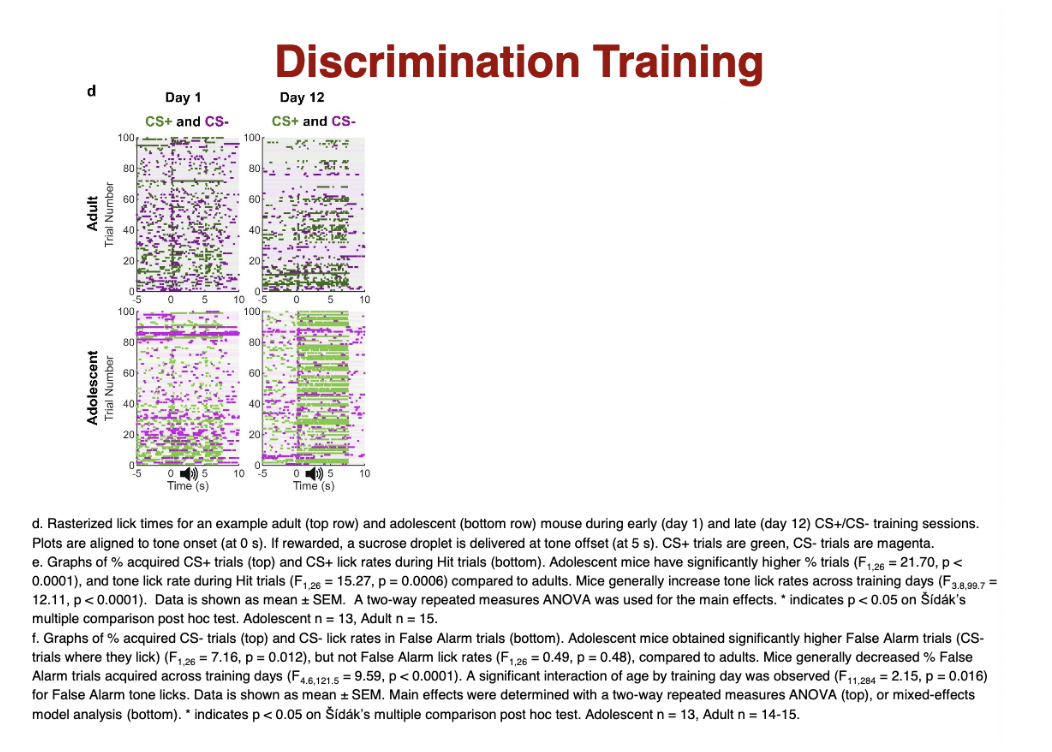
Green: when CS+ is played
Purple: when CS- is played
Everytime they lick its a little dot on the graph
Graph with MOST dots/licks → adolescent on day 12
Has the most dots between 0-5 because that is when the tone is playing
Many licks immediately after 5 seconds (they get sucrose when they responded during those 5 seconds)
Less purple on day 12 compared to day 1
Licking to CS- decreases across day, licking to CS+ increases across days
Huge difference between 2 ages, adults lick less than the adolescents do (tends to be true across tasks)

Hit + false alarm graphs:
Hit:
Lick to CS+ and get reward, lick more
When we first threw in CS- after we taught them if they lick to CS+ they get rewards and the amount of licking is the same, they are trying to lick to CS- because they think maybe they will get a reward, this means they have not learned to DISCRIMINATE yet (they cannot tell the difference between the meaning of the two tones)
With enough training, the licking starts dropping off
Why do they never reach 0? (why is the discrimination between the two tones never perfect)
Every so often they want to check, have the rules changed?
Has the contingency changed?
Are we on a different reinforcement schedule?
We can decrease responding to CS- by making the CS- ______
AVERSIVE
If we do this, this might also decrease licking in CS+
Adolescents lick a ton even if they only need to lick once, adults respond less
true in most cases
Why was this operant? (instrumental)
They needed to do an ACTION (lick) for a reward during CS+
Discrimination CAN be done as a PAVLOVIAN behavior
We need to remove the behavior that causes the change in the outcome (licking)
Still have CS+ and CS-
The mouse can still lick but it won’t change the outcome
Behavior not linked to outcome
*Basically → he gets a reward during CS+ no matter what happened, no reward with CS- no matter what happened
What type of pavlovian learning is this?
Short traced conditioning
Delayed conditioning
Very short
How precise is control that S+ acquires over instrumental behavior?
What factors determine precision of stimulus control achieved?
find out how steep the generalization gradient is when the participants are tested with stimuli that systematically vary from the S+
find out which aspect of discrimination training procedure responsible for type of stimulus generalization gradient obtained
What fights in favor of generalization?
What fights against generalization?
Generalization is the opposite of discrimination !!!!!
Low generalization, high discrimination (and vice versa)
When is generalization a positive thing?
Interoceptive cues:
internal sensations produced by psychoactive drugs (or other physiological manipulation such as food deprivation)
Detection of interoceptive cues associated with drug withdrawal, and the stimuli control that such cues may exert are prominent components of modern theories of drug addiction
Positive patterning procedure:
whenever each of two stimuli occur individually, they are not reinforced (a- and b- trials)
two things must occur together?
Ex your mom comes home everyday, but you know when she comes home later she also brings food , stimuli are mom coming home and context (time), when these two things occur you get food!
If its late but your mom is already home it doesn’t mean anything that its late
Reinforcement occurs when two stimuli presented simultaneously (AB+)
To accurately predict reinforcement, participant cannot respond on presence of individual cues; must identify when two cues are present simultaneously (AB)
OPPOSITE: Negative patterning procedure
when they are both together the thing doesn’t happen
When mom comes home, helps with homework, when mom comes home late you do not get help with your homework
Similar to positive patterning procedure except role of reinforced and non -reinforced trails is reversed
Time reinforcement available when cues are presented individually ( C+ and D+) but not when they appear simultaneously (CD-)
Testing can be separate or concurrent
Spence’s Theory of Discrimination Learning
Kenneth Spence
assumes reinforcement of response in presence of S+ conditions excitatory response tendencies to S+
non-reinforcement of responding during S- conditions inhibitory properties to S- that suppress instrumental behaviors
differential responding to S+ and S- reflects both conditioned excitation to S+ and conditioned inhibition to S-
EXPLAINED:
Kenneth Spence believed that we learn to respond differently to two stimuli because one is associated with reward and the other is associated with no reward.
His theory involves two processes:
1.S+=Excitation(Reward)
S+ is the stimulus that signals a reward.
When you respond correctly to S+, you receive reinforcement (a reward).
Over time, you learn to respond more strongly when you see S+.
Example: A rat learns that a green light means pressing a lever gives it food. The green light becomes associated with reward, so the rat presses the lever when it sees green.
2.S-=Inhibition(NoReward)
S- is the stimulus that signals no reward.
When you respond to S-, you do not receive reinforcement.
Over time, S- develops inhibitory properties, meaning it suppresses the response.
Example: The rat sees a red light. Pressing the lever does not give it food. Eventually, the rat learns not to press the lever when it sees red.
3.BothWorkTogether
Spence argued that discrimination learning happens because of BOTH:
Excitation: S+ encourages the learned response.
Inhibition: S- suppresses the learned response.
Spence’s Theory Cont.
emphasis in analysis of druge abuse= identifying/moderating factors that lead to drug self-administration; involved excitatory conditioning
S- cues can exert powerful inhibitory influence on drug seeking and drug self-administration behavior
inhibitory influence counteracts excitatory effects of S+ for drug administration
suggests that drug-seeking can be reduced by inhibition even in excitatory processes remain intact
Intradimensional discrimination: training procedure in which S+ and S- differ only in terms of value of one stimulus feature; can produce peak-shift effect
Learn rule that one specific sound will give you a reward
2 sounds have an overlapping area (ambiguous → not sure whether you should respond or not!!)
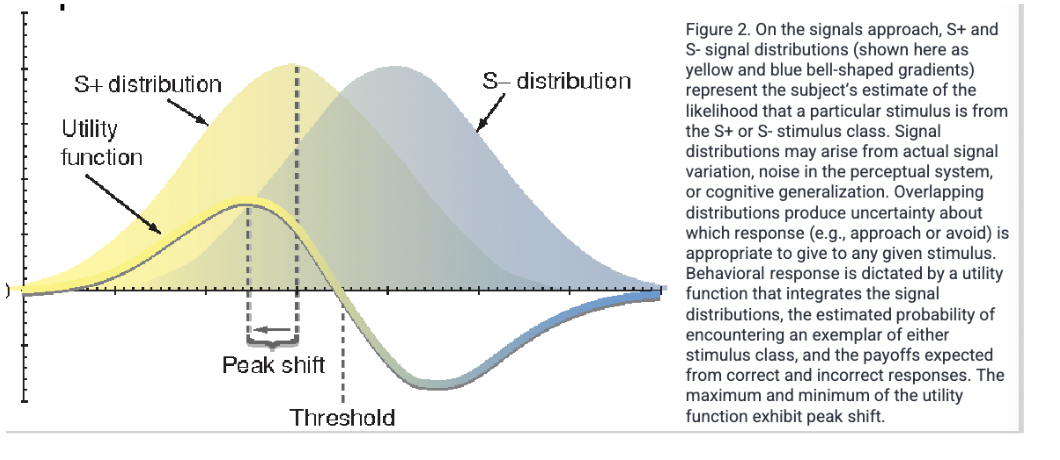
The Peak Shift Effect (interactions between S+ and S-)
shows that S+ not necessarily one that produces highest response rate
Spence’s explanation: discrimination training leads to learning of excitation to S+ and inhibition to S-; both assumed to generalize to other similar cues with the excitatory stimulus generalization gradient centered around S+/inhibitory gradient centered around S-
S+ and S- overlap and inhibition to S- may generalize to S+/suppress responding to S=
more inhibition from S- to S+ if S- in closer to S+; results in greater peak-shift effect
GRAPH from above
alternate explanation: organisms learnt o response to stimulus based on other situational cues
Stimulus Equivalence Training:
Equivalence training encourages generalized responding among set of stimuli or establishment of stimulus equivalence
basically you are generalizing things???
Common outcome training:
Links each of several different stimuli to common outcome
Ex: noise and clicker paired with food
Involved training same response to several physically different stimuli
Ex: “fruit” to mean apples, strawberries, etc.
Discrete stimulus:
presented for brief period; has clear beginning and end; can be easily characterized
Discrete discrimination stimuli occur in presence of background contextual cues (visual, auditory, olfactory) where discrete discriminative stimuli presented
Contextual cues can provide an important additional source of control of learned behavior
Control by Contextual Cues
Contextual cues signal reinforcement same way as discrete CS
Contextual cues control behavior if they serve as a signal for a US or a reinforcer
Instead of a tone, the CS is a place (a context)
Control by Contextual Cues: *** on exam
determines whether drug has reinforcing effects; important in drug development because drugs that can condition place preference have potential of becoming abused
Contextual cues used in same way as discrete CSs: instead of being associated with particular stimulus, each context activates different S+/S- contingency or conditional relation
If there is something rewarding in a room, you will spend more time in that room, if there is something aversive in a room, you will spend less time in a room
Is a drug rewarding on its own, or can a drug obtain rewarding properties (like if it makes your headache go away)
2 compartments connected by a doorway
Each one has a different cue (visual or tactile)
Animal makes association between drug and environment (will avoid or go to compartment depending on the effects of the drug
It likes the compartment where there are given coke since its addictive
Conditioned place preference vs. conditioned place aversion
CS (2) → the cues of the room, stripes + diamonds **on exam
What is the point of having 2 different stimuli in the task? → to test if they have learned the association between place and drug (one cue is rewarded and one is not), this is DISCRIMINATION (discriminate cues, one cue good drug)
If they don't know which chamber is which this is useless
One compartment stripes, the other diamonds
Both in same dimension, visual dimension
*****************
US → the drug !
UR→ response to drug
CR→ the compartment you pick to go in
Is there an innate behavior in this task?
Response to drug???
Is there something else? → moving around the chamber

we are doing this to find out if you like or dislike the drug!
pb/cup ex
2 rooms, one with peanut butter, one with nothing??
Why do we all refer the room with the cup or the peanut butter
Could be CUP OR PEANUT BUTTER (you don’t know which one they like)
You should put something in the other room, like an empty cup
CONTROL GROUPS:
Drugs can be rewarding, but what else is happening ??? they are getting INJECTED
You need to inject in both to have a control
Because what if the injection is aversive and the drug is pleasant, but not enough to cancel out the aversiveness??? You will think the drug has NO effect when it DOES have an effect
Drug can have no effect, but you can find it aversive bc of the INJECTION
Know difference between different groups, control groups, cs, and if they need to discriminate or not
modulator
nature of binary relation determined by third event; conditional relation
animals learn to use modulators to tell when binary relation is in effect
In classical conditioning:
establishing conditional relation requires introducing modulator indicating when presentation of auditory CS will end in food
rescorla called pavlovian modulator a facilitator; modulator facilitates responding to target CS
Distinction between Excitation and Modulation
difference in effects of extinction procedure on conditioned excitatory stimuli and modulators related to what is signaled
conditioned excitatory stimulus signals forthcoming US presentation; absence of US following CS presentation during extinction is violation of that expectancy
signal value of CS readjusted in extinction to bring it in line with the new reality
modulator signals relation between CS/US; absence of US when modulator presented alone does not mean that relation between target CS/US changed
information signaled by modulator not invalidated by presenting modulator by itself during extinction
Chapter 9
Extinction of Conditioned Behavior
extinction
omitting the US or reinforcer
In classical conditioning, extinction involves repeated presentations of CS without US
In instrumental conditioning, extinction involved no longer presenting reinforcer when response occurs
Both pavlovian and operant conditioning can BOTH undergo extinction
Learn CS no longer predicts US
Extinction makes you stop responding
Ex: fear conditioning
Pavlovian → learning tone tells you a foot shock is coming, over trials you start freezing to the tone, your response is freezing
When you show the CS without the US, tone without the shock, this is now extinction learning, start teaching mouse the tone is no longer followed by foot shock
Forgetting
decline in responding occurs because of passage of time and does not require nonreinforcement of CS/instrumental response
First memory is tone shock association
Second memory is the tone and no shock association
2 memories, not a change in the first memory, creating a new memory/association
If second memory is winning, freezing is low
If first memory is winning, freezing is high
First memory is usually stronger, why → its AVERSIVE
****
Extinction is NOT forgetting

Within learning session→ within session memory
Without memory you would not be able to learn/respond to tone
You need memory to learn
Memory retrieval!!!
we retrieve whatever won the battle
2 memories, 2 retrievals
tone foot shock memory won
Why is fear conditioning so popular?
follows same trends as anxiety, ptsd, phobias
we are trying to figure out a way to may memory 2 win
** extinction does NOT reverse or eliminate effects of CS-US association
*extinction learning is also forming a memory
there is overlap between CS-US acquisition regions and extinction acquisition

2 memories fighting each other
Manipulating amygdala
PL and IL communication, mostly both controlling amygdala (BLA), which one wins also helps determines which memory wins
Dissociable roles of prelimbic and infralimbic cortices, ventral hippocampus, and basolateral amygdala in the expression and extinction of conditioned fear
IL inactivation —> no effect on freezing, impaired acquisition of extinction and extinction memory = IL essential for extinction memory but NOT fear expression
PL inactivation → REDUCED freezing, NO effect on extinction memory = Pl necessary for fear expression, but NOT extinction memory
BLA inactivation → REDUCED freezing, IMPAIRED extinction memory = BLA necessary for both fear expression and extinction memory


Forms of Recovery from Extinction
Extinction decreases the behavior you were just performing
Decrease in behavior observed in extinction is opposite of what occurs during acquisition
Extinction does not reverse or eliminate effects of acquisition
Because extinction does not erase what was originally learned; extinguished response reappears under various circumstances
The term conditioning is ambiguous
Extinction is secondary learning that happens because of the association you already learned
Cannot extinct an association that was never learned
Technically these are both conditioned behaviors buttt ignore that (extinction IS conditioning)
Need to know the CS predicts the US in order to learn the CS no longer predicts the US
Extinction is HIGHLY specific to the context in which it was done (we don't want it to be this way but it is)
*Extinction works for OPERANT and PAVLOVIAN conditioning
All the ways we know extinction fails….
spontaneous recovery
renewal
reinstatement
external disinhibition (novel stimulus)
spontaneous recovery
Rest period introduced after extinction training and responding comes back; nothing specific is done during rest period to produce recovery
Extinction memory never produces as big a drop of behavior during the recall test as it does during the last extinction session
During extinction trial the behavior tends to be produced better during recall test, there is always a gap and this gap is spontaneous recovery
Renewal
Renewal: recovery of conditioned responding when contextual cues present during extinction are changed
Whenever you change the context, the original memory will reemerge
Renewal effect; recovery of responding with change in original contex
Memory of extinction is specific to cues that were present during extinction phase; shift away from context of extinction disrupts retrieval of memory of extinction, and extinction and performance is lose
Original acquisition performance generalizes from one context to another more easily than does extinction performance
example= in effective therapeutic procedure extinguishing phobia in therapists office, conditioned fear may easily return when the client encounters the fear CS in a different context. PLUS effects of excitatory conditioning readily generalize from one context to another
……
Problems:
Extinction is hyper specific (hippocampus plays much bigger role in extinction learning vs. fear learning) , gives a lot of info about where you were when you learned that distinction
Is the hippocampus helping you generalize or help you discriminate??? Discriminate
Like you are only low on anxiety in therapists office, you walk out its back
Reinstatement of conditioned responding
How do we know that the original conditioned memory is still present even after extinction?
How do we know that extinction does not affect conditioned memory?
We don't know where memory is
We call memory a change of proteins on the neurons
Reinstatement
recovery of conditioned behavior that occurs when individual encounters US again
Responses that are successfully extinguished during course of therapeutic intervention can reappear if individual is exposed to US again
Ex: abuse, anxiety, abuse later in life
Context conditioning has relatively little effect on stimuli that do not have a history of extinction
Even when you extinguish behavior or association, having that reinforcer or having the punishment occur again without all the cues, will bring back the strength of the behavior of the cue, JUST having experienced US
how extinction FAILS
passage of time is enough to make the extinction fail (spontaneous recovery)
Extinction training → playing the tone over and over again without the shock
US alone without presence of CS is enough to get your mouse
The new stimulus (bright light) is enough to reemerge CS and US association (external disinhibition)
Renewal → you learned original association, learn CS no longer paired with US, freezing decreases, CHANGE CONTEXT → everything all comes back (no more extinction) HIGH FREEZING to CS
Things can be compounded! (multiple of these at the same time)
The only one that NEEDS time to pass is spontaneous recovery

resurgence
reappearance of extinguished target response when another reinforced response is extinguished
2 different responses
One response is initially conditioned, then extinguished
Second response is then also reinforced and extinguished
Does extinction of the second response increase the frequency of the first response? yes usually?
If she taught us the floor is lava, and every time she plays a song and the floor is lava you have to get on your chair
Now she plays a sound and the floor is no longer lava but you are still on your chair
She will do this forever and you at some point will need to check if the floor is lava or not
You must “ check” in order for extinction to occur
We periodically check to see if the environment has changed
Functional Communications Training (FCT): Children with developmental disabilities who engage in disruptive or self- injurious behavior in the classroom if they get frustrated working on an assignment because they lack communication skills to request a break or rest from the task. FCT reinforces making an appropriate request for a break. However, if teacher becomes too busy and ignores the student’s raised hand, resurgence of the disruptive behavior may occur.
***extinction does NOT erase what was originally learned !!!
KNOW THIS
Extinguished behavior can reappear with:
Passage of time (spontaneous recovery)
Change in context (renewal)
Re-exposure to US (reinstatement)
Extinction of another response (resurgence)
MORE extinction trials = BETTER
Ex: eating a nibble of yucky fish and not getting sick over and over
Ceiling + floor effects (top and bottom of graph)
Ceiling → how much behavior i can record from you (only so much scared I can see/record)
Floor (only so much extinction I can see/record, all I can see if that you are not doing the behavior)
TIME between extinction trials MATTERS
Presenting stimuli close together in time (massed) produces greater decrement in startle responding than presenting stimuli spread out in time (spaced)
Massed extinction trials may produce a rapid immediate decrement in responding, but conditioned behavior is likely to return with a period of rest (spontaneous recovery) or change in context (renewal)
Massed: Showing or presenting something repeatedly with very little time in between.
Spaced: Showing or presenting something with longer breaks in between.
What it means: When stimuli are presented close together (massed), the startle response decreases faster than when they are spread out (spaced)
Memory consolidation:
Memory consolidation is the process of your brain turning a new experience into a long-term memory.
Immediate extinction: If you try to remove the fear response right after learning it, the fear behavior decreases faster.
Delayed extinction: If you wait one day before extinction, the fear behavior takes longer to decrease.
BUT there's a catch!
When extinction happens immediately, the fear response is more likely to come back later.
Immediate extinction may reduce fear faster, BUT the fear is more likely to return later or in a different environment.
with immediate extinction, behavior more likely to show spontaneous recovery and renewal
Extinction does not need to happen immediately after fear response for exposure therapy to be effective

conditioning shows CS-US association
acquisition is them forming the memory for the extinction
consolidation is a period where nothing is happening
Your ability to recall a memory changes across time points!!!
Might be able to recall rally well 2 hours or 4 hours, but have bad recall of it the next day
WHY → there are different places that are promoting memory, the brain regions involved + promoting the behavior change slightly with time (part of this is the proteins strengthening the neurons in places)
Infantile amnesia
hard to recall memories as a child/baby → if you ask a little kid to recall memories they can do it, it's just that these memories are not very good at being placed on their parameters, proteins on membrane are more malleable, they tend to go away with time
If you inhibit protein synthesis you can get amnesia
Repetition of Extinction/Test Cycles
Repeating extinction/test cycle can reduce reappearance of extinguished behavior


Why is CS US association is easier to generalize than the CS no US →
Aversive?
Also learning about the ABSENCE of something is NOT interesting
Presenting Extinction Reminder Cues:
Extinction training does not generalize when learned behavior tested in new place
Introducing cues present during extinction training can reduce spontaneous recovery and enhance extinction performance
Extinction cues may reduce renewal effect by reactivating extinction performance in renewal context
Can increase generalization of treatment outcomes by encouraging clients to carry a card, repeat a short phrase, or call a help line whenever they are concerned about relapsing
Ex: carrying a chip in AA
Priming Extinction to Update Memory for Reconsolidation:
Presentation of CS activated memory of acquisition
Reconsolidating window
once activated, memory in modifiable state and can be changed before memory is reconsolidated and returned to long-term store
Window lasts less than 6 hours; long enough for extinction training
Whenever you recall a memory, you are making the memory malleable (this process is called reconsolidation)
When you remember something, that memory temporarily becomes easier for your brain to change
Reconsolidation
Fear memories require protein synthesis in the amygdala for reconsolidation after retrieval
ACSF= artificial cerebrospinal fluid = Vehicle = Control group
Anisomycin= a pyrrolidine-class antibiotic produced by the bacterium Streptomyces griseolus that primarily inhibits eukaryotic protein synthesis = experimental group

***Review
Before conditioning: low levels of freezing, after conditioning : high levels of freezing (both groups learned CS predicts US)
After they do this test it recalls the memory (starts process of reconsolidation) - new proteins forming
Recall memory THEN get injected (one control one experimental) these injections happening in amygdalaThen they do memory recall tests
Two groups have same level of memory and freezing
Do test again 20 hours later, NOW you see the experimental group has WAY less freezing than the control group
If we inhibit proteins from synthesizing during reconsolidation window, we inhibit them to be created and placed in membrane (affecting LONG TERM memory)
Tells us protein synthesis during memory recall can make these memories vulnerable AND there is a window in time in which they are vulnerable
We can’t see immediate affect, we have to wait like a day
We now know sleep will alter these windows!!!, if you sleep consolidation is easier (can remember it with less time)
Showed us:
Recalling memory makes it vulnerable
Protein synthesis is required to recall memory ?
Short term and long term memory are DIFFERENT
What is learned in Extinction?
Again… extinction is NOT unlearning a response
Outcome (R-O) and stimulus outcome (S-O) associations remain enact after extinction
Extinction training creates a new memory (Extinction memory)
Depends on person’s history with reinforcement, omission of expected reward created disappointment or frustration
Paradoxical Reward Effects:
Overtraining extinction effect: more training provided with continuous reinforcement = stronger frustration during extinction; procured more rapid extinction
The more you practice a behavior while consistently getting rewarded, the faster your responding may decrease when the reward suddenly stops.
Magnitude Reinforcement Extinction Effect: responding declines more rapidly in extinction following reinforcement with larger reinforcer
The bigger the reward you receive, the faster your behavior may decrease when that reward is taken away
Partial reinforcement Extinction Effect (PREE): schedule of reinforcement in effect before extinction procedure determines magnitude of behavioral/ emotional effects of extinction
Intermittent reinforcement creates persistence in responding
When you are only rewarded SOMETIMES instead of every time, you tend to keep doing the behavior longer when rewards stop completely.
Example: slot machines in Vegas
Mechanisms of the Partial-Reinforcement Extinction Effect Resistance to Change and Behavioral Momentum
Discrimination hypothesis: introduction of extinction is easier to detect after continuous reinforcement than after partial reinforcement
Learning is long-lasting from partial reinforcement
Frustration theory: persistence in extinction results from learning something counterintuitive, namely continue responding when you expect to be nonreinforced or frustrated
Sequential theory: assumed individuals can remember whether reinforced for performing instrumental response in the recent past. Nonreward becomes cue for performing instrumental response
Behavioral Momentum: susceptibility of behavior to disruptions; directly related to rate of reinforcement/unrelated to response rate
Conclusion

Chapter 10
Aversive Control: Avoidance and Punishment