Hon Bio intro to CHEM ( Basile)
 Call Kai
 Learn
 Practice Test
 Spaced Repetition
 Match
 Flashcards
 Knowt Play
1/21

There's no tags or description
Looks like no tags are added yet.
22 Terms
Know the symbols for the following elements: hydrogen, oxygen, carbon, nitrog
H. O. C. N . S . P. Ca. Na. K. Cl
Know the formula for each of the following compounds: water, oxygen gas, carbon dioxide, glucose
Water H20
oxygen gas 02
carbon dioxide CO2
Glucose C6H1206
How many electrons can the 1st energy level hold? The second energy level? The third energy level?
1 level 2
2 level 8
3 level 8
Why do elements ‘want’ to form a compound?
To fill their energy levels to balance out their systems
Why does water act like a magnet but neither O2 or CO2 do
Water acts like a magnet because its bent shape creates distinct positive and negative sides, while O2 and CO2 do not because their symmetrical shapes share or balance their electrical charges equally.
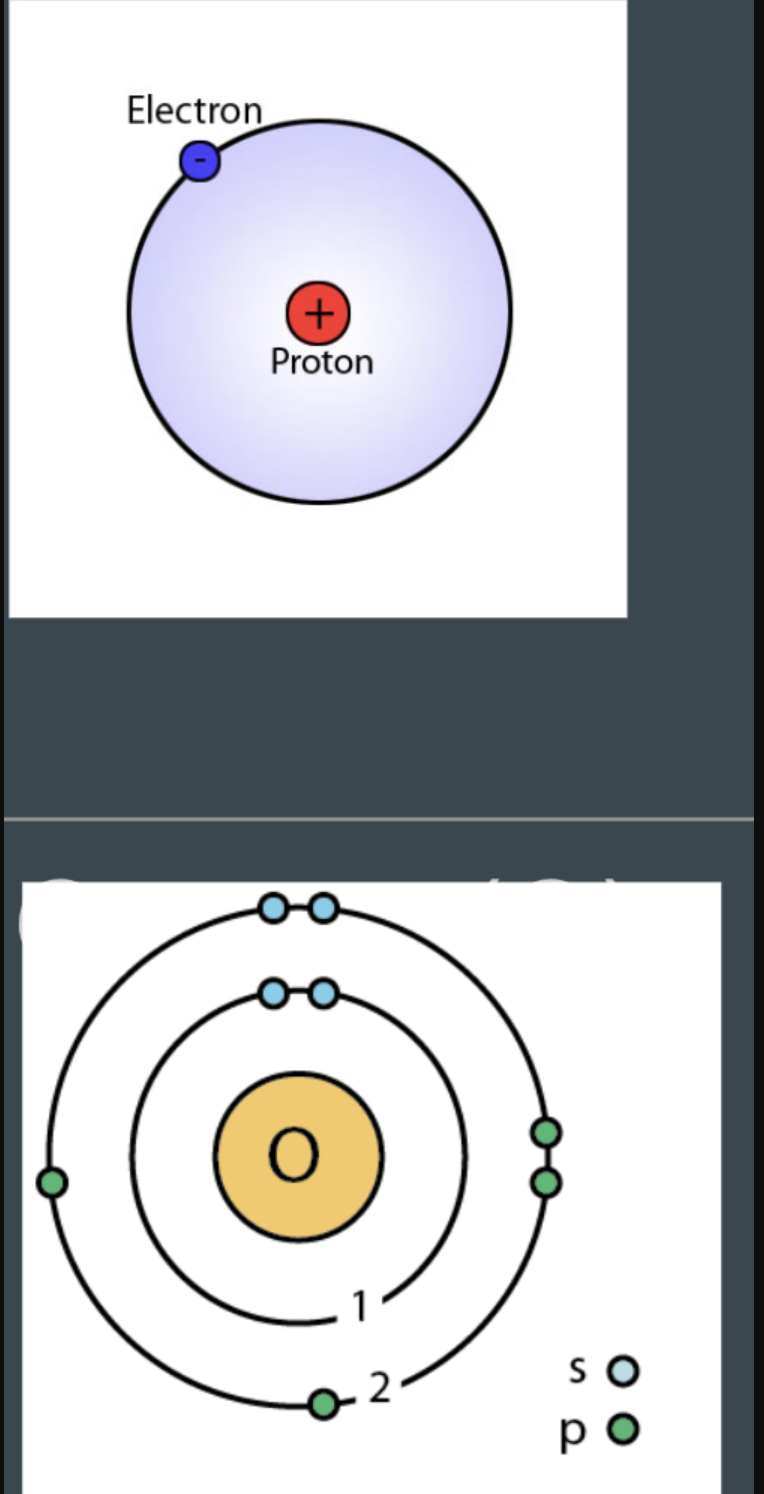
Use Bohr models to explain why water’s formula is H2O.
The oxagen has two empty sets hat the hydroden wanys to fill
What are compounds called that contain C and H?
hydrocarbons.
Draw a Bohr model of C given that its atomic number is 6.

Why does carbon form so many large, complex structures?
Because Carbon is tiny and able to put many together and share because it is nice and wants to be kind
What are macromolecules? What are the 4 groups of macromolecules?
Large Molecule or compound 4 main parts are Proteins, carbohydrates, nucleic acids and lipids
How are monomers related to polymers?
Monomers are tiny molecules that link together to make the huge polymer chains
Describe what happens during hydrolysis.
This is the opposite of dehydration synthesis; water is added to the monomers letting the hydrogen and hydroxyl groups bond together and build a larger polymer
Describe what happens during dehydration synthesis.
2 monomers join to form a larger polymer, and a water molecule is released: the hydrogen from one and the oxygen from the other combine to form water
How is the structure of a carbohydrate different from the structure of a lipid?
Carbohydrates are made of carbon, hydrogen, and oxygen in a 1:2:1 ratio, usually forming ring-like sugar units that link into chains. Lipids, by contrast, have a glycerol backbone attached to Long fatty acid chains, contain far less oxygen, and are nonpolar, so they are water-insoluble
How is the structure of a carbohydrate different from the structure of a protein?
Carbohydrates are built from carbon, hydrogen, and oxygen, usually as sugar rings or straight chains linked by glycosidic bonds. Proteins are made of amino acids that contain nitrogen and sometimes sulfur, connected by peptide bonds and folded into complex three-dimensional shapes
Carbohydrates Elements and ratio, Function, Monomer:, Examples
Elements and ratio: C H O 1:2:1
Function: To gain quick energy
Monomer: Monosaccharides and glucose, C6H12O6
Examples: bread, pasta, sugar, and starches
What is the relationship between a monosaccharide and a polysaccharide?
Monosaccharides are the small individual Building Blocks made up of mainly sugars, while polysaccharides are many monosaccharides put together into a long chain
What is glucose’s formula?
C6H1206
What do the names of most sugars end in?
ose
Lipids Elements and ratio, Function, Monomer:, Examples
Elements and ratio; C , H ,O 1;2; very few Froms lines
Function ; Long term energy used for Insulation
Monomer; No Monomer
Examples; Fats Oils waxs
Protein Elements and ratio, Function, Monomer:, Examples
Elements: C H O N
Function; Many speed up ractions , transfer items , defend against pathogens , Give structure
Monomer: Amino acids
Examples: Enzymes nuts beans
Nucleic acids Elements and ratio, Function, Monomer:, Examples
Elements: C , H , O N P
Function: Gives Genetic infromasion which helps create proteins
Monomer : Nucleotide
Examples: DNA RNA