Biology Unit 4 - Respiratory System
 Call Kai
 Learn
Learn Practice Test
 Spaced Repetition
 Match
Match Flashcards
 Knowt Play
1/396

Earn XP
Description and Tags
nnguhghhhhhhh
Name | Mastery | Learn | Test | Matching | Spaced | Call with Kai | Chat |
|---|
No analytics yet
Send a link to your students to track their progress
397 Terms
What are the functions of the respiratory system?
Helps the body inhale oxygen, remove carbon dioxide, warms and moistens inhaled air, protects the body from foreign particles, allows you to talk, helps you smell, helps you swallow, and balances acidity levels.
What is the main function of the respiratory system?
Help the body inhale oxygen and get rid of carbon dioxide by exhaling through gas exchange.
Where does gas exchange occur?
Between small air sacs called alveoli in the organs and nearby blood vessels.
What does adding moisture and humidity to the air the body breathes?
It does this to match body temperature and the humidity levels the body needs.
What are the respiratory tracts divided into?
Upper and lower
What does the upper respiratory tract contain?
Nose, pharynx and larynx
What does the lower respiratory tract contain?
Trachea, bronchial tree and lungs

What is 1?
Primary bronchus

What is 2?
Secondary bronchus

What is 3?
Tertiary bronchus

What is 4?
Bronchiole

What is 5?
Terminal bronchiole

What is 6?
Nasal cavity

What is 7?
Pharynx

What is 8?
Larynx

What is 9?
Trachea

What is 10?
Diaphragm

What is 11?
Pulmonary vein

What is 12?
Pulmonary artery
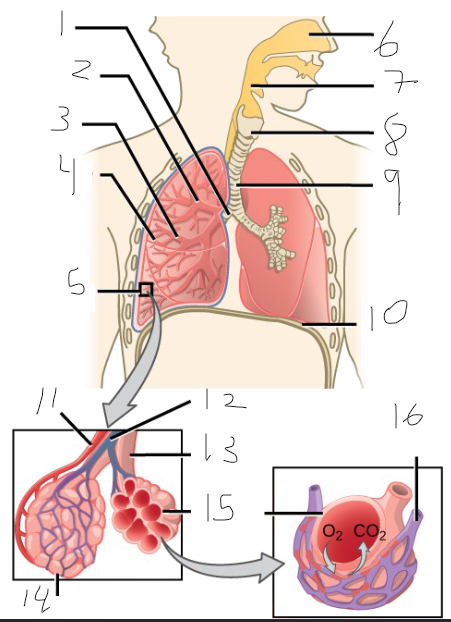
What is 13?
Alveolar duct

What is 14?
Alveolar sac

What is 15?
Alveolus

What is 16?
Capillaries
What is the respiratory system compared to?
An inverted tree if it were hollow.
What is an analogy of the respiratory system?
Trachea is the trunk, bronchi are the branches and alveoli are the leaves.
What is the type of gas exchange that occurs in the respiratory system?
Diffusion

What is 1?
Trachea

What is 2?
Right lung

What is 3?
Left lung

What is 4?
Upper lobe

What is 5?
Lower lobe

What is 6?
Upper lobe

What is 7?
Middle lobe

What is 8?
Lower lobe

What is 9?
Diagraphm
What is the respiratory mucosa?
Type of mucous membrane that lines the airways of the respiratory system.
What does the respiratory mucosa produce?
Mucus
How many mL of mucus does the respiratory mucosa produce each day?
Over 125 mL
What does the mucus produced by the respiratory mucosa form?
“Mucus blanket” over the majority of the respiratory mucosa
What are the functions of the respiratory mucosa?
Air purification
How does the respiratory mucosa serve as an air purification mechanism?
Traps irritants such as dust and pollen and moving them into the pharynx for removal.
How does the respiratory mucosa move trapped irritants into the pharynx?
Via cillia on mucosal cells.
What direction do cillia move in?
Only one
Whatt is pseudostratified ciliated epithelium?
A single layer of epithelial tissue cells that looks like multiple layers because the cells have different heights and their nuclei are at different levels.
Where is pseudostratified ciliated epithelium found?
Primarily in the airways of the respiratory system.
What are goblet cells?
Specialized epithelial cells that form and release mucus to protect and lubricate the airways and intestines.
What divides the interior of the nose?
The nasal septum.
What does the nasal septum divide the interior of the nose into?
Two cavities.
What are the nasal cavities lined with?
Respiratory mucosa.
What are the functions of the nose?
Helps the body smell, filters air and warms and moistens inhaled air.
How does the nose help the body smell?
It contains olfactory receptors on the olfactory epithelium that detect smell and send signals to the olfactory bulb above the olfactory epithelium.
Where is the olfactory epithelium located?
Top of the nasal cavity
How does the nose warm the air we breathe?
Blood vessels inside the nose transfer heat to the incoming air.
How does the nose moisten and filter the air we breathe?
Mucus made by the respiratory mucosa moistens the air and traps dust and germs, while cilia move them away.
What are nasal polyps?
Noncancerous growths that project from the nasal mucosa.
What can cause nasal polyps?
Chronic allergies, upper respiratory infections or asthma that cause long term nose inflammation.
What are symptoms of nasal polyps?
Runny nose, no sense of smell, no sense of taste and headache.
What are treatments for nasal polyps?
Nasal steroids, oral steroids and antihistamines.
What are paranasal sinuses?
Four paired cavities in the face that make mucus that drains the nose.
How many paranasal sinuses are there?
4
What are the four pairs of paranasal sinuses?
Frontal, maxillary, sphenoidal, and ethmoidal sinuses
What is the most common condition that affects sinuses?
SInusitis
What is sinusitis?
Inflammation in the tissue lining the sinuses.
Where is the frontal sinus located?
It is triangle shaped in the forehead area above the eyebrows.
Where is the sphenoid sinus located?
Inside the sphenoid bone behind the eyes.
Where is the ethmoid sinus located?
Between the eyes behind the bridge of the nose.
Where is the maxillary sinus located?
In the maxillary bone which is the bone that makes up the upper jaw.
What are common signs of a sinus condition?
Sinus pressure, runny nose and stuffy smell.
What are treatments for sinus conditions?
Corticosteroids, anti-inflammatory drugs or sinus surgery.
What is the pharynx?
Muscular tube in the middle of the neck.
How long is the pharynx?
About 12.5 cm or 5 inches.
What is the pharynx also known as?
The throat.
What is the pharynx divided into?
Nasopharynx, oropharynx, and laryngopharynx
What is the pharynx lined with?
Respiratory mucosa
What does the pharynx connect?
The nasal cavities and mouth to the esophagus and larynx.
What is the nasopharynx?
The upper part of the throat where nasal cavities, pharyngeal tonsils and auditory tubes open into.
What is the oropharynx?
The middle of the throat behind the mouth that contains tonsils.
What is the laryngopharynx?
Most distal part of the pharynx that connects the oropharynx to the esophagus.
What are the functions of the pharynx?
Food distribution, immune protection and air distribution.
How does the pharynx contribute to food distribution?
It acts as a passageway for food and liquids.
How does the pharynx contribute to immune protection?
Tonsils provide immune protection by stopping foreign things from entering the lungs and filtering germs that enter through the nose and mouth.
What are tonsils?
Oval-shaped pads of lymphoid tissue embedded in the back of the pharynx.
How does the pharynx contribute to air distribution?
It acts as a passageway that carries air from the nose and mouth to the larynx.
What is the larynx?
A hollow tube in the middle of the neck.
What is the larynx also known as?
The voice box
Where is the larynx located?
Just below the pharynx.
What is the larynx formed by?
Several pieces of cartilage.
What are two pieces of cartilage that form the larynx?
Thyroid cartilage and epiglottis
What is the thyroid cartilage?
The largest cartilage that makes up the larynx.
What is another name for the thyroid cartilage?
Adam’s apple
What is tonsilitis?
Inflammation of the tonsils
How many tonsils are located on each side?
One
What are symptoms of tonsillitis?
Red and swollen tonsils, sore throat, difficulty swallowing and yellow patches on the tonsils.
What are causes of tonsillitis?
Common viruses and bacterial infections such as strep throat.
What are treatments for tonsillitis?
Ibuprofen, rest, saltwater gargle and antibiotics.

What is 1?
Sphenoid sinus

What is 2?
Frontal sinus

What is 3?
Ethmoid air cells

What is 4?
Superior conchae

What is 5?
Middle conchae