A2.1 Origins of Life
 Call Kai
 Learn
 Practice Test
 Spaced Repetition
 Match
 Flashcards
 Knowt Play
1/37

There's no tags or description
Looks like no tags are added yet.
38 Terms
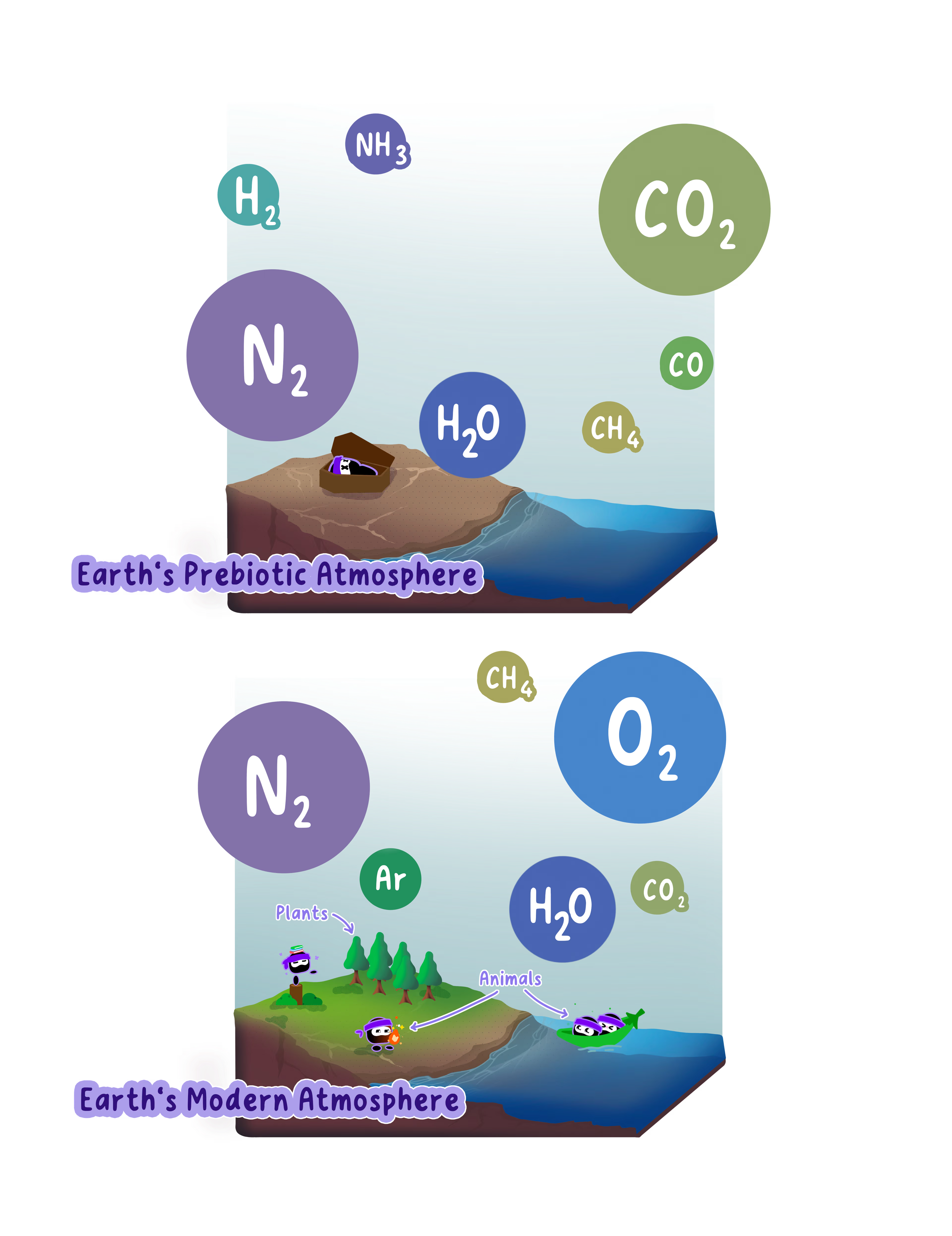
Early Earth Atmosphere vs Today’s Atmosphere
Geology suggests free oxygen was nearly absent in early earth
Atmosphere likely consisted of gases such as methane (CH₄), carbon dioxide (CO₂), ammonia (NH₃), and water vapor (H₂O)
Why Early Earth Favoured Chemical Reactions
Lack of Free Oxygen (O₂)
No Ozone Layer
High CO₂ Levels
Abundant Energy Source
Spontaneous Formation of Carbon Compounds
Combination of these conditions enabled chemical processes that no longer occur today
Under these conditions, simple carbon-based molecules like aldehydes, carboxylic acids, and formaldehyde formed spontaneously
UV radiation provided the activation energy needed for chemical reactions that would not normally occur today
Ozone
Blocks UV radiation
Why These Processes No Longer Occur
Presence of Oxygen breaks down organic molecules
Ozone layer now absorbs most of the Sun's UV radiation, preventing it from reaching the surface
Three Basic Requirements for Cell Based Life
Membrane
Metabolic System
Information System
Smallest Unit of Self Sustaining Life
Cells
Membranes in Cell Based Life
Cell needs to separate inside from outside
For humans the membrane of a cell is a phospholipid
Metabolic System In Cell Based Life
Uses energy and materials from environment to sustain
Catalysis
Process of inc. rate of reaction by using a substance called a catalyst which isn’t consumed during rxn
Lowers activation energy needed for reaction to occur, making it faster + more efficient
Spontaneous Origin of Cells Required Developments
Catalysis: speeding up reactions.
Self-replication: passing on information.
Self-assembly: forming complex molecules.
Compartmentalization: creating membrane-bound environments
Characteristics of Living Things
Metabolism: Chemical reactions convert energy and build molecules
Reproduction: Ability to produce offspring + pass on genetic information
Homeostasis: Maintaining a stable internal environment
Growth: Increasing in size or cell number
Response to Stimuli: Detecting and reacting to changes in the environment
Excretion: Removing waste products from metabolism
Nutrition: Acquiring energy + materials, either by producing food (autotrophs) or consuming others (heterotrophs)
Pasteur’s Experiment
Asked whether life comes from existing life
Used a nutrient broth, boiled to kill microbes, in a swan neck flask
Result = no microbial growth unless contamination was allowed
Spontaneous generation disproven
Milley Urey Experiment
Asked whether organic compounds could form under conditions thought to resemble those of early earth
Simple biomolecules were found
Limitations include lack of UV radiation, too high methane levels, and only monomers not polymers formed

Amphipathic
Molecule with both hydrophilic (water-attracting) and hydrophobic (water-repelling) regions, such as a phospholipid
Why Compartmentallization Was Essential
Internal chemistry had to be separated from the external environment
Membranes provide this separation, allowing cells to maintain stable internal conditions (compartmentalization)
Fatty Acid Structure
Hydrophilic head = polar, attracted to water
Hydrophobic tail = nonpolar, repelled by water
These molecules naturally arrange to minimise energy when placed in water
Why Bilayer Formation Happen Spontanously
Molecules arrange themselves to minimize energy + self organizing

RNA World Hypothesis
Suggests that RNA serves as both genetic material and catalyst
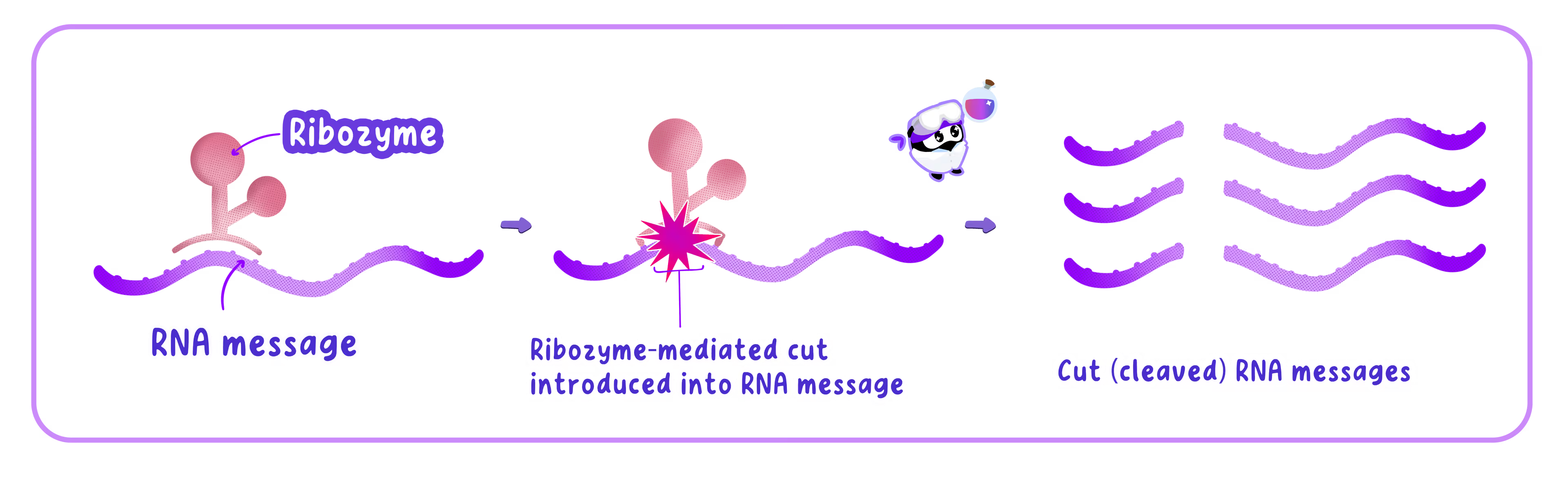
Ribozyme
Catalyzes peptide bonds between amino acids
First catalytic RNA
Found in ribosome
Significance of RNA
Establishment of metabolic cycles and construction of polymers
Genetic information → later converted to DNA
Self-Replication of RNA
RNA strands can serve as templates for complementary base pairing
Laboratory evidence shows some RNA molecules can catalyse their own replication (though imperfectly)
Early RNA replication was likely error-prone, producing high mutation rates that allowed rapid evolution
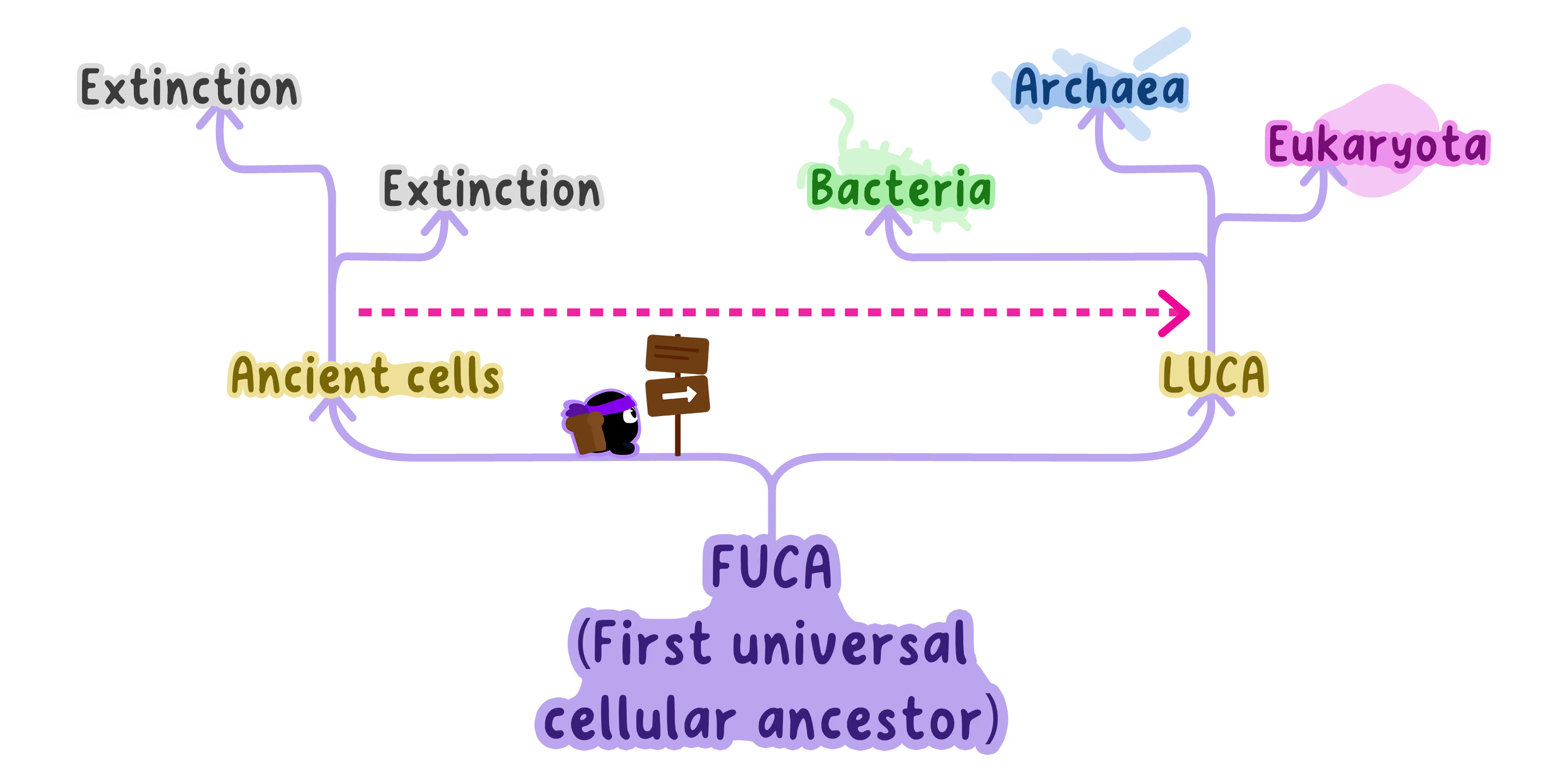
LUCA
Stands for last common ancestor of life
Ancestor of all present day living organisms, representing the root of life
Universal features shared across all life forms today
Likely lived around 4 billion years ago
How Genetic Identity Provides Evidence for LUCA
By identifying common elements between archaebacteria and eubacteria, which reveals shared traits + functions from inherited genes
How Time of Divergence from LUCA is Estimated
By using a molecular clock which extrapolates backwards using mutations
Mutations
Constant rate of nucleotide change
Environment LUCA Predicted to Have Evolved in
Evolved near deep sea volcanic vents, where it could harvest energy from inorganic chemicals to power biosynthesis
Three Main Evolutionary Branches Shown Diverging from LUCA
Eubacteria
Archaebacteria
Eucaryotes
Characteristics of Archaebacteria that Support Theory of LUCA's Environment
Many are extremophiles that thrive in high temperature and acidic conditions
Dating Life's Origin
Fossils formed about 3.5 billion years ago
The first living cells and the Last Universal Common Ancestor (LUCA) appeared soon after, but direct evidence is limited
Scientists use a combination of fossil, isotopic, and molecular evidence to estimate when life began
Stromatolites as the Oldest Evidence of Life
The oldest known fossils are stromatolites, layered rock structures formed by cyanobacteria, photosynthetic microorganisms
Their layered pattern resembles modern cyanobacterial mats
Molecular Clock
Method of using the gradual buildup of mutations to estimate when species split from a common ancestor
Molecular Clocks in Dating LUCA
Uses DNA to Date LUCA
Molecular clocks estimate divergence times by comparing genetic differences between species
Since DNA and proteins mutate at steady rates, scientists can back-calculate when two lineages shared a common ancestor
Evidence for LUCA near Hydrothermal Vents
Shared genes between eubacteria and archaebacteria match traits of modern hydrothermal vent organisms
Genes Found in Both Domains
Refers to eubacteria and archaebacteria
Inherited from a common ancestor (LUCA)
LUCA’s Three Shared Metabolic Traits
Nitrogen metabolism
Carbon dioxide fixtation
Anaerobic metabolism
Carbon Dioxide Fixtation
Conversion of inorganic carbon dioxide molecules into organic hydrocarbons
Chemotrophs
Organisms that break down into inorganic molecules for energy to synthesize organic molecules from carbon dioxide are chemoautotrophs