9: Cranial Nerve Nuclei
 Call Kai
 Learn
Learn Practice Test
 Spaced Repetition
 Match
Match Flashcards
 Knowt Play
1/95

There's no tags or description
Looks like no tags are added yet.
Name | Mastery | Learn | Test | Matching | Spaced | Call with Kai | Chat |
|---|
No analytics yet
Send a link to your students to track their progress
96 Terms
GSE information
innervates skeletal muscles (which derive from somites), next to midline
GVE information
innervates smooth muscles, cardiac muscles, glands, next to GSE
SVE information
innervates muscles derived pharyngeal (branchial) arches → muscles of pharynx, larynx, facial expression
GSE nuclei
oculomotor, trochlear, hypoglossal, abducens
GVE nuclei
Edinger-westphal, superior salivatory, inferior salivatory, dorsal vagal
SVE nuclei
facial motor, ambiguus, accessory, trigeminal motor
oculomotor nucleus associated with what cranial nerve, function
3: oculomotor nerve → eye movement, pupil control
trochlear nucleus associated with what cranial nerve, function
4: trochlear → eye movement
hypoglossal nucleus associated with what cranial nerve, function
12: hypoglossal → tongue control
abducens nucleus associated with what cranial nerve, function
6: abducens → eye movement
Edinger-westphal nucleus associated with what cranial nerve, function
3: oculomotor → movement of eyes/eyelid, pupil control
superior salivatory nucleus associated with what cranial nerve, function
7: facial → facial expression muscles, salivary glands, taste/smell
inferior salivatory nucleus associated with what cranial nerve, function
9: glossopharyngeal → throat muscles, salivary glands, 1/3 of tongue, sensing blood pressure in aorta
dorsal vagal nucleus associated with what cranial nerve, function
10: vagus → heart/lungs/abdominal organ control, pain from viscera, throat muscles
facial motor nucleus associated with what cranial nerve, function
7: facial → facial expression muscles, salivary glands, taste/olfaction
ambiguus nucleus associated with what cranial nerve, function
9: glossopharyngeal
10: vagus
→ throat muscles, salivary glands, heart/lung/abdominal muscle control, sense blood pressure in aorta
accesory nucleus associated with what cranial nerve, function
11: spinal accessory → throat and neck muscles
trigeminal motor nucleus associated with what cranial nerve, function
5: trigeminal → mandibular muscle control, sensation of touch to face

where is edinger-wesphal nucleus?
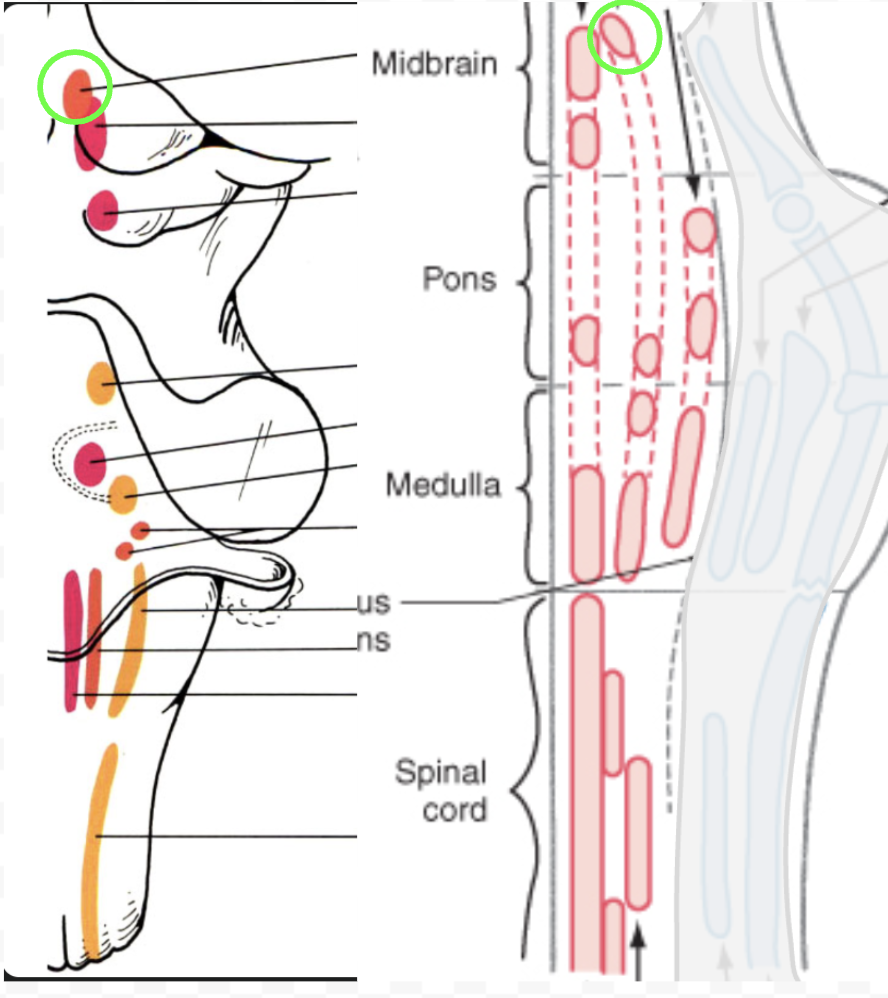
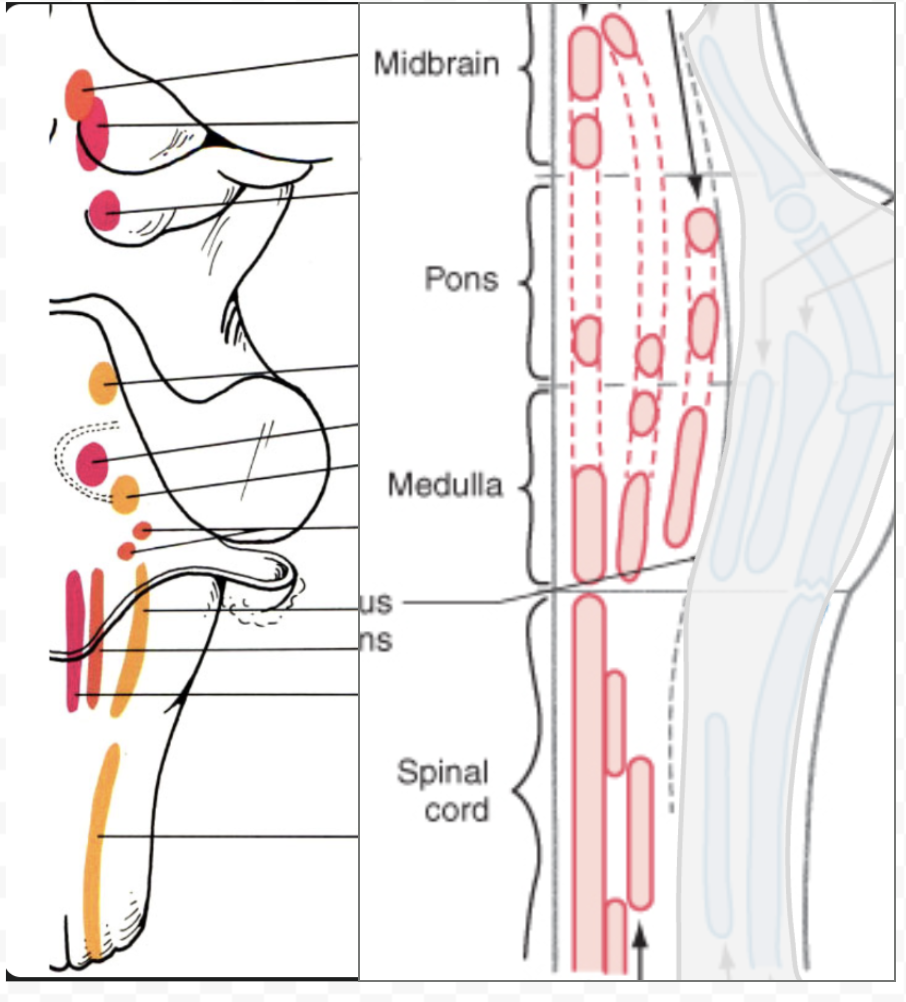
where is oculomotor nucleus?


where is trochlear nucleus?


where is trigeminal nucleus?

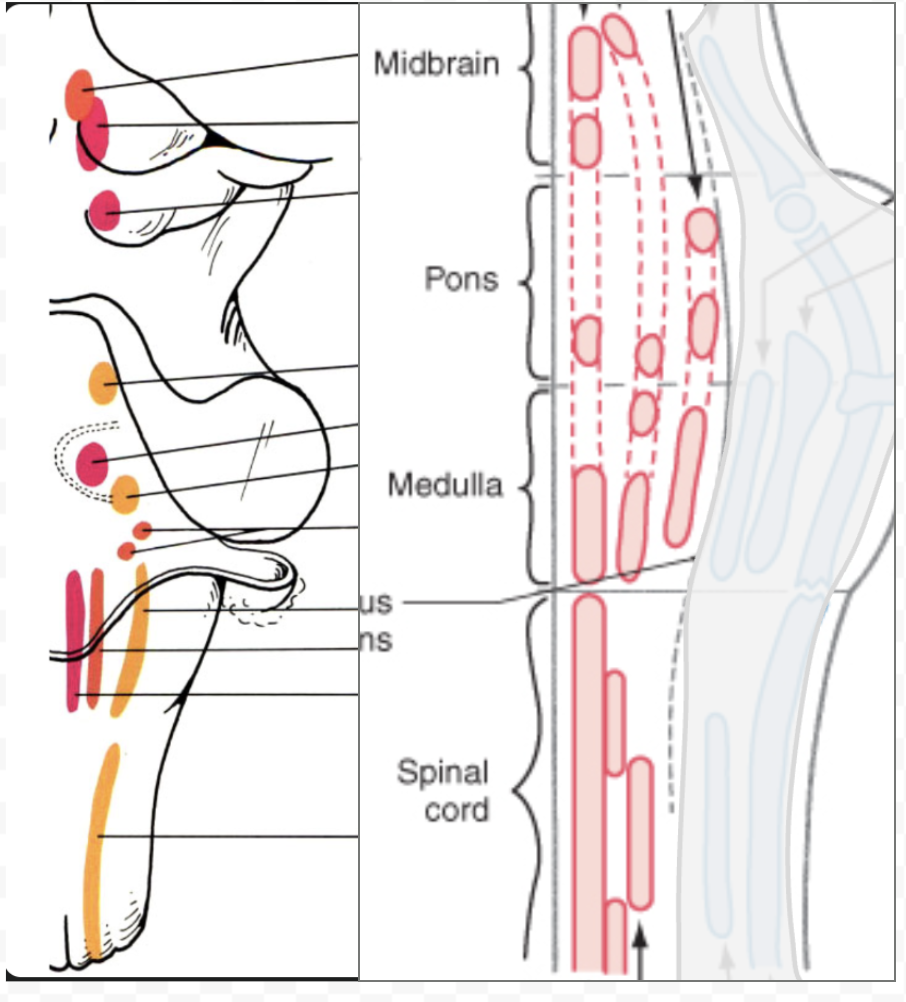
where is abducens nucleus?


where is facial motor nucleus?


where is superior salivatory nucleus?


where is inferior salivatory nucleus


where is hypoglossal nucleus?


where is dorsal vagal nucleus?


where is ambiguus nucleus?


where is accessory nucleus?

nuclei associated with cranial nerve 3 (oculomotor)
oculomotor, edinger-westphal
nuclei associated with cranial nerve 4 (trochlear)
trochlear
nuclei associated with cranial nerve 5 (trigeminal)
trigeminal motor
nuclei associated with cranial nerve 6 (abducens)
abducens
nuclei associated with cranial nerve 7 (facial)
superior salivatory, facial motor
nuclei associated with cranial nerve 9 (glossopharyngeal)
inferior salivatory, ambiguus
nuclei associated with cranial nerve 10 (vagus)
dorsal vagal, ambiguus
nuclei associated with cranial nerve 11 (spinal accessory)
accessory
nuclei associated with cranial nerve 12 (hypoglossal)
hypoglossal
information carried in efferents v. afferents
efferents: motor info from basal plate derivatives
afferents: sensory info from alar plate derivatives
GVA info
input from internal organs, glands, blood vessels
SVA info
input from special (head only) chemical/visceral senses (taste, smell)
SSA info
non-visceral senses in head (vision, hearing balance)
GSA info
skin, muscle, tendon inputs
GVA nucleus
nucleus of solitary tract
SVA nucleus
nucleus of solitary tract
SSA nuclei
vestibular nucleus, cochlear nucleus
GSA nuclei
trigeminal nucleus (mesencephalic, principal, and spinal components)
nerves associated with nucleus of solitary tract for GVA
7 & 9 for gustatory rostral (facial, glossopharyngeal)
10 for caudal (vagus)
input from nerves of GVA
7, 9, 10 → sensation, taste (2/3 tongue), olfaction // 1/3 tongue (taste), detect pressure in carotid artery with baroreceptors // pain from viscera, CO2 & O2 aortic body
nerves associated with nucleus of solitary tract for SVA
gustatory rostral: 7, 9 (facial, glossopharyngeal)
input from nerves of SVA
7,9 → sensation, taste (2/3 tongue), olfaction // 1/3 tongue (taste), detect pressure in carotid artery with baroreceptors
nerves associated with vestibular and cochlear nuclei of SSA
8 (auditory-vestibular)
input from nerves of SSA
hearing, balance
nerves associated with GSA
5, 7, 9, 10 (trigeminal, facial, glossopharyngeal, vagus)
input from nerves of GSA
sensation of touch to face // sensation, taste (2/3 tongue), olfaction // 1/3 tongue (taste), detect pressure in carotid artery with baroreceptors // pain from viscera, CO2 & O2 aortic body

where is trigeminal nucleus


where is vestibular nucleus


where is cochlear nucleus


where is nucleus solitarius

major fiber tracts throughout entire brainstem
corticospinal-pyramidal, trigeminal, spinothalamic-anterolateral, posterior column-medial lemniscus
input/outputs and info of corticospinal-pyramidal fiber tract
descending fiber/efferent goes from cortex to spine on contralateral side
carries info about voluntary motor control (motor function)
input/outputs and info of trigeminal fiber tract
ascending and descending fibers on ipsilateral sides
carries info about touch in face sensation and jaw movement
input/outputs and info of spinothalamic-anterolateral system
ascending fiber/afferent goes from spine to thalamus
carries info about pain and temperature
input/outputs and info of posterior column-medial lemniscus system
ascending fiber/afferent from spinal cord upwards to thalamus
carries info about touch, vibration, proprioception from body to thalamus
reticular formation location/setup
meshwork of cells distributed across the brainstem, midbrain to medulla
reticular formation controls…
sleep/wake cycle, consciousness via ascending reticular activating system
issues may cause coma
reticular formation main information carried and what it manages
pain modulation
respiration, cardio functions, swallowing, vomiting, muscle tone, voluntary and involuntary movement
raphe nuclei main function and controls…
releases serotonin to rest of the brain
controls vigilance/alertness, circadian rhythms, emotional state regulation (mood, anxiety, stress), pain contro;
cranial nerve nuclei specifically in the midbrain
motor
GSE: oculomotor (3) and trochlear (4)
GVE: edinger-westphal (3)
sensory
mesencephalic trigeminal (5)
non-nuclei/nerve structures found specifically in the midbrain
tectum, tegmentum, cerebral peduncle/crus cerebri
tectum parts and info
superior colliculus: visual info
inferior colliculus: auditory info
tegmentum parts and info
red nucleus and substantia nigra → motor system
cerebral peduncle/crus cerebri parts and info
descending fibers/efferents from cortex towards motor centers in brainstem and spinal cord → motor function
midbrain blood supply
almost exclusively from posterior cerebral artery (PCA) branches P1 and P2

label rostral midbrain with: edinger-westphal nucleus, oculomotor nucleus, superior colliculus, substantia nigra (pars reticulata, pars compacta), red nucleus

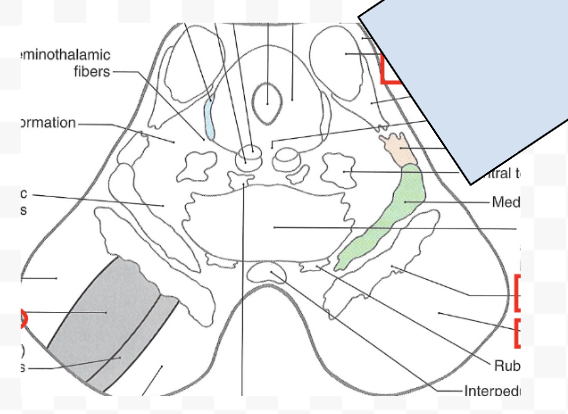
label caudal midbrain with: cerebral aqueduct, inferior colliculus (pericentral, external, central nucleus), corticospinal fibers, substantia nigra, crus cerebri

efferent/motor cranial nerve nuclei in pons
GSE → abducens (VI)
GVE → superior salivatory (VII), inferior salivatory (IX)
SVE → trigeminal motor (V), facial motor (VII)
afferent/sensory cranial nerve nuclei in pons
GSA → sensory trigeminal principal AND spine (receive from V)
SSA → vestibular and cochlear (receive from VIII)
non-nuclei/nerve structures specific to the pons
basal pontine nuclei, superior olivary nucleus
basal pontine nuclei function and input/output
motor function; receive motor input from cortex and send it to cerebellum
superior olivary nucleus function and input/output
auditory function; compares auditory info from both ears to locate source of sound
blood supply to pons, medial to lateral
basilar artery branches; paramedian, short circumferential, long circumferential

label rostral pons with: mesencephalic tract and nucleus, trochlear nerve, middle cerebellar peduncle, pontine nuclei, corticospinal fibers


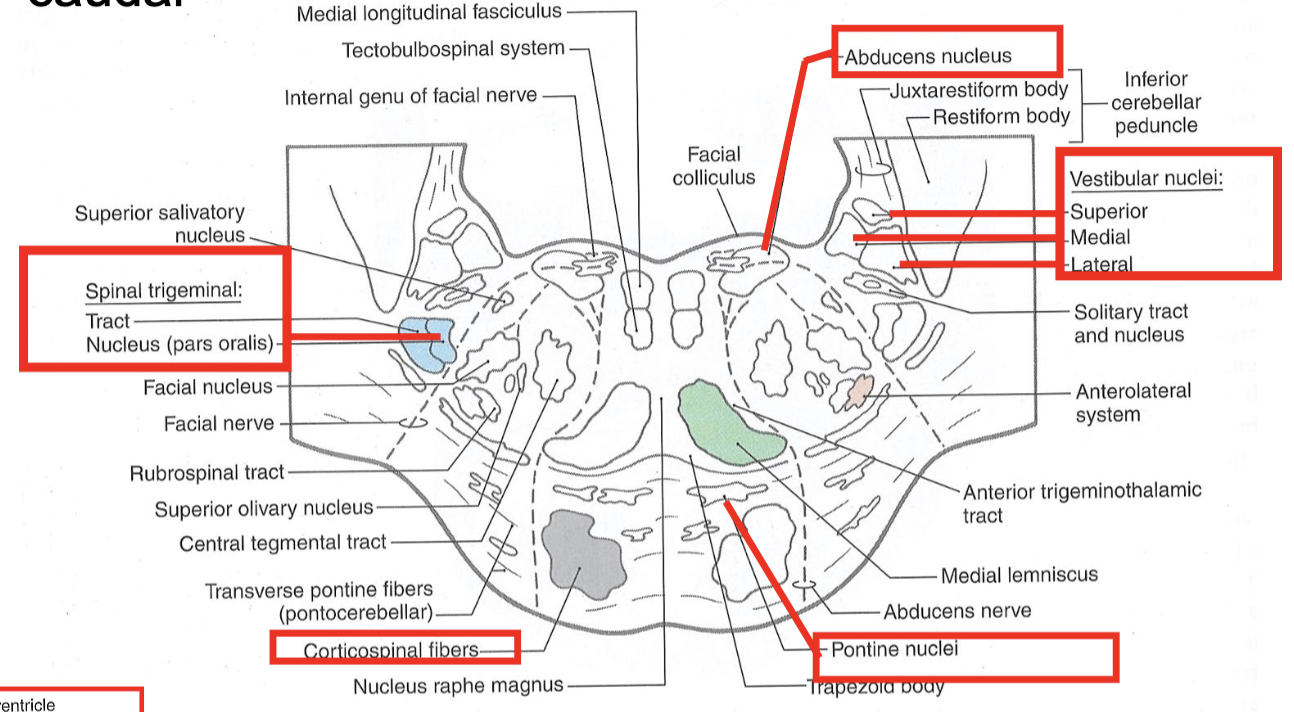
label caudal pons with: abducens nuclei, vestibular nuclei (superior, medial, lateral), abducens nerve, pontine nuclei, spinal trigeminal nucleus (AKA pars oralis), spinal trigeminal tract, facial nerve, and corticospinal fibers
efferent/motor cranial nerve nuclei in medulla
GSE: hypoglossal (origin of XII)
GVE: dorsal motor vagal (X)
SVE: nucleus ambiguus (IX, X)
afferent/sensory cranial nerve nuclei in medulla
GSA: spinal trigeminal nucleus (receives afferents from V)
SSA: vestibular and cochlear nuclei (receive afferents from VIII)
SVA: solitary nucleus (receive info from VII, IV)
GVA: solitary nucleus (receive info from X)
non-nuclei/nerve structures specific to medulla
inferior olivary nuclei
dorsal column nuclei
pyramids
inferior olivary nuclei function/info
motor coordination, processes info from position of muscles in body and send to cerebellum
dorsal column nuclei info/location
somatosensory information from spinal cord to thalamus
pyramids info/location
descending motor fibers from cortex toward spinal cord
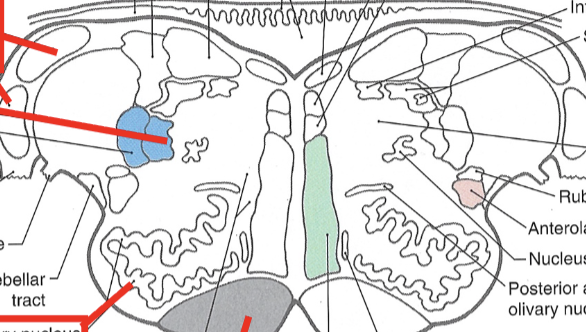
label rostral medulla with: cochlear nuclei (posterior, anterior), spinal trigeminal nucleus (pars oralis), spinal trigeminal tract, pyramid/corticospinal fibers, principal olivary nucleus, solitary tract, solitary nucleus


label middle medulla with: principal olivary nucleus, hypoglossal nucleus, dorsal motor vagal nucleus


label caudal medulla with: gracile nucleus, cuneate nucleus, spinal trigeminal nucleus (pars caudalis), spinal trigeminal tract

blood supply to medulla
primarily from vertebral artery branches (bottom/sides) and posterior interior cerebellar artery branches (upper/sides)