Week 3: Steel manufacturing process
 Call Kai
 Learn
 Practice Test
 Spaced Repetition
 Match
 Flashcards
 Knowt Play
1/17

There's no tags or description
Looks like no tags are added yet.
18 Terms
4 qualities of why we use steel
Strong: Withstand substantial forces before failure → High strength to weight ratio
Stiff: Resists deformation when forces are applied + wind loads
Fabricated: Built in factory, ready to be used on site → reduce waste + quality control
Ductile: Can undergo significant deformation before failure → More steel reinforcement in columns, slabs, beams = High ductility
Strength VS Stiffness
Strength: Tells how much stress a material can handle before yielding or failing
Stiffness: Tells how much the material can resist deformation under loading.
Process of making steel
1. Iron making: Iron found in Earth’s crust as iron ore, transported to blast furnace site
2. Steelmaking: Turn iron into steel with more suitable carbon content. Uses two methods: BOS and EAF
3. Secondary steelmaking: Treating molten steel produced in both BOS and EAF to refine steel to achieve desired properties
4. Continuous castings: Molten steel is cast into cooled mold, solidifying thin steel shell. The shell strand then gets cut into desired length
5. Primary forming: Steel is shaped into useful products, often through hot rolling. Hot rolling uses roller to shape steel and improve its surface quality and internal structure
6. Fabrication: Steel is prepared for its final application → gives steel its final shape and properties (shaping, coating, surface treatment, machining, heat treatment)

BOS (Basic oxygen steel making) VS EAF (Electric blast furnace)
BOS: Produces steel from molten iron using oxygen, generally resulting in higher embodied carbon due to coal intensive iron production
EAF: Produces steel using electricity, often from recycled scrap, generally resulting in lower embodied carbon

Strength limit condition
S*= Demand
Ru= reduced design resistance (capacity)
Demand must be lesser than capacity
Capacity reduction factor for steel= 0.9
How does tensile strength test work and how is it recorded
A material (e.g steel) is placed into a testing machine and pulled until failure. During the test, the machine records the applied force and elongation. Then the tensile strength is the maximum pressure observed before failure occurs
- These info are used to understand the material’s behavior under tension
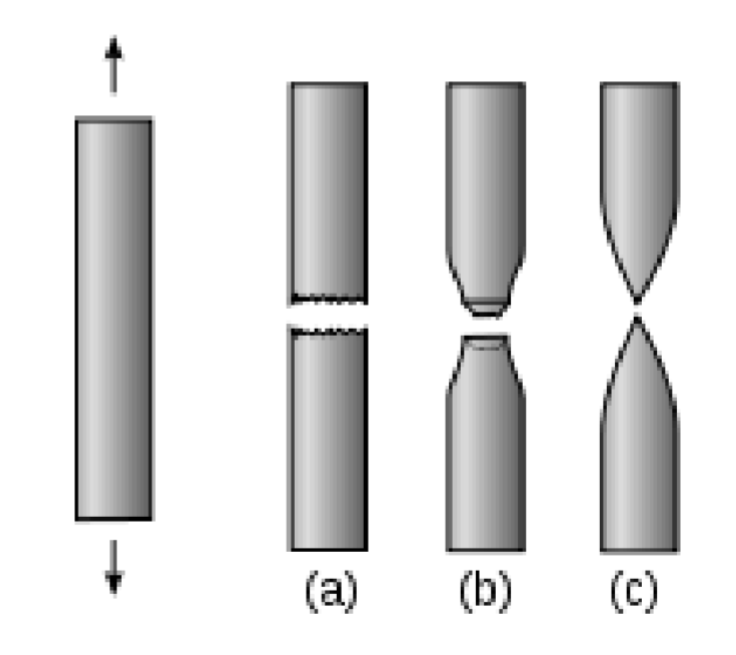
3 Behaviors of material under tension
a) Brittle: Fractures with little to no deformation
b) Ductile: Undergoes deformation before failure
c) Completely ductile
Stress and strain equation and what each one means
Stress is the pressure applied to the material → basically how concentrated the pull from tensile force is over the cross-sectional area. It measures the force per unit area
Stress = Applied axial force/cross-sectional area [Pa]
Strain is the change in length as a percentage of original length
Strain = Final length - original length/original length


Explain different stages of stress-strain curve
Elastic region: The beginning stage where stress and strain increase approximately proportional to one another. The material returns back to normal length/shape when load is removed.
Yield strength: Maximum stress the material can undergo before it permanently deforms, cannot go back to original shape → This is the stage where we want to avoid. From this point onwards, the material is in plastic region
Strain hardening: After yielding, the material can still withstand increasing stress as it continues to deform plastically
Ultimate strength: Maximum stress the material can handle before failure/breaking
Necking: After reaching maximum tensile force, deformation becomes concentrated in one area, making cross section thinner as it reaches towards failure
- At this stage the curve slopes down because force is acting over a smaller area of the cross section, making stress value reduced.
Fracture: Eventually, that thin cross section would eventually break
Young’s Modulus (E)
Measures how stiff a material is → How much material can resist stretching or compression when forced is applied.
E= stress/strain → which this is the gradient of the stress-strain curve. So, the steeper the slope, the stiffer the material is
High E: Stiffer material, resists bending
Low E: Flexible material, large deformation and bends more easily


Explain the difference between these two graphs and the property of the material
Graph 1: Material has High strength and high ductility. This means the material is able to withstand high load, and continues to deform its shape until failure, which is why the graph has high strain value and high stress value
Graph 2: The graph shows that the material break at very less strain value, meaning that the material is stiff so it experienced very little deformation before it breaks. However, it’s strong in strength as it’s able to carry large amount of load (high stress value on graph)
5 important properties of steel
Ductility: Ability to deform under tensile load without breaking
Brittleness: Material failure with little deformation
Elasticity: Ability to return to original shape and size when unloaded
Plasticity: Ability to deform permanently without breaking
Stiffness: Resistance to deformation, related to Young’s modulus E
Equilibrium
A structure is in equilibrium when all forces or moment acting on it are balanced. So sum of Fy, Fx, and M would equal to zero
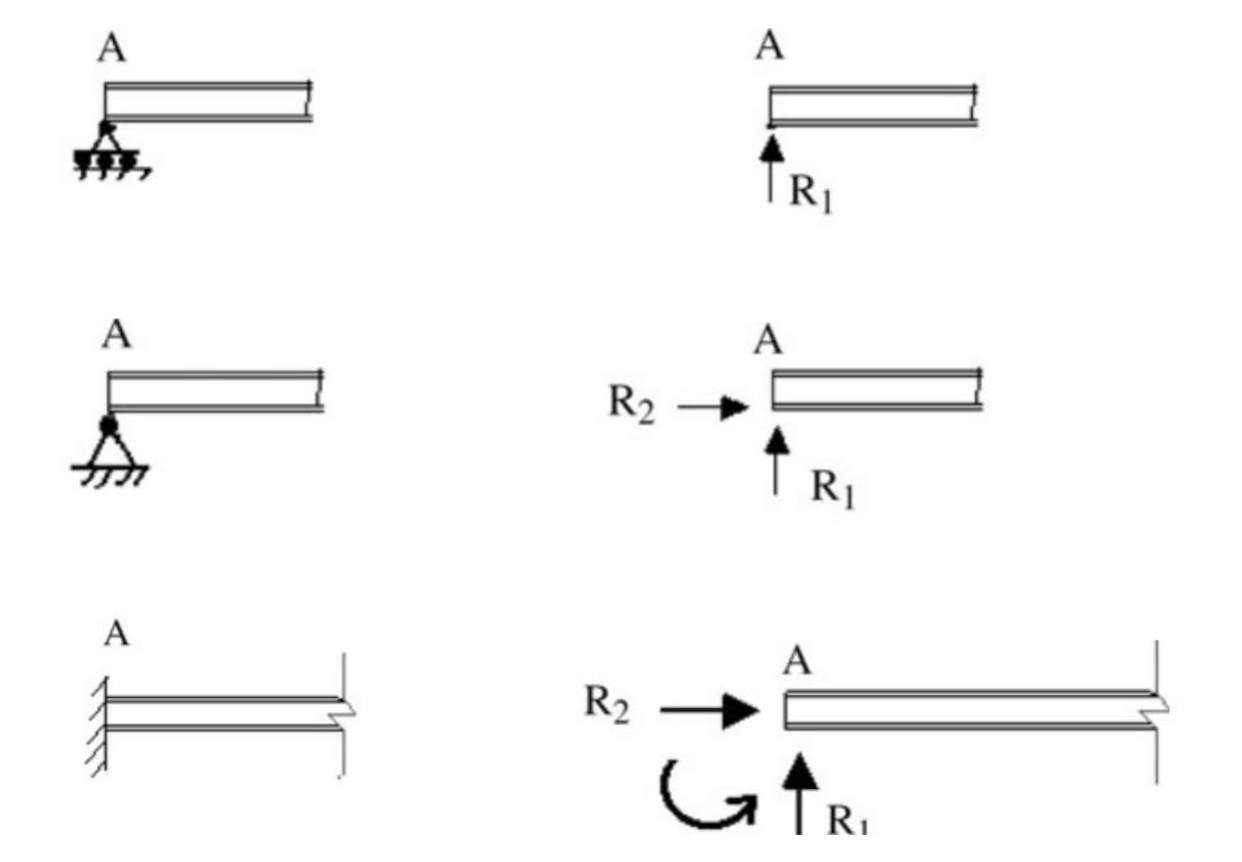
Support connection types
Roller support: Free to rotate, moves along the surface upon which the roller rest, but resists vertical movement
- This support provides on vertical force acting perpendicular to the surface (Fy)
= Fy ONLY
Pinned support: Can resist bother vertical and horizontal force but not a moment.
- This support allows beam to rotate, but prevents it from moving horizontally and vertically
= Fy + Fx
Fixed support: Resists vertical, horizontal, and moment
- This means the structure only need one fixed support to be stable
= Fy + Fx + M
Why does stress rise during strain hardening
Plastic deformation makes dislocation in the material increasingly difficult to move, meaning more stress is required to continue deforming the material
Why does stress decrease during necking
Stress decreases because the material’s load bearing capacity decrease as its cross-sectional area rapidly reduce during necking
What permanent load (G) and what is live load (Q)
Permanent or dead load is the self-weight of the structure, they are permanent. Whereas live load are occupancy load such as people and furniture