Unit III: Biodiversity and Conservation
 Call Kai
 Learn
Learn Practice Test
 Spaced Repetition
 Match
Match Flashcards
 Knowt Play
1/28

Earn XP
Description and Tags
Vocabulary flashcards covering the key terms, concepts, classifications, and conservation strategies presented in Unit III: Biodiversity.
Name | Mastery | Learn | Test | Matching | Spaced | Call with Kai | Chat |
|---|
No analytics yet
Send a link to your students to track their progress
29 Terms
Biodiversity
The variability among living organisms from all sources (including terrestrial, marine, and other aquatic ecosystems); etymologically derived from 'bio' (meaning life) and 'diversity' (meaning variety), formalized during the 1992 Rio Earth Summit Convention on Biological Diversity.
Genetic Diversity
The variation in DNA sequences among individuals of the same species, seen for example in over 400 recognized dog breeds with wide differences in size, shape, behavior, and physiology.
Species Diversity
The diversity and variety of different species existing within a specific habitat or ecosystem, such as the numerous mammals, birds, reptiles, amphibians, and insects found in tropical rainforests.
Ecosystem Diversity
The diversity of ecosystems found in a particular area or across the Earth, encompassing ecological interactions among organisms and their physical environment across both terrestrial (forests, taiga) and aquatic (rivers, lakes, oceans) biomes.
Ecosystem Services
Essential life-support processes maintained by biodiversity that are vital for human survival, including air and water purification, crop pollination, climate regulation, soil fertility, and nutrient cycling.
Biodiversity Hotspot
A biogeographic region containing a significant reservoir of biodiversity that is under serious threat from humans, identified based on species richness, endemism, and the degree of threat faced.
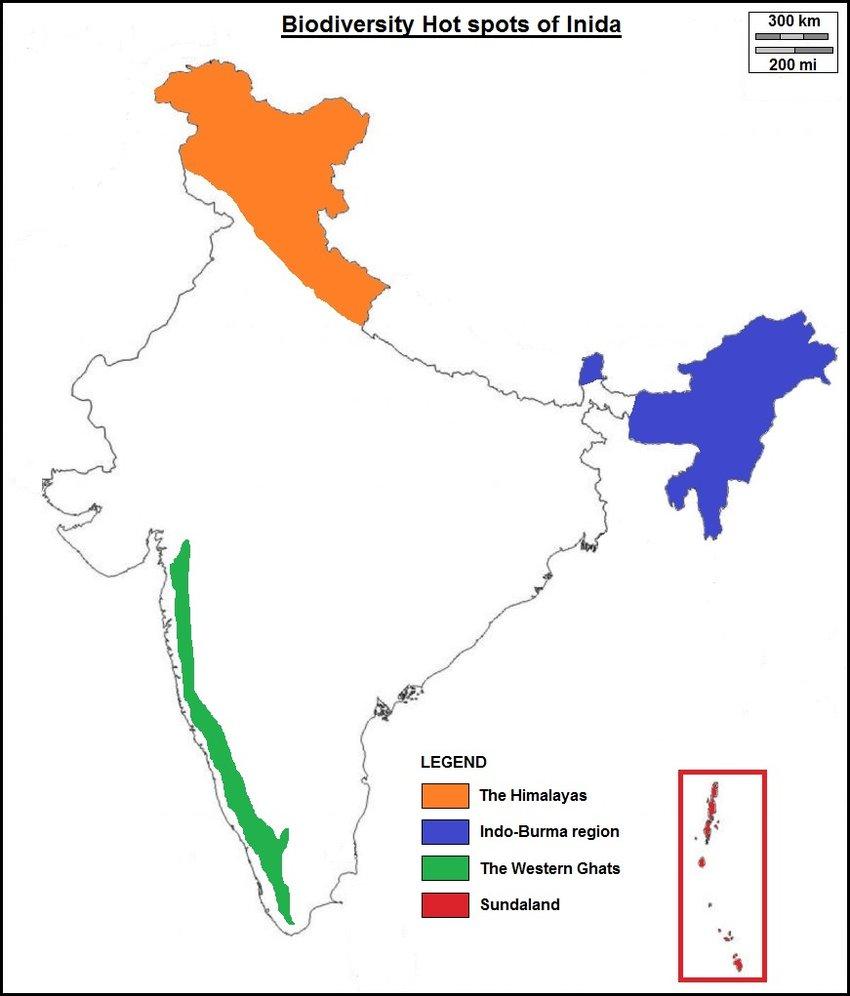
Biodiversity Hotspots of India
The four global biodiversity hotspot regions that cover parts of India: The Western Ghats, The Himalayas (Eastern Himalayas), Indo-Burma, and Sundaland (Nicobar Islands).
Human-Wildlife Conflict
Occurrences where encounters between humans and wildlife result in negative consequences, including property loss, destruction of livelihoods, and animal or human fatalities.
Extinct Species
A species that no longer exists anywhere on Earth after the last individual has died, possessing no possibility of recovery in the wild or captivity, categorized as 'EX' under the IUCN Red List.

Endangered Species
Organisms facing a very high risk of extinction due to factors such as habitat loss, climate change, poaching, pollution, and invasive species, monitored and protected by organizations such as WWF and IUCN.
Vulnerable Species
A plant or animal species categorized by the IUCN Red List as facing a high risk of extinction in the wild in the medium-term future, with Indian examples including the Sarus crane, Nilgiri Langur, and Barasingha.
Rare Species
A species with small population numbers or restricted geographic distribution that is currently stable rather than declining, but which may become threatened if its habitat is disrupted.
EDGE Species
An acronym for 'Evolutionarily Distinct and Globally Endangered' species, prioritizing species that face high extinction risks while possessing unique evolutionary history and phylogenetic uniqueness, such as Asian elephants, Chinese Pangolins, Malayan Tapirs, and red pandas.
Red Data Book
A biological record established by the International Union for Conservation of Nature (IUCN) in the late 1960s to document and assess the conservation status of rare and endangered species of plants, animals, and fungi worldwide.
In-situ Conservation
The conservation and protection of animal and plant species, ecosystems, and genetic resources directly within their natural and original habitats.
Ex-situ Conservation
The conservation and preservation of biodiversity components outside or away from their natural habitats in human-managed facilities.
National Parks
Protected in-situ conservation areas established to preserve entire ecosystems, plants, and wildlife, where commercial exploitation, hunting, poaching, and grazing are strictly prohibited.
Wildlife Sanctuaries
Protected in-situ conservation areas focused on safeguarding wild animal populations and habitats from hunting and poaching, where certain regulated human activities may be permitted.
Biosphere Reserves
Large-scale protected in-situ conservation landscapes designed to preserve biodiversity and genetic resources while promoting sustainable community development, organized into Core, Buffer, and Transition zones.
Core Zone
The strictly protected inner area of a biosphere reserve that conserves ecosystems, wildlife, and genetic resources with zero permitted human interference.
Buffer Zone
The zone surrounding the core area of a biosphere reserve that permits scientific research, education, environmental monitoring, and limited sustainable activities.
Transition Zone
The outermost sector of a biosphere reserve that accommodates human settlements and sustainable economic activities carried out in cooperation with local communities.
Gene Bank
An ex-situ conservation facility designed for storing germplasm and genetic materials over long periods, including seed banks, pollen banks, sperm banks, and ova banks.
Plant Tissue Culture
An ex-situ asexual propagation method in which small explants (shoot apices, leaf sections, or isolated cells) are cultured under sterile, nutrient-rich conditions in containers to regenerate whole plants.

Mega-Diverse Countries
A group of 18 nations identified by Conservation International in 1998, including India, that house a disproportionately vast share of the planet's biodiversity and endemic species.
Biogeographic Zones of India
The 10 major ecological zones dividing India: Trans-Himalayan, Himalayan, Desert, Semi-Arid, Western Ghats, Deccan Peninsula, Gangetic plain, North-east India, Islands, and Coasts.
Phytogeographical Regions of India
The nine botanical divisions of India established based on flora distribution: The Western Himalayas, The Eastern Himalayas, Western Deserts, Gangetic Plains, Central India, Western Coast, Deccan Plateau, North-East India, and Andaman and Nicobar Islands.
Zoogeographical Regions of India
The six faunal divisions of India classified by animal distribution: Himalayan Region, Malabar Region, Nilgiri Region, Northern Plains, Desert Lands, and Deccan Plateau Region.
Biodiversity
The variability among living organisms from all ecological complexes, including terrestrial, marine, and other aquatic ecosystems.