BIO 141 ch 11 - cell communication
 Call Kai
 Learn
 Practice Test
 Spaced Repetition
 Match
 Flashcards
 Knowt Play
1/4

There's no tags or description
Looks like no tags are added yet.
5 Terms
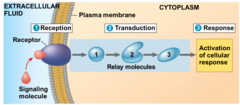
explain the three major steps of signal transduction
Reception - target cell detects a signaling molecule that binds to a receptor protein on the cell surface
transduction - the binding of the signaling molecule alters the receptor and initiates a signal transduction pathway [often occurring in a series of steps]
response - the transduced signal triggers a specific response in the target cell.
describe the actions of a G protein coupled receptor
they are cell surface receptors
for example there are amino acids that are coming off the protein witch can act as a binding site and once binded can possibly change its shape
most water-soluble signal molecules bind to specific sites on receptor proteins that transmit information from the extracellular environment to inside the cell
explain how the signal amplification comes out
what is a phosphorylated cascade
describe the flow of a cascade
A signaling molecule attaches to a receptor which then activates with an enzyme
An inactive protein kinase becomes active [which can transfer phosphates from ATP [phosphorylation]] and the process continues as a phosphorylation cascade
this will continue as a chain reaction - gradually making the signal bigger finally reaching a cellular response

describe what a second messenger is and give two examples
what is apoptosis and how it might be regulated
if cells are infected, damaged, or at the end of their functional lives they will undergo an programed cell death
the biggest regulator is a protein called Ced-9
when the death signal is received the protein is inactivated which disables the brake