Chem. Unit 3 vocab
 Call Kai
 Learn
Learn Practice Test
 Spaced Repetition
 Match
Match Flashcards
 Knowt Play
1/32

There's no tags or description
Looks like no tags are added yet.
Name | Mastery | Learn | Test | Matching | Spaced | Call with Kai | Chat |
|---|
No analytics yet
Send a link to your students to track their progress
33 Terms
Mendeleev
organized the elements by increasing atomic mass and so that elements in the same row have similar properties

Moseley
rearranged the elements by increasing atomic number

Periodic Law
“when elements are arranged in order of increasing atomic numbers, there is a periodic pattern in their physical and chemical properties”
Period
the horizontal rows of the periodic table
Group
the vertical columns on periodic table
S block
representative elements
P block
representative elements
D block
transition metals
F block
inner transition metals
Alkali Metals
elements that make up group 1 of the periodic table, excluding hydrogen
Alkaline Earth Metals
elements in Group 2 of the periodic table
Transition Metals
elements located in the middle of the periodic table, spanning Groups 3 through 12 (the d-block)
Halogens
elements in Group 17
Noble Gases
elements that make up Group 18
Metals
a chemical element that easily loses electrons to form positive ions (cations)
Non metals
elements on the upper-right side of the periodic table
Metalloids
touch the staircase and have properties of both metals and non-metals (Al is a metal)
Electron Configuration
the distribution of an atom's or molecule's electrons among atomic or molecular orbitals
Principal Energy Levels
a main region or floor around an atom's nucleus where electrons reside
Sublevels
correspond to the different areas an electron can be located on an atom
Atomic Orbitals
each sublevel is oriented differently in 3-D space, and each orientation is called an atomic orbital
Aufbau Principle
electrons enter sublevels with the lowest energy first
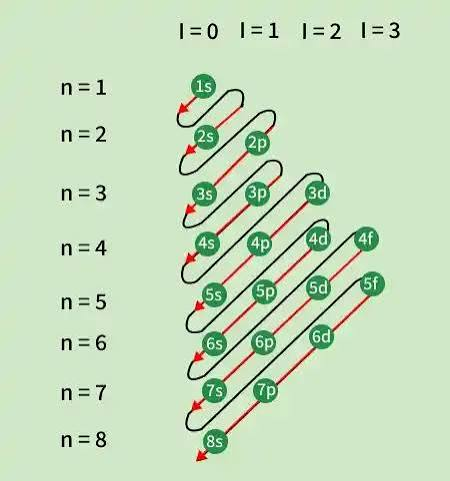
Orbital Notation
uses circles to represent atomic orbitals with a label underneath to indicate sublevel and energy level

Pauli Principle
atomic orbitals can hold only 2 electrons at most and they must have opposite spins

Hund’s Rule
when electrons fill orbitals with the same energy level, such as the p, d, or f, they occupy each orbital with parallel spins before any pairing occurs

Isoelectronic
two or more atoms, ions, or molecules share the exact same number of electrons and the same electron configuration
Valence Electrons
electrons located in the outermost energy level (responsible for bonding)

Atomic Radius
the distance from the center of an atom's nucleus to the outer boundary of its electron shell
Nuclear Charge
the total positive charge of an atomic nucleus

Shielding Effect
the inner-core electrons block or reduce the attractive pull of the positive nucleus on valence electrons
Ionization Energy
the minimum amount of energy required to remove the outermost electron from an isolated gaseous atom to form a positively charged cation
Ionic Size
the distance from the nucleus of an ion to its outer edge

Electronegativity
an atom's tendency to attract shared electrons toward itself when forming a chemical bond
