Organic Chemistry Exam 2
 Call Kai
 Learn
 Practice Test
 Spaced Repetition
 Match
 Flashcards
 Knowt Play
1/16

There's no tags or description
Looks like no tags are added yet.
17 Terms
Electrophilic Addition Reactions
donation of e- pair from the alkene pi bond (acts as nucleophile) to an electrophile center
Markovinkov —> electrophilic atom bonded to alkene C with fewer alkyl substituents
nucelophilic atom completes the addition by donating e- to alkene C with the greater number of alkyl substituents
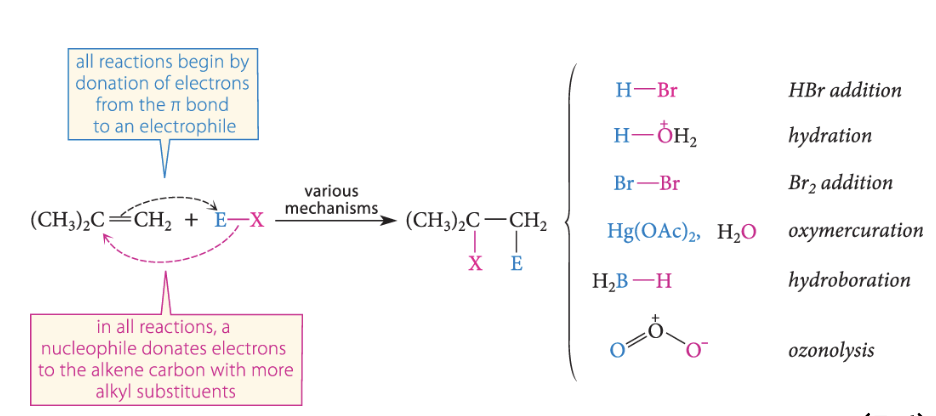
Markovnikov
C-H bond forms on the “least substituted” carbon (fewest carbons directly attached) and the C-X bond forms on the “most substituted” carbon (most carbons directly attached)
Anti-Markovnikov
Anti-Addition
two new bonds to carbon are formed on opposite faces
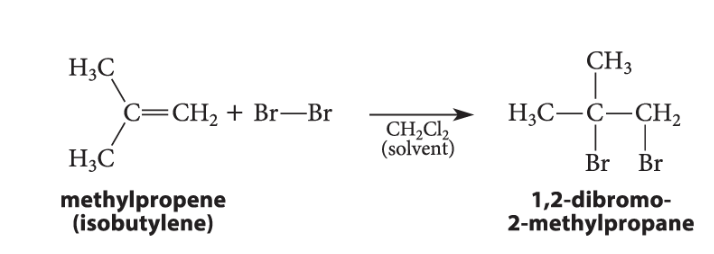
Bromine addition
Oxymercuration

Hydroboration

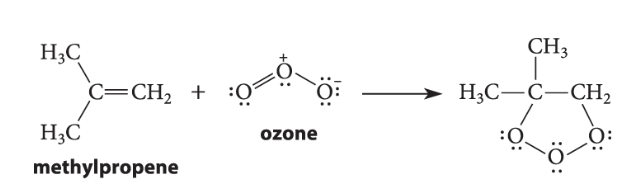
Ozonolysis
Halogenation of Alkene (addition of Bromine or Chlorine)
2 grous added —> halogens to both sides of alkene
No Markovnikov or Anti-Markovinok
intermediate is a 3 membered ring
Anti-addition —> involving 3 membered ring with a halogen —> backside attack

Halohydrin Formation
2 groups added - X to less substituent side + OH or OR to more substituent side
Markovnikov
Anti-Addition

Halohydrin Formation Alternative; Alcohol Instead of H2O

Oxymercuration-Demercuration
H to less substituent, OH to more substituent
Markovnikov
Anti
Intermediate is 3 membered ring - mercurinium ion, no carbocation so no concern of rearrangment
