4.3 Monopolistic Competition
 Call Kai
 Learn
 Practice Test
 Spaced Repetition
 Match
 Flashcards
 Knowt Play
1/7

There's no tags or description
Looks like no tags are added yet.
8 Terms
The characteristics of monopolistic competition
A market in which there are many firms operating, each
producing similar but not identical products, so that there is
some scope for influencing price
Product differentiation
A strategy firms adopt that marks their product as being
different from their competitors
Assumptions of Monopolistic Competition
-There are many producers and many consumers - the industry concentration ratio is low
-Consumers are aware that there are non-price differences among products i.e. there is slight product differentiation so non-price competition is strong and plenty of consumer switching takes place
-Producers have some control over price - they are “price makers” not “price takers” but the price elasticity of demand is higher than it would be under monopoly (the cross-price elasticity is high)
-Barriers to entry and exit are low – this allows producers respond to changing profit signals and means profits are competed away in the long run
Short run Monopolistic Competition curve
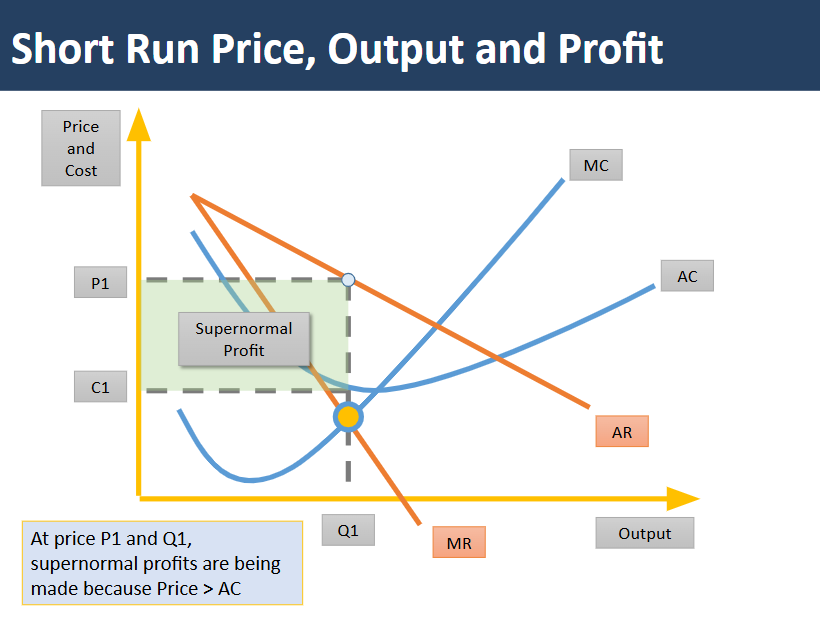
-In the short run, profits competing in monopolistic competitive markets can be at any level
-Unlike monopoly, there are little to no barriers to entry
Long run Monopolistic Competition curve
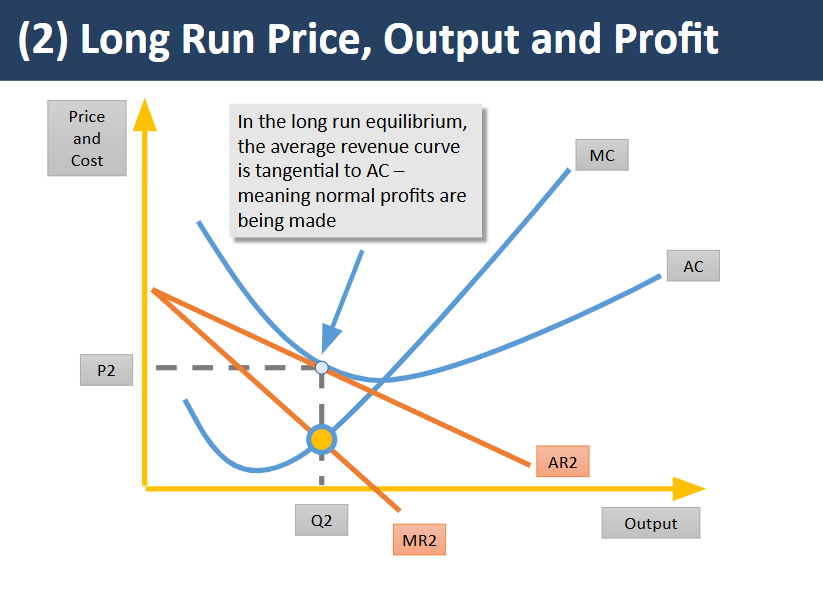
-Short-run supernormal profit attracts new producers with new products and so normal profits only are made in the long run equilibrium i.e. where AR = AC
-As more firms enter the market, the demand curve for any existing firm shifts to the left as consumers opt to buy products offered by new or alternative companies.
-The demand curve continues to move to the left until it is tangential to the AC curve.
-At this point, the monopolistically competitive firm is at its profit-maximising level of output (because MR = MC) but is also making only normal profit (because AR = AC)
Efficiency in Monopolistic Competition
-Prices are above marginal cost – meaning that the equilibrium is not allocatively efficient
-Saturation of the market may lead to businesses being unable to exploit fully economies of scale - causing average cost to be higher – therefore not productively efficient
-Critics of heavy spending on marketing and advertising argue that much of this spending is wasteful and an inefficient use of scarce resources. (x-inefficiency)
-Debate over the social costs of packaging and negative externalities is linked to monopolistic competition
Advantages of Monopolistic competition
—A few barriers to entry for new companies
-Active business environment;
-Customers can obtain a great variety of products and services since the products are differentiated;
-Consumers are informed about goods and services available in the market
Disadvantages of Monopolistic Competition
-An excess waste of resources
-Limited access to economies of scale because of the big number of companies
-Misleading advertising
-Excess of capacity
-A lack of standardised goods
-Inefficient allocation of resources
-Impossibility to obtain abnormal profits