Genetics Vocabulary
 Call Kai
 Learn
 Practice Test
 Spaced Repetition
 Match
 Flashcards
 Knowt Play
1/39

40 Terms
Allele
one of two or more versions of a gene
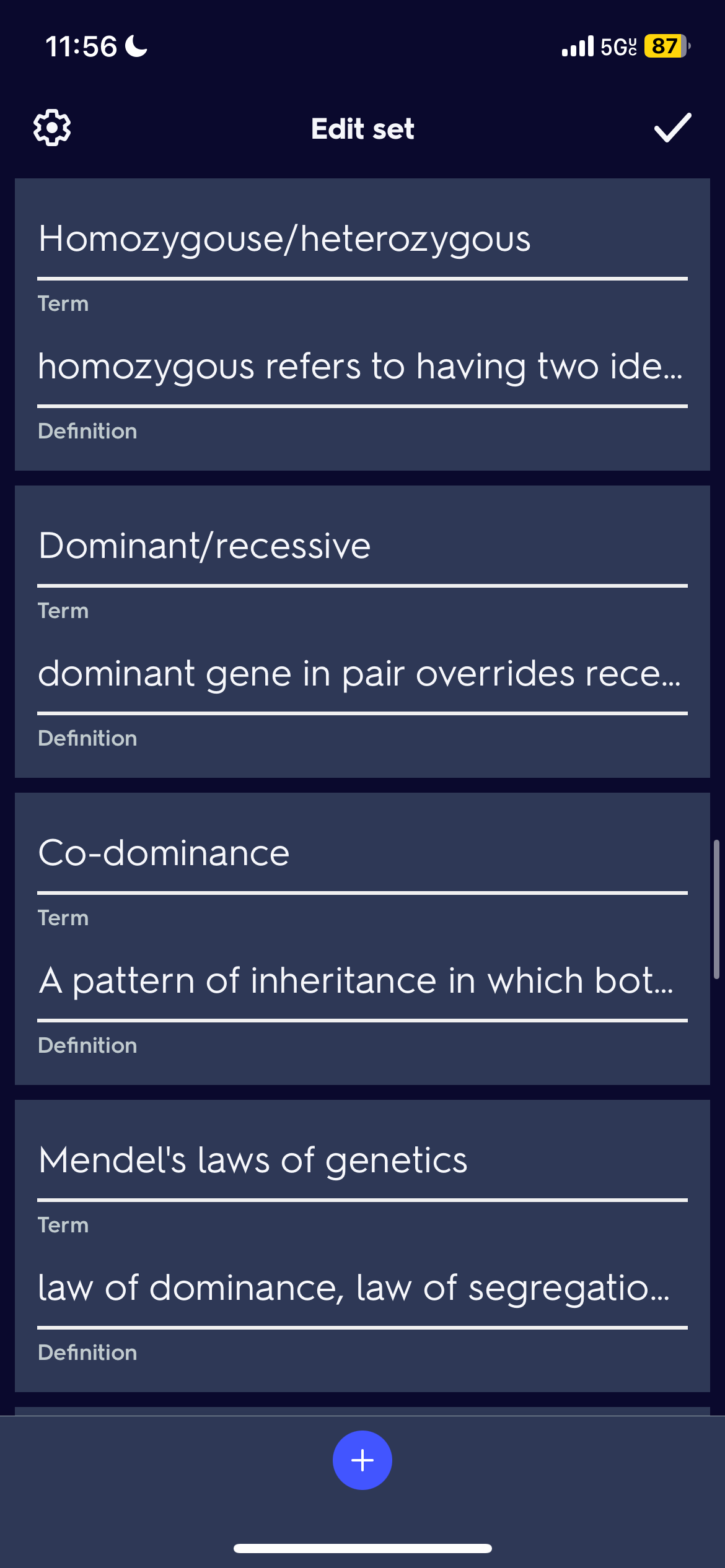
Homozygous/Homozygouse
homozygous refers to having two identical alleles for a particular gene, while heterozygous refers to having two different alleles for the same gene
Dominant/recessive
dominant gene in pair overrides recessive gene Ex. hair color, hearing, dimples, vision
Co-dominance
A pattern of inheritance in which both alleles for a gene are fully expressed
Mendel's laws of genetics
law of dominance, law of segregation, law of independent assortment
Test Cross
breeding that can be used to determine an organism's genotype
Pedigrees
a chart that shows a trait in a family and how it is inherited
Cystic fibrosis
A genetic disorder that is present at birth and affects both the respiratory and digestive systems.
Huntingtons's disease
a genetic disorder that causes nerve degeneration with symptoms that most often appear in midlife
Blood Types
A, B, AB, O
Sex-linked genes
Genes located on the sex chromosomes.
Patterns of Inheritances
Description of how traits are passed on from parents to offspring
Multiple allele traits
traits controlled by a single gene with more than two alleles
Polygenic inheritance
occurs when multiple genes determine the phenotype of a trait
Chromosome theory of inheritance
A basic principle in biology stating that genes are located on chromosomes and that the behavior of chromosomes during meiosis accounts for inheritance patterns.
Genetic testing
The use of methods to determine if someone has a genetic disorder, will develop one, or is a carrier
Hemophilia
An X-linked recessive disorder in which blood fails to clot properly, leading to excessive bleeding if injured.
Red-green color blindness
A common, recessive sex-linked genetic trait.
Law of Independent Assortment
the law that states that genes separate independently of one another in meiosis
Law of Independent Segregation
allele pairs segregate from each other during the production of gametes
Dominant
a trait that is expressed even when only one copy is present
Recessive
a trait only expressed when 2 copies are present
Genetics
The science of heredity
Genotype
an organism's allele pairs
Heredity
the passing on of traits to the next generation
Heterozygous
an organism with 2 different alleles for a trait
Homozygous
an organism with 2 of the same alleles for a trait
Hybrid
offspring resulting from the breeding of 2 different species
Phenotype
observable characteristics that are expressed as a result of an allele pair
Probability
a measurement tool that helps predict the chance of an event occurring
Punnett square
a diagram used in genetics to predict the outcome of a particular cross or breeding combination
Purebred
an organism whose ancestors are all of the same variety
Gene
a segment of DNA that determines a particular trait
Trait
a specific characteristic or feature of an organism
Other terms for 'true breeding'
homozygous, pure bred
Gregor Mendel
Augustinian monk and botanist whose experiments in breeding garden peas led to his eventual recognition as founder of the science of genetics
Why Mendel use peas for his experiments
they were easy to grow, had a short life cycle, and produced many offspring
P/F1/F2 generations
parent, child, child's child
Human Genome Project/gene therapy
The objectives for this ambitious effort included determining the complete sequence of human DNA and identifying all human genes