Suspension System Terminology and Fundamentals
 Call Kai
 Learn
 Practice Test
 Spaced Repetition
 Match
 Flashcards
 Knowt Play
1/33

Earn XP
Description and Tags
Comprehensive vocabulary flashcards covering automotive suspension system components, kinematics, alignment geometry, and dynamic principles from the lecture notes.
34 Terms
Suspension system
The springs, dampers, links, and joints connecting the wheels to the chassis. It supports the vehicle, controls wheel movement, and helps maintain tire contact with the road.
Sprung mass
The mass supported by the suspension springs, including most of the chassis, driver, and battery.
Unsprung mass
The mass that moves directly with the wheels, including tires, wheels, hubs, and portions of the suspension links. Less of this mass generally helps wheels follow uneven roads.
Control arm / A-arm
A suspension link that guides wheel movement relative to the chassis. A triangular ____ has two inboard attachment points and one outboard attachment point.

Double-wishbone suspension
A suspension arrangement with upper and lower A-arms. Their geometry controls how wheel alignment changes as the wheel moves. The lower arm typically carries most of the vertical load through the spring and damper, while the upper arm controls camber and caster angles as the wheel moves

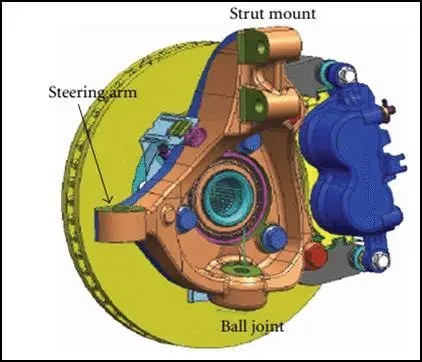
Upright / Steering knuckle
The structural component that carries the wheel bearing and connects the wheel assembly to the suspension links. On a steering wheel, it turns about the steering axis. the central link between the wheel hub, suspension, and steering systems, holding the wheel in place while allowing it to rotate, steer, and absorb road impacts
Wheel hub
The rotating component to which the wheel attaches. Bearings allow it to rotate relative to the upright.
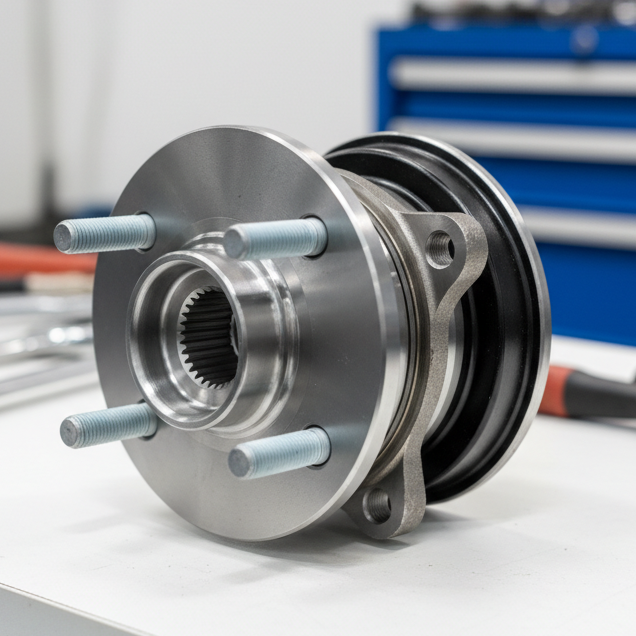
Wheel bearing
A component that supports wheel loads while allowing the hub to rotate with low friction.

Ball joint
A joint that allows angular movement in multiple directions, often connecting a control arm to the upright.

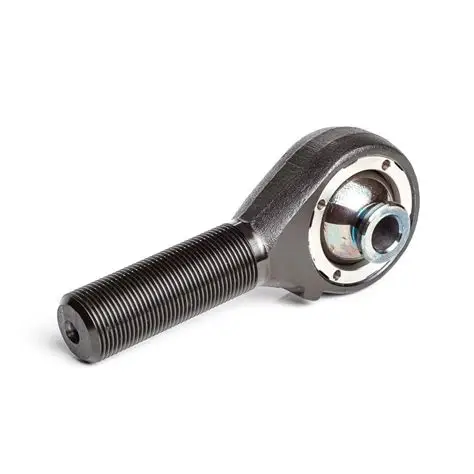
Rod end / Heim joint
A spherical bearing with a threaded shank used at the end of a link. It permits angular movement and often allows link-length adjustment.
Bushing
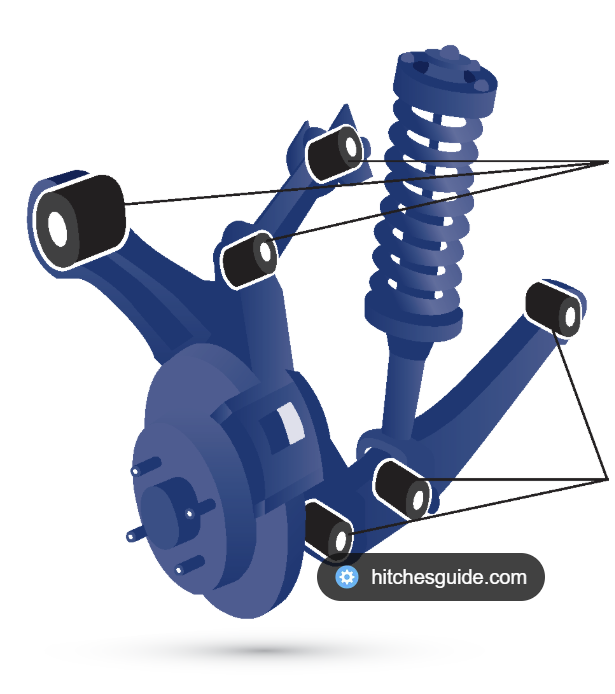
A sleeve or compliant insert at a suspension pivot. It permits movement and can isolate vibration, but its flexibility may allow alignment changes under load.
Spring rate
The change in spring force per unit compression, usually expressed in N/mm. A higher spring rate means a stiffer spring.
Damper / Shock absorber
A device that resists suspension motion and dissipates energy, usually through fluid flow. It controls oscillation after bumps.

Coilover
A unit with a coil spring mounted around a damper. It combines spring support and motion control in one assembly.
Compression / Bump travel
Suspension movement in which the wheel moves upward relative to the chassis.
Rebound / Droop travel
Suspension movement in which the wheel moves downward relative to the chassis.
Bump stop
suspension component that limits suspension travel to prevent bottoming out, protect springs and shocks, and stop tires from contacting the body. It acts as a final cushion during compression, commonly made from rubber or polyurethane, and is used in cars, trucks, SUVs, and off‑road vehicles.

Ride height
The vertical distance between a specified chassis reference point and the ground. It affects ground clearance and suspension geometry.
Camber
The wheel’s tilt when viewed from the front. Negative camber means the top of the wheel leans inward toward the vehicle.
Caster
The steering axis’s tilt when viewed from the side. Positive caster means the top of the axis tilts rearward and generally helps steering return toward center.
Toe
The direction the wheels point when viewed from above. Toe-in means their front edges point toward each other; toe-out means they point away.
Steering axis inclination
The steering axis’s inward tilt when viewed from the front. Together with wheel geometry, it affects steering effort and scrub radius.
Scrub radius
The lateral distance at ground level between the steering axis intersection and the center of the tire contact patch. It affects steering reactions to braking and road forces.
Tie rod
A link that transmits steering motion to the upright. Changing its effective length typically adjusts toe.
Bump steer
A change in toe as the suspension moves through bump or droop, even when the steering input stays fixed.
Ackermann steering geometry
Steering geometry that makes the inside front wheel turn more sharply than the outside wheel, helping both follow their different cornering paths.
Motion ratio
The relationship between spring or damper travel and wheel travel. Always state the convention—for example, spring travel divided by wheel travel.
Wheel rate
The effective spring stiffness measured at the wheel. For a locally constant motion ratio defined as spring travel/wheel travel, wheel rate is approximately spring rate multiplied by motion ratio squared.
Roll center
A geometric reference point used to understand how lateral forces pass through the suspension and how the body rolls. Its location can change with suspension travel.
Anti-roll bar
A torsion spring connecting the left and right suspension. It resists unequal wheel movement and increases resistance to body roll.
Load transfer
The redistribution of tire normal loads during acceleration, braking, or cornering. For example, cornering increases load on the outside tires and reduces it on the inside tires.
Contact patch
The area where a tire touches the road. Forces for braking, acceleration, and cornering act through this region.
Suspension hardpoints
The locations of suspension attachment points on the chassis and upright. Their positions determine wheel motion and alignment changes.
Load path
The route a force follows through the structure. For suspension design, this often runs from the tire through the hub, upright, links, and chassis mounts.