06 cohesion in female and male - präsi
 Call Kai
 Learn
 Practice Test
 Spaced Repetition
 Match
 Flashcards
 Knowt Play
1/14

There's no tags or description
Looks like no tags are added yet.
15 Terms
[A]How is cohesion defined in sport psychology according to Carron, Brawley, & Widmeyer (1998)?
Cohesion is defined as "a dynamic process that is reflected in the tendency for a group to stick together and remain united in the pursuit of its instrumental objectives and/or for the satisfaction of member affective needs"
[A] What is the difference between Task Cohesion and Social Cohesion?
Task Cohesion: How united team members are in working towards common performance goals (e.g., players cooperating and coordinating actions on the field)
Social Cohesion: How united team members are through interpersonal relationships and social connections (e.g., players enjoying spending time together outside of sport)
[A] Why is cohesion considered one of the most important group variables in sport teams, and what key outcomes does it influence?
Performance: Moderate-to-large positive relationship with team performance (teams with higher cohesion perform better)
Athlete Retention: Higher cohesion increases athletes' willingness to remain part of a team
Anxiety & Collective Efficacy: Associated with less debilitating anxiety symptoms and a greater sense of collective efficacy
[A] According to coaches' perceptions (Eys et al., 2015), how do female and male sport teams differ regarding overall importance of cohesion and social cohesion?
Overall Importance: Female teams need more cohesion to win, whereas male teams can fight/conflict and still win
Type of Cohesion: Social cohesion is essential for female teams, whereas male teams require less social cohesion to function effectively
[B] How does the direction of the cohesion-performance relationship and temporal development differ between female and male teams?
Relationship direction: male teams gain cohesion from success (Success → cohesion), whereas female teams gain success from cohesion (Cohesion → Success)
Temporal Differences: female teams take longer to reach cohesiveness, whereas male teams gain cohesion quickly
[A] How do female and male sport teams differ across role differentiation, subgroup formation, approach to conflict, and style of play?
Role Differentiation & Status: Males establish a quick hierarchy; females are sensitive to new teammates
Clique Formation: Subgroups harm cohesion; female teams are more prone to subgroup formation
Approach to Conflict: Male teams openly display and quickly resolve conflict; female teams keep conflict quiet/covert
Style of Play: Female teams display more dependency; male teams can be carried by one individual
(Keep in mind: experiences from individual coaches may not apply to all teams)
[A] How should coaches manage social cohesion, early season competition, and conflict differently for male and female teams?
Developing Social Cohesion: Females naturally benefit from getting together outside sport; males need more encouragement to socialize outside sport
Early Season Competition: Male teams need early competitive success; female teams need an early team bonding moment
Group Structure & Conflict: Coaches must mediate between subgroups, communicate between bench and starting positions, and ensure personal conflict is left "at the door"
(Keep in mind: experiences from individual coaches may not apply to all teams)
[A] What was the rationale behind Eys et al. (2015), and what qualitative research methodology was used?
Rationale: Carron et al. (2002) found cohesion was more strongly related to performance in female teams; Eys et al. explored coaches' experiences to understand why8.
Methodology: Semistructured interviews analyzed via an inductive approach (specific → general), breaking data into 233 meaning units coded independently by two researchers

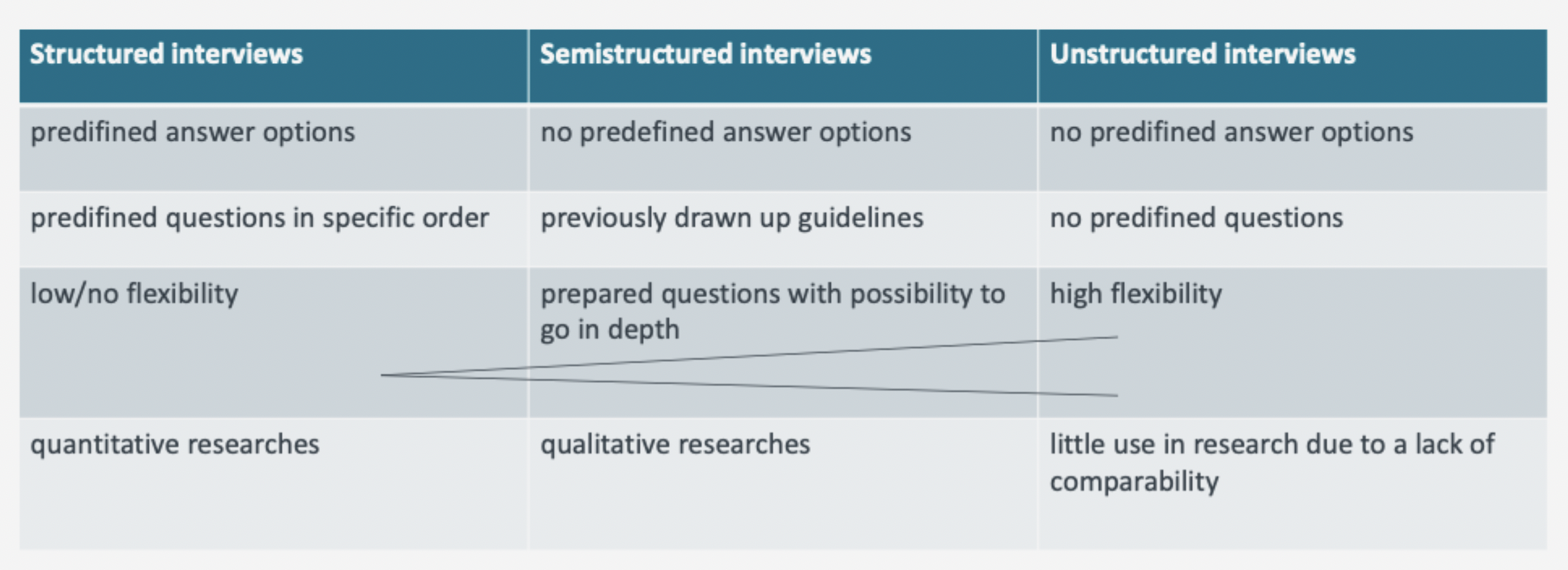
[A] Compare structured, semistructured, and unstructured interviews as presented in the lecture
Structured: Predefined answer options, predefined question order, low/no flexibility, quantitative research
Semistructured: No predefined answer options, drawn-up guidelines, high flexibility to explore topics in depth, qualitative research
Unstructured: No predefined answer options or questions, high flexibility, little research use due to lack of comparability
[A] What key limitations of the Eys et al. (2015) study were highlighted in the presentation?
Restricted Viewpoints: Relies solely on coach perceptions (investigated no athletes or parents)
Social Norms: Problematises female sport involvement without questioning underlying social constructions of gender norms
Generalisability: Experiences of individual coaches are qualitative and may not apply to all teams
[B] What are the four main reasons to study cohesion in sport psychology?
It is important for understanding team dynamics.
Its relationship with performance is complex.
There are clear differences between male and female teams.
It provides practical relevance for coaches.
[B] In the qualitative data collection process, what three types of probes were used alongside open-ended questions?
Questions about details: Asking for a more detailed explanation of a specific experience.
Clarifications: Clarifying ambiguous comments made by coaches.
Elaboration probes: Encouraging coaches to continue discussing a particular point.
[A] Into what three main categories were the study's results divided, and what three overarching findings apply across all teams?
3 Categories: (1) Nature of cohesion, (2) Antecedents of cohesion, (3) Management of cohesion.
3 Overarching Findings:
There is a belief in the importance of cohesion regardless of gender.
The level of competition has an impact on cohesion.
Cohesion depends on individuals and context as well.
[A] How do female and male sport teams differ across the four dimensions of the "Nature of Cohesion"?
Overall Importance: Female teams need more cohesion to win; male teams can fight/conflict and still win.
Type of Cohesion: Social cohesion is essential in female teams; less social cohesion is needed in male teams.
Relationship Direction: Males gain cohesion from success (Success → Cohesion); females gain success from cohesion (Cohesion → Success).
Temporal Differences: Female teams take longer to reach cohesiveness; male teams are quick to gain cohesion.
[B] What are the three primary conclusions of the cohesion study on gender differences?
There are gender differences in cohesion dynamics and management.
Cohesion is important regardless of gender for overall team success.
Further research is needed regarding role differences, status, subgroup development, and conflict handling