OIANs exam 4

0.0(0)
Studied by 0 people
call kaiCall Kai
learnLearn
examPractice Test
spaced repetitionSpaced Repetition
heart puzzleMatch
flashcardsFlashcards
GameKnowt Play
Card Sorting

1/24

encourage image

There's no tags or description

Looks like no tags are added yet.

25 Terms

1
New cards

deep back muscles

extend from the pelvis to the skull

  • innervated by segmental branches of the posterior/dorsal rami of spinal nerves


2
New cards

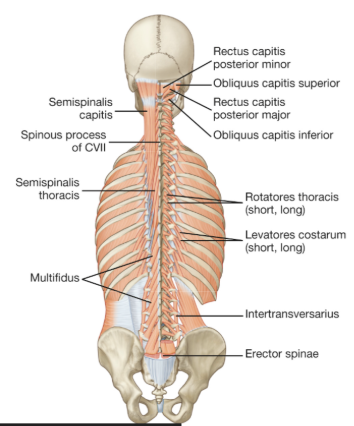
muscles groups of deep back muscles

  • Muscle groups include:

    • Spinotransversales: spinous to transverse process

    • Erector spinae

    • Transversospinales: transverse to spinous process

    • Segmental: muscles that go from segment to segment

    • Suboccipital muscles


  • Muscle groups are named for the orientation of their origins and insertions

<ul><li><p><span style="background-color: transparent;">Muscle groups include:</span></p><ul><li><p><span style="background-color: transparent;">Spinotransversales: spinous to transverse process </span></p></li><li><p><span style="background-color: transparent;">Erector spinae</span></p></li><li><p><span style="background-color: transparent;">Transversospinales: transverse to spinous process </span></p></li><li><p><span style="background-color: transparent;">Segmental: muscles that go from segment to segment </span></p></li><li><p><span style="background-color: transparent;">Suboccipital muscles</span></p></li></ul></li></ul><p></p><ul><li><p><span style="background-color: transparent;">Muscle groups are named for the orientation of their origins and insertions</span></p></li></ul><p></p>
3
New cards

spinotransversales group

include:

  • Splenius capitis (head)

  • Splenius cervicis


4
New cards

splenius capitis

O: lower ½ ligamentum nuchae and spinous processes of C7-T4
I: mastoid process, lateral 1/3 superior nuchal line
A:

  • bilateral: extends the head and neck

  • unilateral: rotate head ipsilaterally

N: posterior rami, middle cervical nerves


<p>O: lower ½ ligamentum nuchae and spinous processes of C7-T4<br>I: mastoid process, lateral 1/3 superior nuchal line<br>A:</p><ul><li><p>bilateral: extends the head and neck </p></li><li><p>unilateral: rotate head ipsilaterally </p></li></ul><p>N: posterior rami, middle cervical nerves </p><p></p>
5
New cards

splenius cervicis

O: spinous processes T3-T6
I: transverse processes C1-C3
A:

  • bilateral: extends neck

  • unilateral: laterally flexes and rotates the neck ipsilaterally

N: posterior rami lower cervical nerves


<p>O: spinous processes T3-T6<br>I: transverse processes C1-C3<br>A:</p><ul><li><p>bilateral: extends neck </p></li><li><p>unilateral: laterally flexes and rotates the neck ipsilaterally </p></li></ul><p>N: posterior rami lower cervical nerves </p><p></p>
6
New cards

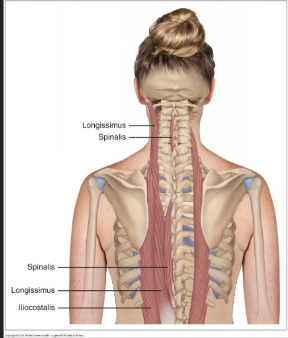
erector spinae

Intrinsic back muscles

  • Posterior and lateral to the vertebral column

  • Positioned between the spinous processes medially and the angles of the ribs laterally

  • Three vertical columns:

1) Iliocostalis (I)

2) Longissimus (love)

3) Spinalis (spaghetti)

  • Further subdivided regionally, depending on where the muscles attach superiorly

    • Lumborum

    • Thoracis

    • Cervicis

    • Capitus


7
New cards

erector spinae muscles

  • Iliocostalis lumborum

  • Iliocostalis thoracis

  • Iliocostalis cervicis

  • Longissimus thoracis

  • Longissimus cervicis

  • Longissimus capitis

  • Spinalis thoracis

  • Spinalis cervicis

  • Spinalis capitis


8
New cards

general origins and insertions of erector spinae

Origins inferior, insertions superior

  • Iliocostalis:

(O) ilium, spinous processes and ribs → (I) ribs and transverse processes in cervical spine

  • Longissimus:

    • (O) Transverse processes → (I) transverse processes

  • Spinalis:

    • (O) Spinous processes → (I) spinous processes

    • (O&I) Spinalis capitis usually blends with semispinalis capitis


<p><span style="background-color: transparent;">Origins inferior, insertions superior</span></p><ul><li><p><span style="background-color: transparent;"><strong>Iliocostalis:</strong></span></p></li></ul><p>(O) ilium, spinous processes and ribs → (I) ribs and transverse processes in cervical spine</p><ul><li><p><span style="background-color: transparent;"><strong>Longissimus</strong>:</span></p><ul><li><p><span style="background-color: transparent;">(O) Transverse processes </span>→<span style="background-color: transparent;"> (I) transverse processes</span></p></li></ul></li><li><p><span style="background-color: transparent;"><strong>Spinalis</strong>:</span></p><ul><li><p><span style="background-color: transparent;">(O) Spinous processes </span>→<span style="background-color: transparent;"> (I) spinous processes</span></p></li><li><p><span style="background-color: transparent;">(O&amp;I) Spinalis capitis usually blends with semispinalis capitis</span></p></li></ul></li></ul><p></p>
9
New cards

actions of erector spinae group

As a group these muscles are the primary extensors of the vertebral column and head

  • Acting Bilaterally:

    •  Extend the vertebral column from a flexed position

    • Control vertebral column flexion by contracting and relaxing in a coordinated fashion

  • Acting Unilaterally:

    • Laterally flex the vertebral column

    • Ipsilateral rotation of the head and neck (cervical and capitis attachments only)

  • All muscles innervated by posterior rami

<p><span style="background-color: transparent;">As a group these muscles are the <u>primary extensors</u> of the vertebral column and head</span></p><ul><li><p><span style="background-color: transparent;">Acting Bilaterally:</span></p><ul><li><p><span style="background-color: transparent;">&nbsp;Extend the vertebral column from a flexed position</span></p></li><li><p><span style="background-color: transparent;">Control vertebral column flexion by contracting and relaxing in a coordinated fashion</span></p></li></ul></li><li><p><span style="background-color: transparent;">Acting Unilaterally:</span></p><ul><li><p><span style="background-color: transparent;">Laterally flex the vertebral column</span></p></li><li><p><span style="background-color: transparent;">Ipsilateral rotation of the head and neck (cervical and capitis attachments only)</span></p></li></ul></li><li><p><span style="background-color: transparent;">All muscles innervated by posterior rami</span></p></li></ul><p></p>
10
New cards

transversospinalis group

This muscle group runs obliquely upward and medially from the transverse processes to the spinous processes filling the groove between these two vertebral projections

  • Deep to the erector spinae

  • Three major groups

1) Semispinalis

2) Multifidus

3) Rotatores

  • Further subdivided regionally, depending on where the muscles attach superiorly

    • Lumborum

    • Thoracis

    • Cervicis

    • Capitis 


<p><span style="background-color: transparent;">This muscle group runs obliquely upward and medially from the transverse processes to the spinous processes filling the groove between these two vertebral projections</span></p><ul><li><p><span style="background-color: transparent;"><u>Deep</u> to the erector spinae</span></p></li></ul><ul><li><p><span style="background-color: transparent;">Three major groups</span></p></li></ul><p><span style="background-color: transparent;">1) Semispinalis</span></p><p><span style="background-color: transparent;">2) Multifidus</span></p><p><span style="background-color: transparent;">3) Rotatores</span></p><ul><li><p><span style="background-color: transparent;">Further subdivided regionally, depending on where the muscles attach superiorly</span></p><ul><li><p><span style="background-color: transparent;">Lumborum</span></p></li><li><p><span style="background-color: transparent;">Thoracis</span></p></li><li><p><span style="background-color: transparent;">Cervicis</span></p></li><li><p><span style="background-color: transparent;">Capitis&nbsp;</span><br></p></li></ul></li></ul><p></p>
11
New cards

transversospinalis muscles

  • Semispinalis thoracis

  • Semispinalis cervicis

  • Semispinalis capitis

  • Multifidus


  • Rotatores lumborum

  • Rotatores thoracis

  • Rotatores cervicis


12
New cards

transversospinalis: semispinalis thoracis and cervicis

  • Most superficial group

  • Begins in the lower thoracic region

O:

  • thoracis: transverse process of T6-T10

  • cervicis: transverse processes of T1-T6

I:

  • thoracic: spinous processes of C6-T4

  • cervicis: spinous processes of C2-C5

A:

  • bilateral: extends the vertebral column

  • unilateral: rotates the vertebral column to opposite side

I: posterior rami


<ul><li><p><span style="background-color: transparent;">Most superficial group</span></p></li><li><p><span style="background-color: transparent;">Begins in the lower thoracic region</span></p></li></ul><p>O:</p><ul><li><p>thoracis: transverse process of T6-T10</p></li><li><p>cervicis: transverse processes of T1-T6</p></li></ul><p>I: </p><ul><li><p>thoracic: spinous processes of C6-T4 </p></li><li><p>cervicis: spinous processes of C2-C5</p></li></ul><p>A: </p><ul><li><p>bilateral: extends the vertebral column </p></li><li><p>unilateral: rotates the vertebral column to opposite side </p></li></ul><p>I: posterior rami </p><p></p>
13
New cards

transversospinalis: semispinalis capitis

O: transverse processes of C7-T7 and articular processes of C4-C6
I: between the superior and inferior nuchal lines on the occiput

A:

  • bilateral: extends the head

  • unilateral: extends and upward rotates chin to ipsilateral side

I: posterior rami


<p>O: transverse processes of C7-T7 and articular processes of C4-C6<br>I: between the superior and inferior nuchal lines on the occiput </p><p>A:</p><ul><li><p>bilateral: extends the head </p></li><li><p>unilateral: extends and upward rotates chin to ipsilateral side</p></li></ul><p>I: posterior rami </p><p></p>
14
New cards

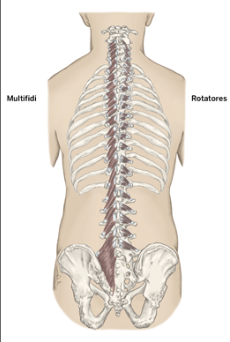
transversospinalis: multifidus

  • Deep to semispinalis

  • Span the length of the vertebral column, crossing between 2-4 vertebral levels

  • most prominent in the lumbar region

O: origins of erector spinae, mammillary processes of lumbar vertebrae, TP of thoracic and articular processes of cervical vertebrae

I: base of spinous processes

A:

  • bilateral: extends the vertebral column

  • unilateral: rotates the vertebral column to opposite side

I: posterior rami

<ul><li><p><span style="background-color: transparent;">Deep to semispinalis</span></p></li><li><p><span style="background-color: transparent;">Span the length of the vertebral column, crossing between 2-4 vertebral levels</span></p></li><li><p><span style="background-color: transparent;">most prominent in the lumbar region</span></p></li></ul><p>O: origins of erector spinae, mammillary processes of lumbar vertebrae, TP of thoracic and articular processes of cervical vertebrae </p><p>I: base of spinous processes </p><p>A: </p><ul><li><p>bilateral: extends the vertebral column </p></li><li><p>unilateral: rotates the vertebral column to opposite side </p></li></ul><p>I: posterior rami </p><p></p>
15
New cards

transversospinalis: rotatores

  • Deepest of the transversospinalis group

  • Most prominent in the thoracic region

  • Long rotatores cross two vertebrae, short cross one vertebrae

O: mammillary processes (L1), TP (T), articular processes (C)
I: spinous processes
A:

  • bilateral: extends the vertebral column

  • unilateral: rotates the vertebral column to opposite side

N: posterior rami


<ul><li><p><span style="background-color: transparent;">Deepest of the transversospinalis group</span></p></li><li><p><span style="background-color: transparent;">Most prominent in the thoracic region</span></p></li><li><p><span style="background-color: transparent;">Long rotatores cross two vertebrae, short cross one vertebrae</span></p></li></ul><p>O: mammillary processes (L1), TP (T), articular processes (C)<br>I: spinous processes <br>A:</p><ul><li><p>bilateral: extends the vertebral column</p></li><li><p>unilateral: rotates the vertebral column to opposite side  </p></li></ul><p>N: posterior rami </p><p></p>
16
New cards

segmental muscles

  • Levator costarum (false muscle)

  • “True” segmental muscles

    • Interspinales

    • Intertransversarii

  • Deeply placed in the back

  • Innervated by posterior rami


<ul><li><p><span style="background-color: transparent;">Levator costarum (false muscle)</span></p></li><li><p><span style="background-color: transparent;">“True” segmental muscles</span></p><ul><li><p><span style="background-color: transparent;">Interspinales</span></p></li><li><p><span style="background-color: transparent;">Intertransversarii</span></p></li></ul></li><li><p><span style="background-color: transparent;">Deeply placed in the back</span></p></li><li><p><span style="background-color: transparent;">Innervated by posterior rami</span></p></li></ul><p></p>
17
New cards

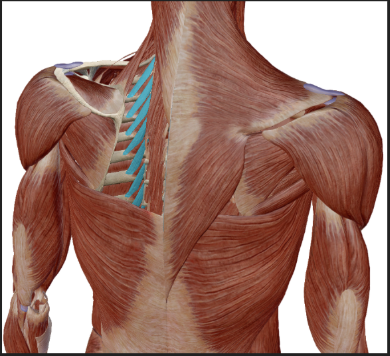
levator costarum

O: transverse process C7-T11
I: rib below the vertebrae (origin) near the tubercle
A: elevates ribs
N: posterior rami
<p>O: transverse process C7-T11<br>I: rib below the vertebrae (origin) near the tubercle <br>A: elevates ribs <br>N: posterior rami </p>
18
New cards

interspinales

O: spinous processes
I: spinous process above
A: stabilize adjoining vertebrae during movement
N: posterior rami

<p>O: spinous processes <br>I: spinous process above <br>A: <span>stabilize adjoining vertebrae during movement</span><br>N: posterior rami</p>
19
New cards

intertransversarii

O: transverse process
I: transverse process above
A: stabilize adjoining vertebrae during movement
N: posterior rami

<p>O: transverse process<br>I: transverse process above <br>A: <span>stabilize adjoining vertebrae during movement</span><br>N: posterior rami</p>
20
New cards

suboccipital muscle group

A small group of muscles in the upper cervical region

  • Defined by their location to the occiput

  • All innervated by the posterior ramus of the first cervical nerve (suboccipital nerve)


<p><span style="background-color: transparent;">A small group of muscles in the upper cervical region</span></p><ul><li><p><span style="background-color: transparent;">Defined by their location to the occiput</span></p></li><li><p><span style="background-color: transparent;">All innervated by the posterior ramus of the first cervical nerve (suboccipital nerve)</span></p></li></ul><p></p>
21
New cards

suboccipital muscles

  • Muscles:

    • Rectus capitis posterior major

    • Rectus capitis posterior minor

    • Obliquus capitis inferior

    • Obliquus capitis superior

  • Main function of the suboccipital muscle group is to maintain posture

  • Also produce movements of the head.

  • bilateral


<ul><li><p><span style="background-color: transparent;">Muscles:</span></p><ul><li><p><span style="background-color: transparent;">Rectus capitis posterior major</span></p></li><li><p><span style="background-color: transparent;">Rectus capitis posterior minor</span></p></li><li><p><span style="background-color: transparent;">Obliquus capitis inferior</span></p></li><li><p><span style="background-color: transparent;">Obliquus capitis superior</span></p></li></ul></li></ul><ul><li><p><span style="background-color: transparent;">Main function of the suboccipital muscle group is to maintain posture</span></p></li><li><p><span style="background-color: transparent;">Also produce movements of the head.</span></p></li><li><p><span style="background-color: transparent;">bilateral </span></p></li></ul><p></p>
22
New cards

rectus capitis posterior major

O: spinous process of C2 (axis)
I: lateral surface of the occipital bone, below inferior nuchal line
A:

  • bilateral: extends the head

  • unilateral: ipsilateral rotation of head

N: posterior ramus C1


<p>O: spinous process of C2 (axis)<br>I: lateral surface of the occipital bone, below inferior nuchal line <br>A:</p><ul><li><p>bilateral: extends the head </p></li><li><p>unilateral: ipsilateral rotation of head </p></li></ul><p>N: posterior ramus C1</p><p></p>
23
New cards

rectus capitis posterior minor

O: posterior tubercle of C1 (atlas)

I: medial surface of the occipital bone, below inferior nuchal line
A: extends the head

N: posterior ramus C1

<p>O: posterior tubercle of C1 (atlas)</p><p>I: medial surface of the occipital bone, below inferior nuchal line <br>A: extends the head </p><p>N: posterior ramus C1<br></p>
24
New cards

obliquus capitis superior

O: transverse process of C1 (atlas)
I: between superior and inferior nuchal lines on the occiput
A:

  • bilateral: extends head

  • unilateral lateral flexion of head ipsilaterally

N: posterior ramus C1


<p>O: transverse process of C1 (atlas)<br>I: between superior and inferior nuchal lines on the occiput <br>A: </p><ul><li><p>bilateral: extends head </p></li><li><p>unilateral lateral flexion of head ipsilaterally </p></li></ul><p>N: posterior ramus C1</p><p></p>
25
New cards

obliquus capitis inferior

O: spinous process of C2 (axis)
I: transverse process C1
A: ipsilateral rotation of head

N: posterior ramus C1

<p>O: spinous process of C2 (axis) <br>I: transverse process C1<br>A: ipsilateral rotation of head </p><p>N: posterior ramus C1<br></p>