Chapter 9.5: Between the Extremes: Electronegativity and Bond Polarity
 Call Kai
 Learn
 Practice Test
 Spaced Repetition
 Match
 Flashcards
 Knowt Play
1/10

11 Terms

Electronegativity (EN)
The relative ability of a bonded atom to attract shared electrons
Inversely related to atomic size due to greater nuclear attraction
Can be compared in 0.5 increments across period two, starting with Li (1.0) to F (4.0)
Hydrogen (H) has a value of 2.1
Halogens descend: F (4.0), Cl (3.0), Br (2.8), and I (2.5)
4.0
What is the EN value of F?
3.0
What is the EN value of Cl?
2.8
What is the EN value of Br?
2.5
What is the EN value of I?
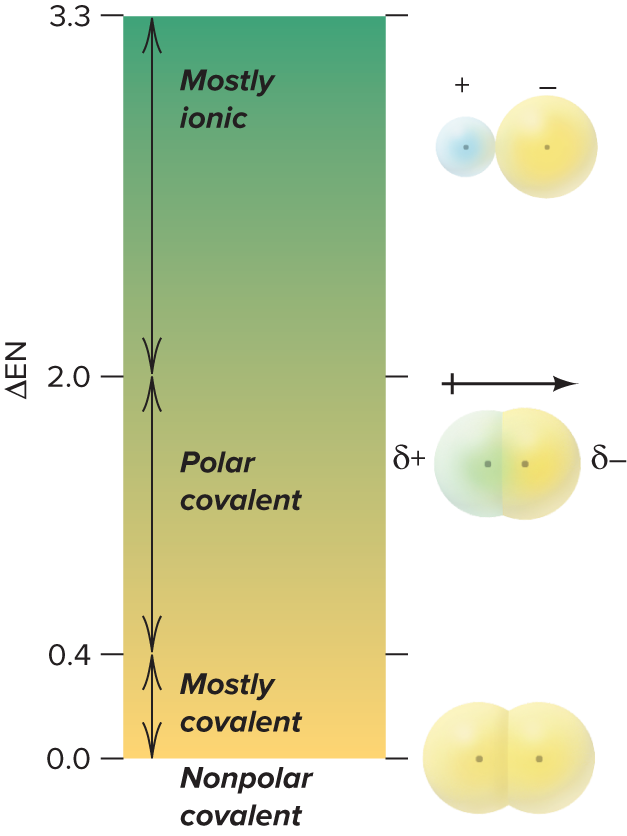
Electronegativity difference (ΔEN)
The difference between the electronegativity values of the bonded atoms
Greater levels equate to a higher partial ionic character due to charge separation
Nonpolar covalent bonds have a value of 0.0
Mostly covalent bonds have a value from 0.0 to 0.4
Polar covalent bonds have a value from 0.4 to 2.0
Mostly ionic bonds have a value from 2.0 to 3.3

Nonpolar covalent bond
The equal sharing of electrons in a covalent bond with an electronegativity difference of 0.0
Seen with identical atoms or atoms with close electronegativity values
Mostly covalent bond
The roughly equal sharing of electrons in a covalent bond with an electronegativity difference between 0.0 and 0.4

Polar covalent bond
The unequal sharing of electrons in a covalent bond with an electronegativity difference between 0.4 and 2.0
Denoted by a polar arrow pointing towards the partially negative pole, or with symbols δ+ and δ-
Mostly ionic bond
The unequal sharing of electrons in a bond with an electronegativity difference greater than 2.0
Range is capped at 3.3, between Cs (0.7) and F (4.0)

Percent ionic character
A number quantifying the level of sharing between atoms, increasing with electronegativity difference
A value at 50% divides ionic and covalent bonds
A value of 100% is not possible due to some electron sharing always occurring