Bio Gr 11 Quiz 1- Viruses, Prokaryotes, and the Theory of Endosymbiosis
 Call Kai
 Learn
 Practice Test
 Spaced Repetition
 Match
 Flashcards
 Knowt Play
1/53

There's no tags or description
Looks like no tags are added yet.
54 Terms
Who is the “Father of Taxonomy”?
Carolus Linnaeus
List the taxonomic groups from broadest to most specific in the taxonomic hierarchy.
Domain
Kingdom
Phylum
Class
Order
Family
Genus
Species
What are the rules of binomial nomenclature?
The first word is the genus, the second word is the species. The genus must be capitalized and the species must not. The entire name must either be italicized or underlined.
What is a virus?
Non-living infectious particles without any cellular structure and are obligate parasites.
Describe the structure of a virus.
Has either RNA or DNA. Has a capsid (protective protein coating and helps them to attach to host cells). Animal viruses often have an envelope (derived from the host cell as extra protection).
What are 4 ways in which viruses can be classified?
Structure
Genome type
Host type
Transmission mechanics
Differences of the lytic cycle and the lysogenic cycle.
The lytic cycle has the viruses replicate and destroy the host cell immediately after entry whereas the lysogenic cycle has the viruses lay dormant while the cells naturally divide and make more copies of the virus and then once triggered the viruses replicate and burst out of the host cells at once.
Similarities between the lysic and lysogenic cycles
Both the cycles attach and enter the host cell similarly with the purpose of replication. The lysogenic cycle can also switch back to the lytic cycle if triggered.
What is a viroid? What type of organism does a viroid affect?
Small infectious pieces of RNA that interfere with normal RNA functions in their host cells in plants. These pieces are smaller than a virus and lack a capsid.
What is a prion? What type of organism/system in the body do prions affect?
They are proteins that change from their normal form to harmful particles that have the same chemical composition but different shape. It causes several deadly brain diseases.
What are some examples of prion diseases?
Bovine spongiform encephalopathy (BSE- “Mad Cow”)
Creutzfeldt-Jakob Disease (CJD)
Kuru
What is a vaccine?
They are materials that are injected into the body to help strengthen the body’s adaptive immune system but exposing it to weakened or dead versions of viruses.
How does a vaccine provide immunity?
They trigger the body’s adaptive immunity without causing harm.
Live attenuated vaccine
A weakened version of the pathogen is injected into the body.
Inactive vaccine
A dead versions of the pathogen is injected into the body.
Subunit vaccine
Only the antigen of the pathogen is injected into the body.
DNA vaccine
Only the isolated gene for the antigen is injected into the body.
Who discovered the first vaccine? What was the first vaccine created from? Created for?
Edward Jenner. Cowpox. Smallpox.
What is herd immunity?
When a large enough amount of the population is immune to a disease making it difficult to spread.
What is the one virus we discussed that infects plants?
Tobacco Mosaic Virus (TMV)
What is the one virus we discussed that infects bacteria?
T7 virus
What was the first virus to be discovered?
Tobacco Mosaic Virus (TMV)
Why is the association of rabies with dogs incorrect?
Many other mammals also can obtain and spread rabies such as bats and rodents.
HIV
Human Immunodeficiency Virus causes people to lose the ability to fight off any diseases over time and it can permanently incorporate its genome to its host, meaning it can last a lifetime.
What is a common name for papillomas?
Warts.
Why is Zika virus a concern for pregnant woman?
It can cause microcephaly and other neurological defects with the baby.
What animals are associated with ebola virus outbreaks?
Bats.
What system in the body is typically affected by coronavirus?
Respiratory.
What are prokaryotes?
Single celled organisms that lack membrane bound organelles. They have a single circular chromosome.
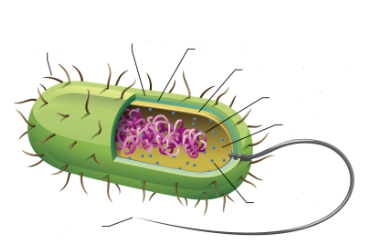
Be able to label a diagram of a prokaryote.

What is the function of the plasma membrane in a prokaryotic cell
Controls what can enter and leave the cell
What is the function of the cell wall in a prokaryotic cell
Provides shape and support.
What is the function of the capsule in a prokaryotic cell
Thick, sticky, overcoat that some bacteria have to help them stick to surfaces.
What is the function of the pilus in a prokaryotic cell
Used to trade pieces of DNA with other bacteria and help adhesion to surfaces.
What is the function of the flagellum in a prokaryotic cell
Used for movement
What is the function of the nucleoid in a prokaryotic cell
Region of the cell where the circular DNA is found
What is the function of the ribosome in a prokaryotic cell
They synthesize proteins.
What are the 3 main shapes of prokaryotes?
coccus (cocci) - round
bacillus (bacilli) - rod
spirillum (spirilla) - spirals
What are the 3 main arrangements of prokaryotes?
diplo - pairs
strepto - chains
straphylo - clusters
What would a streptococcal bacterium look like?
Chains of spheres.
Identify and describe the 3 different ways that prokaryotes can obtain energy.
Heterotrophs: decomposing
Photosynthetic autotrophs: photosynthesis
Chemosynthetic autotrophs: use inorganic materials from the environment to obtain energy
How do Eubacteria differ from Archaebacteria?
Archaaebacteria tend to live in extreme conditions whereas Eubacteria tend to live in normal environments.
What are the 5 different groups of archaea and where are they found?
Halophiles: highly saline enviroments
Methanogens: low-oxygen enviroments
Psychrophiles: extremly cold enviroments
Extreme thermophiles: extremely hot enviroments
Thermoacidophiles: hot and acidic enviroments
What is an antibiotic?
A chemical that inhibits the growth of or kills bacteria.
Who discovered the first antibiotic? What was the first antibiotic called?
Alexander Fleming. Penicillin.
What does it mean for a bacterium to be antibiotic resistant? Why is this a problem?
When a bacteria becomes antibiotic resistant it is no longer susceptible to die or get weakened by antibiotics which makes it much more difficult for us to treat bacterial infections.
How are humans contributing to the evolution of antibiotic resistance in bacteria?
By overusing (adding anti-bacterial agents in household cleaning products) and misusing (prescribing antibiotics for viral infections) antibiotics.
What are 3 examples of harmful bacteria? What diseases do they cause?
Typhoid bacteria: Causes typhoid fever
Pneumonia bacteria: Causes pneumonia (attacks lungs)
Tuberculosis bacteria: Causes tuberculosis (attacks lungs and other organs)
What are 3 ways in which bacteria are helpful?
Some bacteria help in decomposing which helps in returning nitrate and other minerals to he earth.
Help in digestion as they help break down the food
Transforms nitrogen in the air to usable nitrates for plants
What does the Theory of Endosymbiosis describe the origins of?
The mitochondria and chloroplast in eukaryotes.
What does the theory say about the origins of mitochondria?
A larger anaerobic prokaryotic cell engulfed a smaller aerobic prokaryote but did not digest it. Over time the two cells become co-depended and the aerobic prokaryote evolved into what is now known as the mitochondria.
What does the theory say about the origins of chloroplasts?
The early eukaryotic cell engulfed a photosynthetic prokaryote which later evolved into what is now known as a chloroplast.
Which organelle is thought to have formed first and why?
The mitochondria is thought to have been formed first as all eukaryotic cells have mitochondrion but not all eukaryotic cells have chloroplasts which might have meant that only a select few eukaryotes took part in this second endosymbiotic event.
How are mitochondria and chloroplasts similar to prokaryotes?
They have the same kind of DNA, replication method, size, and ribosomes.