Cell transport
 Call Kai
 Learn
 Practice Test
 Spaced Repetition
 Match
 Flashcards
 Knowt Play
1/29

There's no tags or description
Looks like no tags are added yet.
30 Terms
crosses bilayer on its own
gases
small uncharged polar molecules
does not cross bilayer on its own
large uncharged polar molecules (needs transport protein)
Ions (need channel or pump)
charged polar molecules (they cant cross, must stay in)
simple diffussion
passive transport
molecule dissolves in the lipid and passes through down the gradient
no energy, no protein needed
facilitated diffusion
passive transport
there is a protein that decided what to allow, no energy
channel
open pore
aquaporins, Na+/K+ channels

carrier
binds and changes shape
GLUT transporters for glucose

pump
spends energy to go up hill in the concentration gradient
active transport
osmosis
the movement of water across a semipermeable membrane, from where solute is dilute to where it is concentrated. Nothing pushes the water. It simply diffuses down its own gradient.
osmotic pressure
The more particles in solution, the higher the osmotic pressure — and it is the NUMBER of particles that counts, not what they are.
osmolarity
A measurement. The total number of dissolved particles per liter, whatever they are.
Plasma sits at roughly 290–310 mOsm/L in the domestic species.
tonicity
A prediction. What a solution will DO to a cell placed in it.
It counts only the particles that cannot cross the membrane — because only those hold water where they are.
isotonic
cells keep its normal shape
0.9% NaCl
Water always moves towards the higher solute concentration. Decide which side that is and the direction, and the consequence, follow automatically.

hypotonic
cell swells then bursts- hemolysis
pure water
Water always moves towards the higher solute concentration. Decide which side that is and the direction, and the consequence, follow automatically.
hypertonic
cells shrinks and crenates
7.2% NaCl
Water always moves towards the higher solute concentration. Decide which side that is and the direction, and the consequence, follow automatically.
primary active transporters
ATP driven
NA+/K+ ATPase

Secondary active transporters
• SGLT1 & SGLT2 (Sodium-Glucose Cotransporters)
Na⁺ and glucose bind the same carrier. Na⁺ falls down its gradient and drags glucose up against its own.

Na/K pump
3 Na out, 2 K in, for every ATP (remember Nokia 321 mnemonic)
uphill (costs energy)
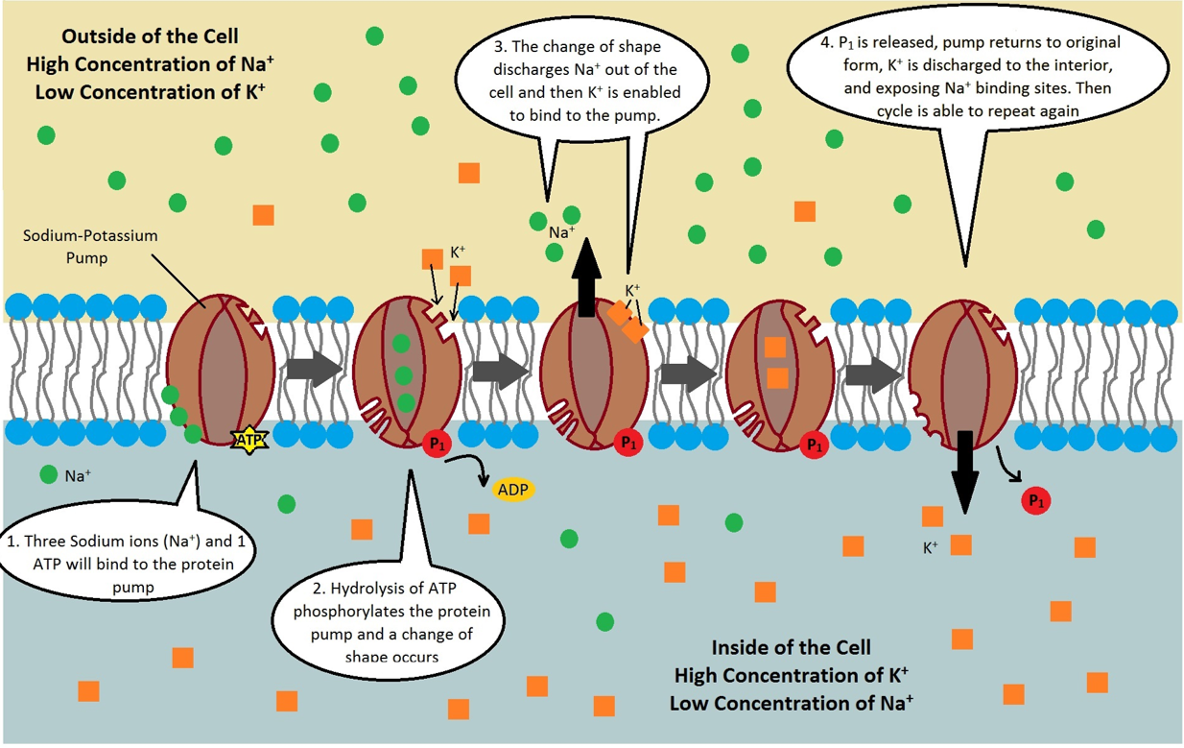
primary vs secondary active transport
primary spends ATP directly (Na+/K+ pump)
secondary spends a gradient that ATP built earlier

exocytosis
out of the cell
both consume energy
constitutive
regulated
constitutive exocytosis
default
A steady stream of vesicles leaves the trans Golgi network in every cell, all the time. Delivers new membrane and secretes whatever is in the vesicle.
regulated exocytosis
Cargo is stored in secretory vesicles and released only on a signal/demand.
Hormones, neurotransmitters, digestive enzymes, mast cell granules.
endocytosis
into the cell
both consume energy
phagocytosis
pinocytosis
receptor-mediated
phagocytosis
endocytosis
cell eating, large particles.
triggered not constant

pinocytosis
Cell drinking. Small vesicles, ~100 nm, taking in fluid and whatever is dissolved in it. Continuous, in every cell

receptor mediated endocytosis
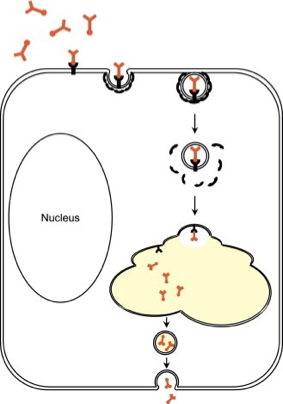
Selective. Cargo binds a specific receptor, concentrates in a clathrin-coated pit, and comes in enriched.
transcytosis
combination of endocytosis (cell takes extracellular cargo), intracellular transport (vescicle moves and carries cargo inside cell) and exocytosis (vesicle reaches the opposite of the cell
0.9% NaCl
isotonic (tonicity in patient)- volumen replacement, stays in extracellular space
LRS
slightly hypotonic
balanced maintenance and replacement fluid
5% dextrose in water
effectively hypotonic - not volume expander
7.5% NaCl
strongly hypertonic - small volume resucitation - pulls water into vasculature fast