Bio, unit 3, GENETICS
 Call Kai
 Learn
 Practice Test
 Spaced Repetition
 Match
 Flashcards
 Knowt Play
1/58

There's no tags or description
Looks like no tags are added yet.
59 Terms
What is locus?
A specific place along the length of the chromosome where a given gene is located
Geographic distinction
what is an allele?
Allele: different versions of the same gene
For example, one allele codes for purple flows, and one codes for white, they are a pair of homologous chromosomes
what are homologous chromosomes?
Homologous chromosomes are the two versions that each somatic cell (not eggs or sperm) has.
They are not identical and have the 2 alleles, or versions of genes, in each cell.
What was Mendel’s monohybrid cross?
first experiment
Monohybrid cross – crossing a true-breeding plant with a recessive trait with a true-breeding plant with a dominant trait.
Mendel's pioneering breeding experiments (1856-1863) aimed to understand inheritance patterns.
Chose the pea plant (Pisum sativum) due to its advantageous features: variations, self-pollination, rapid cycles, and observable traits.
Explored seven traits: seed shape, seed color, flower color, pod shape, pod color, flower position, and stem height.
When Mendel did his monohybrid cross, what were the results in the F1 and F2 generations?
F1: Whatever comes out in the first generation is the dominant trait/allele
Crossed F1 generation with itself→F2 generation
75% of the f2 generation had the dominant phenotype(3:1 ratio)

What is homozygous vs. heterozygous?
Homozygous (true breeding) has two identical copies or alleles of a gene
Heterozygous has two different alleles.
Homozygous: same phenotypes in every generation; two identical copies of the gene
Heterozygous: two different alleles
what is the law of segregation?
Law: The cell that has two alleles for a gene will equally separate them into its gametes.Each gamete recieves only one allele)
States that an organism has two allele copies for each gene, and these copies separate randomly during gamete formation (meiosis) so that each sperm or egg cell receives only one allele
Alleles segregate during gamete formation.
Each gamete carries only one allele for each gene.
During fertilization, alleles from each parent combine to form the offspring's genotype.

what is a dihybrid cross?
In a dihybrid cross, two traits are being crossed, and both parents are heterozygous for both traits/alleles.
Extended research to study the inheritance of two distinct traits.
Crossbred purebred parental plants with different traits (YYRR × yyrr).
F1 generation displayed dominant traits (yellow color and round shape).
F2 generation revealed a complex phenotypic ratio of 9:3:3:1 for the four combinations of traits.
What was the ratio for mendel’s dihybrid cross? F2
9:3:3:1
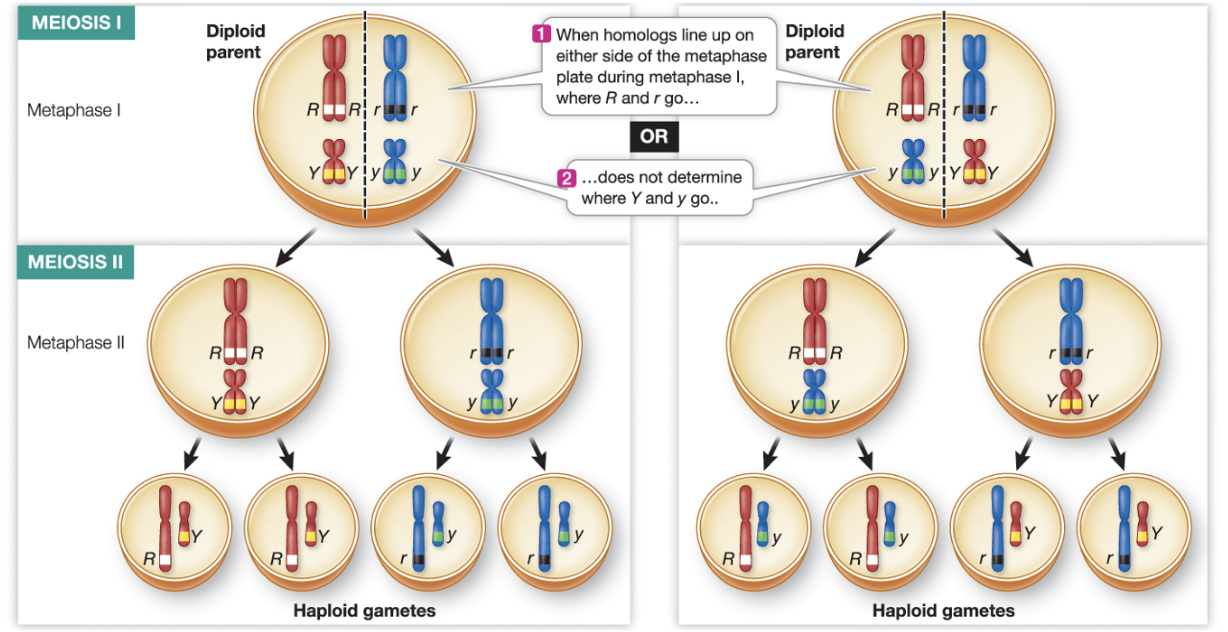
what is the law of independent assortment?
traits(like pea color and shape) are inherited indepndent of one another
when homologs line up on either side of the metaphase plate during metaphase I, where R and r go does not determine where Y and y go
Genes on different chromosomes assort independently during gamete formation.
Alleles for different traits segregate randomly and without preference.
What is incomplete dominance?
Incomplete Dominance: Heterozygote is intermediate between the 2 homozygotes
Heterozygote is not homozygous dominant or homozygous recessive; it is somewhere in between
Somewhere in between purple and white is pink
Pp
The offspring's phenotype is intermediate between the parents.
Neither allele fully dominates (e.g., pink flowers from red and white parents).

what is co-dominance?
Co-Dominance – both alleles are expressed in about equal amounts at the same time
The Heterozygote expresses both alleles, but is not intermediate(blood types, AB)
Both alleles are fully expressed in the phenotype.
No dominance or masking (e.g., AB blood type).
what is complete dominance?
Heterozygote Phenotype =(looks like, what Mendel saw) Homozygous Dominant Phenotype
what is pleiotropy?
Pleiotropy is when One gene influences more than one phenotype
How does pleiotropy connect to sickle cell?
Only one gene causes this: a 1-base-pair change
Negative effects on many parts of the body – liver, eyes, heart, etc
Two different phenotypes dictated by one gene: the trait and the cell
How does pleiotropy connect to ApoE gene—Allele E4?
One allele in one gene that causes multiple different phenotypes
2 amino acid changes:
Higher progesterone in women
Higher cholesterol and
Higher risk for heart disease
Higher risk Alzheimer’s disease
What is epistasis?
One gene alters (masks) the phenotypic effects of another gene at an independent locus.
this of the dogs
Interaction between multiple genes affects expression of another gene.
One gene's phenotype masks or modifies another's.
the cross of the two dogs(one gene codes for color of fur, but the other gene determines if that color gets released) demonstartes …
epistasis
what is polygenic inheritance?
Polygenic inheritance: More than one gene for one phenotype
Polygenic inheritance occurs when two or more independent genes collectively influence a single physical trait, rather than a trait being determined by a single gene
Add in environmental effects (tanning), and just 3 genes could account for all possible skin shades
Autism is hard to diagnose because there are multiple genes involved in it
flies have very few chromosomes, so….
…the likelihood of choosing two genes on the same chromosome is high.
This impacts the chances of independent assortment
Linked genes are always….
when genes are linked(very close to each other on a chromosome), they….
…inherited together
…do not follow Mendel’s Law of Independent Assortment at the expected ratios.
What were the results of T.H. Morgan’s test?
he did not get mendel’s ratio(1:1:1:1), the ones he was getting the highest number for looked exactly like the parents, not a combination of each(a little like mom and a little like dad)
What is recombinant vs. parental phenotypes?
Recombinant phenotype: a little from each
Parental phenotypes: look exactly like one parent(more of this)
when we divide the recominats by the parental, what does that number mean?
recombinants / total offspring =frequency(17%)
Only 17% of flies were recombinant
17 morgans apart; we can map the location of genes on the genome
If you get 50%, you get independent assortment, and they are so far apart that mendel’s law still applies
What is the maximum distance between two genes? What does this maximum distance mean?
50
Anything above 50% is gonna be independent assortment; crossing over always happens
50% Recombinants = Independent Assortment due to 100% crossover frequency
what is sex linkage?
Unexpected patterns of inheritance also occur when a gene is on a sex-linked chromosome. Either the X or Y chromosome (but usually the X)
These can be denoted differently:Xallele
Genes located on sex chromosomes (X or Y) show specific inheritance patterns.
Hemophilia and color blindness are examples of X-linked disorders.

what is cytoplasmic inheritance?
In cytoplasmic inheritance, genes that are not found in nuclear DNA (chloroplasts or mitochondria) show different patterns.
What did the Griffith experiment conclude?
S strain (virulent) causes mice to die and R strain (non-virulent)
Conclusion: The dead lethal bacteria still contain the ‘information’ that can make non-lethal bacteria deadly.
The Griffith Experiments showed that substance can transfer or be transformed from a dead bacterium to a living bacterium. That substance contains all of the information needed to turn a non-lethal bacterium into a lethal bacterium. The information is genes.
what did the avery experiment conclude?
Conclusion: When DNA is destroyed by DNase, genetic information is lost. DNA is the genetic molecule.
Avery built on the Griffith Experiment, but added a twist – systematically degrading the three major types of biological macromolecules (Protein, RNA, DNA) with enzymes that destroy them and seeing which can transform a non-lethal bacterium into a lethal one. Identified DNA as the molecule of heredity.
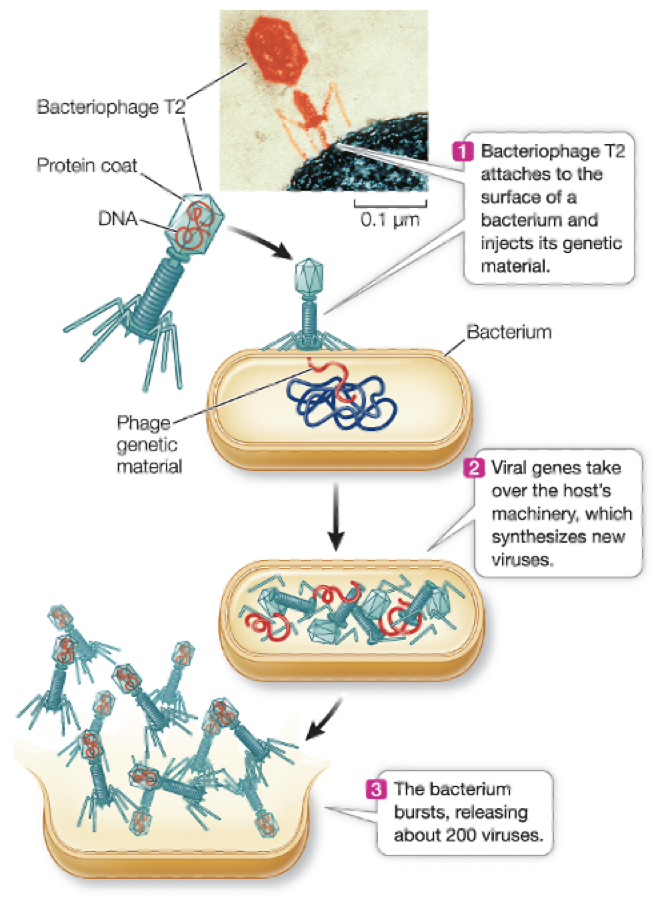
What are bacteriophages and what do they show about genetic information?
Bacteriophages are viruses that infect bacteria. They are made only of DNA and protein, so they are a simple system. Once infected, bacteria make tons of new viruses, so whatever the virus injects into the bacterial cell contains all of the genetic information needed to make a new virus.
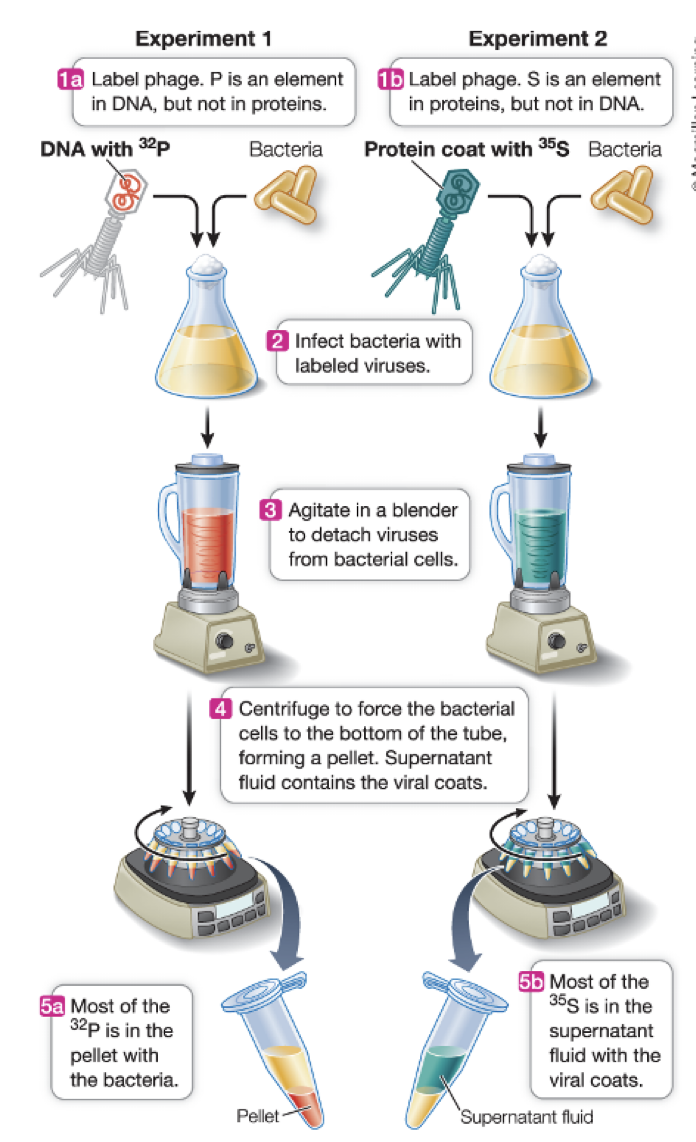
What was the approach and conclusion of the Hershey-Chase experiment?
Question: Is there a way to positively show that DNA is the information molecule of genes? (without destroying other molecules)
Approach: Radioactively label either protein OR DNA. Phosphorus is abundant in DNA, while Sulphur is only found in protein.
Conclusion: The radioactive 32P was in the infected bacterial cells, while the radioactive 35S was not. DNA is all that is needed to infect cells and contains all of the information to make new viruses from raw materials.
Only radioactive material was found in infected DNA
DNA contained the information
describe the strucutre of DNA
DNA is double-stranded
Forms a right-handed helix
The two strands run antiparallel
All phosphate groups are negative, so DNA is highly negative
what are he complementary bases of DNA and what are they held together by
Complementary bases (A & T) (C & G) pair together using hydrogen bonds while van der Waals forces keep adjacent bases in place
How do you tell if the strand runs 5’—>3’?
if the sugar is pointing up, it starts with the 5’ carbon
5’—>3’

what is stronger, G and C or A and T?
3 hydrogen bonds hold G and C together
Only 2 hold A and T
So G and c is stronger
What are major and minor grooves? What does the angle have to be to be considered a major groove?
Diversity of binding partners increases bc of the major and minor grooves
Increases the number of proteins that can bind to unique sites in DNA
The major and minor grooves are places where proteins can access the sequence of DNA without necessarily opening the hydrogen bonds that hold it together. Each groove has electronegative Nitrogen and Oxygen or electropositive Hydrogens that make precise binding sites for each set of base pairs.
The major groove is more than 180 degrees
what is dispersive replication?
Dispersive replication: chop the DNA in pieces and then put it back together randomly; mix of new and old

What is conservative replication?
Conservative replication: we conserve the original strand of DNA, and a completely new copy

What is semiconservative replication?
Semiconservative replication: daughter molecule with both an OG strand and a new strand
Big benefit of both having an original strand
The original strands don't have any errors, the new strand is the one with a mistake

where do the nucleoside triphosphates(ATP) get added to?
nucleoside triphosphates are added to the three prime hydroxyl
where are new bases only able to be added?
New bases can ONLY be added onto the 3’ end of an existing strand.
is the addition of nucleoside triphosphates to dna in replication exergonic or endergonic?
New DNA bases are added as nucleoside triphosphates (ATP, GTP, CTP, and TTP).
Recall how much energy ATP has – this is highly exergonic.
How do prokaryotes replicate DNA vs. eukaryotes?
In prokaryotes, you open up the ori
When you open up the bubble, you have two replication forks (1 bubble, 2 forks)
In eukaryotes, they are linear, not circular
Lots of DNA, so you cannot just have one origin of replication
At each replication spot, you have a bubble and 2 forks

What is helicase?
helicase(the unzipping enzyme)
Unzipping the two strands of DNA breaks though the hydrogen bonds
what is DNA polymerase?
DNA polymerase(the builder)
Replicates DNA molecules
DNA polymerase – synthesizes new DNA starting at the 3’ –OH of the primer
what is primase?
Primase(the initializer)
Makes the primer so DNA polymerase knows where to go
The primer is made of RNA
Primers are needed on both template strands
It synthesizes an RNA primer that complements a single strand of DNA. Required for DNA synthesis.
What is ligase?
Ligase(the gluer)
Glues DNA fragments together
What is the goal of initiation?
Goal: Open the DNA and provide a starting point for DNA synthesis.
Helicase unwinds; single-stranded binding proteins keep the strands separate
Cells add a small piece of RNA called a primer
DNA polymerase sythesizs new DNA starting at the free 3’-OH of the primer

what is the goal of elongation?
Goal: Make the new DNA strands longer.
DNA polymerase builds new DNA using each original strand as a template.
It adds complementary nucleotides: A/T, G/C
DNA polymerase can only build in the 5′ → 3′ direction, meaning it adds new nucleotides to the 3′ end of the new strand.
This means it moves along the old, or template, strand in the 3′ → 5′ direction.
The lagging strand can only be synthesized in bits at a time because more template DNA becomes available as helicase opens the fork.
Primase repeatedly adds new primers to this newly exposed template.
DNA polymerase extends each primer to make an Okazaki fragment.

What proofreads the replication of DNA?
DNA polymerase
What is the sliding clamp?
The sliding clamp is circular and holds onto both strands of DNA, holds onto the DNA polymerase, and keeps it from falling off
It keeps things moving
The Sliding Clamp keeps DNA polymerase attached to the DNA and keeps things moving.

what are the 3 issues that need to be handled following elongation?
RNA primers need to be removed, but that means there is a gap!
2.The gaps left by the primers need new DNA filled in.
The backbone (phosphodiester bonds) needs to be complete all along the strands. New covalent bonds need to be formed
What is the goal of termination? when does replication end?
Goal: Finish replication and complete the new DNA molecules.
Replication ends when replication forks meet or reach the end of the DNA being copied.
DNA polymerase I removes RNA primers and replaces them with DNA in bacteria.
DNA ligase “glues” the new fragments on the lagging strand together.

what question does a test cross ask?
A test cross asks the question, is a plant with a dominant trait homozygous or heterozygous?
what is the law of dominance?
Dominant alleles mask the expression of recessive alleles.
In heterozygous individuals (Aa), the dominant trait is expressed.
The recessive trait is expressed only in homozygous recessive individuals (aa).
What are multiple alleles?
Genes have more than 2 possible alleles in a population
Example: ABO blood group system with A, B, and O alleles
Multiple alleles is when more than two alleles can code for a gene.
In the dark gray, bc the C allele is dominant, multiple genotypes are possible for one phenotype

What is genetic linkage?
Genes located close together on the same chromosome tend to be inherited together.
Deviation from the law of independent assortment.
what is extranuclear inheritance?
Inheritance of genetic material from organelles outside the nucleus (e.g., mitochondria, chloroplasts).
Maternal inheritance pattern due to cytoplasmic presence.
how do we make a test cross? what are the possible results of it?
To test, we cross a true-breeding recessive with a dominant (R_)
The results of the test cross help determine if the parent was hetero or homozygous
Cross the unknown with a recessive plant (must be homozygous recessive) to find out
Two potential outcomes are shown. One where the parent with the dominant phenotype is homozygous and the other where the parent is heterozygous.