Patho chp 26
 Call Kai
 Learn
 Practice Test
 Spaced Repetition
 Match
 Flashcards
 Knowt Play
1/80

There's no tags or description
Looks like no tags are added yet.
81 Terms
What are the 2 diseases of the arterial system?
dyslipidemia and atherosclerosis
what are the other diseases of the arterial system? (3)
vasculitis
arterial disease of the extremities
arterial aneurysms
condition of imbalance of the lipid components of the blood
dyslipidemia
greater than 240 mg/dL ; levels that contribute to a heart attack, stroke, or other cardiovascular event associated with atherosclerosis
hypercholesterolemia
high cholesterol
hypercholesterolemia
What is another name for hypercholesterolemia?
hyperlipidemia
What are the 3 causes of hyperlipidemia
hereditary
nutrition
secondary dyslipidemia (metabolic)
What is an example of hereditary hyperlipidemia
familial hypercholesterolemia
Familial hypercholesterolemia causes
defective LDL receptors
What is example of nutrition of hyperlipidemia
high saturated fat intake; obesity
high saturated fat or obesity causes
reduced number of activity of HDL receptors
What is an example of hypercholesterolemia secondary dyslipidemia?
diabetes mellitus
In hypercholesterolemia dibetes mellitus causes
increased lipoprotein levels
What are 3 manifestations of hypercholesterolemia (what we see)
CAD (coronary artery disease)
PAD (peripheral artery disease)
Xanthomas
What manifests at extremely high levels of hypercholesterolemia
paresthesia
dyspnea
confusion
paresthesia
numbness
dyspnea
shortness of breath
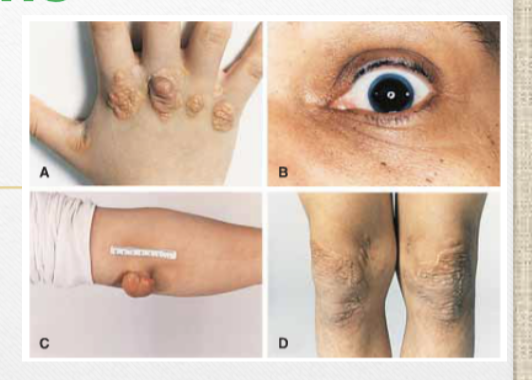
This photo is an example of what?
xanthomas
hardening of the arteries
atherosclerosis
atherosclerosis is a formation of ______ in the intimal lining of large medium sized arteries
fibrofatty lesions
What are 3 non modifiable risk factors for atherosclerosis
age
genetics
gender
What are 3 modifiable risk factors for atherosclerosis
cigarette smoking
obesity
hypertension
What are 2 non traditional risk factors for atherosclerosis
increased lipoprotein levels
inflammation marked by elevated C reactive proteins levels
What are the 3 types of lesions associated with atherosclerosis plaque
fatty streaks
fibrous atheromatous plaque
Complicated lesions
This atherosclerosis plaque is most common in children in their first year of life
fatty streaks
This atherosclerosis plaque is the most basic definition of lesion of clinical atherosclerosis
fibrous atheromatous plaque
This atherosclerosis plaque when the size of the lesion increases it begins to occlude the vessel and blood flow is reduced
fibrous atheromatous plaque
This atherosclerosis plaque is a thrombus clot the develops due to slowing of blood flow
complicated lesions
Complicated lesions are
more advanced
What are 3 major risk factors for atherosclerosis
cigarette smoking
hypertension
family history (genetics)
Which vessel has the important complications that are those of thrombus formation and weakening of the vessel wall?
larger vessels
In which artery has ischemia and infarction? Vessel occlusion are also more common
Medium sized arteries
Inflammation of the blood vessel wall resulting in vascular injury and necrosis
vasculitis
With vasculitis what may be affected?
arteries, capillaries and veins
With vasculitis the inflammatory process may be initiated by what 3 things?
direct injury
infectious agents
immun processes
What are the 4 other flow issues?
acute arterial occlusion
atherosclerotic occlusive disease
thromboangiitis obliterans (burger’s disease)
raynaud’s disease
Which flow is a disruption of blood flow caused by thrombus, embolus, and trauma?
Acute arterial occlusion
Which flow is the MOST common in arteries of LOWER legs and feet for 60-70 yr old men
atherosclerotic occlusive disease
Which flow is in the lower leg, feet, arm and hand; mostly men 25-40 and is caused by heavy cigarette smokers?
thromboangiitis obliterans (Burger's disease)
Which flow has intense vasospasm of arteries is in the fingers, toes and is in young women?
Raynaud's disease
This disease is often precipitated by cold or strong emotions; ischemia causes finger pallor to cyanosis
Raynaud’s disease
Abnormal localized dilation of a blood vessel; occurs in veins and arteries and can cause out pouching
Aneurysms
What are the 4 aneurysms?
Berry aneurysms
Fusiform aneurysms
Saccular aneurysms
dissecting aneurysms (false)
This type of aneurysms is found in the BRAIN specifically the circle of willis in the brain circulation; consists of a small spherical vessel dilation
Berry aneurysms
This type of aneurysms is found in the thoracic characterized by gradual and progressive enlargement of the aorta
fusiform aneurysm
This type of aneurysms is found in the abdominal aorta characterized by gradual and progessive enlargement of the aorta
saccular aneurysm
This type of aneurysms is an acute life threatening condition that involves hemorrhage into the vessel wall with longitudinal tearing (dissection) of the vessel wall to form a blood filled channel
dissecting aneurysms (false)
What are the 3 disorders of venous circulation?
Varicose veins
Chronic Venous insufficiency
Venous thrombosis
What are the two types of varicose veins?
superficial vein
deep vein
This is a disorder of venous circulation due to pressure on the valves, venous system in the leg it can be caused by excessive standing, obesity, pregnancy
varicose veins
This is a disorder of venous circulation that is caused by deep vein thrombosis or bad valves
chronic venous insufficiency
This is a disorder of venous circulation is the worst, DVT associated inflammation response; blood stasis + blood coagulability + vessel wall injury
Venous Thrombosis
What are 7 risk factors associated with venous thrombosis?
bad rest
immobility
spinal cord injury
surgery
fractured hip
pregnancy
genetic factors
sustained condition of elevation of the blood pressure within the arterial circuit
hypertension (high BP)
What are the 2 types of hypertension
Essential/ primary
Idiopathic
This type of hypertension is chronic elevation in blood pressure
essential/ primary hypertension
This type of hypertension occurs without evidence of other disease basically IDK
Idiopathic (IDK cause ID)
When systolic BP is 120-129 and diastolic BP is <80 what is the classification?
elevated blood pressure
When systolic BP is 130-139 and diastolic BP is 80-89 what is the classification?
Stage 1 hypertension
When systolic BP is >140 and diastolic BP is >90 what is the classification?
Stage 2 hypertension
Elevated BP #’s
systolic BP of 120-129
diastolic BP under 80.
Stage 1 hypertension #’s
systolic BP of 130-139
diastolic BP of 80-89.
Stage 2 hypertension #’s
systolic BP of 140 or higher
diastolic BP of 90 or higher.
Essential hypertension 4 risk factors
genetics
race
diabetes
age
Essential hypertension 5 lifestyle risk factors
salt
obesity
inactivity
alchohol
contraceptives
What are the consequences of essential hypertension
left ventricular hypertrophy which is caused by an increased workload on the LEFT side of the heart and this can lead to renal insufficiency and accelerate other types of kidney diseases
What are the major risk factors for essential hypertension? (3)
ischemic heart disease, CHF, dysrhythmias
What are the 4 risk factors for hypertension
age
tobacco
obesity
family history and genetics
secondary hypertension can develop into an accelerated potentially fatal form; Usually in younger people, African American men and women who a are pregnant that is suddenly increased in BP; diastole > 120;
malignant hypertension
Why is malignant hypertension dangerous?
Cause of vascular changes and retinopathy
Elevation of BP that results from some other disorder and can be corrected by surgery or specific medical treatment
secondary hypertension
This hypertension is the largest single cause in renal disease renal hypertension
Secondary hypertension
Secondary hypertension causes what 4 things
renal
adrenocoricosteroid disorders
pheochromocytoma
coarctation of the aorta
This increases in renal blood blow then increases in renin
Renal
This undergoes hyperplasia or hyperaldosterone; excessive glucocorticoid hormone
Adrenocoricosteroid disorders
This is a tumor in adrenal medulla causes excessive epinephrine and nonrephinephrine
Pheochromocytoma
This is narrowing of aortic arch increases resistance to LV pumping
Coarctation of the aorta
Abnormal drop in blood pressure on assumption of the standing position
Orthostatic Hypotension (postural hypotension)
This is caused by a drop in BP because of posture
Orthostatic hypotension
What are the 4 causes of Orthostatic (postural) hypotension
reduced blood volume
drug induced hypotension
aging
extensive bed rest
What are the autonomic nervous dysfunctions caused by orthostatic hypotension (4)
neuropathies of diabetes mellitus
CVAs
spinal cord injury
Parkinson’s