Exam 3 Human Physiology Lecture
 Call Kai
 Learn
 Practice Test
 Spaced Repetition
 Match
 Flashcards
 Knowt Play
1/42

Earn XP
Description and Tags
These are the textbook and Pointsolution questions
43 Terms
Muscle that has a striped appearance is described as being ________.
Elastic
Nonstriated
Excitable
Straitated
Muscle fiber and t tubericle fill in the blanks
know how to fill out
Depolarization of the sarcolemma means ________.
the inside of the membrane has become less negative as sodium ions accumulate
Which of the following statements about muscle contraction is true?
The Powerstroke occurs when ADP and phosphate dissociate from the myosin head
Muscle fatigue is caused by ________.
exhaustion of energy reserves and buildup of Lactic Acid levels
The muscles of a professional sprinter are most likely to have ________.
80 percent of fast twitch muscle fibers and 20 percent slow twitch muscle fibers
The correct order for the smallest to the largest unit of organization in muscle tissue is ________.
Filament, myofibril, muscle fiber, fascicle
During which phase of a twitch in a muscle fiber is tension the greatest?
contraction phase
From which embryonic cell type does muscle tissue develop?
myoblast cells
If cardiac muscle cells were prevented from undergoing aerobic metabolism, they ultimately would ________.
stop contracting
Which of the following statements is true?
Fast fibers have large glycogen reserves
Why do baroreceptors communicate to the CNS? What specific location in the CNS is the center for this communication?
regulate control over blood pressure; medulla obliganta
What is total peripheral resistance?
combined resistance to flow of all systemic blood vessels
What is cardiac output? CO
Blood volume circulated each minute

What type of diagram is this figure?
Electrocardiogram
The ________ layer secretes chemicals that help to regulate ionic environments and strength of contraction and serve as powerful vasoconstrictors.
Endocardium
Which of the following is unique to cardiac muscle cells?
Only cardiac muscle is capable of autorhythmicity
The first heart sound represents which portion of the cardiac cycle?
closing of the atrioventricular valves
A molecule of hemoglobin ________.
consists of four globin proteins, each bound to a molecule of heme
Interleukins are associated primarily with which of the following?
All of the above (had production of various lymphocytes, immune responses, and inflammation)
Two factors help maintain the pressure gradient between the veins and the heart. Those factors are:
respiratory and skeletal muscle pump
Which portion of the ECG corresponds to repolarization of the atria?
none of the above: atrial repolarization is masked by ventricular depolarization
At the end of atrial systole and just prior to ventricular contraction, the ventricles contain approximately 130 mL blood in a resting adult in a standing position. This volume is known as the ______________.
end diastolic volume (EDV)
A healthy elastic artery ________.
is compliant
The influx of which ion accounts for the plateau phase?
calcium
What is the role of tropomyosin in skeletal muscle contraction?
Option A
It blocks the binding sites on actin when calcium levels are low
Option B
It triggers the release of calcium ions
Option C
It provides structural support to myofibrils
Option D
It enhances the binding of myosin to actin
Option A
Correct:
It blocks the binding sites on actin when calcium levels are low
Correct answer
Which protein is involved in the thick filament of skeletal muscle and is crucial for muscle contraction?
Option A
Troponin
Option B
Actin
Option C
Myosin
Option D
Tropomyosin
Correct:
Myosin
Correct answer
Which structure within the skeletal muscle cell stores calcium ions and releases them during muscle contraction?
Option A
T-tubules
Option B
Mitochondria
Option C
Myofibrils
Option D
Sarcoplasmic reticulum
Option D
Sarcoplasmic reticulum
What is the primary physiological role of ATP in skeletal muscle contraction?
Option A
ATP serves as a secondary messenger in muscle contraction
Option B
ATP phosphorylates actin to initiate contraction
Option C
ATP is produced during the contraction process
Option D
ATP binds to myosin, allowing cross-bridge detachment
Option D
ATP binds to myosin, allowing cross-bridge detachment
What distinguishes cardiac muscle from skeletal muscle?
Option A
Cardiac muscle is smooth and voluntary, while skeletal muscle is smooth and involuntary.
Option B
Cardiac muscle has no nuclei, while skeletal muscle is multinucleated.
Option C
Cardiac muscle is unstriated and involuntary, while skeletal muscle is striated and voluntary.
Option D
Cardiac muscle is striated and involuntary, while skeletal muscle is striated and voluntary.
Option D
Cardiac muscle is striated and involuntary, while skeletal muscle is striated and voluntary.
Match the following muscle proteins with their functions or characteristics:
Prompts
Answers
1
Actin
2
Troponin
3
Sarcoplasmic reticulum
4
Myosin
Correct:
Organelle that stores and releases calcium ions.
Correct:
Regulatory protein that binds calcium and affects tropomyosin.
Correct:
Thick filament protein responsible for muscle contraction.
Correct:
Thin filament protein that interacts with myosin to enable contraction.
1
Actin
Correct:
Thin filament protein that interacts with myosin to enable contraction.
2
Troponin
Correct:
Regulatory protein that binds calcium and affects tropomyosin.
3
Sarcoplasmic reticulum
Correct:
Organelle that stores and releases calcium ions.
4
Myosin
Correct:
Thick filament protein responsible for muscle contraction.
Increasing pressure in ventricles leads to aortic and pulmonary valves opening and blood ejection. This event occurs during:
Option A
Systole
Option B
Diastole
Option A
Systole
Define stroke volume. How is it calculated?
Option A
blood volume ejected by each ventricle with each beat, CO=SVxHR
Option B
blood volume ejected by each ventricle with each beat, SV= EndDiastoleVolume – EndSystoleVolume
Option C
blood volume ejected by each ventricle with each minute, SV= EndDiastoleVolume – EndSystoleVolume
Option D
blood volume ejected by each ventricle with each minute, CO=SVxHR
Option B
blood volume ejected by each ventricle with each beat, SV= EndDiastoleVolume – EndSystoleVolume
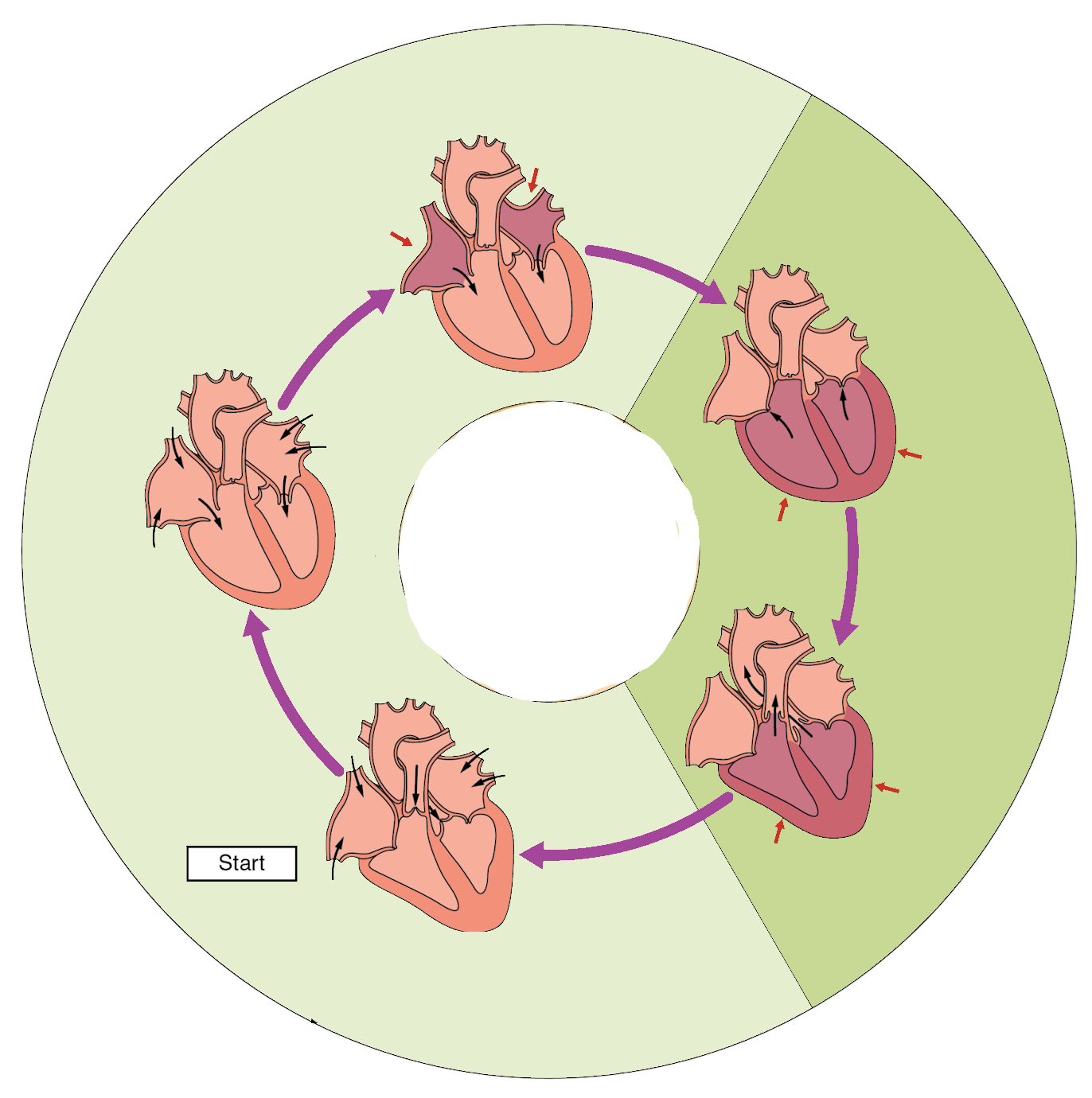
Referring to the cardiac cycle in terms of the ventricles (i.e. how we discussed in class). During _______ atrial contraction completes and ventricles fill. During ________ the ventricles contract and blood ejects.
Option A
systole; diastole
Option B
systole; systole
Option C
diastole; systole
Option D
diastole; diastole
Option C
diastole; systole

At the beginning of isovolumetric ventricular relaxation
Option A
left ventricular pressure exceeds aortic pressure.
Option B
the aortic semilunar valves are open.
Option C
all valves are closed
Option D
ventricular pressure is increasing.
Option C
all valves are closed

A small amount of blood is located in the atria and the action potential is located at the AV Node. What is the next step in connecting the Cardiac Cycle and Electrical events?
Option A
contraction of the atria
Option B
action potentials spread down the Purkinje fibers
Option C
blood filling the atria
Option D
opening of the aortic and pulmonary valves
Option A
contraction of the atria
The myocardium cannot exhibit summation and tetanus. Why? Check all that apply.
Option A
The muscle must relax and allow the heart to fill with blood again.
Option B
The refractory period lasts almost as long as the duration of contraction, preventing a fiber from re-excitement.
Option C
The SA node must await nervous stimulation from the sympathetic nerve.
Option A
The muscle must relax and allow the heart to fill with blood again.
Option B
The refractory period lasts almost as long as the duration of contraction, preventing a fiber from re-excitement.
Question 1
What is the primary function of arteries in the circulatory system?
Option A
To collect deoxygenated blood from the body
Option B
To carry oxygenated blood away from the heart
Option C
To store blood for later use
Option D
To exchange gases with tissues
Option B
To carry oxygenated blood away from the heart
Question 2
What mechanism primarily drives blood flow in the veins?
Option A
Constriction of venous valves
Option B
Pulsing of capillaries
Option C
Skeletal muscle pump and respiratory pump
Option D
Pressure gradients from the left ventricle
Option C
Skeletal muscle pump and respiratory pump
Question 3
Question 3
1 Point
Question 3
Which type of blood vessel is primarily responsible for nutrient and gas exchange?
Option A
Arteries
Option B
Veins
Option C
Capillaries
Option D
Venules
Option C
Capillaries
Question 5
What triggers the end of the systolic phase and the beginning of diastole in the cardiac cycle?
Option A
Contraction of the atria
Option B
Decrease in ventricular pressure leading to closure of the semilunar valves
Option C
Increase in atrial pressure
Option D
Relaxation of the ventricles
Option B
Decrease in ventricular pressure leading to closure of the semilunar valves
Question 6
Capillaries are the only blood vessels that allow for the exchange of oxygen and carbon dioxide between blood and tissues.
True
False
True
Question 4
What is the main role of the pulmonary circulation?
Option A
To filter blood through the kidneys
Option B
To deliver oxygenated blood to the body
Option C
To regulate blood flow through the arteries
Option D
To transport deoxygenated blood to the lungs for oxygenation
Option D
To transport deoxygenated blood to the lungs for oxygenation