Unit 2 - Cells and Tissues (All Types)
 Call Kai
 Learn
 Practice Test
 Spaced Repetition
 Match
 Flashcards
 Knowt Play
1/85

There's no tags or description
Looks like no tags are added yet.
86 Terms
What are the 4 types of tissues?
Connective, Nervous, Epithelial, Muscle

What is connective tissue?
Tissue that provides support and binds other tissues together

Identify this tissue
Nervous tissue — Transmits electrical signals and coordinates body functions; made of neurons and neuroglia.
What is epithelial tissue?
Tissue that covers body surfaces and lines organs and cavities
What is muscle tissue?
Tissue that contracts to produce movement
What are the 3 types of connective tissue proper?
Connective tissue proper, Cartilage, Bone
What are the functions of connective tissues?
Support, insulation, protection, and transportation
What are connective tissues mostly composed of?
Extracellular matrix
What is extracellular matrix?
Substance secreted by cells, composed of ground substance and fibers
What are the types of fibers in the extracellular matrix?
Collagen, elastic, reticular
What are the types of loose connective tissue?
Areolar, Adipose, Reticular

Identify this tissue
Areolar connective tissue — Mostly open space, holds water and salts for surrounding tissues, found under epithelium and around organs.
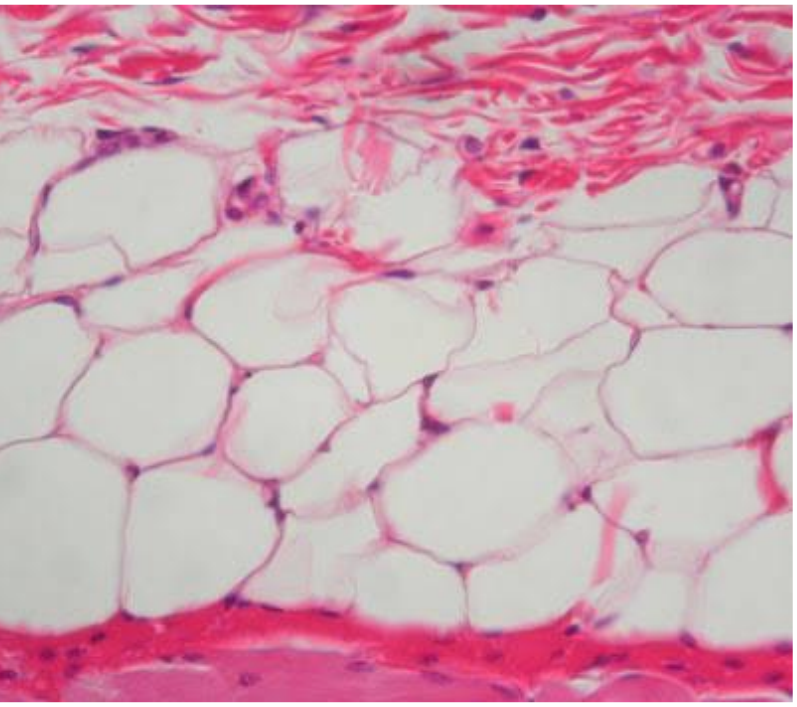
Identify this tissue
Adipose tissue — Fat cells (adipocytes) with large vacuoles of fat/oil; insulates and warms the body, provides nutrients to other cells.

Identify this tissue
Reticular connective tissue — Reticular fibers create a stiff framework that supports other cells.
What are the types of dense connective tissue?
Regular, Irregular, Elastic

Identify this tissue
Dense regular connective tissue — Collagen fibers arranged in one direction, provides tensile strength, found in tendons and ligaments.

Identify this tissue
Dense irregular connective tissue — Collagen fibers arranged in many directions, provides strength in multiple directions, found in capsules around organs.
What are the characteristics of elastic dense connective tissue?
Provides flexible cushioning, found between vertebrae and in arteries

Identify this tissue
Hyaline cartilage — Glassy looking, firm ground substance with lacuna, few collagen fibers.
What are the locations where fibro-cartilage is found?
Larynx, bridge of nose, and ribs
What is the composition of fibro-cartilage?
Contains lots of collagen, mostly running parallel
Where is areolar tissue found?
Found in intervertebral spaces

Identify this tissue
Elastic cartilage — Highly flexible, contains more elastic fibers.
Where is hyaline cartilage found?
Found in outer ear and tip of nose
What do osteocytes secrete?
Ground substances, fibers, collagen, and fluids
What are the two types of bone tissue?
Spongy and compact

Identify this tissue
Blood — Ground substance is plasma (fluid); red blood cells (erythrocytes) and white blood cells (leukocytes); platelets.
What is the function of mast cells?
Detect foreign substances and secrete inflammatory chemicals
What is the function of macrophages?
Engulf invading substances or organisms
What are the two types of blood cells?
Red blood cells (erythrocytes) and white blood cells (leukocytes)
What are the different types of ground substances in connective tissues?
Cartilage has a flexible ground substance, bone has a calcified ground substance, and blood has a fluid ground substance
What happens when cells rupture?
Cells rupture and spill products into the duct.
What does 'Hol' stand for?
'Hol' stands for whole.
What is secretion?
Secretion is the process of releasing substances.
Where are sebaceous glands found?
Sebaceous glands are found in the skin.
What do endocrine glands secrete?
Endocrine glands secrete hormones.
How are endocrine cells packed together?
Endocrine cells are packed tightly together with capillaries running through the glandular tissue.
How do cells excrete products?
Cells excrete products through exocytosis into the blood.
What is a capillary?
A capillary is a small blood vessel.
Give examples of endocrine glands.
Examples of endocrine glands include the thyroid, thymus, adrenal glands, and pancreas.
What is glandular tissue?
Glandular tissue is a specialized type of epithelial tissue.
How do exocrine glands secrete their products?
Exocrine glands use tube-like ducts to secrete their products.
How do exocrine glands differ from endocrine glands?
Exocrine glands differ in the portion of the cell that is secreted with the product.
What are the 4 types of tissues?
The 4 types of tissues are connective, nervous, epithelial, and muscle tissue.
What are examples of connective tissue?
Examples of connective tissue include connective tissue proper, cartilage, bone, and blood.
What is the function of connective tissues?
Connective tissues provide support and bind other tissues together. They can also provide insulation and protection for other tissues, and some are able to transport substances.
What are connective tissues mostly composed of?
Connective tissues are mostly composed of extracellular matrix.
What is extracellular matrix?
Extracellular matrix is the material that fills the space between cells in connective tissue.
What are the components of extracellular matrix?
The components of extracellular matrix are ground substance (watery or gel-like substance secreted by cells) and fibers or threads (collagen, elastic, or reticular).
What are the types of loose connective tissue?
The types of loose connective tissue are areolar, adipose, and reticular.
What are the characteristics of areolar tissue?
Areolar tissue is mostly open space, holds water and salts for surrounding tissues, and is found under epithelium and around organs.
What are the characteristics of adipose tissue?
Adipose tissue is comprised of fat cells (adipocytes), has large vacuoles that contain fat/oil, insulates and warms the body, and provides nutrients to other cells.
What are the characteristics of reticular tissue?
Reticular tissue contains reticular fibers, which create a stiff framework that supports other cells.
What are the types of dense connective tissue?
The types of dense connective tissue are regular, irregular, and elastic.
What are collagen fibers?
Protein fibers that provide tensile strength
How are collagen fibers arranged in tendons and ligaments?
In one direction
What is the function of collagen fibers in tendons and ligaments?
To provide tensile strength
What are irregular fibers?
Collagen fibers arranged in many directions
Where are irregular fibers found?
In capsules around organs
What is the function of irregular fibers?
To provide strength in multiple directions
What are elastic fibers?
Fibers that provide flexible cushioning
Where are elastic fibers found?
Between vertebrae and in arteries
What is the function of elastic fibers?
To provide flexibility and cushioning
What is hyaline cartilage?
Glassy-looking cartilage with few collagen fibers
Where is hyaline cartilage found?
In the larynx, bridge of nose, and ribs

Identify this tissue
Fibrocartilage — Lots of collagen fibers, mostly running parallel; found in intervertebral spaces.
Where is fibro-cartilage found?
In intervertebral spaces
What is areolar tissue?
Highly flexible tissue with more elastic fibers
Where is areolar tissue found?
In the outer ear and tip of the nose
What are osteocytes?
Cells that secrete ground substances, fibers, collagen, and fluids in bone
What are the two types of bone?
Spongy and compact
What are the requirements for a tissue to be considered connective tissue?
Cells surrounded by an extracellular matrix made of fibers
What is the ground substance in cartilage?
Flexible
What is the ground substance in bone?
Calcified
What is the ground substance in blood?
Fluid
What are the types of muscle tissue?
Smooth, Cardiac, Skeletal

Identify this tissue
Smooth muscle — Contracts involuntarily, non-striated, found in walls of stomach, uterus, intestines, bladder, arteries, veins and eyes.

Identify this tissue
Cardiac muscle — Contracts involuntarily, striated, found in the heart muscle, activated by brain or hormones.

Identify this tissue
Skeletal muscle — Contracts voluntarily, striated, connected to bones of the skeleton, controlled by somatic nervous system.
What are the types of nervous tissue?
Neurons, Neuroglia
What are the characteristics of neurons?
Make up 10% of all nerve cells, Convert stimuli into nerve impulses, Pass impulses to other neurons, muscle fibers, or glands, Unable to regenerate
What are the characteristics of neuroglia?
Make up 90% of all nerve cells, Support & protect neurons, Do not generate nerve impulses, Able to regenerate after injury
What is the function of muscle tissue?
Used for movement, can be voluntarily or involuntarily controlled
What is the function of nervous tissue?
Transport impulses around the body
What is the composition of nervous tissue?
Mostly comprised of neuroglia which support neurons
What is the composition of muscle tissue?
Primarily made up of muscle fibers