Sources of Information
 Call Kai
 Learn
 Practice Test
 Spaced Repetition
 Match
 Flashcards
 Knowt Play
1/29

Earn XP
Description and Tags
The benefits of research, finding and reading the literature
30 Terms
What is a comparison group?
A group in an experiment whose levels on the independent variable differ from those of the treatment group in some intended and meaningful way → enables us to compare what would happen both with + without the thing we're interested in
E.g. radical mastectomies for breast cancer (never used comparison condition/treatments)
Why can’t we rely on personal experiences to decide what is true?
Daily life doesn't include comparison experiences
Even if a change has occurred, we often can't be sure what caused it (too much goes on at once) → several possible explanations for an outcome (confounds)
What are confounds?
A general term for a potential alternative explanation for a research finding; a threat to internal validity, occurs when you think 1 thing caused an outcome but in fact other things changed too (become confused about what the cause really was)
How do researchers carefully control and isolate variables?
Researchers can set up the conditions to include at least 1 comparison group → outside view allows insight to determine overall trends
Control for potential confounds
E.g. Bushman (2002) → study on the effect of catharsis on aggression is a systematic comparison that controls for potential confounds
What are the results of a single study better evidence than?
Experience + consistent results from several similar studies → mean that scientists can be more confident in the findings
Additional studies → data support theories
What word describes the results of behavioural research?
Probabilistic → findings don't explain all cases all of the time
Conclusions are meant to explain a certain (preferably high) proportion of the possible cases -> imperfect predictions
Scientific conclusions are based on patterns that emerge only when researchers set yp comparison groups + test many people
Individual experiences may differ
What is intuition?
Using our hunches about what seems natural or attempting to think about things logically
What is wrong with using our intuition?
Biased → awareness doesn't mean that we're not busy or sufficiently motivated to correct + control for these biased
Tend to believe good stories
Availability heuristic
Confirmation bias
Bias blind spot
What is our tendency to believe good stories?
Accepting a conclusion just because it makes sense or feels natural
Must be aware of limits of intuition -> must adjust beliefs on the basis of research + empirical evidence
What is availability heuristic?
A bias in intuition, in which people incorrectly estimate the frequency of something, relying predominantly on instances that easily come to mind rather than using all possible evidence in evaluating a conclusion
Things that pop up easily in our mind tend to guide our thinking, being persuaded by what comes easily to mind
When events are vivid, recent or memorable they come to mind more easily → overestimate how often such things happen (leads us to wrongly estimate the number of something or how often something happens)
Attention is inordinately drawn to certain instances → overestimation
What comes to mind easily biases our conclusions about frequency of occurrences
What is confirmation bias?
Tendency to consider only the evidence that supports a hypothesis, including asking only the questions that will lead to the expected answer
People gather only a certain kind of information + then conclude that their beliefs are supported
Lebowitz & Ahn (2017) → PPTs sought and interpreted the available information in biased ways by focusing on only the kinds of evidence they expected to see
Without scientific training, we are not very rigorous in gathering evidence to test our ideas
When people are asked to test a hypothesis, they tend to seek only the evidence that supports their expectations + forget to ask questions that would disconfirm their initial view (Copeland & Snyder, 1995; Klayman & Ha, 1987; Snyder & Campbell, 1980; Snyder & Swann, 1978; Snyder & White, 1981)
Merton’s norm of organised scepticism → scientists should make a habit of questioning everything and seek evidence both for and against their ideas
What is the bias blind spot?
Tendency for people to think that compared to others, they themselves are less likely to engage in biased reasoning
The belief that we are unlikely to fall prey to the other biases described above (Pronin>
Most of us think we're less biased than others
Pronin et al. (2002) -> most of whom said the average American is much more biased than themselves
Increases trust in our faulty reasoning
Can make it difficult for us to initiate scientific theory-data cycle -> must learn not to use feelings of confidence as evidence for the truth of our beliefs
Strive to collect potentially disconfirming evidence, not only evidence that confirms their hypotheses
Data must speak louder than their own confidence
How should the sources of authorities be questioned?
Comparison group
Unbiased
Why should the sources of authorities be questioned?
The research that experts use to support their arguments might have been conducted poorly
The research someone cites to support an argument may not accurately and appropriately support that particular argument
Did the authority systematically and objectively compare different conditions, as a researcher would do?
Or maybe they have read the research + are interpreting it for you → they might be practitioners who are basing their conclusions on empirical evidence
In this respect, an authority with a scientific degree may be better able to accurately understand and interpret scientific evidence
If an authority refers to peer-reviewed evidence in their own area of expertise →their advice might be worthy of attention
BUT authorities can also base their advice on their own experience or intuition → they might present only the studies that support their own side
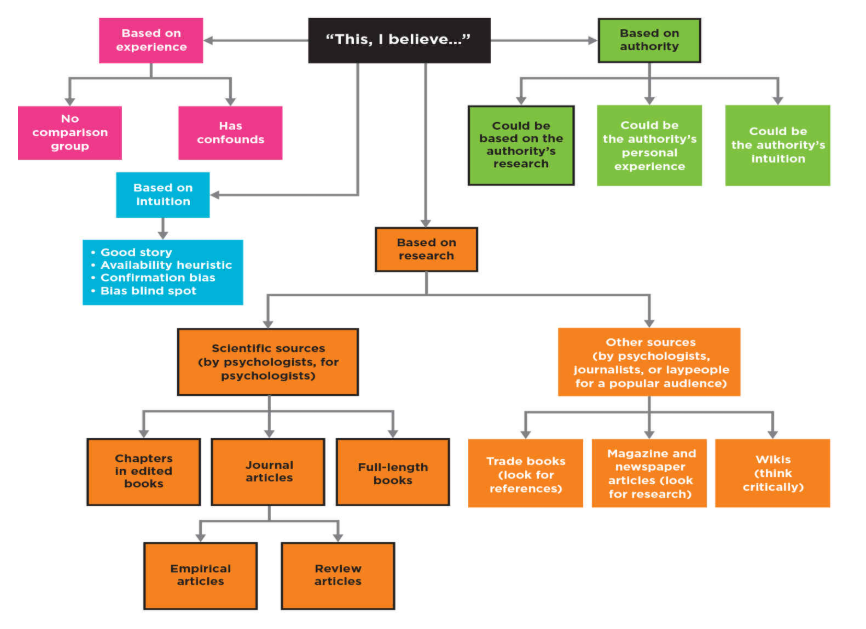
What are journal articles?
Come out monthly or quarterly
Written for an audience of other psych scientists + students
Must be peer-reviwed
What are the 2 types of journal article?
Empirical journal articles = report the results of an empirical research study
Contain details about the study's method, stats tests used + results
Review journal article = summarise + integrate all the published studies that have been done in 1 research area
Can use a meta-analysis (combined the results of many studies + gives a number that summarises the magnitude) or the effect size of a relationship
Meta-analysis is valued by psychologists because it weighs each study proportionately and does not allow cherry-picking particular studies
Both types are considered the most prestigious forms of publication, in part because of this peer-review process
What is an edited book?
Psychologists don't write many full-length scientific books for an audience of other psychologists → more common to contribute a chapter to an edited book
Edited book = collection of chapters on a common topic, each is written by a different team of contributors
E.g. The handbook of emotion regulation (Riedeger & Klipker, 2014)
Good place to find a summary of a set of research a particular psychologist has done
Not peer-reviewed as rigorously as empirical journal articles or review articles BUT editor only invites experts (researchers who are intimately familiar with the empirical evidence on a topic)
Audience = psychologists + psych students
What are the components of empirical journal articles?
Introduction
Method
Results
Discussion
References
What is included in an introduction?
1st section of regular text
Its first paragraphs typically explain the topic of the study
Middle paragraphs lay out the background for the research
What theory is being tested? What have past studies found? Why is the present study important?
The final paragraphs include the specific research questions, goals, or hypotheses for the current study
What is included in the methods section?
Explains in detail how the researchers conducted their study
Contains subsections such as PPTs, materials, procedure + apparatus
An ideal Method section gives enough detail that if you wanted to repeat the study, you could do so without having to ask the authors any questions
What is included in the results section?
Describes the quantitative +qualitative results of the study, including the stats tests used to analyse the data
Usually provides tables + figures that summarise key results
Although you may not understand all the statistics used in the article, you might still be able to understand the basic findings by looking at the tables + figures
What is included in the discussions section?
Opening paragraph generally summarises the study’s research question + methods → indicates how well the results of the study supported the hypotheses
Discuss the study’s importance
Perhaps their hypothesis was new, or the method they used was a creative + unusual way to test a familiar hypothesis, or the participants were unlike others who had been studied before.
The authors may discuss alternative explanations for their data + pose interesting questions raised by the research
What is included in the references section?
Full bibliographic listing of all the sources the authors cited in writing their article → enables interested readers to locate these studies
What issues should be considered when reading about science in popular sources?
Journalists may select a more sensational, clickable story while overlooking its flaws
Even when studies are conducted well, journalists may not describe them accurately
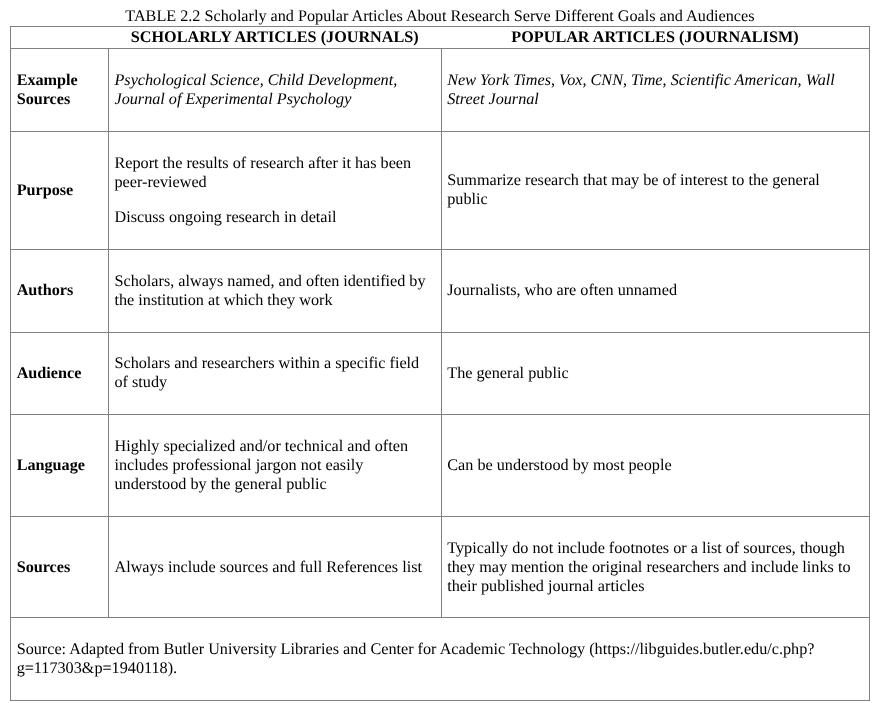
Why might journalists not get the story right despite reporting on reliable, well-conducted research?
Sometimes a journalist does not have the scientific training, motivation, or time before deadline to understand the original science very well
Maybe the journalist sands down the details to make the research more accessible to a general audience
Sometimes a journalist wraps up the details of a study with a more dramatic headline than the research can support
What is disinformation?
The deliberate creation and sharing of information known to be false (Wardle, 2017)
What factors motivate disinformation?
Propaganda
Passion
Politics
Emotional lies can drive votes and enhance political support
Provocation motivates people who want to “punk” others into emotional reactions
Profit
False scientific claims about e.g. herbal supplements, or crystals may accompany a shopping website
Parody
Sites like The Onion create false stories only to make us laugh
What subtle forms can disinformation take?
It might attribute false quotes to real people or use a real quote out of context
Photos + videos can be especially provocative/convincing → might involve manipulating photos/videos or pasting real images into false contexts
What is click restraint?
A critical reading technique in which one deliberately pauses before accepting, sharing, or following an online link, especially when it provokes an emotional response
What is lateral reading?
A critical reading technique in which, rather than reading deeper into a suspicious website, one checks its claims on alternative, legitimate news sources