11f — Developmental Amnesia + Hierarchical Model
 Call Kai
 Learn
 Practice Test
 Spaced Repetition
 Match
 Flashcards
 Knowt Play
1/16

There's no tags or description
Looks like no tags are added yet.
17 Terms
Who were the three developmental amnesia patients (Vargha-Khadem et al., 1997)?
Beth (14, born without a heartbeat for 7–8 minutes), Jon (19, born prematurely at 26 weeks, 2 months in an incubator on a ventilator), and Kate (22, a toxic theophylline dose at age 9 causing seizures and respiratory arrest).

What damage did all three have? [Figure: vargha-khadem-hippocampal-volume.png]
Bilateral hippocampal damage on MRI, with clearly reduced hippocampal volume and cross-sectional area.
What brought them to the clinic?
Their parents' reports that they failed to remember the events of daily life.
What episodic deficits did they show?
None could find their way in familiar surroundings, stay oriented in date and time, or give a reliable account of the day's activities.

How impaired were they on episodic memory tests? [Figure: vargha-khadem-episodic-tests.png]
Severely impaired on logical memory, visual memory, and word-list tests, recalling almost nothing after a delay while controls retained much more.

What did the Rey-Osterrieth figure show? [Figure: rey-osterrieth-recall.png]
They copied the figure fine but 30 minutes later could reproduce almost nothing of it, while controls recalled most of it.

What was intact in these patients? [Figure: vargha-khadem-literacy-table.png]
Semantic memory acquisition: literacy (reading, spelling, comprehension) in the normal range, with normal Information, Vocabulary, and Comprehension subtests.
Give examples of their intact semantic knowledge.
Beth knew China has the largest population, Kate knew Rome is Italy's capital, and Jon explained "one swallow does not make a summer" as needing more evidence before concluding.

What is the hierarchical account (Vargha-Khadem et al.)? [Figure: hierarchical-model.png]
The perirhinal and entorhinal cortices alone can support context-free semantic memories, but context-rich episodic memories need the additional processing of the hippocampal circuit.
Why could these children acquire semantic memory without a hippocampus?
Their perirhinal and entorhinal cortices were intact and can slowly acquire semantic knowledge; only the hippocampus was damaged.
Why is H.M. impaired on both episodic and semantic memory while these children are not?
H.M.'s resection removed the hippocampus plus the surrounding perirhinal and parahippocampal cortices, while the children had selective hippocampal damage only.
Who were patients SS and PS (Verfaellie et al., 2000)?
SS (H+): hippocampus plus surrounding cortex, from herpes simplex encephalitis; PS (H−): hippocampus only, from anoxia after a severe asthmatic attack and pneumonia.
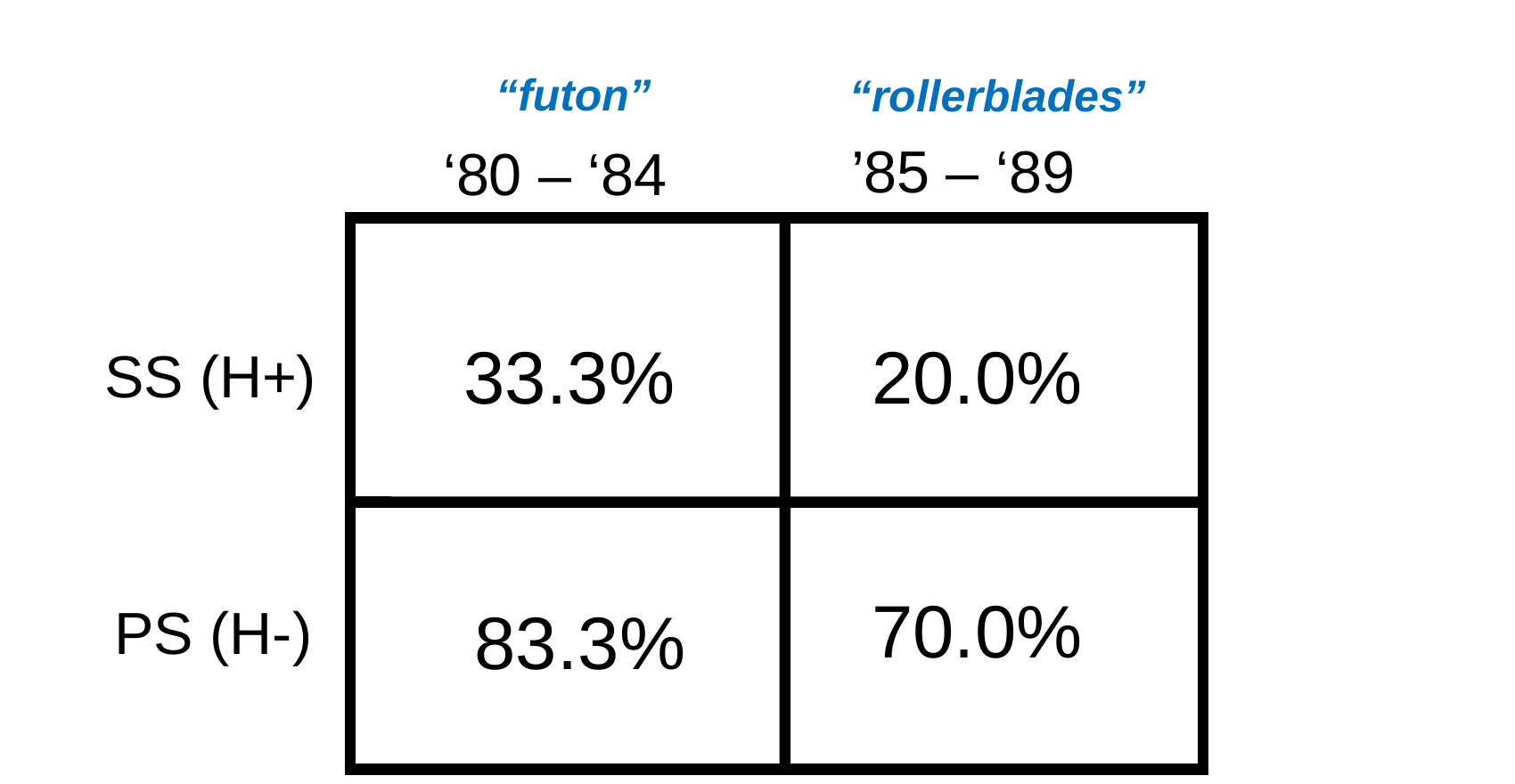
What did SS and PS show about learning new words? [Figure: verfaellie-ss-ps-table.png]
SS was impaired (33.3% for '80–'84 words, 20.0% for '85–'89), while PS learned normally (83.3% and 70.0%), like controls.
What does the SS/PS comparison rule out?
That the developmental patients' intact semantic memory was just due to childhood plasticity, since the same dissociation appears in adults.

What is the unitary vs modular view of the MTL system? [Figure: unitary-vs-modular-views.jpeg]
Unitary (Squire): the whole MTL system supports both episodic and semantic memory; modular (Moscovitch/Vargha-Khadem): adjacent cortices support semantic memory, and only the hippocampus is needed for episodic memory.
What is the asymmetry between episodic and semantic memory?
You can have a selective episodic impairment with intact semantic memory, but not a selective semantic impairment with intact episodic memory, because episodic memory is built on semantic memory through the same pathway.
What challenges the asymmetry?
Semantic dementia, a variant of frontotemporal dementia, shows impaired semantic but intact episodic memory — the topic Heindel picks up on Mond