Motor Dev Exam II
 Call Kai
 Learn
Learn Practice Test
 Spaced Repetition
 Match
Match Flashcards
 Knowt Play
1/70

There's no tags or description
Looks like no tags are added yet.
Name | Mastery | Learn | Test | Matching | Spaced | Call with Kai | Chat |
|---|
No analytics yet
Send a link to your students to track their progress
71 Terms
History of studying motor skills
Sir Chales Sherrington 1890-1900
Nikolai Bernstein 1900-1920s (this was that one guy)
Pretty new!
What is skilled movement?
The ability to bring about some end result with maximum certainty and minimum outlay of energy, or of time and energy
Skills definition parts
Predicated on having a desired goal
Meet the performance goal with reliability and certainty
Minimization: do it with maximum allowable energy efficiency
Proficient: able to perform in a minimum time
Open vs closed skills
Based on stability and predictability of environment
Closed: environment highly stable and predictable (playing pool)
Open: variable and unpredictable (football game)
Skills fall within a spectrum
Discrete skills
Easily defined beginning and end, typically can calculate some kind of outcome score
EX: shoot a freethrow, cornhole throw
Continuous skills
no beginning or end
tracking, controlling an object to follow movements of a target
Serial skills
Groupings of discrete skills strung together to make a new, more complicated action
Input to brain for skilled movement
comes in all sensory forms- auditory, visual, tactile, ect.
Visual is the most powerful and most complex
*more info=more time to process (more brain power needed)
One problem- we’re always receiving insane amounts of data, require more processing energy (we have tricks)
Example tricks for processing
anticipation, understanding/skill (about the rules and game)
More skill=better understanding= ruling out more= more accurate guesses
3 stages of information processing
stimulus identification, response selection, movement programming
*not an exact science

Stimulus ID (info processing)
has info been presented? If so, what is it?
Response selection info processing
Decide what response would be appropriate- given the context and info given- THIS IS KEY
Movement processing info processing
Preparing the motor system for action
ready the spinal cord and peripheral nerves (recruitment, reduce resting membrane potential)
retrieve and organize a motor program
→ output (pass info along, produce response)
Reaction time
important variable to help us understand how long it takes someone to ID, select response, and process movement.
Does NOT include the time to actually execute the movement successfully
Response time
Reaction time + Movement time
Factors affecting decision making
number of stimulus response alternatives
stimulus response compatibility
amount of practice
Number of S-R Alternatives
Stimulus response alternatives
Choice reaction time→ choose a response from a number of predetermined responses.
More choices=more time (hicks law)
S-R compatibility
the extent to which a stimulus and response are connected in a natural way
EX: turning handle bars on a bike right also makes it go right
More compatibility= reduced RT
We also have population stereotypes (associations are learned from societal norms)
Amount of practice (reaction time)
more practice can overcome disadvantages of low SR compatibility→ lower RT
more practice can overcome disadvantages of high SR alternatives→ lower RT
Anticipation- types and benefits
Can reduce RT to almost 0 by anticipating what will happen next.
elite performers are very good at this
2 types: spatial and temporal
Costs of anticipation (downsides)
incorrect anticipation enacts an incorrect motor program that has to be stopped, reg processed, re retrieved, and re implemented.
Incorrect may place you at a spatial disadvantage (getting juked)
Bayesian statistics
Equation that explains how we update predictions based on experience.
we are good at learning how to adjust
*chronic pain→ begin to predict pain
Memory systems
Short term sensory store
Short term memory/working memory
Long term memory
Short term sensory store
Very transient storage (visual ~1 sec)
Vast amounts of information, stored long enough to make a decision
Short term memory/working memory
temporary holding place for info
Transient storage, around a few minutes
Requires REHERSAL to prevent loss from ST
Long term memory
essentially limitless
“forgetting” may be retrieval issue rather than a storage issue
STM→ LTM via rehearsal and connecting info into bits (chunking)
Many motor skills (particularly continuous ones), maintain almost perfect retention even after decades
EX: swimming, bicycling
Discrete skills are more easily forgotten (specific gymnastic routines)
What is attention
a pool of resources
when a task is new- it requires more brainpower (attention)
Parallel processing
Feature of stimulus ID
2+ streams of info can enter and be processed without interfering
EX: color and shape of object
Cocktail party effect
Stimulus ID feature
study that had 2 different streams of info via headphones, participants were told to attend to 1 and ignore the other.
When asked to recall both→ low recall of unattended ear, but some recall
shows that you can effectively block a lot of info, but not all
this is parallel processing! even unattended stimuli is processed
Inattentional Blindness
Feature of stimulus ID
when you have a goal→ this limits our ability to process other information, you’re “blind” to non goal related objects
Can happen in real time→ “looked but failed to see” accidents
Things that affect sustained attention
*stimulus ID
sustained attention is focusing on one thing for a long time
Effected by:
motivation
arousal (SNS, if you’re super stressed) decreased arousal if you feel safe=better for learning
Secondary tasks: environment when studying (are you studying, texting, TV+music)
Fatigue (EX: microsleeps when driving)
Controlled processing vs automatic processing in response selection
Controlled: slow, attention demanding with interference from competing processing
serially organized (task has before and after)
volitional
EX: tie shoes, surgery, not taking
Automatic processing: fast, not attention demanding, don’t generate much interference
organized in parallel
involuntary, often unavoidable (reflexes)
EX: blocking something
Limits to automatic response selection
Becomes automatic through LOTS of practice
allows for fast processing
accurate interpretation
best when environment is stable and predictable
automatic is easier to develop with closed skills, much more practice needed with open skills
Drawback: if you guess wrong there will be massive error very quickly
How to develop automaticity
LOTS of practice
Ideally: consistent vs varied mapping
Consistent=same behavior with every input
Varied= multiple choices (most real life tasks)
Based on the variability, it may be nearly impossible for the task to become automatic
why distracted driving is bad, it can’t become automatic
Double stimulation paradigm
respond with separate responses to two stimuli presented closely together in time EX: head fake
delay called psychological refractory period
Psychological refractory period
How soon a person can switch from making a goal directed response to one stimuli→ to a different goal directed stimuli
once the system IDs and selects a response to stimulus→ 2nd stimulus presented during 1st processing→ onset of 2nd response will be significantly delayed
PRP bottleneck
(Psychological refractory period)→ multiple motor programs are like a bottleneck (multiple can form but only one can go through)

PRP Stimulus onset asynchrony (SOA)
(Psychological refractory period)→ SOA is the time between stimuli→ if its really short the system produces both responses simultaneously
called “grouping”
internal vs external focus of attention
External→ better performance
automated movements run off external
Internal→ worse performance
consciously controlled movements run off of internal focus
Therefore, switching to an internal focus forces the performer to consciously control a task→ could be disastrous
Choking phenomenon (internal focus of attention)
failed performance during high pressure situation→ focus shifts from well learned task (external) to over thought conscious task (internal)
Decision making under stress
arousal=level of excitement produced under stress
Stress bears a relationship to performance→ increasing arousal improves performance up to point
arousal level can be different among people (do you need to get super hyped or meditate before a game)

2 categories of intrinsic feedback
Exteroception and proprioception
Feedback
information processed as a result of an action “fed back” to the performer
inherent/intrinsic→ directly available to performer through senses (if you miss a shot or not)
Exteroception
info about the state of environment in which one’s body exists
Most prominently vision
physical structure of environment
movement of objects in the environment in relation to you
detect your own movement
Audition
musical instruments (important)
sound of power tools
hearing in speech
Proprioception
sensing movement of body parts (joints, muscles, ect) and getting info about position of body parts relative to each other and the environment
Important receptors:
vestibular
joint receptors
muscle spindles
GTOs
Weighing different sensations
we don’t attend to only one piece of sensory information
we WEIGHT certain info more than others
EX: you’re camping and its dark. you hear a twig break…
vs trying to run down a pop fly
Components of ALL closed loop systems
An executive for decision making about errors
An effector system for carrying out decisions
A reference of correctness against which the feedback is compared to define an error
An error signal, which is the information acted on by the executive
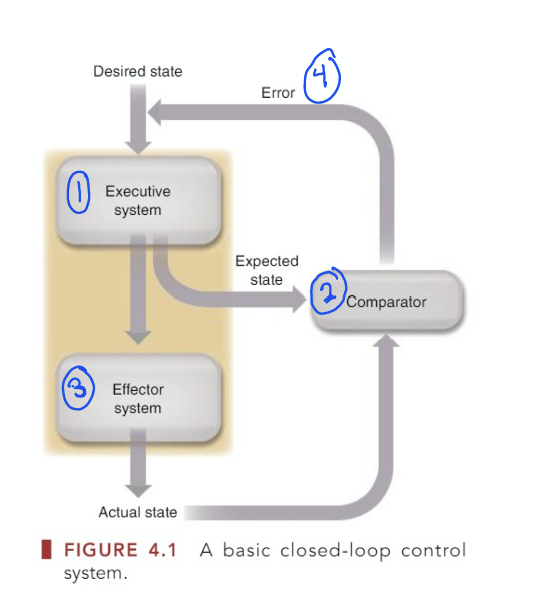
Closed loop human performance
Slow movements=closed loop
Compensations can be made during the movement
Feedback: from receptors, after movement
Feedforward: have a plan and expectation
Comparator is critical: cerebellum is how you learn to move!
Good model for long duration/steady state activities

Tracking tasks
closed loops can produce 3 corrections per sec
error processed every ~300 milliseconds (stimulus ID)
movement correction chosen (response selection)
correction organized and initiated (movement programming)
Why tracking tasks with >3 errors/second are usually handled poorly (get juked)
Rapid, discrete tasks
Most rapid tasks the performers initiates a fully planned movement to achieve goal
you’re committed once you decide
EX: punching
If sensory info says error→ few hundred milliseconds to respond & several hundred milliseconds to alter movement
Don’t have time to process feedback
M1 reflex
monosynaptic reflex: 30-50ms
ON/OFF= threshold based
quad has set resting length
stretch stim→ unexpected
afferent info→ synapse w/ AMNs in SC
Bring back to normal length via little kick
Protects you from injury in unexpected situations
EX: when you step off a curb, adjust before aware
M2 reflex
references the motor plan/context
EX: soft grab vs not
throw water when falling, not kid
EMG times M1 and M2
Draw it

Ventral stream visual system
The “what” in motor control
object ID to motor planning prior to initiation
relative to planning/goal
what you’ve seen others do
Dorsal stream visual control
utilizes the optical array (each light ray entering at different angles)
as you move in environment, or environment moves around you, the optical array is changing
this is OPTICAL FLOW
Optical flow provides important info for
time to contact
direction of movement of objects
balance (should I have stuff moving around me rn or no?)
Tau equation
Tau=retinal image size/images rate of change of size
Time to contact image
As an object gets closer to you, the object looks bigger on your retina
Can also see direction→ moves to different parts of the retina and indicates direction

Balance and vision relationship
Optical flow/dorsal stream is highly important for balance
Study:
showed how infants are highly dependent on visual info
adults are better at integrating proprioceptive, vestibular and visual info
if you manipulate both in adults=fall
Processing visual info at high speeds
High speeds= less than 200ms
Visual feedback is not used to guide movement
why we predict- reaction can be reduced to 80-100ms
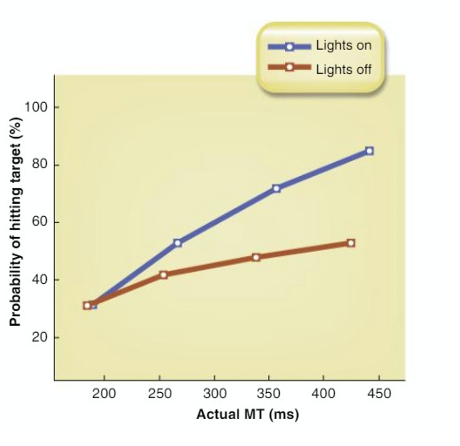
Audition and motor control
powerful
microphone w/ echo→ causes speaker to slow down, increases error rates
delayed auditory feedback is also a treatment for speech therapy (makes people slow down and process)
if a shot sounds good→ provides feedback
Motor program definition
a prestructured set of movement commands that defines and shapes movement
the blueprint
Open loop control systems
advance instructions specify the operations to be done, their sequencing, and their timing.
once the program has been initiated the system executes the instructions w/ NO modification
no capability to detect or correct errors, no feedback
most effective in stable, predictable environments, where the need for modification is low
more rapid=more open loop
*compare success after action
Is motor behavior just open or closed loop?
No. We do such complicated stuff we have to dumb is down→ just remember that!
How do we know motor programs exist?
Reaction time
hicks law→ reaction time is slowed when more info needs to be processed
SR incompatible situations→ when processing is not natural
**these tell us the fast conditions are happening because of pre-programmed plan happening
How does reaction time get slowed down
when additional elements in a series are added to the action (EX: do a forehand THEN a backhand)
when more limbs must be coordinated (EX: one handed piano chord faster than two hands)
when the duration of the movement becomes longer (EX: a 100ms bat swing is initiated faster than a 300ms swing)
The main point: when movements are more complex, RT is slower because we need more organization time→ tells us that organization happens in advance
Startle RT experiments
had people respond to a moderately loud sound with a pre-defined reaction, recorded time
randomly blasted them with a very loud sound, recorded time
Found: the movement was performed ~100ms faster
indicates the loud noise bypassed the processing time→ there was a motor program!
Monkey experiment sensory
Cut all incoming sensory nerves to legs→ watched monkeys move
had surprisingly low levels of observed disability
only difficult for very fine tasks
this is true in humans with sensory neuropathy too!
shows that sensory info is NOT required to perform familiar movements (open loop)
Inhibition experiments
asked participants to prevent/stop movements
observed that 130-150ms before the intended action the participants couldn’t ignore them
any info to inhibit the command after this was too late and action commenced
Triple burst experiment
Triple burst during quick movements (triceps extension)
movement, decelerate, fine tune
present when randomly blocked→ even when the movement wasn’t executed!
super strong argument→ sensory info is NOT necessary to activate muscles

Anticipatory postural adjustments (APAs)
Your brain is managing torque ALL THE TIME
brain signals are sent BEFORE movements are initiated