Section 1 — Pregnancy Basics → Fertilization → Pre-Embryonic Stage
 Call Kai
 Learn
 Practice Test
 Spaced Repetition
 Match
 Flashcards
 Knowt Play
1/42

There's no tags or description
Looks like no tags are added yet.
43 Terms
What is pregnancy and how is it divided
events from fertilization to birth
Divided into 3 three month intervals called trimesters
Gestation period and how long is it
Time period from last menstrual period (LMP) until birth
around 280 days = 1 full term
How long is conception to childbirth
compare to gestation period (timeline)
38 weeks → 266 days
Last Menstrual period → 14 days (2weeks) → ovulation → conception → 266 days (38 weeks) → childbirth
What is conceptus and what are the 3 stages
Conceptus = the products of conception / fertilization
Pre embryonic stage, embryo, fetus
Pre embryonic stage
From fertilization → first 16 days
Embryo
conceptus from day 16 - week 8
Fetus
conceptus from week 9 through birth
What is the pathway of conceptus
Fertilization → pre embryo (till day 16) → embryo (till week 8) → fetus (9 - birth)
How long is oocyte viable for
How long is sperm viable for
after ovulation → sent to uterine tubes → if not penetrated by sperm within 12-24 hrs → degenerates
sperm is viable for 24-48 hours after ejaculation
For fertilization to occur when must coitus / intercourse occur
no more than 2 days before ovulation and 24 hours after ovulation
What is fertilization
Sperm’s chromosome combines with secondary oocyte chromosome → fertilized egg (zygote)
What hormone triggers ovulation
LH → luteinizing hormone
How is sperm transported to oocyte (3)
whiplike tail movement of flagella → move
endometrial (inner most layer of uterus) cilia + uterine contractions → disperses sperm throughout uterine cavity
What are ejaculated sperm (40-500 million)
(4)
leaked out of vagina
destroyed by acidic vaginal environment
stopped by cervical mucus
dispersed in uterine cavity → destroyed by phagocytes
How many reach the uterine tubes and how long is the whole trip
100-few thousand
5 inch trip
What are the two barriers that the sperm has to reach the oocyte
corona radiata → zona pellucida

label the 2 barriers that the sperm has to pass through here
Ground the green is the corona radiata
Green is the zona pellucida
Blue - fluid filled antrum

What must happen to the sperm before it can penetrate the oocyte
The sperm must be capacitated
Capacitation
female tract → secretions → weakens acrosome membrane → makes sperm membrane fragile to → allow release of hydrolytic enzymes
What are two other things that capacitation does
It makes sperm membrane more permeable to calcium
Activates receptors on sperm for chemical attractants (attracts the sperm)
What happens once the sperm reaches the oocyte (part 1 of penetration)
acrosomal process forms → binds to receptor of oocyte membrane → sperm and oocyte membrane fuses together → sperms nucleus is pulled into the oocytes cytoplasm
Monospermy vs polyspermy
monspermy → only one sperm can penetrate the oocyte
Polyspermy → multiple sperm penetrates oocyte
Why is polyspermy not desired
too many sperms → too many chromosomes for zygote
What happens once sperm enters oocyte and what does it activate (2)
Waves of Ca2+ are released into oocyte’s cytoplasm
→ oocyte prepares for 2nd meiotic division (continue from metaphase II)
→ cortical reactionC
cortical reaction
oocyte’s cortical granules release → Zonal inhibiting proteins (ZIPS) are released → blocking other sperms from entering
What is the full pathway of sperm getting to and penetration of oocyte
Sperm surfance enzymes help sperm get past granulosa cells of corona radiata
Sperm binds to sperm binding site of zona pellucida → increase Ca2+ in sperm → acrosomal reaction → forms acrosomal process + releases enzymes that digest through zona pellucida
acrosomal process binds to receptors on oocyte membrane → oocyte and sperm membranes fuse
Sperm nucleus enters oocyte cytoplasm → Ca2+ increases in oocyte cytoplasm → cortical reaction (coritcal granules release cortical granules / zona inhibiting proteins → hardens zona pellucida blocking off other sperm

What happens after sperm penetrates secondary oocyte
Secondary oocyte → completes meiosis 2 from when it was last arrested → ovum + second polar body
→ sperm and ovum nuclei swell → male and female pronuclei → pronuclei approach each other and mitotic spindles form between each other → chromosomes intermix → fertilization compeltes → zygote
Pre embyronic stage and what are the three stages
first 16 days of development that results in embryo
cleavage → implantation → embryogenesis
Cleavage
rapid mitotic division of zygote without increase in size → increases number of cells but not size of entire structure
For what reason does cleavage increase in number of cells but not in size
increases surface area → easier to uptake O2/ nutrients, easier to remove waste
Development sequence during cleavage
Zygote → blastomeres → morula → blastocysts
each division → cells get smaller

Blastomeres
+ how long
2-8 cells → 36 hrs
morula + how long
16 or more cells
72 hrs
blastocyts
+ how long
4-5 days → fluid filled hollow sphere reaches uterus
as the cells divide → get smaller → creating more space
morula → blastocysts : sodium uptake → followed by water
Monozygotic
identical twins
one egg + 1 sperm → 1 zygote → embryocyst → embryoblast divides into 2 within 2 weeks of fertilization
Dizygotic
fraternal twins
2eggs + 2 sperm → 2 zygotes
What are the two parts of blastocysts
trophoblast cells + inner cell mass/ embryoblasts
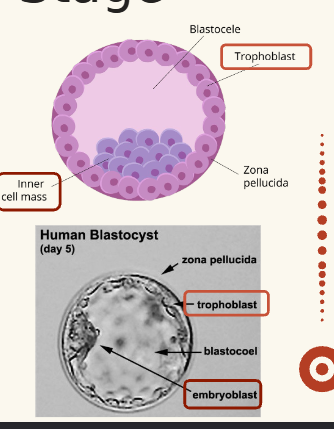
Trophoblast cells
single outer layer of flat cells thats part of placenta formation

Inner cell mass
“embryoblasts” → becomes part of embryonic disc that eventually becomes embyroI
What happens after blastocyst reaches uterus
after reaching uterus, embryocyst floats for 2-3 days being nourished by uterine secretions
Implantation and when does it happen
6-7 days after ovulation
trophoblasts of blastocysts attaches/adheres to endometrium of uterus → secretes enzymes that break irritate the endometrium (break down some endometrium tissue so blastocyst can burrow deeper)
What happnes if implantation fails
blastocyst is aborted
ectopic pregnancy
instead of implanting in uterus, the implantation occurs in abnormal location such as uterine tube